

Difference Between EFAW and FAW Courses: Which Do You Need?

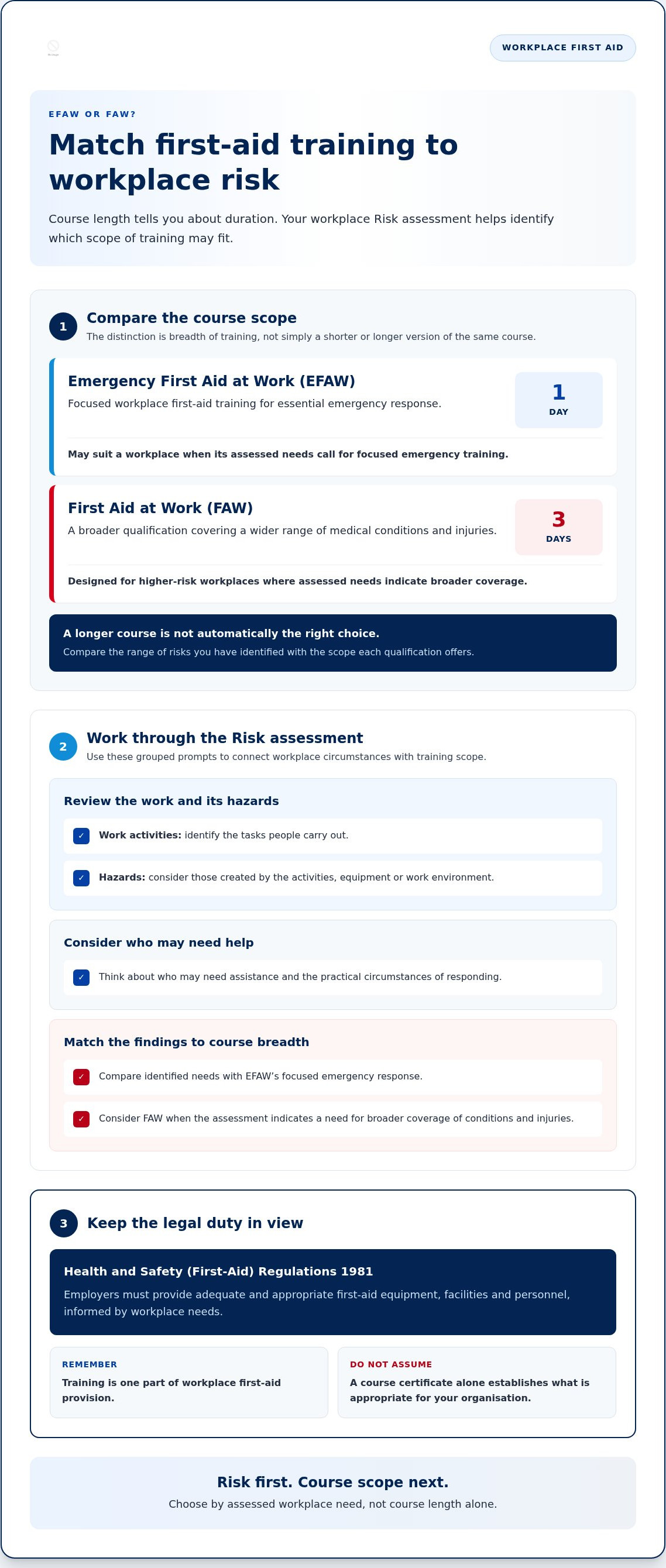
The three-day course is not automatically the right choice just because it covers more. The difference between EFAW and FAW courses is the breadth of training: Emergency First Aid at Work is a one-day course focused on essential responses, while First Aid at Work is a three-day qualification covering a wider range of injuries and illnesses. Course duration matters for planning, but it does not tell you on its own which option suits your workplace.
Start with a workplace Risk assessment. Under the Health and Safety (First-Aid) Regulations 1981, employers must provide adequate and appropriate first-aid provision based on their workplace needs. Consider the hazards and circumstances staff may face rather than choosing a course by default. A qualification is one part of that provision, not a substitute for assessing what your workplace requires.
This guide explains how EFAW and FAW differ, which factors to consider in your assessment and how to plan your next step. First Medical Training Ltd delivers a one-day Emergency First Aid at Work course for workplaces whose assessed needs support EFAW.
Key Takeaways
- The difference between EFAW and FAW courses is their scope: EFAW focuses on essential emergency response, while First Aid at Work covers a wider range of injuries and illnesses.
- Compare course content as well as duration to see which qualification may address your workplace’s first-aid needs.
- Use a workplace Risk assessment to review hazards and decide what first-aid provision is appropriate.
- Keep emergency response and RIDDOR reporting separate: provide appropriate assistance first, then record relevant facts and assess whether reporting is required.
- Review your risks, identify training needs and match them to course scope. If EFAW fits your assessed needs, consider First Medical Training Ltd’s one-day Emergency First Aid at Work course.
EFAW and FAW courses: what do the qualifications mean?
Emergency First Aid at Work (EFAW) is a one-day workplace first-aid qualification focused on essential emergency response. First Aid at Work (FAW) is a three-day qualification for higher-risk workplaces, covering a broader range of medical conditions and injuries. The different durations reflect different training scopes, rather than a shorter and longer version of the same course.
Both qualifications prepare people to respond to workplace incidents. General first aid training develops knowledge and skills for providing initial assistance, but a qualification is only one part of workplace provision. Under the Health and Safety (First-Aid) Regulations 1981, employers must provide adequate and appropriate first aid informed by their workplace needs. A course certificate alone does not establish what is appropriate for your organisation.
What is Emergency First Aid at Work?
Emergency First Aid at Work is a one-day qualification that provides focused workplace first-aid training. It prepares learners to respond to emergencies, rather than covering the wider range of conditions addressed by First Aid at Work. Whether it fits depends on your workplace’s assessed needs. Completing EFAW does not automatically make your first-aid provision suitable for every hazard, work pattern or site.
What is First Aid at Work?
First Aid at Work is a three-day qualification for higher-risk workplaces. Its broader scope covers a wider range of injuries and medical conditions than EFAW. This may be relevant when your workplace assessment identifies a wider range of potential first-aid needs. The longer duration reflects the broader learning scope; it does not make FAW the right choice for every employer.
To understand the difference between EFAW and FAW courses, consider both duration and purpose. EFAW provides focused training; FAW covers a wider range of conditions and injuries. Choose based on your workplace needs, not course length alone.
Use your workplace Risk assessment to identify hazards and circumstances your first-aid arrangements need to address. Then compare those findings with the focused scope of EFAW and the broader scope of FAW. First Medical Training Ltd provides a one-day Emergency First Aid at Work course for workplaces whose assessment supports EFAW.
What is the difference between EFAW and FAW course content?
The clearest distinction is the breadth of training, not just the time spent in the classroom. Emergency First Aid at Work (EFAW) focuses on essential workplace emergency response, while First Aid at Work covers a broader range of medical conditions and injuries. Neither qualification prepares learners for every possible emergency, so compare the course scope with the risks your team may face.
| Comparison | Emergency First Aid at Work | First Aid at Work |
|---|---|---|
| Duration | One day | Three days |
| Stated scope | Focused workplace first-aid training | Broader coverage of medical conditions and injuries |
| Workplace context | May suit a workplace where assessed needs call for focused emergency training | Designed for higher-risk workplaces where assessed needs indicate broader coverage |
| Decision factor | Whether the focused scope addresses identified workplace risks | Whether the wider scope matches the range of identified risks |
How do EFAW and FAW differ in breadth?
EFAW provides focused training for workplace emergencies. FAW extends beyond that focus to cover a wider range of conditions and injuries. This difference matters if the hazards in your workplace could create varied first-aid needs. Review the work people do and the circumstances in which an incident might occur. Do not assume one qualification covers every situation.
Does a longer course automatically make FAW the right choice?
No. A three-day course covers broader learning, but duration alone does not show whether it fits your workplace. A low-hazard setting and a workplace with more varied hazards may have different first-aid needs. Use a first-aid needs assessment to consider the risks and identify appropriate provision, rather than applying the same course choice everywhere.
Match course scope to assessed workplace need, not course length alone. Compare the risks you have identified with the breadth of training each qualification offers. If your assessment supports focused EFAW training, explore First Medical Training Ltd’s one-day Emergency First Aid at Work course.
EFAW or FAW: how should employers decide which course fits?
Start with the workplace, not the course catalogue. The Health and Safety (First-Aid) Regulations 1981 require employers to provide adequate and appropriate first-aid equipment, facilities and personnel. A workplace Risk assessment helps determine what provision is appropriate by examining the hazards and circumstances staff may face. Training is one part of the arrangements; a course certificate does not, by itself, show that your workplace has the right level of cover.
What should a workplace Risk assessment consider?
Review the work people do and the hazards created by those activities. Then consider who may need assistance and the practical circumstances of responding. Work through these factors:
- Work activities and hazards: identify tasks, equipment or environments that could lead to injury or illness.
- People at work: consider the number of employees and their work patterns, including when and where work takes place.
- Access to assistance: account for site location and how quickly help could reach someone who is injured or unwell.
- Previous incidents: review accident history for patterns that may indicate first-aid needs.
Use your findings to decide what level of first-aid provision the workplace needs, including which training best matches its risks. Review current HSE guidance as part of the assessment. Revisit your arrangements when work activities or workplace circumstances change.
When might broader FAW training be relevant?
First Aid at Work may be relevant when your assessment identifies a wider range of potential injuries or medical conditions than focused Emergency First Aid at Work training is intended to cover. For example, varied workplace activities and hazards may point to a need to consider broader training. This does not mean a particular sector automatically requires FAW. Base the decision on your assessed circumstances, not a general rule about the industry.
Keep the employer’s decision separate from an individual’s qualification. A learner may hold EFAW or FAW, but you still need to consider whether the overall provision, including trained personnel and workplace arrangements, meets the needs identified in your assessment.
Dental teams should also distinguish workplace first aid from clinical medical emergency and CPD training. EFAW or FAW relates to workplace first-aid provision; dental-specific medical emergency training addresses a separate clinical learning need. Consider both without treating one qualification as a substitute for the other.
The difference between EFAW and FAW courses helps you compare training scope; your Risk assessment shows which scope is relevant to your workplace. Match your training decision to the risks you have identified rather than assuming the same qualification suits every employer.
How do first aid training and RIDDOR reporting fit together?
First-aid training prepares people to respond to an injury or sudden illness. RIDDOR, the Reporting of Injuries, Diseases and Dangerous Occurrences Regulations 2013, concerns certain workplace incidents that must be reported to the Health and Safety Executive (HSE). These are separate responsibilities. Holding an Emergency First Aid at Work or First Aid at Work qualification does not establish whether an incident is reportable or replace your workplace reporting procedure.
What should staff do after a workplace accident?
Follow your workplace emergency arrangements in order:
- Make the situation as safe as possible. Address immediate hazards without putting yourself or others at further risk.
- Provide appropriate assistance. Use your training and follow workplace procedures. Call for emergency help if the situation requires it.
- Record relevant facts. Complete the appropriate internal accident or incident record, following your organisation’s process.
- Assess reporting separately. An internal record does not, by itself, mean an incident must be reported under RIDDOR.
Keep response, internal recording and external reporting as distinct steps. Follow your organisation’s current procedures, including who reviews an incident and decides what action is required.
How should readers check whether RIDDOR applies?
Consult the HSE’s current RIDDOR guidance to assess whether an incident meets the applicable reporting criteria. Check the relevant incident category, any applicable time limits and who is responsible for making a report. Do not assume every accident is reportable, and do not use a first-aid qualification as a guide to reporting duties.
Keep the distinction clear: EFAW or FAW training supports an immediate response, while RIDDOR reporting is a separate process for qualifying workplace incidents. The difference between EFAW and FAW courses concerns training scope; neither qualification replaces incident records or reporting procedures. Review those procedures with your team so staff know how to respond and where to pass incident details for follow-up.
If your workplace assessment supports focused EFAW training, explore First Medical Training Ltd’s one-day Emergency First Aid at Work course.
How can your team take the next step towards suitable EFAW training?
Turn your assessment into a practical training plan. The difference between EFAW and FAW courses helps you compare scope, but your workplace findings should guide the decision. Work through these steps:
- Review the risks. Record the hazards, work activities and circumstances that could affect first-aid needs.
- Identify the training need. Decide whether focused Emergency First Aid at Work or broader First Aid at Work training better matches the risks you have assessed.
- Compare course scope. Check that the qualification you select addresses the needs identified in your assessment.
- Plan team arrangements. Consider who needs training and how first-aid responsibilities will be covered across work patterns and locations.
Keep a record of your assessment, the reasons for your training choice and the workplace arrangements that support an emergency response. This helps your team understand the decision and what to do if an incident occurs. Review the plan when work activities, hazards or working arrangements change, and refer to current HSE guidance when considering first-aid provision.
If your assessment supports EFAW, First Medical Training Ltd’s one-day Emergency First Aid at Work course provides a practical training option. For further context, read the Emergency First Aid at Work guide for dental practices.
How can dental teams keep workplace and clinical training distinct?
Workplace first-aid training supports arrangements for responding to incidents at work. Clinical medical emergency training has a different purpose: it supports dental teams in managing medical emergencies in the practice setting. Treat these as related but distinct training needs, rather than assuming one course replaces the other.
Explore the medical emergencies in a dental practice course guide for clinical training context, and use the dental practice emergency preparedness checklist to consider wider practice arrangements.
What should a practical training plan include?
Bring the elements together in one usable plan: your assessment, selected training, trained personnel and the procedures staff should follow in an emergency. Make sure relevant team members know where to find those procedures and how to raise concerns if risks change. A qualification is most useful when it forms part of arrangements that reflect the workplace.
Use your assessment to decide whether focused EFAW meets your identified needs. If it does, explore First Medical Training Ltd’s Emergency First Aid at Work training option as your next step.
Match your training plan to workplace need
The difference between EFAW and FAW courses is the breadth of training: Emergency First Aid at Work is a one-day qualification, while First Aid at Work is a three-day qualification covering a wider range of conditions and injuries. Duration alone does not decide what your workplace needs. Use your Risk assessment to guide the choice and shape your wider first-aid arrangements.
Keep response training distinct from incident reporting. EFAW or FAW prepares learners to provide first aid; it does not replace workplace procedures or the separate process for assessing whether an incident is reportable. For dental teams, workplace first aid and clinical medical emergency training also serve different purposes.
First Medical Training Ltd has delivered specialised education since 2006 and is an accredited CPD provider following Resuscitation Council UK guidelines. If your workplace assessment supports focused EFAW training, explore Emergency First Aid at Work training as your next step. A clear, risk-informed plan helps your team understand its first-aid responsibilities.
Frequently Asked Questions
What is the main difference between EFAW and FAW?
The main difference is the breadth of training. Emergency First Aid at Work (EFAW) is a one-day qualification focused on workplace emergency response. First Aid at Work (FAW) takes three days and covers a broader range of medical conditions and injuries. The difference between EFAW and FAW courses is not simply course length: compare the training scope with the needs identified in your workplace Risk assessment.
Is EFAW enough for my workplace?
EFAW is suitable only if its focused scope fits your workplace’s assessed first-aid needs. Consider the hazards, work activities, people on site, work patterns and circumstances that could affect a response. Do not assume EFAW is suitable simply because it is shorter, or that every workplace needs FAW. Review current Health and Safety Executive guidance and use your assessment to decide what level of first-aid provision is appropriate.
Can EFAW-trained staff provide first aid at work?
Yes. Someone who has completed EFAW can provide first aid within the scope of their training and ability. The qualification supports an immediate response, but it does not mean the person is trained for every injury or illness, or establish that your workplace has adequate first-aid provision. Consider the team’s training alongside workplace hazards, arrangements and the needs identified in your assessment.
How long do EFAW and FAW courses take?
Emergency First Aid at Work takes one day, while First Aid at Work takes three days. The difference in duration reflects their scope: EFAW is focused, and FAW covers a broader range of medical conditions and injuries. Use duration as a planning detail, not the deciding factor. Assess your workplace needs first, then match the training scope to your findings.
What happens if a workplace accident needs reporting under RIDDOR?
If an incident may be reportable, follow your emergency procedures first, make the situation as safe as possible and provide appropriate assistance. Record relevant facts using your internal process, then assess whether RIDDOR applies. Not every workplace accident must be reported. Check current Health and Safety Executive guidance for the criteria and reporting process, and follow your organisation’s arrangements for handling the decision.
Does completing EFAW or FAW automatically meet an employer’s first-aid responsibilities?
No. A qualification is one element of workplace first-aid provision, not proof that the overall arrangements meet your needs. Under the Health and Safety (First-Aid) Regulations 1981, employers must provide adequate and appropriate first-aid equipment, facilities and personnel. Use a workplace Risk assessment to determine suitable provision, then consider how training fits with your procedures and the people available to respond.
Is dental medical emergency training the same as EFAW?
No. EFAW is workplace first-aid training, while dental medical emergency training focuses on responding to medical emergencies in a dental practice. The courses have different purposes, so do not treat one as an automatic replacement for the other. Consider workplace first-aid provision separately from clinical training needs, using the relevant assessment and professional guidance to plan appropriately.