

Find 1 Day EFAW Training UK Courses: 2026 Schedule and Info

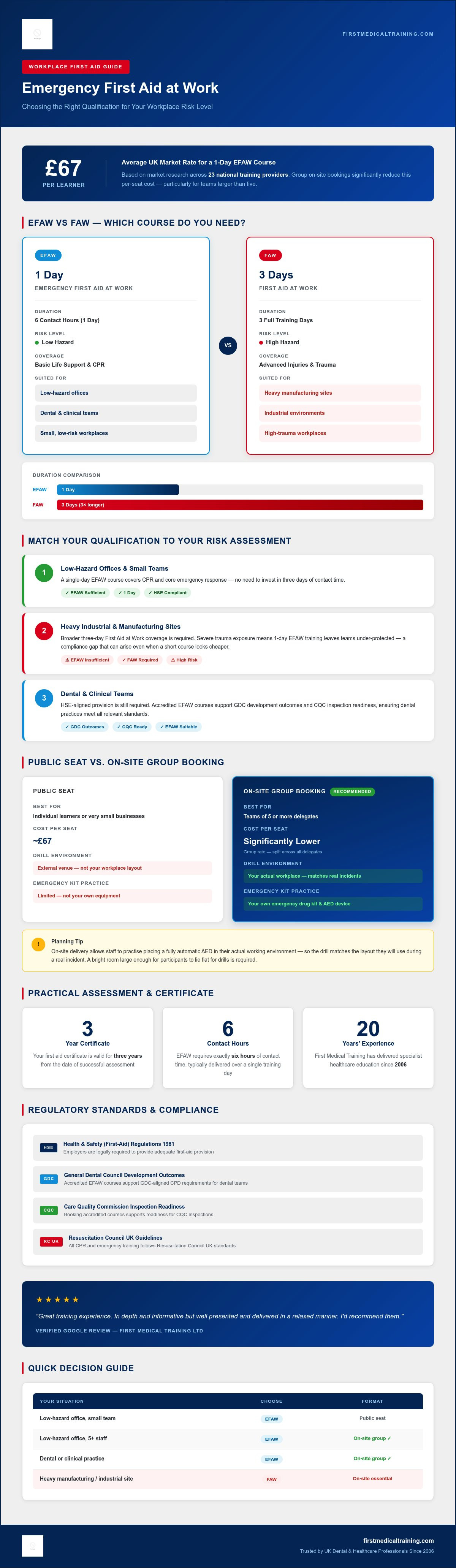
Standard 1-day EFAW training UK courses typically cost around 67 GBP per learner, based on market research across 23 national training providers. Booking a course ensures your workplace meets fundamental Health and Safety Executive (HSE) first aid requirements. Complete your first aid certificate (efaw qualification) to protect colleagues and maintain regulatory compliance. The decisions that matter before you pay are which qualification matches your risk profile, when a single day is enough, and whether public or on-site delivery fits your headcount and budget.
Key Takeaways:
- Individual learners typically pay 67 GBP while group bookings on-site significantly reduce per-seat costs.
- Except when your workplace involves heavy industry or manufacturing, where a 1-day course is insufficient.
- Best for low-hazard offices and dental teams needing GDC-aligned training and CQC inspection readiness.
- On-site training requires a bright room large enough for participants to lie flat for drills.
Match your first aid qualification to your risk assessment findings
Your first aid qualification should follow your workplace risk assessment findings and staff headcount, not a generic course list. In practice, three situations come up most often:
- Low-hazard offices with a small team: a single-day Emergency First Aid at Work path covers CPR and core emergency response without buying three days of contact time.
- Heavy industrial or manufacturing sites: broader three-day First Aid at Work coverage matches higher trauma exposure.
- Dental and clinical teams: you still need HSE-aligned provision, with protocols that support GDC development outcomes and CQC inspection readiness.
With clients we see that low-hazard offices often choose a single-day option, whereas heavy industrial sites require broader three-day coverage. Selecting the right path keeps you aligned with Health and Safety Executive (HSE) guidelines.
Standard office environments suit the Emergency First Aid at Work course, which covers essential CPR training and immediate workplace response skills. High-risk settings such as manufacturing plants need a full First Aid at Work qualification. Booking accredited courses supports CQC inspection readiness and meets GDC development outcomes for dental teams. More on this: Emergency First Aid at Work.
EFAW versus FAW: pick the duration your hazards demand
Emergency First Aid at Work lasts one day, whereas First Aid at Work (FAW) takes three days to complete. You must choose the correct level based on your workplace risk assessment. Under the Health and Safety (First-Aid) Regulations 1981, employers are legally required to provide adequate first-aid provision.
Based on current rates, an entry-level emergency course runs about 67 GBP. Low-risk settings suit this shorter qualification. High-risk environments require comprehensive instruction, so evaluate staff counts and hazard severity together before you book.
| Feature | EFAW Course | FAW Course |
|---|---|---|
| Course Duration | 1 Day | 3 Days |
| Workplace Risk Level | Low Risk | High Risk |
| Coverage Scope | Basic Life Support | Advanced Injuries |
You can secure accredited qualifications through First Medical Training. A first aid certificate lasts three years. Select FAW for complex hazards, and emergency training for smaller low-risk offices.
Six contact hours shape how you book an EFAW course
Completing an Emergency First Aid at Work course takes six hours of contact time, usually scheduled over a single day. That fixed contact time is why the booking format (public seat versus group on your premises) drives both cost and how well staff rehearse real procedures.
Comparing attendance options reveals clear financial differences. Individual bookings suit smaller businesses with one delegate. Group bookings hosted at your business premise lower per-seat expenses significantly while ensuring staff rehearse with your emergency drug kit. Read our 2026 EFAW compliance guide to select the right approach for your team.
One planning detail that often arrives late: hosting on-site sessions allows staff to practice placing a fully automatic AED in their actual working environment, so the drill matches the layout they will use in a real incident.
Tip: Group bookings delivered at your own premises significantly lower the per-person training expense for teams larger than five.
A multi-staff site paying for separate public seats had little chance to rehearse with its own emergency drug kit or room layout. Moving to a group booking on the business premise cut the per-seat expense and put drills next to the kit staff already use. Among First Medical Training Ltd's Google reviews, one learner (5★) wrote:
"Great training experience. In depth and informative but well presented and delivered in a relaxed manner. Id recommend them."
That style of delivery helps learners absorb critical first aid instruction in a setting they already know. Calculate your team size first, then decide between a public place and an on-site group date.
When 1 day efaw training uk leaves high-risk teams under-protected
A 1-day course is insufficient for high-risk commercial environments or complex medical settings. From client work we see teams struggle when real emergency demands exceed their basic training. Employers must assess specific workplace hazards under UK safety regulations to select appropriate qualifications.
High-risk industries should not rely on minimal provision, because severe trauma requires comprehensive care skills. You should choose full First Aid at Work for heavy manufacturing, whereas Emergency First Aid at Work suits low-hazard offices.
Selecting inadequate training creates compliance gaps even when a short course looks cheaper on paper. Dental practices face distinct clinical risks that require targeted emergency protocols. Review the dental EFAW FAQ guide so your plan maintains full GDC compliance.
Four steps that protect your fee if attendance plans change
Checking terms early protects your budget if staff cannot attend their scheduled training day. A short review of the booking rules before payment is often enough to avoid a lost seat.
- Locate the cancellation terms on the booking portal.
- Identify hidden transfer fees for changing your scheduled attendance date.
- Verify short-notice rules to see if illness qualifies for a full refund.
- Confirm written guarantees regarding course rebooking options.
First Medical Training delivers flexible Emergency First Aid Course options across the UK. If your rota changes often, favour providers that state transfer guarantees in writing before you pay.
Practical assessment and the three-year certificate window
You demonstrate your skills through continuous practical assessment during the course. Instructors evaluate your technique on chest compressions, rescue breaths, and wound management. You must complete a practical evaluation to earn your first aid certificate.
First Medical Training Ltd delivers accredited instruction following Resuscitation Council UK guidelines. Managing your long-term compliance schedule requires tracking the precise issue date, as the certificate stays valid for exactly three years. You should arrange annual refresher sessions to maintain practical readiness before full recertification. Confirm your arrangements against Health and Safety Executive (HSE) standards so your workplace meets legal requirements.
On-site delivery works when your room supports floor drills
You can host in-practice training at your own business premises provided you have sufficient floor space for practical exercises. An external public place sits near typical market baseline fees per delegate, so local delivery becomes efficient once several staff need the same date. Hosting on-site allows your team to practice CPR and AED awareness with anaphylaxis course skills within their actual working environment.
Clear a bright room large enough for participants to lie flat on the floor. First Medical Training Ltd supplies all required resuscitation manikins, training AEDs, and educational materials. Ensure the space accommodates a basic life-saving (BLS training) scenario without obstructions.
This setup fits busy practices that want to train the whole team together. Confirm that your venue meets HSE guidelines for group learning activities before the trainer arrives.
Add UKCA-marked equipment beside your first aid certificate
Integrating essential anti-choking devices alongside your first aid certificate supports immediate readiness for severe airway obstructions. A choking victim may lose consciousness within minutes if standard back blows fail. Equipping your facility with proven clearance tools bridges the gap until emergency services arrive.
From client work we see that staff act faster when visual safety gear is mounted beside standard first aid kits. Physical equipment removes hesitation during sudden choking incidents.
The LifeVac Anti-Choking Device is registered as a Class I Medical Device in the UK and carries UKCA and CE marks, confirming compliance with British medical standards. These certified tools give your team a mechanical option when manual clearance fails.
Select compliant devices to maintain CQC inspection readiness. First Medical Training Ltd supplies verified equipment to support your workplace response protocols. Keep all items accessible and fully inspected.
Frequently asked questions
What does EFAW stand for?
EFAW stands for Emergency First Aid at Work, a single-day course designed to teach essential life-saving skills for workplace emergencies. Completing this training provides a basic first aid certificate that helps employers meet Health and Safety Executive standards.
What is the difference between EFAW and FAW?
EFAW is a one-day course covering fundamental emergency responses, whereas First Aid at Work (FAW) is a comprehensive three-day qualification for higher-risk environments. Match the level to your risk assessment rather than to course length alone.
How long does an EFAW certificate stay valid?
Your first aid certificate remains valid for three years from the issue date. Plan annual refreshers so practical skills stay sharp before you book full recertification.
How long is the course?
The training runs for six hours in total, excluding break periods, and is completed within a single day. First Medical Training Ltd provides this structured instruction at your business premise or through specialised training venues in Leeds and Bradford.
Next Steps for Your First Aid Readiness
Return to the same decisions you started with: confirm your risk level, choose EFAW or FAW, and pick public or on-site delivery that fits your headcount. Book your 1 day efaw training uk provision to keep your workplace compliant in 2026. Health and Safety Executive guidance requires employers to maintain valid first aid cover at all times. First Medical Training Ltd brings two decades of clinical education experience to support your compliance needs. To secure your 2026 course schedule or request a bespoke group quote, view our EFAW course options. Trainers guide your staff through practical life-saving protocols using equipment with UKCA/CE marking compliance and MHRA-registered Class I Medical Device standards. Contact the team when you are ready to arrange your session.