

EFAW 1 Day Course UK: The Essential FAQ Guide for Dental Practice Compliance in 2026

Could a CQC inspector find a gap in your safety protocols even if your clinical skills are impeccable? Many practice managers feel a justified sense of dread when trying to distinguish between the Health and Safety Executive (HSE) requirements for the workplace and the General Dental Council (GDC) standards for patient care. The debate regarding EFAW vs ILS for dental practice environments often leaves teams wondering if they're doubling up on training or, worse, missing a vital legal requirement. It's a common frustration, but ensuring your staff are prepared for both a clinical collapse and a workplace injury doesn't have to be a regulatory headache.
This guide provides a clear framework to help you master the 2026 Emergency First Aid at Work (EFAW) standards whilst ensuring they integrate seamlessly with your existing ILS training. We'll demystify the latest BS 8599-1:2019+A1:2026 amendments and show you how to secure verifiable CPD hours for your GDC portfolios. You'll gain a definitive roadmap for team emergency roles and AED protocols, giving you the confidence to face any inspection with absolute certainty in your practice's compliance and safety standards.
Key Takeaways
- Understand why the Emergency First Aid at Work (EFAW) qualification remains the essential statutory baseline for all UK dental practices under the Health and Safety (First Aid) Regulations 1981.
- Master the methodical DRABC primary survey and the critical steps for managing unconscious casualties and seizures within a clinical environment.
- Learn how to conduct a mandatory First Aid Needs Assessment to resolve the confusion of EFAW vs ILS for dental practice environments, ensuring your team has the correct training mix.
- Discover how to align your workplace first aid certification with GDC Enhanced CPD requirements to ensure your training records are audit-ready for the 2026 cycle.
- Prepare for a hands-on training experience that prioritises practical clinical competence and builds staff confidence without the pressure of traditional exam stress.
The EFAW 1-Day Course Framework for UK Dental Practices in 2026
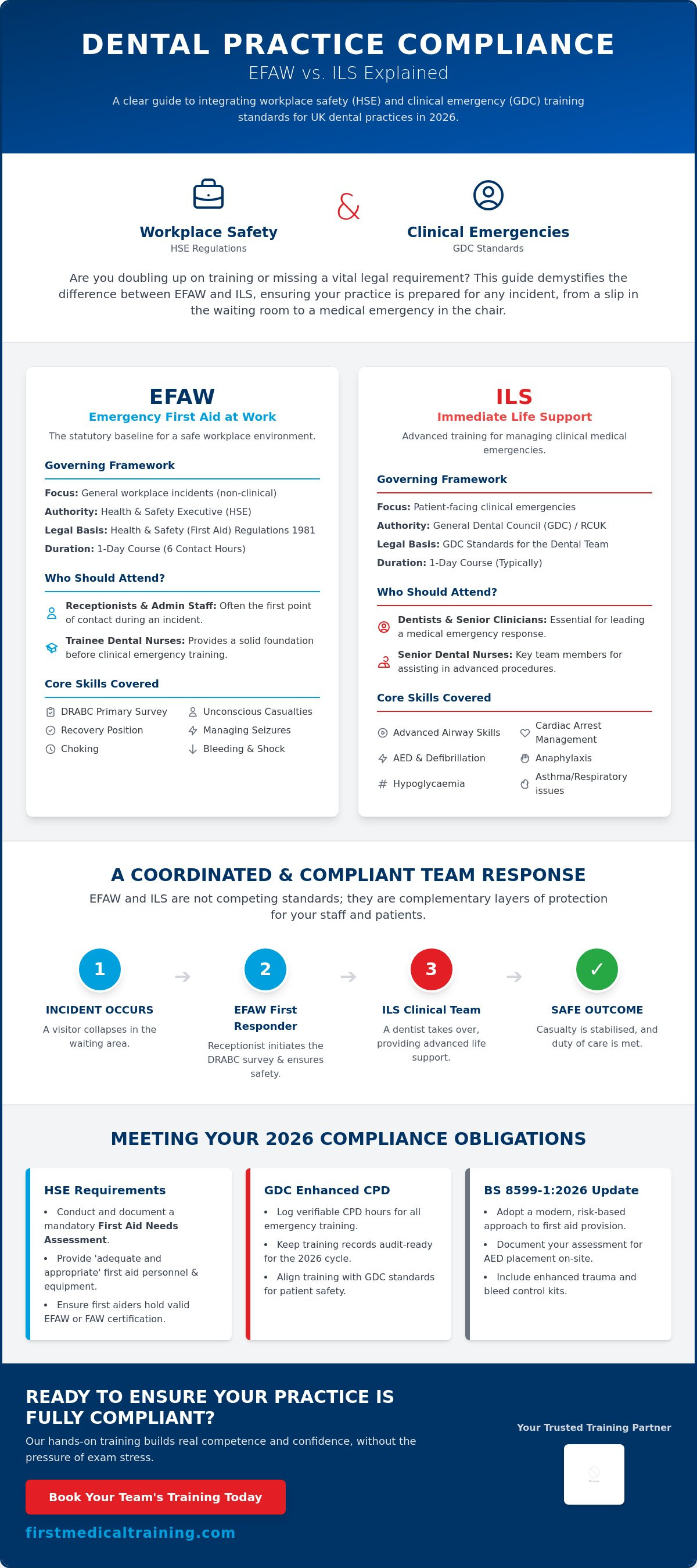
The Emergency First Aid at Work (EFAW) qualification is the foundational pillar of safety for any UK business. For dental practices, it serves as the statutory baseline required to satisfy the Health and Safety (First Aid) Regulations 1981. Whilst clinical staff often focus on advanced life support, the EFAW course ensures the entire practice remains a safe environment for everyone who walks through the door. This 1-day course consists of six contact hours and is specifically designed for environments classified as low-to-medium risk. Understanding the distinction of EFAW vs ILS for dental practice management is crucial because EFAW addresses general workplace injuries that occur outside the dental chair, such as a slip in the waiting room or a minor burn in the staff kitchen.
The 2026 HSE curriculum has evolved to reflect modern risks. Under the updated BS 8599-1:2019+A1:2026 standards, there's now a much stronger emphasis on a risk-based approach. This includes a documented assessment for Automated External Defibrillator (AED) placement and enhanced trauma preparedness, such as the inclusion of bleed control kits. Mastery of basic first aid principles is no longer just a "tick-box" exercise; it's a dynamic requirement that protects your staff and patients alike.
The Statutory Duty of the Dental Practice Owner
Every practice owner has a legal obligation to provide "adequate and appropriate" first aid equipment and personnel. In a surgery setting, you must distinguish between a First Aider, who has completed the EFAW or FAW course, and an Appointed Person, who simply takes charge of first aid arrangements. Relying solely on an Appointed Person is rarely sufficient for a busy dental practice. Failure to meet these standards can lead to HSE intervention, significant fines, or increased professional liability if an incident isn't managed correctly. A robust first aid provision demonstrates a commitment to safety that extends beyond clinical duty.
Who Should Attend the EFAW Course?
EFAW is particularly well-suited for dental receptionists, administrative staff, and trainee dental nurses. While your senior clinicians will likely hold Immediate Life Support (ILS) certification, your front-of-house team needs the skills to manage an incident before a clinician can intervene. Having a clear division of EFAW vs ILS for dental practice staff allows for a tiered response system. Consider these key roles:
- Receptionists: They're often the first to spot a patient in distress in the waiting area or a visitor suffering a medical episode.
- Trainee Nurses: EFAW provides a solid foundation of life-saving skills before they progress to more complex clinical emergency training.
- Administrative Staff: Training these team members ensures coverage for back-office incidents and accidents in non-clinical zones.
When planning your training, always consider the impact of annual leave and sickness. Having multiple staff members trained ensures that a qualified responder is always on-site, even during staff shortages or busy periods.
The 2026 EFAW Syllabus: Essential Skills for the Modern Surgery
Whilst the statutory framework sets the legal stage, the 1-day EFAW syllabus provides the practical tools your team needs to manage a crisis effectively. The curriculum is built around the primary survey, often referred to by the acronym DRABC (Danger, Response, Airway, Breathing, Circulation). This methodical approach is the gold standard for assessing any casualty. It ensures that responders don't get distracted by minor injuries whilst a life-threatening condition remains untreated. In the context of EFAW vs ILS for dental practice safety, EFAW provides the essential stabilisation techniques required under the Health and Safety (First-Aid) Regulations 1981 before clinical help arrives.
Managing an unconscious casualty is a core component of the training. Your team will learn to identify the subtle differences between a simple faint and a more complex seizure. The course covers the recovery position in detail, ensuring the airway remains clear and protected. For seizures, the focus is on protecting the casualty from injury and timing the episode, which is vital information for paramedics. These skills are particularly relevant for non-clinical staff who might encounter a patient in distress in the waiting area or staff room.
Resuscitation and AED Mastery
The 2026 standards have introduced a mandatory requirement for Automated External Defibrillator (AED) training within the EFAW syllabus. It's no longer enough to simply know CPR; first aiders must demonstrate competence in deploying an AED. This shift aims to overcome the "fear factor" that often prevents bystanders from using life-saving equipment in public spaces. The training aligns with current Resuscitation Council UK guidelines, focusing on high-quality chest compressions and rapid defibrillation. The chain of survival represents a sequence of critical actions that, when performed rapidly, significantly increase the chances of a casualty surviving a sudden cardiac arrest. If your team needs to build this specific confidence, our Emergency First Aid at Work Course (EFAW) - 1 Day provides the hands-on practice required to ensure everyone is ready to act.
Managing Medical Emergencies and Trauma
Beyond resuscitation, the syllabus covers a range of medical emergencies that can occur in a busy practice. Choking is a primary concern; staff are trained in back blows and abdominal thrusts to clear an obstructed airway. We also discuss the role of anti-choking devices for high-risk scenarios. Trauma management is equally important, particularly identifying the signs of clinical shock. Prompt recognition and positioning can prevent a casualty's condition from deteriorating. Finally, the course addresses minor injuries specific to a surgery environment, such as burns from sterilisation equipment or eye irrigation following a chemical splash. This comprehensive approach ensures that every staff member, regardless of their clinical background, can provide effective first aid when it matters most.
EFAW vs. ILS: Which Training Does Your Dental Team Need?
The primary distinction between EFAW and ILS lies in the regulatory body they satisfy. EFAW is designed to meet the Health and Safety Executive (HSE) standards for workplace safety, ensuring that staff can handle injuries like falls, burns, or minor wounds. Conversely, ILS is tailored to the clinical requirements of the General Dental Council (GDC) and the Resuscitation Council UK. It focuses on life-threatening medical emergencies that occur during dental procedures. When considering EFAW vs ILS for dental practice environments, it's vital to recognise that ILS does not legally replace the requirement for a workplace first aider. A practice with ten clinical staff all trained in ILS still technically lacks a designated HSE-compliant first aider if no team member holds a valid EFAW or FAW certificate.
Conducting Your First Aid Needs Assessment
Your training strategy must be rooted in a formal First Aid Needs Assessment. This document serves as your evidence for both CQC and HSE inspectors during an audit. You should evaluate the total number of staff on-site against the daily volume of patient throughput. High-risk factors, such as the use of medical gases, the handling of sharps, and the performance of complex surgeries, necessitate a more robust response plan. For instance, a sharps injury or a chemical splash in the decontamination room is a workplace accident that falls under EFAW protocols. Documenting this decision-making process proves that your training choices are deliberate and risk-based, rather than arbitrary. It ensures you aren't just guessing at your compliance requirements but are actively managing the specific risks present in your surgery.
Mapping Roles to Qualifications
A "Hybrid Practice" model is the most effective way to ensure 360-degree coverage for both patients and staff. This approach assigns specific qualifications based on staff roles to avoid gaps in care. Non-clinical staff and front-of-house teams should follow the EFAW route. This provides them with the foundational skills to manage the waiting room and office areas without feeling overwhelmed by clinical procedures. Meanwhile, GDC-registered professionals, especially those handling sedation or high-risk cases, require Dental Immediate Life Support (ILS) Training. By integrating both qualifications, you create a seamless Dental Practice Emergency Preparedness plan. In this model, every team member knows their exact responsibilities. Whilst the clinician focuses on the patient in the chair, the EFAW-trained receptionist can manage the environment, contact emergency services, and ensure the AED is ready for use. This collaborative framework is the hallmark of a truly compliant and safe dental practice.
Professional Standards: GDC CPD and HSE Compliance
Compliance in a dental setting is a dual-layered responsibility. Whilst the HSE focuses on your duties as an employer, the General Dental Council (GDC) demands that you maintain your professional standing through Enhanced CPD. The 1-day EFAW course is not merely a workplace requirement; it is a significant contributor to your professional portfolio. For 2026, the GDC continues to categorise medical emergencies as a highly recommended CPD topic. Registered professionals must complete at least 10 hours of verifiable CPD in this area every five-year cycle, with a strong recommendation to undertake at least two hours of training every year. A six-hour EFAW course provides a substantial foundation for these requirements, specifically aligning with GDC Development Outcome C: the maintenance of clinical and professional skills through high-quality training.
To be considered "verifiable," your EFAW certificate must meet strict criteria. It needs to clearly state the learning aims and objectives, the date of the training, and the total number of hours completed. It must also provide a confirmation from the provider that the quality of the course was assured. When mapping out EFAW vs ILS for dental practice portfolios, remember that EFAW certificates carry a three-year validity, but the GDC's annual expectations remain constant. Simply holding a certificate is not enough; you must be able to demonstrate how that training translates into practical readiness during a CQC inspection or a GDC audit.
Meeting the GDC Annual Requirement
A common question amongst practice managers is whether the 6 hours gained from an EFAW course can be spread across multiple years. Whilst the hours are logged in the year they are earned, the GDC expects clinicians to keep their skills "fresh" annually. This is where an integrated approach is essential. We recommend ensuring your training provider is intimately familiar with the Medical Emergencies in a Dental Practice standards. By hosting "In-Practice" training, your team can run drills in their own surgery rooms. This builds a level of cohesion and muscle memory that a generic off-site course simply cannot replicate. It allows your EFAW-trained receptionists to work alongside ILS-trained clinicians, ensuring everyone knows exactly where the emergency kit is kept and how to use it under pressure.
Certification and Validity in 2026
Managing the re-certification cycle for a large team requires a disciplined approach to record-keeping. Although the EFAW certificate is valid for three years, the HSE "strongly recommends" that first aiders undergo annual refresher training. In a high-stakes environment like a dental surgery, skills can fade quickly. We suggest storing digital copies of all certificates in a central compliance folder that is easily accessible for CQC inspectors. Regular audits of these records will prevent you from accidentally falling into non-compliance when a certificate expires. Secure your team's compliance and professional standing by booking our Emergency First Aid at Work Course (EFAW) - 1 Day to ensure your staff remain confident and capable responders.
Preparing for Your EFAW Training Day: What to Expect
Attending a first aid course shouldn't be a source of anxiety for your team. At First Medical Training, we've refined our approach to ensure the day is practical, engaging, and directly relevant to the dental environment. We understand that your staff are used to high standards of clinical care, so we've stripped away the generic "office-based" fluff. Instead, we focus on hands-on skills that build real-world confidence. Whether you're navigating the differences of EFAW vs ILS for dental practice roles or simply refreshing your basic skills, our instructors act as seasoned mentors to guide you through every scenario. You'll spend less time looking at slides and more time on the floor, perfecting the techniques that save lives.
Because the course is physically active, we recommend that all attendees wear comfortable clothing. You'll be practicing CPR on manikins and demonstrating the recovery position with your colleagues, which requires a degree of kneeling and bending. If any team member has physical limitations, our trainers are adept at adapting the demonstrations to ensure everyone can participate safely whilst still meeting the assessment criteria. It's this supportive atmosphere that helps demystify complex procedures and empowers every staff member to act decisively in a crisis.
The Practical Assessment Process
We've moved away from high-pressure, end-of-day exams that often hinder learning. Our assessment is continuous throughout the six hours of contact time. This means our trainers observe your progress as you work, providing immediate feedback and correction. You'll need to demonstrate mastery of the AED and show competence in resuscitation on adult manikins. By the time you reach the end of the session, you won't just have a certificate; you'll have the genuine confidence to act under pressure. This is a key part of the EFAW vs ILS for dental practice debate; whilst ILS deals with advanced clinical scenarios, EFAW ensures your team is rock-solid on the foundational life-saving steps that must happen in those first few critical minutes.
Beyond the Certificate: Equipment and Drills
Compliance doesn't end when the trainer leaves your practice. We provide post-course support to ensure your surgery's equipment meets the 2026 HSE and GDC recommendations. This includes reviewing your first aid kits to ensure they align with the latest BS 8599-1:2019+A1:2026 standards. We also encourage you to integrate your new EFAW skills into your regular Cardiac Arrest Management practice drills. Running these drills amongst your team ensures that the transition from a receptionist identifying a collapse to a clinician starting ILS protocols is seamless and efficient. Once your foundational EFAW training is complete, the next logical step is booking a specialist session to ensure your entire team remains at the forefront of clinical emergency standards.
Secure Your Practice Compliance for 2026
Maintaining a safe dental environment requires a clear understanding of your dual responsibilities to the HSE and the GDC. By identifying the specific roles for EFAW vs ILS for dental practice staff, you ensure that every team member is equipped to handle both clinical collapses and workplace accidents. The 2026 standards demand more than just attendance; they require a risk-based approach that includes mandatory AED mastery and verifiable CPD records that stand up to audit.
Since 2006, First Medical Training has acted as a trusted partner in dental and healthcare compliance. Our courses are accredited by leading UK awarding bodies, ensuring your certification holds weight during any inspection. We specialise in demystifying complex regulations and turning them into practical, life-saving skills for your entire team. Book your accredited EFAW 1-day course for your dental team today and take the first step towards total peace of mind. We look forward to helping you build a more confident and capable surgery.
Frequently Asked Questions
Is the EFAW 1-day course enough for a UK dental practice?
An EFAW course is sufficient for meeting your statutory HSE requirements for workplace safety, but it isn't enough for clinical compliance on its own. Whilst it covers general injuries like falls or minor burns, GDC-registered staff must also undertake clinical emergency training. Balancing the requirements of EFAW vs ILS for dental practice management ensures you cover both the office environment and the clinical zones effectively.
Does the EFAW course include training on Automated External Defibrillators (AEDs)?
Yes, the 2026 EFAW syllabus includes mandatory training on Automated External Defibrillators (AEDs). You'll learn how to safely deploy the device, apply the pads, and follow the voice prompts alongside high-quality chest compressions. This ensures every staff member can act immediately during a sudden cardiac arrest, providing life-saving intervention in those critical minutes before an ambulance or a clinician arrives on the scene.
Can GDC-registered staff use EFAW as verifiable CPD?
GDC-registered staff can use EFAW training as verifiable CPD, provided the certificate meets the specific requirements of the Enhanced CPD scheme. The certificate must include clear learning aims, the date, and the total number of hours. This training typically maps to GDC Development Outcome C, which focuses on the maintenance and development of professional skills to protect patients and the public within a clinical setting.
How many first aiders does a dental practice legally require in 2026?
Your legal requirement depends on your specific First Aid Needs Assessment, but general guidelines suggest a low-risk environment with 25 to 50 employees requires at least one EFAW-trained person. For many dental practices, having at least two trained staff members is the safest approach. This ensures you have adequate coverage during periods of annual leave, sickness, or when the team is split across different floors or rooms.
What is the difference between EFAW and Basic Life Support (BLS) training?
The main difference lies in the scope of the training; Basic Life Support (BLS) focuses almost exclusively on resuscitation and choking, whilst EFAW covers a wider range of workplace injuries. EFAW includes managing severe bleeding, burns, fractures, and clinical shock. Understanding the distinction of EFAW vs ILS for dental practice helps you see that EFAW provides the broader safety net required for the entire building and staff.
How long does an Emergency First Aid at Work certificate remain valid?
An Emergency First Aid at Work certificate remains valid for three years from the date of assessment. However, the HSE strongly recommends that all first aiders attend an annual refresher course to keep their skills current. In a fast-paced dental environment, life-saving techniques can fade if they aren't practised regularly, so annual drills are a vital part of maintaining a safe and compliant practice for everyone.
Is the EFAW course suitable for dental receptionists and non-clinical staff?
EFAW is the ideal qualification for dental receptionists, practice managers, and administrative staff who don't have a clinical background. It gives them the confidence to manage incidents in the waiting room and front-of-house areas without needing the advanced clinical knowledge required for ILS. It's a foundational skill set that ensures your non-clinical team members can act as capable first responders in any workplace crisis or accident.
What happens if a staff member fails the practical assessment on the day?
Our trainers use continuous assessment throughout the six-hour contact time to ensure every participant reaches the required standard of competence. If a staff member struggles with a specific practical skill, such as CPR or AED placement, we'll provide extra support and guidance on the spot. Our goal is to build genuine confidence, so we'll work with the individual to ensure they leave the course feeling fully capable.