

LifeVac Anti-Choking Device UK: The Definitive 2026 Buying Guide

Over 10,000 counterfeit anti-choking devices have entered UK households and clinical settings in the last two years, creating a dangerous illusion of safety. When you're faced with a choking emergency where standard back blows and abdominal thrusts have failed, the last thing you need is a non-regulated tool that might worsen the obstruction. It's natural to feel anxious about these high-stakes moments, particularly whilst trying to distinguish a genuine, life-saving lifevac anti-choking device uk from the unregulated imitations often found on major online marketplaces.
We understand that your priority is the absolute safety of your family or patients. This definitive 2026 guide will show you how to identify MHRA-registered equipment and ensure it's correctly integrated into your Basic Life Support protocols. You'll learn how to verify unique serial numbers, understand the importance of UKCA marking, and choose the correct mask sizes for everyone from toddlers to the elderly. We will provide the professional clarity needed to secure a reliable safety net that works when every second counts, ensuring you're prepared for the unexpected with confidence and authority.
Key Takeaways
- Understand why MHRA registration and UKCA marking are non-negotiable standards for ensuring your airway clearance device is safe for clinical or domestic use.
- Identify the specific physical markers used to verify a genuine lifevac anti-choking device uk and avoid the risks associated with unbranded, poor-quality counterfeits.
- Determine which specialised kit is appropriate for your specific setting, including options tailored for home use, travel, or professional medical environments.
- Learn how to correctly integrate suction devices into your annual medical emergency training and existing Basic Life Support protocols.
- Ensure your dental practice meets GDC compliance standards by incorporating regulated emergency equipment into your practice's safety framework.
What is the LifeVac Anti-Choking Device and Why is it Vital in the UK?
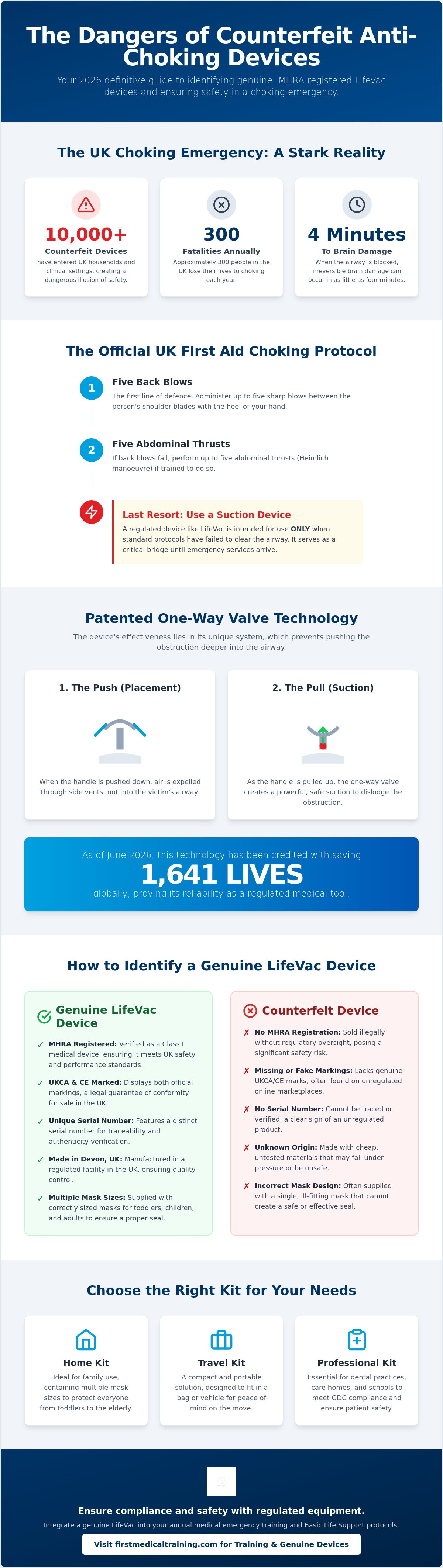
The lifevac anti-choking device uk is a non-invasive, portable suction tool designed to clear an upper airway obstruction when standard first aid protocols prove unsuccessful. Registered with the MHRA as a Class I medical device, it serves as a critical safety net in environments where the risk of Choking is high. In the United Kingdom, approximately 300 people lose their lives to choking every year, with a significant proportion of these fatalities occurring amongst the elderly and those with dysphagia. When a foreign object blocks the airway, brain damage can begin in as little as four minutes. This narrow window means that having a reliable, easy-to-use suction tool on hand is not just a luxury; it is a vital component of modern emergency readiness.
Whilst traditional methods like back blows and abdominal thrusts are the first line of defence, they are not always effective. Physical limitations, such as being in a wheelchair or having certain medical conditions, can make these manoeuvres difficult or impossible to perform correctly. The LifeVac device provides a pragmatic solution that doesn't require the same physical strength or positioning as the Heimlich manoeuvre. It's designed to be used by anyone, from parents in a domestic setting to clinicians in a busy dental surgery, providing a sense of calm and capability during a terrifying event.
How LifeVac Complements UK First Aid Protocols
The Resuscitation Council UK (RCUK) provides a clear algorithm for managing choking: five back blows followed by five abdominal thrusts. LifeVac is intended to be used during the "last resort" phase, specifically when these established manual methods have failed to dislodge the obstruction. It's a secondary measure that bridges the gap between basic first aid and advanced medical intervention. Unlike invasive tools that require specialist training to avoid damaging the throat, this device remains external, using a mask to create a seal over the nose and mouth. This non-invasive approach is preferred in emergency scenarios because it reduces the risk of secondary injury whilst the responder waits for emergency services to arrive.
The Mechanism of One-Way Suction Technology
The effectiveness of the device lies in its patented bellows system. When the bellows are compressed, the air is forced out through the sides of the device rather than into the patient's airway. This prevents the obstruction from being pushed further down into the trachea. The patented one-way valve system ensures that upon compression, air escapes through the sides of the bellows, creating a vacuum that only exerts upward force on the obstruction during the pull phase. This specific suction duration is calibrated to be safe for all ages, from toddlers to adults, provided the correct mask size is utilised. As of June 2026, this technology has been credited with saving 1,641 lives globally, proving its reliability as a regulated medical tool manufactured right here in Devon, UK.
UK Regulations: MHRA Registration and UKCA Marks Explained
Securing a lifevac anti-choking device uk involves more than just a simple purchase; it's a matter of ensuring the equipment meets stringent British medical standards. In the United Kingdom, any airway clearance tool must be registered with the Medicines and Healthcare products Regulatory Agency (MHRA) as a Class I medical device. This classification confirms that the manufacturer has declared the product conforms to all relevant safety and performance requirements. Since June 2023, the MHRA lifted previous voluntary restrictions, allowing these devices to be sold to the general public whilst maintaining rigorous oversight of their manufacturing quality.
The transition from the European CE marking to the UKCA (UK Conformity Assessed) mark is a critical detail for buyers in 2026. While the MHRA will continue to recognise the CE mark until 2028 or 2030, a genuine LifeVac device manufactured in Devon will carry both markings. These symbols are not merely labels; they represent a legal guarantee that the device has undergone the necessary assessments to be sold in British pharmacies and by specialist medical suppliers. Using a device without these credentials puts the user at significant legal and physical risk.
The Role of the MHRA in Airway Device Safety
The MHRA plays a proactive role in monitoring the performance of medical hardware. They manage a Public Access Database for Medical Devices, allowing clinicians and the public to verify the registration of their equipment. This oversight is vital because it provides a mechanism for safety reports and field safety notices. In March 2024, the agency issued a significant MHRA warning on counterfeit devices, noting that over 10,000 unregulated products had entered the market. This is why professional training providers only source hardware from verified lifevac anti-choking device uk supply chains. If you are looking to protect your team, you can purchase a genuine LifeVac Anti-Choking Device to ensure total compliance.
Clinical Evidence and Global Recognition
Beyond UK borders, the suction technology used in these devices is supported by substantial clinical data and peer-reviewed studies. It holds recognition from international bodies such as the FDA in the United States and the TGA in Australia. This global validation informs the precise design of the colour-coded mask system, ensuring that the suction pressure is effective without causing trauma to the delicate tissues of the airway. With 1,641 lives saved globally as of June 2026, the clinical evidence supports its role as a reliable adjunct to standard life support training.
The Counterfeit Crisis: How to Identify a Genuine LifeVac Device
The market for life-saving equipment has seen a troubling rise in unbranded copies appearing on major retail platforms. Marketplaces like Amazon and eBay are often flooded with cheap imitations that claim to provide the same protection as a genuine lifevac anti-choking device uk. However, these products often lack the rigorous testing required for medical certification. The MHRA estimates that over 10,000 unsafe or unbranded anti-choking devices are currently in circulation within the UK. This isn't just a matter of copyright; it's a critical safety issue that could have fatal consequences during a choking event. Using an unregulated tool during a crisis is a gamble no responder should take.
Safety concerns have been highlighted by medical experts regarding the efficacy of these non-regulated tools. The Guardian report discusses the regulatory scrutiny surrounding suction devices, particularly concerning their use on vulnerable groups. Buying a counterfeit might save a small amount of money initially, but the hidden costs are found in poor build quality and unreliable performance. A genuine device is manufactured in the UK under strict quality controls that these mass-produced fakes cannot replicate. Authentic units are designed to work every time, without exception.
The Dangers of Non-Regulated Suction Tools
Counterfeit devices frequently suffer from catastrophic seal failure. If the mask doesn't create an airtight seal, the device cannot generate the suction needed to dislodge an obstruction. Even worse, some poorly designed valves can actually inject air into the patient's airway, pushing the object deeper into the trachea. Genuine masks are made from medical-grade, BPA-free materials designed for long-term storage. Cheap plastics found in fakes can degrade over time, becoming brittle or sticky whilst sitting in your first aid kit. This degradation renders them useless when you need them most.
Verification Checklist for UK Buyers
Protecting your family or practice starts with verifying the authenticity of your equipment. Use this checklist to ensure your device is legitimate:
- Unique Serial Number: Genuine units feature a traceable serial number or hologram on the bellows or the base of the device body.
- Manufacturer Details: The packaging must clearly state "LifeVac Europe" with a confirmed UK manufacturing address in Devon.
- Instructional Quality: Look for a professionally printed booklet in clear English. Counterfeits often contain poor translations or lack specific UK contact details.
- Authorised Sellers: Only purchase from accredited training centres or recognised UK distributors. If the price seems too good to be true, it's likely a dangerous imitation.
Confirming these details takes only a few minutes but provides the certainty required in an emergency. Genuine devices also offer a replacement service; if you use your LifeVac in a real-world emergency, the manufacturer will often replace the unit free of charge once the save is reported and verified.
Buying Guide: Choosing the Right LifeVac Kit for Your Needs
Selecting the correct lifevac anti-choking device uk kit requires a pragmatic assessment of your environment and the individuals under your care. Whether you are managing a busy dental surgery or a private household, the primary consideration is mask accessibility and size. Genuine LifeVac kits are supplied with a range of masks to ensure a secure seal for different facial structures. A standard kit typically includes one paediatric mask, one small adult mask, and one large adult mask. This variety is essential because the device's efficacy relies entirely on the airtight seal created between the mask and the patient's face. Without this seal, the one-way suction technology cannot generate the force required to dislodge an obstruction.
One of the most reassuring aspects of investing in this regulated equipment is the manufacturer’s "Free Replacement" policy. If you are forced to use your device in a documented life-saving emergency, LifeVac Europe provides a replacement unit at no extra cost. This initiative ensures that your safety net is immediately restored whilst allowing the manufacturer to collect vital data that contributes to the 1,641 lives saved globally as of June 2026. It reflects a commitment to community safety that goes beyond a simple transaction. It also ensures that clinicians and parents don't hesitate to use the device due to the cost of replacement.
The LifeVac Home Kit vs Travel Kit
Choosing between the Home Kit and the Travel Kit depends on your lifestyle. The Home Kit is designed for static storage, typically in a kitchen or dining area where most choking incidents occur. It arrives in a durable box that keeps the masks protected from dust and light. Conversely, the Travel Kit is housed in a compact, high-visibility yellow zip-up bag. This is the superior choice for cars, changing bags, or holidays. For a first-time buyer, the Home Kit is often the most practical starting point, providing a permanent station for emergency response. Both kits contain the same high-quality suction unit and mask sizes, ensuring no compromise on safety regardless of the format.
Professional Wall-Mounted Kits
For professional settings like schools or care homes, high-visibility wall-mounted kits are the gold standard. In these environments, seconds matter; staff shouldn't be searching through cupboards for equipment during a crisis. The wall-mounted version ensures the lifevac anti-choking device uk is immediately identifiable to any trained responder. If you are a dental professional, this device should be integrated into your wider medical emergency equipment dental practice. This ensures your practice remains compliant with safety standards whilst providing your team with the tools needed to manage a crisis effectively. Ready to equip your site? You can order your LifeVac Anti-Choking Device today to ensure your practice is fully prepared.
Professional Integration: LifeVac in UK Dental and Healthcare Practices
Dental surgeries are unique clinical environments where the risk of airway obstruction is a constant, albeit manageable, concern. Whilst much focus is placed on the dental chair, the waiting room remains a high-risk area for choking incidents. Patients, particularly the elderly or those with young children, may be consuming sweets or snacks whilst waiting for appointments. Integrating a lifevac anti-choking device uk into your practice's emergency kit ensures that your team is prepared to respond to a crisis anywhere on the premises. This proactive approach directly supports your GDC CPD requirements for medical emergencies, demonstrating a commitment to patient safety that extends beyond mandatory minimums.
To ensure the device is effective during a crisis, it must be formally documented within your practice’s emergency preparedness policy. This involves more than just mounting the kit on a wall; it requires a systematic update to your standard operating procedures. You should clearly define the location of the suction tool and specify its role as a secondary measure following failed manual thrusts. Staff should be encouraged to familiarise themselves with the mask seals during their induction and subsequent annual reviews, ensuring that there is no hesitation when every second is critical.
Compliance and the Care Quality Commission (CQC)
During a CQC inspection, practices are assessed on whether they are safe and well-led. Having a regulated lifevac anti-choking device uk on-site serves as tangible evidence of safety leadership. It shows that the practice manager has evaluated specific risks and implemented additional safeguards to protect vulnerable patients. This level of preparation is a key component of our medical emergencies in dental practice course, where we teach clinicians how to justify their equipment choices to regulatory bodies. A well-prepared practice doesn't just meet standards; it sets them.
The Importance of Accredited Training
Hardware is only half the battle. A suction device is a powerful tool, but it requires a confident responder to be effective. Incorporating LifeVac into your annual medical emergency drills is essential for building muscle memory amongst your team. Training should focus on the transition from manual first aid to suction-based clearance, ensuring a seamless flow of care. At First Medical Training, we believe that clinical confidence is built through practical, hands-on experience rather than just theoretical knowledge.
Equipping your practice with a genuine LifeVac device is a decisive step toward total emergency readiness. By combining regulated hardware with accredited training, you provide the highest possible standard of care for your patients and staff. Ensure your practice is fully compliant and your team is ready to act; invest in professional-grade equipment and comprehensive training today.
Securing Your Practice with Regulated Airway Safety
Securing a reliable safety net for choking emergencies requires a commitment to clinical quality and strict regulatory compliance. You now have the knowledge to distinguish between dangerous counterfeits and a genuine, MHRA-registered tool. By selecting the correct kit for your specific environment and ensuring your team is fully trained, you move beyond simple compliance to a gold standard of patient and family care. This level of preparation is what defines a well-led practice and a safe home environment.
The lifevac anti-choking device uk is a trusted Class I Medical Device currently utilised by over 10,000 healthcare professionals globally. When you invest in a genuine unit, you're protected by a free replacement policy if the device is used in a documented emergency. This ensures your emergency readiness is immediately restored without additional cost. It's a pragmatic, life-saving solution that provides peace of mind whilst reinforcing your professional standards and commitment to safety.
Equip your practice with a genuine LifeVac Anti-Choking Device from First Medical Training to protect your patients and loved ones with absolute confidence. Taking this proactive step today ensures you're ready to act with authority and capability when every second counts.
Frequently Asked Questions
Is the LifeVac device legally approved for use in the UK?
Yes, the LifeVac is fully registered with the Medicines and Healthcare products Regulatory Agency (MHRA) as a Class I medical device. Since June 2023, the MHRA has permitted the sale of these devices to the general public, provided they carry the necessary UKCA or CE markings. This registration confirms that the device meets the safety and performance requirements set out by UK medical regulations.
Can I use LifeVac on myself if I am choking alone?
Yes, you can use the device on yourself if you are alone and standard self-help methods fail. The design allows an individual to place the mask over their own face and operate the bellows to create the necessary suction. It's an essential tool for those living alone or with limited mobility who might struggle to perform effective self-administered abdominal thrusts.
What is the difference between a genuine LifeVac and cheaper versions on Amazon?
Genuine units feature a patented one-way valve that prevents air from being pushed into the patient's airway during compression. Counterfeit versions often lack this critical safety feature and do not hold the required MHRA registration. A genuine lifevac anti-choking device uk is manufactured in Devon and undergoes rigorous quality control that unregulated copies found on online marketplaces simply cannot guarantee.
Does the LifeVac device expire or need servicing?
The suction unit itself does not have an expiry date and does not require regular mechanical servicing. However, the medical-grade masks have a recommended replacement date, typically every two to three years, to ensure the material remains flexible enough to form an airtight seal. You should check these dates during your annual first aid kit inspection to ensure the equipment remains ready for use.
Can LifeVac be used on infants and small children?
Yes, the device is safe for use on infants and children when using the specific paediatric mask included in the kit. The suction pressure is calibrated to be effective whilst remaining safe for smaller airways. It provides a non-invasive alternative for parents and carers when manual back blows don't dislodge an obstruction in a young child.
Should I use LifeVac before or after trying the Heimlich manoeuvre?
You should use the device only after trying the established Resuscitation Council UK choking protocol. This means performing five back blows followed by five abdominal thrusts first. The lifevac anti-choking device uk is designed as a "last resort" safety net to be utilised when these manual first aid manoeuvres have proven unsuccessful in clearing the airway.
Will the LifeVac device be replaced for free if I use it to save a life?
Yes, LifeVac Europe offers a free replacement for any unit that has been used in a documented life-saving emergency. Once the event is reported and verified through their "Life Saving" reporting programme, a new device is sent out to ensure your home or practice remains protected. This policy ensures that the cost of replacement is never a barrier to acting quickly in a crisis.
How do I know if my practice is compliant with GDC choking response standards?
Compliance is achieved by ensuring your team is trained in current Basic Life Support (BLS) protocols and has access to appropriate emergency equipment. The GDC requires dental professionals to be competent in managing medical emergencies, which includes airway obstructions. Integrating a regulated suction device into your annual medical emergency drills and practice policy demonstrates a proactive and well-led approach to patient safety.