

Sedation emergency protocols for dentistry and airway risks

Cardiac arrest is one emergency dental sedation teams must be prepared to manage, alongside airway obstruction, breathing problems, medication-related crises and aspiration. Effective sedation emergency protocols for dentistry bring together patient monitoring, airway and oxygen support, access to emergency medicines and defibrillation capability, with clear team roles and rehearsed procedures. The response should match the emergency and the patient’s condition.
Sedation can affect breathing and protective airway reflexes, so a calm, coordinated response is essential if a patient becomes more deeply sedated than intended. A written plan helps the team recognise deterioration, act promptly and communicate clearly while arranging further emergency support when needed.
This article explains how dental teams prepare for and respond to airway emergencies, oversedation, medication-related events, aspiration risks and cardiac arrest. It also covers how equipment, staff training and regular practice support a reliable response, helping you understand what should happen when seconds matter.
Key Takeaways
- Recognise that sedation can compromise breathing and airway protection, and understand why monitoring and a rehearsed response matter.
- Know how emergency medicines, oxygen, airway equipment and defibrillation capability fit into a prepared dental practice.
- Learn the warning signs of local anaesthetic systemic toxicity and why prompt recognition is essential.
- Understand how fasting guidance, positioning and a coordinated response can help reduce aspiration risks.
- Clarify team roles and practise responses to anaphylaxis, cardiac arrest, seizures and other medical emergencies.
Respiratory depression, hypoxemia and airway obstruction
Dental sedation may depress breathing, lower oxygen levels or obstruct the airway, particularly if sedation deepens beyond its intended level. Reduce the risk of complications through patient assessment, appropriate monitoring, accessible airway equipment and a coordinated response. Build sedation emergency protocols for dentistry around the patient’s condition and the team’s ability to act.
Recognising Airway Obstruction
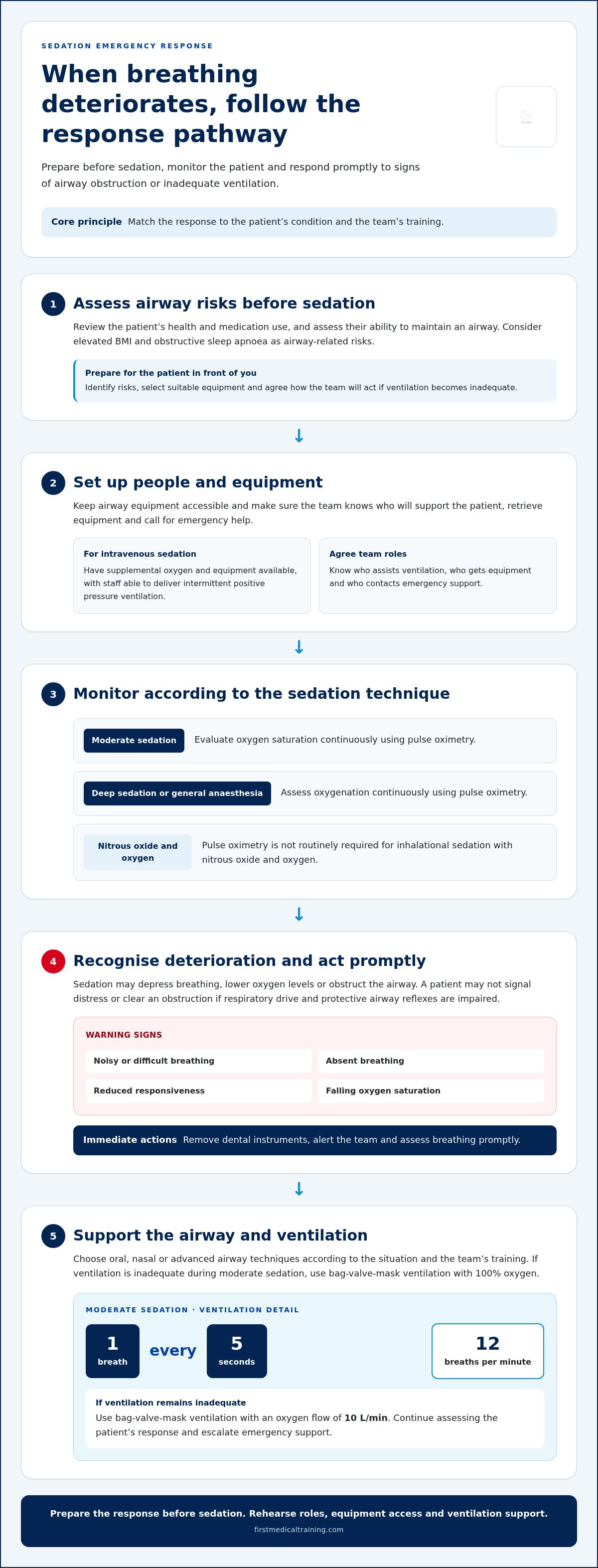
Airway obstruction occurs when airflow is partly or completely blocked, limiting the air reaching the lungs. Watch for noisy, difficult or absent breathing, reduced responsiveness and falling oxygen saturation. Sedation can impair respiratory drive and protective airway reflexes, so a patient may not signal distress or clear an obstruction. Remove dental instruments, alert the team and assess breathing promptly. If ventilation is inadequate, begin the practice’s emergency response and provide appropriate airway support.
Airway Assessment and Monitoring
Airway assessment identifies features that could make ventilation or rescue more difficult before sedation begins. Review the patient’s health, medication use and ability to maintain an airway, and consider elevated BMI and obstructive sleep apnoea as airway-related risks. Sedation emergency protocols for dentistry should specify how staff identify risks and prepare suitable equipment. Practices providing intravenous sedation need supplemental oxygen and equipment, with staff able to deliver it by intermittent positive pressure ventilation. During moderate sedation, oxygen saturation must be evaluated continuously using pulse oximetry. Continuous pulse oximetry is also required to assess oxygenation during deep sedation or general anaesthesia. Pulse oximetry is not routinely required for nitrous oxide and oxygen inhalational sedation.
Airway Adjuncts and Assisted Ventilation
Airway adjuncts help maintain an open airway, while assisted ventilation moves air into the lungs when a patient cannot breathe adequately. Select oral, nasal or advanced airway techniques according to the situation and the team’s training. For inadequate ventilation during moderate sedation, use bag-valve-mask ventilation with 100% oxygen at one breath every five seconds, or 12 breaths per minute. If ventilation remains inadequate, use bag-valve-mask ventilation with an oxygen flow of 10 L/min. Continue assessing the patient’s response and escalate emergency support.
Prepare a patient-specific response before sedation, not during a deterioration. A patient with an enlarged tongue who becomes oversedated may need immediate oral, nasal or advanced airway management. The team should know where oxygen and airway equipment are kept, who will assist ventilation and who will call for emergency help. Rehearse sedation emergency protocols for dentistry so everyone understands their role and can respond promptly.
Consent must also reflect the patient’s ability to make an informed decision. In England, the Mental Capacity Act 2005 is relevant guidance for consent to treatment for patients who lack capacity to give informed consent, according to UK Parliament. In Scotland, the Adults with Incapacity Act 2000 is relevant guidance for consent to treatment for patients who lack capacity to give informed consent, according to UK Parliament. Consider these frameworks when assessing consent before sedation.
Emergency medications and defibrillation capability
Keep emergency medicines and resuscitation equipment immediately accessible during dental conscious sedation. Assign trained team members to retrieve equipment, support the patient, contact emergency medical services and meet responders. For any clinical setting, from community dental providers such as 1rsdental.com to specialised sedation suites, patient safety relies on thorough preparedness. A written protocol should define these roles and explain how the team escalates care if a patient deteriorates.
An emergency drug kit should contain medicines selected for the practice’s emergency response, with clear storage and checking arrangements. Check that medicines are in date and equipment works properly. If sedation causes oversedation, appropriate reversal agents, including naloxone or flumazenil, may be required alongside immediate respiratory support. Continue monitoring after reversal medication: its effects may wear off before those of the sedative, allowing oversedation to recur.
Medication safety starts before administration. Review the patient’s medicines and record each sedative dose and its timing. Allow enough time to assess the full effect of an intravenous dose before considering another. For conscious sedation using midazolam, high-strength presentations can increase overdose risk; guidance recommends 1 mg/ml midazolam in 2 ml or 5 ml ampoules where it is used. Keep dosing decisions within the practitioner’s training and the applicable clinical protocol.
Defibrillation capability matters because a sedation emergency can involve cardiac arrest. Ensure the team can access a defibrillator, begin CPR and follow the device’s prompts. Keep emergency equipment ready and practise who applies the pads, who performs compressions and who communicates with responders. Regular checks should confirm that resuscitation equipment works and medicines remain in date.
Emergency responses vary according to the sedation technique and the patient’s condition. With nitrous oxide and oxygen inhalation sedation, stop the sedative gas and support the patient’s breathing if they become unwell. Oral sedation requires attention to the medicine already taken and its continuing effects. Intravenous sedation requires careful dose recording and timely assessment between doses. In every case, respond to the actual emergency, not just the planned sedation level.
For a serious complication, activate the practice’s emergency response and contact emergency medical services. This section cannot give a separate UK telephone number from the verified facts available, so the practice’s written escalation pathway should state how staff summon urgent help. Assign someone to meet the responding team and provide a clear handover of the event, medication and treatment given.
Document the event promptly, including observations, medicines and doses, the sequence of changes, interventions, the patient’s response and the handover. Report sedation-related critical incidents and carry out significant-event analysis as part of clinical governance. Use the findings to update the written protocol and rehearse any changes with the dental team.
Local anaesthetic systemic toxicity (LAST)
Local anaesthetic systemic toxicity (LAST) occurs when local anaesthetic reaches harmful levels in the body. In dental procedures, possible causes include an excessive total dose or unintended entry into the bloodstream. Early changes may involve altered awareness or behaviour; severe toxicity can include seizures or cardiovascular instability. Treat a sudden change during or after an injection as an emergency, not routine anxiety or sedation.
Prevention starts before the first injection. Record the patient’s weight when relevant to dose calculation, check the product concentration and planned volume, then calculate the total amount of local anaesthetic. Include every cartridge administered during the appointment and reassess the total before any further injection. The maximum dose is a ceiling, not a target. Apply the appropriate guidance for the patient and medicine used.
For paediatric dental patients, the American Academy of Pediatric Dentistry recommends maximum doses of 4.4 mg/kg for lidocaine and 7 mg/kg for articaine. These figures are not interchangeable: calculate each medicine separately and use the relevant maximum. A child’s weight and the amount already administered inform the calculation. If more than one local anaesthetic is used, follow the applicable clinical protocol for assessing combined exposure.
If a patient develops concerning changes during treatment, stop administering local anaesthetic and alert the dental team. Assess responsiveness, breathing and circulation, then activate the practice’s emergency response. A seizure, reduced consciousness or abnormal cardiac signs require urgent attention. Support the airway and breathing, monitor the patient continuously and arrange emergency medical assistance. Do not leave the patient alone while another team member retrieves equipment or calls for help.
- Before injection: confirm the planned medicine, concentration, volume and patient-specific dose calculation.
- During treatment: note the amount given and remain alert to a sudden change in the patient’s condition.
- If toxicity is suspected: stop the injection, assess the patient, summon help and follow the practice emergency protocol.
Keep the response within the team’s training and written procedures. Record the local anaesthetic used, its amount and timing, the patient’s symptoms and observations, and the treatment provided. Include the emergency call and handover in the clinical record. Review the event through clinical governance, then use any learning to improve dose checks, team roles and future emergency practice.
Nausea, vomiting and aspiration prevention
Nausea and vomiting can complicate sedation and create an aspiration risk if stomach contents enter the airway. Fasting instructions, procedure planning and prompt, airway-focused action help dental teams reduce that risk.
Nausea and Vomiting
Nausea is the feeling of needing to vomit; vomiting forcefully expels stomach contents. Either can disrupt treatment, and vomiting can threaten the airway when sedation affects protective reflexes. Ask about previous nausea after sedation and follow the practice’s written preparation and response procedures. If a patient vomits, stop treatment, assess breathing and responsiveness, and follow the emergency protocol. Postoperative nausea and vomiting may persist for two to three days, so provide clear follow-up advice.
Aspiration Prevention
Aspiration occurs when material such as vomit, fluid or dental debris enters the airway. Reduce avoidable risks by following the planned fasting instructions and keeping suction available during treatment. If a throat pack or barrier is used, account for it before and after the procedure. This check helps prevent retained material and unintended airway compromise. If vomiting occurs, pause treatment, clear visible material appropriately and assess breathing promptly.
Fasting intervals vary across published guidance, so distinguish a reference from the protocol followed in your practice. The American Dental Association (ADA) guidelines list minimum fasting periods before dental sedation: two hours for clear liquids, four hours for breast milk, and six hours for infant formula, nonhuman milk or a light meal. For a fatty meal, the ADA lists eight hours. These intervals do not replace the relevant UK clinical guidance or the patient’s sedation plan.
For children, the European Academy of Paediatric Dentistry (EAPD) guidelines advise no clear liquids for two to three hours before sedation. The EAPD also advises no solid foods or non-clear liquids for four hours before sedation. Apply the relevant instructions consistently, explain them to parents or carers, and record whether preparation requirements have been followed. Do not assume the same fasting interval applies to every patient or sedation technique.
Before starting, confirm that suction equipment is accessible and the team knows how to respond if a patient becomes sick. Remove instruments from the mouth and stop dental treatment if vomiting begins. Check for breathing difficulty or reduced responsiveness, and escalate care through the practice’s emergency response when needed. Record the episode, actions taken and the patient’s condition afterwards.
Account for every throat pack or barrier used during dental treatment. Record its placement, confirm its removal before the patient leaves the treatment area, and communicate the check during handover. A retained pack can compromise the airway, so make this a defined team responsibility rather than relying on memory.
How should dental teams manage anaphylaxis, cardiac arrest, seizures, or other medical emergencies during sedation?
Follow the practice’s written emergency protocol, respond to the patient’s symptoms and assign clear tasks. Dental team members should be trained and competent in life support, with emergency equipment and medicines immediately available during conscious sedation.
Start by stopping dental treatment and assessing the patient’s condition. Use the practice’s primary survey to identify immediate threats, including problems with the airway, breathing or circulation. One team member should lead care while others retrieve the emergency drug kit and equipment, contact emergency medical services, meet responders and communicate with accompanying family members. Clear roles reduce confusion during a rapidly changing event.
Anaphylaxis: treat suspected anaphylaxis as an emergency. Stop the procedure, call for emergency assistance and follow the practice’s anaphylaxis protocol. Make emergency medicines available and support the patient’s airway and breathing. Record the symptoms, their progression and all treatment given, including its timing. Do not delay escalation to see whether symptoms improve.
Cardiac arrest: if the patient is unresponsive and not breathing normally, activate the emergency response. Begin life support according to the team’s training, send for the defibrillator and follow its prompts. Assign one person to manage the call for emergency help and another to guide responders into the practice. Keep resuscitation equipment accessible, and ensure staff know where it is before treatment begins.
Seizures: stop treatment, protect the patient from nearby dental instruments and observe what happens. Ask a colleague to note when the seizure starts and ends, and summon help if the patient’s condition requires escalation under the practice protocol. Once movements stop, reassess responsiveness and breathing. Record the episode and give responding clinicians a clear account.
For any sedation-related deterioration, keep the patient under observation and communicate changes promptly. Tell emergency responders which sedation was used, when it was given, what symptoms appeared and which interventions followed. A concise handover gives them a clear account of the event and treatment. Document observations, medicines, actions, response and handover in the clinical record.
Preparation matters as much as the written plan. Check that emergency medicines are in date and equipment works properly. Run drills for separate scenarios, such as anaphylaxis, cardiac arrest and seizures. Afterwards, review communication, equipment access and role allocation. Whether managing high-dependency procedures or routine oral healthcare as seen at dentalplus.co.nz, clear clinical governance and ongoing protocol reviews ensure practices maintain high standards of patient safety. Report critical incidents and use significant-event analysis as part of clinical governance, then update the protocol or rehearsal plan where needed.
First Medical Training: Medical Emergencies in a Dental Practice Course
First Medical Training Ltd’s Medical Emergencies in a Dental Practice - CPD Training is a practical option for dental teams preparing to respond to emergencies. It helps staff build understanding of how to recognise deterioration, coordinate roles and respond to medical crises in the practice. Consider the course when your team needs focused emergency education alongside its existing procedures or wants to reinforce readiness for events such as airway compromise or cardiac arrest.
For teams seeking focused life-support practice, Dental Immediate Life Support (ILS) Training for Professionals is another relevant option. Choose training that supports your team’s learning needs and helps staff act calmly within their roles. Contact First Medical Training Ltd to discuss the training.
Build readiness into your next training session
Turn your written response plan into a practised team routine. Review whether everyone knows their role, where essential equipment is kept and how to communicate during a rapidly changing emergency. Then identify the skills your dental team would benefit from refreshing, whether life-support practice or clearer coordination. Well-rehearsed sedation emergency protocols for dentistry help staff move from written procedures to confident action when a patient needs urgent care.
First Medical Training Ltd offers dental emergency education, including the Emergency First Aid at Work Course (EFAW) - 1 Day. Choose training that fits your team’s learning needs and supports safe, organised responses in the practice. Use your next training session to strengthen the skills your team relies on, and contact First Medical Training Ltd to discuss the next step.
Frequently Asked Questions
Where Does Cardiac Arrest Fit?
Cardiac arrest is a life-threatening complication that requires immediate resuscitation and defibrillation capability. Stop treatment, activate the practice’s emergency response, begin CPR within your training and send for the defibrillator. Assign a team member to contact emergency medical services and another to meet responders. Sedation planning must cover cardiac arrest as well as breathing problems and medication reactions, with equipment and responsibilities ready before treatment starts.
What emergency equipment and medicines must be available during dental sedation in the UK?
Prepare oxygen, airway-management equipment, emergency medicines and a defibrillator, with equipment suited to the sedation service. Include monitoring equipment appropriate to the technique, such as pulse oximetry for moderate sedation. Keep medicines in a tamper-evident, logged emergency drug kit, and check expiry dates. Assign named team members to retrieve equipment and administer treatment within their competence. The written response plan should make each item’s location clear to staff.
What are the emergency protocols for respiratory depression or airway obstruction during dental sedation?
Stop treatment, call for help and assess the patient’s breathing and responsiveness. If ventilation is inadequate during moderate sedation, the stated protocol uses bag-valve-mask ventilation with 100% oxygen at one breath every five seconds, or 12 breaths per minute. If ventilation remains inadequate, use an oxygen flow of 10 L/min. Continue monitoring and arrange emergency medical support when needed. The team should act within its training and the practice’s emergency plan.
What are the UK protocols for reversing benzodiazepine or opioid sedation, including flumazenil and naloxone?
For oversedation, appropriate reversal agents include flumazenil for benzodiazepine effects and naloxone for opioid effects, alongside immediate respiratory support. Use them under the relevant clinical protocol and continue monitoring afterwards. A reversal agent may wear off sooner than the medicine that caused oversedation, so the patient’s condition can deteriorate again. Record the medication, response and subsequent observations, and escalate care if respiratory or cardiovascular concerns persist.
What monitoring is required before, during, and after dental sedation, and what are the discharge criteria?
Before sedation, assess health status and review prescription, herbal, recreational and over-the-counter medicines. During moderate sedation, evaluate oxygen saturation continuously using pulse oximetry; continuous pulse oximetry is also used to assess oxygenation during deep sedation or general anaesthesia. After intravenous sedation, discharge follows sufficient recovery. Patients are advised not to drive for 24 hours and should have an adult with them for that period. Inhalation sedation recovery typically takes around 30 minutes.
What staff training, roles, and emergency drills are required for UK dental sedation?
Dental clinical team members should be trained and competent in life support, with emergency roles allocated before treatment. For example, assign who leads care, calls emergency services, retrieves equipment and meets responders. Practise scenarios through drills, then review gaps in communication or equipment access. Sedation team members are recommended to complete 12 hours of sedation-related verifiable continuing professional development in each five-year cycle. Record critical incidents and use significant-event analysis to inform clinical governance.
What UK emergency numbers and escalation pathways should dental practices use for sedation complications?
For a serious complication, activate the practice’s emergency response and contact emergency medical services. The written escalation pathway should explain how staff summon urgent help, who meets responders and who provides the handover.