

Team communication during a medical emergency: How it works

A team does not need identical expertise to act as one. It needs a shared understanding of the patient’s needs, each person’s role and the next action. That shared mental model gives team communication during a medical emergency a clear purpose: coordinate decisions and tasks so important information is heard, understood and acted on.
In a fast-moving situation, a request can be missed or team members may assume someone else has acted. Clear communication helps prevent this uncertainty. Closed-loop communication confirms that a message was received and understood, while concise handovers help staff pass on essential details.
This article explains how shared mental models support teamwork, how closed-loop communication and structured handovers work, and how crisis resource management and training help teams prepare. These approaches give dental teams a practical framework for coordinating their response when a medical emergency occurs.
Key Takeaways
- Use closed-loop communication to acknowledge requests, confirm understanding and report when tasks are complete.
- Keep handovers focused and structured so essential patient information and recommended actions are clear.
- Build a shared mental model by clarifying roles, exchanging updates and making the next steps understood across the team.
- Support crisis resource management with explicit communication, situational awareness and an environment where staff can raise concerns.
- Practise communication skills through relevant team training so staff can coordinate more confidently in an emergency.
Closed-loop communication
In an emergency, a request is not complete when it is spoken. The receiver acknowledges it, carries it out and reports back, so the sender knows what happened. This exchange is called closed-loop communication. It turns a brief instruction into a shared, verifiable action instead of leaving the team to guess whether anyone heard or acted on it.
Use a clear name, task and response. For example, a team leader might say, “Sam, call 999 now.” Sam replies, “I’m calling 999,” then reports, “The call has been made.” The leader can then confirm the update and direct another task if needed. Naming the person avoids an instruction being mistaken for a general request, while reporting completion makes the action visible to colleagues nearby.
Keep instructions specific, and allow the receiver to clarify anything unclear. “Bring the emergency equipment to the patient” gives a clearer action than “Can someone get help?” The team member can repeat the request, identify the equipment they are retrieving and confirm when it arrives. If circumstances change, they should report that promptly rather than continue silently with an outdated task.
- Direct the message: Name the person responsible and state one clear action.
- Confirm receipt: Ask the receiver to acknowledge or repeat the instruction.
- Close the loop: Have them report when the task is complete, or explain what is preventing it.
- Update the team: Share relevant changes so nearby colleagues know what has happened.
These steps also help prevent duplicated work. If two people both assume someone else has called 999, the call may be delayed. A named caller and a spoken completion report make responsibility clear. The same approach applies to retrieving equipment, relaying information or asking a colleague to take a defined role. Keep messages brief, but include enough detail for the receiver to act safely.
When speaking with the patient and relatives, use calm, plain language. Explain what is happening and give one clear message at a time. Check understanding, listen to questions and avoid conflicting updates. Where possible, designate one team member to communicate with them while others coordinate care.
Closed-loop communication supports team communication during a medical emergency by making requests, responses and task completion audible. It is especially useful when several people are working at once, the room is noisy or attention is divided. Practise both the words and the sequence: a clear acknowledgement, a specific action and a completion report. This gives the team a common pattern to follow under pressure.
Concise updates and handovers
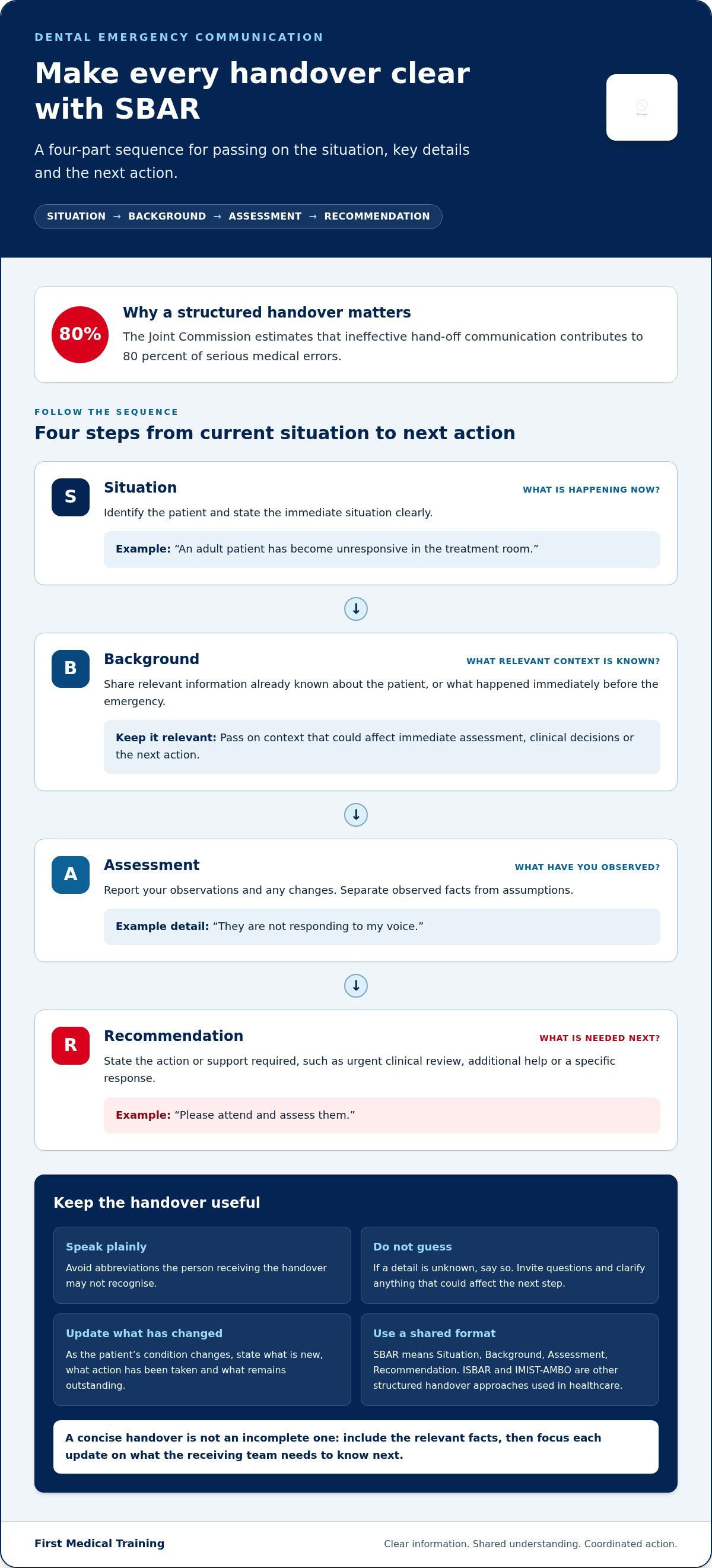
A clinical handover transfers responsibility and essential patient information from one person or team to another. In an emergency, give the receiving clinician a structured account of the current situation, relevant background, your assessment and the action needed. This sequence helps them identify what matters now and what decision or support is required next.
The Joint Commission estimates that ineffective hand-off communication contributes to 80 percent of serious medical errors. This estimate highlights why a handover needs to be concise, complete and clear to the person receiving it. Concise does not mean leaving out relevant facts. Prioritise details that could affect immediate assessment, clinical decisions or the next action.
For a clear emergency handover, identify the patient and immediate situation, share relevant background, describe your assessment, then state the action or support required. Direct the update to the right recipient, invite questions and clarify details that could affect the next step.
- Situation: State who the patient is and what is happening now. For example, “An adult patient has become unresponsive in the treatment room.”
- Background: Share relevant context, such as what happened immediately before the emergency or information already known about the patient.
- Assessment: Report what you have observed and any changes. Separate observed facts from assumptions.
- Recommendation: State what is needed next, such as urgent clinical review, additional help or a specific response.
This sequence is the SBAR tool: Situation, Background, Assessment, Recommendation. Speak plainly and avoid abbreviations the recipient may not recognise. If a detail is unknown, say so rather than guessing. The receiving clinician can then ask a focused question before taking over responsibility for care.
ISBAR and IMIST-AMBO are other structured handover approaches used in healthcare. Choose a shared format that suits the team’s setting and use it consistently. A familiar sequence helps staff anticipate what information comes next, reducing the chance that a relevant detail is lost in a long account.
For example, a team member might say: “This is the patient in surgery two. They became unresponsive during treatment. They are not responding to my voice. Please attend and assess them.” The recipient can ask for relevant missing details, which the person handing over can then provide clearly.
As the patient’s condition changes, give focused updates rather than repeating the entire handover. State what is new, what action has been taken and what remains outstanding. This helps the receiving team maintain an accurate account while keeping attention on current needs.
What is a shared mental model?
A shared mental model means team members understand the situation, their responsibilities and the intended next steps. In an emergency, that common picture helps people coordinate actions rather than rely on different assumptions.
Maintaining situational awareness
Situational awareness means noticing what is happening, understanding its significance and anticipating what may be needed next. It matters because a team’s decisions depend on the information its members share. For example, if a patient becomes less responsive, state the change clearly so colleagues can adjust their actions.
Keep the shared picture current with brief updates about relevant changes. Team members should distinguish what they have observed from what they infer. If help arrives or the patient’s condition changes, communicate that promptly. Colleagues can then respond to the current situation rather than act on outdated information.
Agreeing on the immediate treatment goal also helps everyone stay focused. Clarify who is leading, who is assessing the patient and what support is needed. If priorities change, state the new goal and invite team members to raise concerns or identify missing information.
Building a shared vocabulary
A shared vocabulary is a set of clear terms that team members understand in the same way. It matters because colleagues in different roles need to interpret messages consistently. Agree how to name locations, equipment and tasks, and explain unfamiliar clinical terms rather than assuming everyone knows them.
For example, “bring the emergency equipment to the patient” is clearer than “get the kit”. Name the item or action where possible, and avoid vague instructions such as “sort that out”. If the team uses an abbreviation, make sure everyone involved understands it. Consistent language helps members form the same picture of the patient’s needs and the response.
During a briefing, agree how staff will describe their roles and raise concerns. In an emergency, short statements such as “I’m assessing the patient” or “I need support at the chair” make actions easier to follow. They also give colleagues a clear opportunity to add relevant information or flag a problem.
Preparing and sharing responsibilities
Preparation means discussing likely roles and communication methods before an emergency occurs. Brief the team before patient care begins, and encourage open discussion about responsibilities. Clarify who leads, who provides clinical support and who handles practical tasks, such as bringing equipment or directing arriving help.
State the shared treatment goal and check that each person understands their responsibility. For example, assign one team member to contact emergency services and another to relay relevant updates. Clear allocation reduces uncertainty about who is acting, while allowing staff to speak up if a task is missed or circumstances change.
Include a way to raise questions and concerns in the plan, not just a list of assigned tasks. Invite team members to identify unclear instructions before an emergency. After a practice scenario, discuss where responsibilities overlapped or information was missed, then agree on a specific adjustment for the next exercise.
Communication’s role in crisis resource management
Crisis resource management coordinates people, information and equipment under pressure. Clear communication helps the leader maintain oversight while the team responds to the patient’s changing needs.
Coordinating communication under pressure
Crisis resource management is the organised use of team skills and available resources during an emergency. It matters because a clear leader can direct tasks, invite updates and identify gaps without trying to do everything alone.
For example, the leader can assign one person to assess the patient, another to bring emergency equipment and another to contact emergency services. Each team member reports relevant changes or obstacles. The leader confirms priorities and reallocates tasks if the situation changes. This makes responsibility visible and helps avoid duplicated work.
Guidance on communication and escalation
In the UK, Resuscitation Council UK guidance informs resuscitation practice, while a practice’s emergency response plan sets out local roles and escalation processes. These provide a reference for who leads, how to summon help and how to raise a concern.
Agree how concerns should be voiced before an emergency. A team member who notices a change in the patient’s condition should state it clearly and identify the action needed. If the concern is not acknowledged, repeat it and explain why it matters. Make requests specific and allow colleagues to ask questions.
Communicating during resuscitation
During resuscitation or a suspected cardiac arrest, use short, direct call-outs that name the task and responsible person. The leader can state the immediate priority, assign roles and request concise updates. Team members should speak up about changes, confirm instructions and report when their assigned actions are complete.
Keep each update relevant to the response. For example, report a change you observe and give the leader the information needed to coordinate the next action. Use plain language and avoid speaking over another instruction. Ask for clarification rather than making assumptions.
Reducing risks from poor communication
Poor communication can leave tasks incomplete, delay escalation or create conflicting actions. The Joint Health Care Commission found communication failure was the primary root cause in 70% of 2455 sentinel events. This finding underlines the value of agreed communication practices during emergencies.
Reduce risks by naming task owners, using agreed terms and encouraging questions. The leader should check that critical messages are understood and invite team members to raise concerns without blame. After a practice scenario, review where information was missed, unclear or delayed, then use those observations to improve the emergency response plan.
Team members should feel empowered to question or correct decisions in the patient's interest. The Joint Health Care Commission found patients died in 75% of sentinel events where communication failure was the primary root cause.
Interdisciplinary communication training
Interdisciplinary communication training helps people in different roles practise exchanging information and coordinating decisions. It matters because an emergency may require clinical staff and colleagues handling practical tasks to work towards the same immediate goal. Training provides a structured setting to rehearse those conversations before a patient needs help.
Build practice around realistic scenarios, not communication theory alone. For example, one person can lead an assessment while another summons support and a third records relevant updates. Ask participants to state what they observe, direct messages to named colleagues and raise concerns clearly. Then pause the scenario to identify missed information, unclear roles or instructions that need clarification.
Interdisciplinary communication training can cover several connected skills:
- Team dynamics: clarify who leads, how responsibilities are shared and how colleagues contribute.
- Communication skills: practise concise updates, confirmation and structured handovers.
- Phone etiquette: rehearse giving a clear, relevant message when calling for assistance.
- Assertiveness: practise stating a concern respectfully and repeating it if it remains unanswered.
- Diversity and conflict management: recognise differing communication styles and address disagreement constructively.
- Stress management: practise keeping language clear when the scenario becomes more demanding.
Include an assessment and debrief after each exercise. During the assessment, observe whether messages explain the patient’s situation, specify the action and reach the right team member. In the debrief, ask participants what they understood, where they hesitated and what information would have helped. Turn one finding into a specific change, such as agreeing on a clearer phrase for requesting equipment.
Training should also reflect the emergency tasks people may need to perform. A dental team can rehearse how its members communicate while responding to a patient, including how responsibilities are allocated and concerns are raised. Dedicated providers such as Reston Family Dental Center illustrate how structured protocols and prompt team coordination are essential when handling urgent dental treatment. Dental Immediate Life Support (ILS) Training and an Automated External Defibrillator (AED) Training Course are relevant options for practising emergency response skills in these areas.
Keep the learning focused on observable behaviour. A useful review asks whether the right person received each message, whether instructions were understood and whether team members shared important changes. Repeat a scenario after discussing the findings so participants can apply the agreed improvements and see whether communication becomes clearer.
For dental teams developing emergency response skills, explore Dental Immediate Life Support (ILS) Training and practise coordinating roles, updates and actions in a clinical emergency scenario.
After making the agreed change, ask participants to use the communication approach they selected. Keep the review specific: consider whether roles were clear, updates concise, calls for assistance informative and concerns raised respectfully. If disagreement arises, guide the group to address it constructively rather than letting it obscure the shared task. Practice can cover team dynamics, communication skills, phone etiquette, assertiveness, diversity, conflict management and stress management. Invite each person to identify one communication habit to retain and one to practise further.
Vary the emphasis across exercises while keeping the shared goal in view. One scenario can focus on giving a clear phone message; another can ask participants to speak up under pressure or adapt to different communication styles. During debriefs, connect these skills to how information is exchanged and decisions are coordinated. Revisit the agreed change in a later exercise and discuss whether it made communication clearer.
First Medical Training: Medical Emergencies in a Dental Practice Course
First Medical Training Ltd’s Medical Emergencies in a Dental Practice - CPD Training is a relevant next step for dental teams who want to develop their emergency response knowledge together. Use the learning to discuss how colleagues communicate, coordinate roles and support a patient during an emergency. Dental Immediate Life Support (ILS) Training may also suit teams seeking focused practical development.
Choose training that matches your team’s setting and learning needs, then use it to strengthen a shared understanding of the response. To discuss training for your dental team, contact First Medical Training Ltd or visit firstmedicaltraining.com.
Turn communication plans into team practice
Before your next team meeting, choose an emergency scenario and review how your practice would respond. Check whether staff know who leads, how concerns are raised and how changes in the patient’s condition reach the whole team. Then rehearse the scenario and agree on one improvement to carry into your dental emergency response plan. This gives team communication during a medical emergency a practical starting point, grounded in your own setting and responsibilities.
When your team needs structured learning, First Medical Training offers a Medical Emergencies in a Dental Practice Course and Dental Immediate Life Support (ILS) Training. Its Emergency First Aid at Work Course (EFAW) - 1 Day is another option for relevant workplace first-aid learning. Choose the course that fits your team’s training needs and the roles staff are expected to perform.
Contact First Medical Training to discuss suitable training for your team. Clear preparation gives colleagues a stronger basis for working together when a patient needs urgent help.
Frequently Asked Questions
What are the key principles of team communication during a medical emergency?
Use clear, direct messages, confirm understanding and make it easy to raise concerns. Keep information relevant to the patient’s immediate needs, and distinguish what you have observed from what you suspect. For example, say, “The patient is becoming less responsive,” rather than offering an uncertain diagnosis. Share important changes with the person coordinating the response, and make sure the patient and relatives receive calm, understandable updates.
What communication frameworks are used by UK healthcare teams in emergencies, such as SBAR or ATMIST?
SBAR structures an update around Situation, Background, Assessment and Recommendation. ISBAR and IMIST-AMBO are also structured handover formats. Teams may encounter other mnemonics, including ATMIST, but should use the format agreed and practised in their setting rather than combine several formats in one handover. For example, prepare relevant patient details in the sequence the receiving team expects, then invite questions about anything unclear.
How should roles and responsibilities be assigned during a medical emergency?
Have a designated leader allocate clear tasks to named team members, taking account of their roles and the patient’s immediate needs. State who is coordinating the response, who is carrying out clinical tasks and who is handling support or communication. If someone cannot take an assigned task, they should say so promptly so the leader can reassign it. Close each task with a brief status update.