

The Ultimate Buyer’s Guide to Defibrillators: Choosing the Right AED in 2026

Nearly 90% of out-of-hospital cardiac arrests are fatal, but the presence of defibrillators combined with immediate CPR can triple a person's chances of survival. It's a sobering statistic that highlights why having the right equipment on hand isn't just a regulatory box to tick; it's a fundamental part of your duty of care. Whether you're responsible for a dental practice, a school, or a corporate office, the pressure to choose a device that works perfectly in a crisis is immense.
It's completely natural to feel overwhelmed by technical specifications like IP ratings or joule outputs, especially whilst trying to avoid the trap of hidden maintenance costs. You need peace of mind that the device you buy today will be ready to perform years from now. This guide removes the confusion by providing a clear, professional framework for selecting the ideal AED in 2026. We'll explore the latest advancements in smart monitoring and real-time CPR feedback, ensuring you can establish a compliant environment where every responder feels empowered to act.
Key Takeaways
- Understand how early intervention can increase survival rates from 5% to over 70% by mastering the 'Chain of Survival'.
- Learn the critical differences between semi-automatic and fully automatic defibrillators to ensure you choose the right device for your team's confidence level.
- Identify the specific IP ratings and portability requirements needed for your unique environment, whether it's a high-traffic school or a static office setting.
- Discover the essential maintenance schedule for consumables, including electrode pads and lithium batteries, to avoid equipment failure in a crisis.
- Recognise why hardware alone isn't enough and how accredited training significantly reduces response time whilst improving the quality of CPR.
Understanding Defibrillators: Why Your Organisation Needs an AED
An Automated External Defibrillator (AED) is a portable electronic device that automatically diagnoses life-threatening cardiac arrhythmias. This technology is designed to be used by almost anyone, regardless of their medical background. In the UK, Sudden Cardiac Arrest (SCA) is a leading cause of death, and it doesn't discriminate based on age or physical condition. By having defibrillators readily available, your organisation provides a critical safety net for everyone on-site, from staff members to visitors.
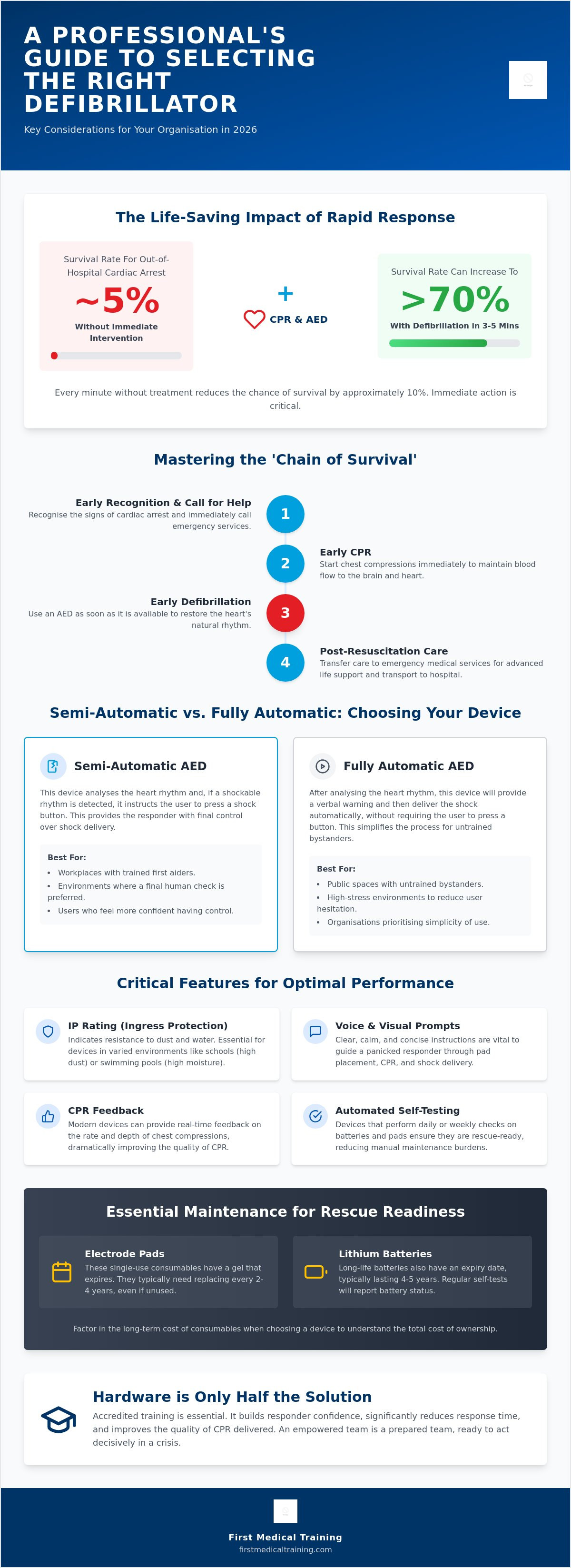
The concept of the 'Chain of Survival' is central to emergency cardiac care. This sequence includes early recognition, early CPR, and, most importantly, early defibrillation. Time is the most significant factor in these crises. Every minute that passes without treatment reduces the chance of survival by roughly 10%. Currently, the survival rate for out-of-hospital cardiac arrests without immediate intervention is approximately 5%. However, when a shock is delivered within three to five minutes of collapse, survival rates can increase to over 70%. This dramatic difference highlights why these devices are indispensable in modern workplaces and public spaces.
In 2026, the moral and professional duty of care has evolved. Employees and customers expect a high standard of safety, and providing life-saving equipment is now a benchmark of a responsible business. It's no longer enough to rely solely on emergency services, as response times can vary depending on location and traffic. Equipping your facility with an AED empowers your team to act decisively during those first few minutes when it matters most.
Sudden Cardiac Arrest vs Heart Attack
A common misconception is that a heart attack and Sudden Cardiac Arrest are the same thing. They aren't. A heart attack is a circulation problem where a blocked artery prevents oxygen-rich blood from reaching a section of the heart. Sudden Cardiac Arrest is an electrical problem. It occurs when the heart's electrical system malfunctions and suddenly stops beating. Whilst a heart attack can lead to SCA, they require different responses. A heart attack victim needs immediate hospital care, but an SCA victim requires an immediate shock from a defibrillator to restart their heart rhythm. SCA can happen to anyone, including those with no prior history of heart issues, making universal access to defibrillators essential.
The Legal and Compliance Landscape
The Health and Safety Executive (HSE) provides clear recommendations for workplace first aid provision. Their guidelines suggest that employers should consider the presence of an AED based on their specific risk assessment. Recent automated external defibrillators (Public Access) legislation has further emphasised the importance of community access to these devices. Legally, having an AED on-site can significantly reduce your organisation's liability in the event of a medical emergency. It demonstrates that you've taken reasonable steps to ensure the safety of your occupants, which can positively impact your workplace safety ratings and insurance considerations.
Key Features to Compare: Choosing the Right Specifications
Selecting defibrillators for your organisation involves more than just comparing brand names. It's about matching technical capabilities to the specific environment where the device will be stored. Modern units now feature sophisticated self-testing technology that performs daily or weekly internal checks on batteries and electrode pads. This ensures the device is rescue-ready without requiring constant manual intervention from your staff. High-quality voice prompts and clear visual instructions are equally vital. In a high-stress cardiac event, these audio cues guide a panicked responder through every stage, from pad placement to CPR rhythm.
Effective procurement also requires looking at the total cost of ownership over the device's lifespan. Whilst some units have a lower initial purchase price, they may require more frequent replacement of consumables. Adhering to FDA guidelines for AEDs ensures you are selecting equipment that meets the highest safety and reliability standards. Practicality and ease of use should always be your primary benchmarks.
Semi-Automatic vs Fully Automatic AEDs
The main difference between these two types is how the life-saving shock is delivered. In a semi-automatic model, the device analyses the heart rhythm and, if a shock is required, instructs the user to press a button. A fully automatic AED handles this step independently, delivering the charge after a clear vocal countdown. For public-facing environments or settings where users might be untrained, fully automatic models are often preferred. They remove the "hesitation factor" where a bystander might be too frightened to press the button themselves.
Durability and IP Ratings for Challenging Environments
An Ingress Protection (IP) rating indicates how well the unit's internal components are protected against dust and water. The first digit refers to solids, and the second to liquids. For a standard office, a moderate rating is usually sufficient. However, for construction sites, leisure centres, or outdoor cabinets, we recommend an IP55 rating or higher. This level of protection ensures the unit remains functional even in dusty or wet conditions. Whilst the hardware is designed to be intuitive, attending an AED training course can significantly boost your team's confidence during a real emergency.
Paediatric Capabilities and Dual-Function Pads
Standard electrode pads are designed for adults. For children under eight years old or weighing less than 25kg, the energy dose must be reduced. Some older devices require you to swap to dedicated paediatric pads, which can waste precious seconds in a crisis. A more efficient solution for schools or nurseries is a unit equipped with a "Child Switch". This feature allows the responder to adjust the energy output instantly for a child without needing to change the pads, ensuring the fastest possible response time.
Selecting the Best Defibrillator for Your Specific Sector
A common error in procurement is assuming all defibrillators are interchangeable. Whilst every unit is designed to save a life, the specific demands of your environment should dictate which model you choose. A large sports stadium requires a portable, rugged device that can be rushed to a casualty, whereas a small office might prioritise a compact, aesthetically discreet unit. Our collection of 14 specialised products has been curated to ensure that every UK sector, from heavy industry to primary education, can find a device that fits their operational needs.
When planning your installation, consider the visibility and accessibility of the equipment. For public-facing businesses, purchasing an AED package that includes high-visibility signage and a wall-mounted cabinet is often the most efficient route. This ensures that in a crisis, anyone on the premises can locate the device within seconds. Adhering to FDA guidance on Automated External Defibrillators helps you understand the rigorous standards these devices must meet to ensure reliability across different sectors.
Healthcare and Dental Practice Requirements
Dental surgeries face unique clinical and regulatory challenges. To remain compliant, practices must align with the GDC CPD requirements for medical emergencies. For these environments, we recommend devices that feature clear ECG displays. This allows clinicians to monitor the patient's heart rhythm professionally whilst waiting for paramedics. It is also standard practice to pair defibrillators with rapid-response kits that include airway management tools, ensuring a comprehensive approach to any medical emergency.
Public Access and Community Defibrillators
For community-funded programmes, ease of use is the absolute priority. You need a "one-button" operation where the device provides loud, clear voice instructions to guide a layperson. Because these devices are often stored in outdoor locations, a heated, weather-proof cabinet is essential to protect the battery and pads from the British winter. Look for models with long standby lives, typically between two and five years, to reduce the administrative burden of frequent maintenance checks.
Industrial and High-Risk Workplaces
In construction or manufacturing, equipment must be able to withstand the rigours of the site. Ruggedised designs that can survive a drop onto concrete are vital here. We also suggest prioritising devices with a fast "Time to Shock" and real-time CPR feedback. These features provide the rescuer with instant data on the depth and rate of their chest compressions. This coaching is invaluable in high-pressure industrial settings, where the physical demands of a rescue can lead to responder fatigue.
Essential Accessories and Ongoing Maintenance Requirements
Every AED should be equipped with a "Rescue Ready" kit. This small pouch typically contains heavy-duty scissors for cutting clothing, a razor for chest hair removal, gloves for the rescuer, and a pocket mask for rescue breaths. These accessories are essential for ensuring the electrode pads make proper contact with the skin, which is a prerequisite for a successful shock. Without them, you risk wasting precious minutes during a rescue attempt.
Managing Consumables: Pads and Batteries
Electrode pads expire because the conductive gel that sticks to the patient's chest dries out over time. This process, known as desiccation, prevents the device from accurately analysing the heart rhythm. We recommend keeping a spare set of pads on-site so the unit isn't out of service immediately after a use. The average battery standby life is typically between three and five years depending on the model.
Storage Solutions: Cabinets and Brackets
The right storage solution balances security with speed. Internal wall brackets are excellent for controlled office environments, whilst external cabinets are necessary for public access. If you use a locked cabinet, you must weigh the protection against potential delays; many communities prefer unlocked or coded cabinets with the code clearly visible. High-impact "AED" signage is also a requirement to ensure bystanders can locate the equipment within seconds during a crisis.
Registration with The Circuit
The Circuit is the national defibrillator network that connects your device directly to UK ambulance services. By registering your unit, you ensure that 999 dispatchers can direct bystanders to its exact location during an emergency. This simple step can transform a private piece of equipment into a community life-saving asset. For clinical professionals, this forms part of a wider approach to cardiac arrest management in dental practice. You can view our full selection of defibrillators and maintenance kits to ensure your organisation stays rescue-ready.
Maximising Safety: Combining Hardware with Accredited Training
Whilst modern defibrillators are engineered to be "idiot-proof," the presence of a device does not automatically translate to a successful rescue. The greatest barrier to saving a life is often the "hesitation factor," those critical seconds of paralysis when a bystander is unsure of what to do first. Professional training bridges this gap by replacing panic with muscle memory. It ensures that when the time comes to act, your team doesn't just follow prompts; they lead the rescue with confidence. By investing in an Automated External Defibrillator (AED) Training Course, you are completing the final and most important link in the Chain of Survival. First Medical Training Ltd serves as your single-source partner for both high-calibre hardware and the accredited skills required to use it.
We believe that a defibrillator is only as effective as the person operating it. Our approach demystifies the technical aspects of emergency response, turning a complex medical event into a manageable series of actions. This holistic strategy ensures that your organisation is not just compliant on paper, but genuinely prepared for a real-world crisis.
What to Expect in an AED Training Course
Our training sessions focus on practical, hands-on experience that builds lasting competence. You can expect to cover several essential areas during the course:
- Hands-on practice with specialised training units that mimic real AED behaviour and audio prompts without delivering a shock.
- Seamless integration of defibrillators with high-quality CPR techniques to ensure the best possible patient outcomes.
- Comprehensive guidance on post-incident care and the protocols for downloading data from the device for medical professionals.
- Practical scenarios designed to reduce "panic time" and improve the speed of response in high-pressure environments.
The First Medical Training Ltd Advantage
Choosing a training provider is as important as choosing the device itself. First Medical Training Ltd has been a leader in medical emergency education since we were founded in 2006. With a twenty year history of excellence, we understand the unique pressures faced by different sectors, particularly healthcare and dental professionals. Our trainers are active healthcare professionals who bring real-world clinical experience to every session, ensuring the advice you receive is grounded and practical. We invite you to browse our full collection of 14 professional defibrillators to find the perfect match for your facility, backed by the expertise of an industry veteran.
Securing the Future of Your Workplace Safety
Selecting the right equipment is the foundation of a robust emergency response strategy. You now understand that modern defibrillators are more than just hardware; they are sophisticated systems requiring proactive management and clear visibility. By prioritising features like self-testing technology and ensuring your consumables are within their expiry dates, you eliminate the risk of equipment failure when it matters most. Registration with The Circuit further ensures that your device is a visible, life-saving asset for the wider community.
Confidence comes from competence. Whilst the technology is designed for ease of use, professional training remains the catalyst that turns a bystander into a capable responder. Since 2006, First Medical Training Ltd has acted as a trusted partner, providing both high-specification units and the clinical expertise required to operate them. We provide full support for maintenance schedules and regulatory compliance, giving you total peace of mind. To take the next step in protecting your staff and visitors, view our full range of professional defibrillators and AED packages. Building a safer environment starts with a single, informed decision today.
Frequently Asked Questions
Do I need a fully automatic or semi-automatic defibrillator for my office?
Fully automatic models are generally the best choice for office environments where responders may not have clinical backgrounds. These devices handle the shock delivery themselves after a clear countdown, which removes the risk of a bystander hesitating to press the button. Semi-automatic units require the user to manually deliver the shock when prompted. Removing this extra decision-making step can save vital seconds in a high-stress emergency.
How often do defibrillator pads and batteries need to be replaced?
Electrode pads and batteries need replacing every two to five years, depending on the specific model you choose. The conductive gel on the pads is designed to stick to the skin, but it will eventually desiccate and lose its effectiveness. Your device's status indicator will usually alert you if the battery is low, but you should always keep a log of expiry dates to ensure your equipment is never out of service.
Is it a legal requirement for UK businesses to have a defibrillator in 2026?
There's currently no blanket legal requirement for every UK business to install an AED, but it's often a requirement of your sector-specific duty of care. For instance, dental practices must meet GDC standards, and many schools are now required to have devices on-site. The HSE expects employers to consider defibrillators as part of their first aid needs assessment, particularly in high-traffic or high-risk environments.
Can I accidentally shock someone who doesn’t need it with an AED?
You cannot accidentally shock someone with an AED if they don't need it. The device's internal software is programmed to only deliver a charge if it identifies a specific, shockable heart rhythm. If the patient has a normal heartbeat or another non-shockable condition, the device won't allow a shock to be delivered. This built-in safety protocol ensures that defibrillators are safe for anyone to use without fear of causing injury.
What is the average cost of maintaining a defibrillator over five years?
Ongoing maintenance primarily involves replacing consumable items before they expire. You won't typically need to pay for external technicians because the hardware performs its own diagnostic self-checks daily. Your main responsibility is ensuring that electrode pads and batteries are swapped out according to the manufacturer's specified lifespan. This ensures the unit remains rescue-ready without unexpected operational downtime.
Do I need special training to use a defibrillator in an emergency?
Formal training isn't a prerequisite for using a defibrillator because the units are designed to talk the user through the entire process. That said, professional training is strongly encouraged to reduce "panic time" and improve the quality of chest compressions. A team that has practised with a training unit will act much faster and more effectively than one relying on the voice prompts for the first time.
Should I keep my defibrillator in a locked or unlocked cabinet?
We recommend prioritising speed over security by using an unlocked or coded cabinet. In a cardiac arrest, every second that passes without a shock reduces survival chances, so you don't want responders hunting for a key. If security is a major concern, a coded cabinet is a sensible middle ground, provided the access code is registered with the ambulance service and clearly marked on the unit.
What is The Circuit and why must I register my AED on it?
The Circuit is the national database that links your AED to the UK's ambulance services. By registering your device, you ensure that 999 dispatchers are aware of its location and can guide bystanders to it during a nearby emergency. It's a critical step in the Chain of Survival that turns your private investment into a life-saving tool for the wider community.