

2026 Dental Medical Emergency Equipment Training Guide

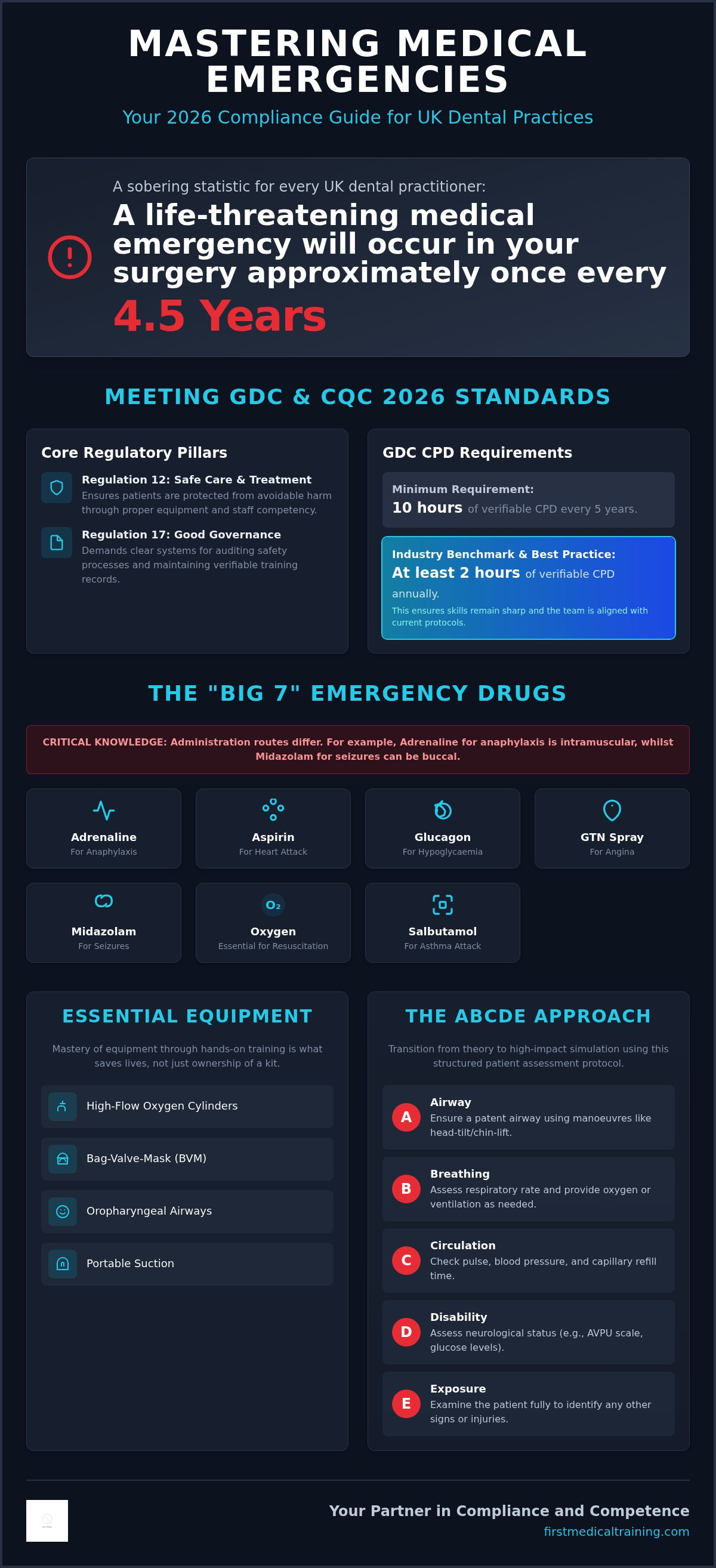
Did you know that the average UK dental practitioner will face a life-threatening medical emergency in their surgery approximately once every four and a half years? It's a sobering statistic that highlights why your medical emergency equipment training dental protocols must be more than just a box-ticking exercise for the Care Quality Commission. We understand the weight of responsibility you feel. Navigating a complex regulatory landscape whilst ensuring every staff member remains calm and competent during a real-life collapse is a significant challenge for any practice leader.
This guide will help you master the essential skills to operate life-saving equipment and meet General Dental Council requirements with absolute confidence. You'll learn how to transform your annual training from a logistical headache into a streamlined cycle that empowers your entire team. We will preview the mandatory 2026 standards for Automated External Defibrillators and emergency drugs kits, ensuring your practice remains fully compliant and your verifiable CPD records are beyond reproach. By shifting your focus from simply owning a kit to mastering the sequence of care, you'll foster a culture of steady reliability that protects both your patients and your professional reputation.
Key Takeaways
- Understand how GDC and CQC regulations 12 and 17 define the 2026 clinical standard for emergency preparedness in your surgery.
- Learn to bridge the gap between simply owning a kit and achieving clinical mastery through dedicated medical emergency equipment training dental professionals can rely on.
- Gain clarity on the "Big 7" emergency drugs, including the critical differences in administration routes for adrenaline and midazolam.
- Discover how to transition from theoretical learning to high-impact in-practice simulations that build genuine team-wide confidence and calm.
- Identify the essential steps to streamline your annual training cycles whilst maintaining perfect verifiable CPD records for your next inspection.
Understanding GDC and CQC Requirements for Dental Emergency Training
The 2026 clinical standard for medical emergency preparedness in the UK is no longer just a suggestion; it's a rigorous benchmark for safety. Both the GDC and CQC expect dental practices to demonstrate a high level of readiness. This preparedness is built on two regulatory pillars. Regulation 12 (Safe Care and Treatment) ensures that patients are protected from avoidable harm through proper equipment and staff competency. Regulation 17 (Good Governance) demands that practices maintain clear systems for auditing these processes. To meet these standards, medical emergency equipment training dental sessions must be comprehensive and inclusive of the entire team.
The GDC mandates that all registrants complete a minimum of 10 hours of verifiable CPD in medical emergencies every five years. Whilst this is the legal minimum, the GDC strongly recommends at least two hours of training annually. This yearly update has become the industry benchmark for "verifiable competence" because it ensures that life-saving skills remain sharp and that staff are familiar with any updates to emergency protocols or equipment. Consistency is the key to ensuring that, in the event of a crisis, every team member acts with instinctive precision.
The Role of the Resuscitation Council UK
Dental teams are required to follow the Quality Standards for Primary Dental Care issued by the Resuscitation Council UK. These standards place a heavy emphasis on the ABCDE approach (Airway, Breathing, Circulation, Disability, Exposure) for patient assessment. By 2026, the focus has intensified on rapid defibrillation and advanced airway management. Understanding what is a dental emergency versus a medical crisis is vital for triage. Your training should ensure that every staff member, from the receptionist to the lead clinician, knows their specific role when a patient collapses. This clarity reduces panic and ensures that emergency services are contacted without delay.
GDC CPD: Verifiable vs General Requirements
Medical emergencies are classified as a "highly recommended" CPD topic. For training to be considered "verifiable," it must have clear learning aims and a robust quality assurance process. You can find more detail on how to align your practice with these standards in our guide to GDC CPD requirements for medical emergencies. Maintaining accurate training records for all clinical and non-clinical staff is essential for a successful CQC inspection. These records prove that your team has engaged in consistent medical emergency equipment training dental exercises, transforming a regulatory burden into a source of professional pride. Practice managers should verify that every certificate includes the required GDC development outcomes to ensure full compliance.
The Essential Medical Emergency Kit: Training for Hands-on Competence
Having a fully stocked kit is a regulatory requirement, but clinical mastery is what truly saves lives during a crisis. A practice must have immediate access to specific hardware, including portable suction, spacer devices, and a self-inflating bag-valve-mask (BVM). These items shouldn't be hidden away in a cupboard; they must be stored in a central, accessible location known to every team member. Regular kit checks aren't just about checking expiry dates on labels. They should be integrated into your wider medical emergency equipment training dental programme to ensure everyone knows exactly how to assemble and operate the hardware under pressure. When the team is familiar with the weight and feel of the equipment, their response becomes more fluid and less prone to error.
Airway and Oxygen Management Equipment
Maintaining a patent airway is the priority in almost every medical crisis. Training must move beyond theory to include hands-on practice with oropharyngeal airways and BVM ventilation. Team members need to feel comfortable handling high-flow oxygen cylinders, ensuring the flow rate is set correctly and the mask is fitted securely. Mastering manual airway opening manoeuvres, such as the head-tilt/chin-lift or jaw-thrust, is a fundamental skill that requires repeated practice to become instinctive. Our Medical Emergencies in a Dental Practice Course focuses heavily on these physical skills, ensuring your team can manage an airway whilst waiting for paramedics to arrive.
The Life-Saving Role of the AED
According to the Resuscitation Council UK Quality Standards, all dental surgeries must have an Automated External Defibrillator (AED) with immediate access. Practical AED training is essential to dispel the fear of "doing it wrong." Realistic simulations help staff, including non-clinical personnel like receptionists, learn to deploy the device in under three minutes. Modern AEDs guide the user with voice prompts, but confidence in pad placement and rhythm analysis only comes from tactile experience. This hands-on medical emergency equipment training dental component ensures that when the heart stops, your team's training starts without hesitation.
Mastering the Emergency Drug Protocol in a Dental Setting
Whilst hardware provides the mechanical support for life-saving, the pharmaceutical kit represents the frontline of clinical intervention. Every UK dental practice is required to maintain a specific stock of emergency medications. However, the presence of these drugs is only half the battle. Your medical emergency equipment training dental programme must ensure that every staff member is competent in the "Big 7" medications: Adrenaline, Aspirin, Glucagon, Glucose, GTN, and Midazolam, alongside Salbutamol and Oxygen. Transitioning from identifying a drug to administering it safely requires a deep understanding of dosages and administration routes. This practical application is a cornerstone of our comprehensive medical emergencies in dental practice course.
Training manoeuvres for drug administration must be precise. For instance, the team must differentiate between the Intramuscular (IM) route required for adrenaline and the buccal route used for midazolam during a prolonged seizure. Simulated scenarios allow the team to practice these specific physical actions without the stress of a real-life crisis. By rehearsing the retrieval, preparation, and administration of these drugs, the team moves from theoretical knowledge to clinical confidence. This reduces the risk of dosage errors and ensures that the right intervention is delivered at the right time.
Anaphylaxis and Adrenaline Training
Recognising the rapid onset of anaphylaxis is critical for any dental team. Symptoms such as facial swelling, respiratory distress, or a sudden drop in blood pressure require immediate action. Training should focus on the correct dosage for adults and children, alongside the physical technique for IM injection into the anterolateral aspect of the middle third of the thigh. In 2026, the clinical standard identifies that the immediate administration of adrenaline within the first few minutes of symptom onset is the primary factor in preventing biphasic reactions and ensuring patient survival. Regular drills ensure that the team can deploy adrenaline instinctively whilst other members manage the airway and call emergency services.
Managing Hypoglycaemia and Cardiac Events
Hypoglycaemia is one of the most common emergencies in the dental chair. Training must cover the use of oral glucose for conscious patients and the administration of Glucagon for those who have lost consciousness. Similarly, for suspected myocardial infarction, the protocol involves the administration of sublingual GTN spray and 300mg of chewed aspirin. It's vital that the team understands contraindications; for example, GTN should be withheld if the patient's systolic blood pressure is dangerously low. Mastering these nuances through medical emergency equipment training dental sessions ensures that your practice remains a safe environment for all patients, regardless of their medical history.
Implementing an Annual Training Programme: From Theory to Simulation
Transitioning from a theoretical understanding of protocols to high-stakes practical application requires a structured, repeatable framework. A well-organised annual programme ensures that your medical emergency equipment training dental sessions provide maximum value. The first step involves a comprehensive training needs analysis for the entire team. This identifies specific knowledge gaps amongst clinical and non-clinical staff, ensuring that the training is tailored to your practice's unique requirements. By assessing individual roles, you ensure that everyone, from the principal dentist to the part-time receptionist, understands their specific duties during a crisis.
Once you've identified these needs, schedule a dedicated day for in-practice dental practice emergency preparedness drills. It's vital to run these simulations in the actual clinical rooms where emergencies would occur. This allows the team to practice retrieving equipment from its permanent storage location and navigating the physical constraints of the surgery. After each drill, conduct a detailed performance review to update your practice protocols based on real-world simulation outcomes. Finally, ensure all sessions are meticulously documented to provide robust, verifiable evidence for the GDC. This documentation should include the date, duration, and specific learning outcomes achieved by every attendee.
The Power of In-Practice Simulation
Training within your own surgery is significantly more effective than attending external centres. It builds essential muscle memory by allowing staff to handle their own equipment and familiarise themselves with the layout of the clinical environment. This approach also addresses the "Human Factor," focusing on communication and leadership during a crisis. When a patient collapses, the ability to communicate clearly under pressure is as important as clinical skill. A calm, organised team response is only possible when everyone knows exactly where to stand and how to support the lead clinician. These sessions turn abstract concepts into instinctive behaviours.
Beyond BLS: Dental Immediate Life Support (ILS)
Whilst Basic Life Support (BLS) provides the foundation, Dental Immediate Life Support (ILS) offers a more advanced level of training tailored specifically to the dental environment. This transition involves mastering complex techniques, such as the use of the LifeVac anti-choking device and advanced airway adjuncts. Specialised ILS training builds deeper clinical confidence for the whole team, ensuring they're prepared for more than just the initial resuscitation steps. By elevating your team's skills beyond the basics, you ensure a higher standard of patient care and a more resilient practice culture. Secure your team's compliance and confidence by enrolling in our Medical Emergencies in a Dental Practice Course.
Why Dental Teams Choose First Medical Training for 2026 Compliance
First Medical Training has been a cornerstone of professional development in the dental sector since 2006. We carry the quiet confidence of an industry veteran, understanding that medical emergency equipment training dental must be both authoritative and accessible. Our instructors aren't just teachers; they're seasoned mentors who bridge the daunting gap between rigid GDC regulations and the fast-paced reality of a clinical environment. By choosing our "Medical Emergencies in a Dental Practice Course," you're opting for a curriculum that has been refined over two decades. We integrate the latest clinical standards with hands-on practice, ensuring that your team doesn't just know the protocols but can execute them with steady reliability. We also simplify your procurement by acting as a supplier of essential hardware, such as the LifeVac anti-choking device, ensuring your kit is as prepared as your staff.
Tailored Training for the Whole Team
A truly resilient practice requires every staff member to act in unison. From the lead clinician to the front-of-house reception team, we define and drill every specific role. This team-wide approach is vital for building the clinical confidence mentioned in earlier sections. We've also evolved our training to include specialised Mental Health First Aid for dental teams, recognising that the definition of an "emergency" in a modern surgery has expanded. This comprehensive focus helps you maintain a perfect compliance record for CQC inspections. We provide the structured documentation you need to prove that every staff member has met their verifiable CPD requirements, turning a complex regulatory landscape into a streamlined, manageable process.
Booking Your 2026 Training Session
We've made the process of securing your 2026 compliance as efficient as possible. With national UK coverage, our instructors bring the training directly to your surgery, respecting your time and minimising disruption to your patient list. This in-practice delivery is the gold standard for medical emergency equipment training dental, as it allows for simulations in the very rooms where a collapse might occur. Following the completion of the course, your team will receive their verifiable CPD certificates immediately, ensuring your records are always audit-ready. Book your Medical Emergencies in a Dental Practice course today and partner with a guide that is passionate about the human element of care.
Elevating Your Practice Standards for 2026
Mastering your emergency drug protocols and airway management equipment is the foundation of patient safety. The 2026 standards prioritise rapid action and team-wide competence over passive compliance. By moving your training into the surgery environment, you ensure that every staff member builds the muscle memory needed to act decisively during a crisis. This shift from simply owning a kit to achieving clinical mastery is what truly distinguishes a resilient dental practice. It transforms a regulatory requirement into a source of genuine professional pride.
Maintaining a perfect regulatory record doesn't have to be a source of anxiety. Since 2006, we've helped thousands of professionals bridge the gap between complex GDC requirements and real-world application. With our accredited Medical Emergencies in a Dental Practice Course, your team receives hands-on medical emergency equipment training dental experts trust. We offer national UK coverage with flexible in-practice options tailored to your specific clinical layout. Secure your team’s clinical confidence with our expert Dental Emergency Training and ensure your practice remains a safe, compliant environment for every patient. You have the skills to save lives; we provide the structure to use them with confidence.
Frequently Asked Questions
What is the mandatory medical emergency equipment for a UK dental practice in 2026?
UK dental practices must maintain portable oxygen, a bag-valve-mask, oropharyngeal airways, and a spacer device for inhalers. Portable suction and an Automated External Defibrillator are also essential components of a compliant surgery. Every staff member needs medical emergency equipment training dental professionals can trust to ensure they can operate these tools under pressure. It's vital that this equipment is stored in a central location and checked regularly to guarantee clinical readiness.
How often does the GDC require dental staff to update their medical emergency training?
The General Dental Council requires registrants to complete a minimum of 10 hours of verifiable CPD in medical emergencies within every five-year cycle. However, the GDC strongly recommends that at least two of these hours are completed annually to maintain clinical competence. Regular updates ensure your team remains familiar with the latest Resuscitation Council UK guidelines. Annual sessions are the industry benchmark for demonstrating safe care during a CQC inspection.
Is an Automated External Defibrillator (AED) legally required in a dental surgery?
Yes, it's now mandatory for all UK dental surgeries to have an Automated External Defibrillator with immediate access in clinical areas. This requirement is enforced by both the GDC and the Care Quality Commission to ensure patient safety. Having the device is only the first step; your team must also receive regular practical training to deploy the AED confidently. Our courses include hands-on drills to help staff overcome the fear of using the device.
Can dental receptionists take part in medical emergency equipment training?
The GDC and CQC expect evidence that the whole team is competent in responding to medical emergencies. Non-clinical staff like receptionists play a vital role, from calling emergency services to retrieving the AED or drugs kit. Including the entire practice in your medical emergency equipment training dental sessions builds a cohesive response. This ensures that every individual knows their specific duties, which significantly reduces panic and improves patient outcomes during a crisis.
What emergency drugs must be kept in a dental practice according to the CQC?
Dental practices must stock the "Big 7" essential drugs as guided by the British National Formulary. These include adrenaline, aspirin, glucagon, glyceryl trinitrate (GTN), midazolam, salbutamol, and oxygen. Your training should focus on the correct administration routes, such as intramuscular injections for adrenaline or buccal administration for midazolam. It's vital to check expiry dates monthly and ensure all clinical staff are comfortable with the dosage requirements for adults and children.
What is the difference between BLS and Dental ILS training?
Basic Life Support focuses on chest compressions and rescue breaths, whereas Dental Immediate Life Support (ILS) provides a more advanced framework. ILS includes training on airway adjuncts, the use of a bag-valve-mask, and the deployment of an AED. It also places a stronger emphasis on team leadership and the ABCDE assessment approach within a dental setting. Dental ILS is designed to empower clinicians to manage a patient until the ambulance crew arrives.
How do I ensure my dental emergency training counts as verifiable CPD?
To count as verifiable CPD, your training must have clear learning aims, defined outcomes, and a robust quality assurance process. You must receive a certificate that includes the course date, duration, and the specific GDC development outcomes covered. First Medical Training provides accredited certificates immediately after our sessions, ensuring your records are audit-ready. It helps you maintain a perfect compliance record by documenting every aspect of the training for your portfolio.
Can I get training on specific devices like the LifeVac anti-choking tool?
Yes, we provide specialised training on the LifeVac anti-choking device as part of our broader curriculum. As an authorised supplier, we ensure your team understands how to use this non-invasive suction tool when standard choking protocols fail. This training is particularly valuable for practices treating vulnerable patients or young children. Mastering the LifeVac alongside your standard airway management tools adds an extra layer of safety to your practice and builds deeper clinical confidence.