

A Guide to Managing Medical Emergencies in Elderly Dental Patients

Managing medical emergencies in elderly dental patients requires immediate checking the patient (ABCDE approach) and prompt access to mandatory drugs and oxygen. Your core decisions are practical ones: how you recognise common collapse patterns in older adults, whether your emergency kit and defibrillator are audit-ready, who on your team is trained and authorised to act, and whether drills run inside your own surgery rather than in a generic hall. Practice teams must maintain strict compliance with Resuscitation Council UK guidelines and execute clear emergency response plans to safeguard vulnerable patients. Established in 2006, First Medical Training Ltd supports dental practices nationwide with expert-led instruction to ensure complete clinical readiness.
Three clinical scenarios that decide your first response
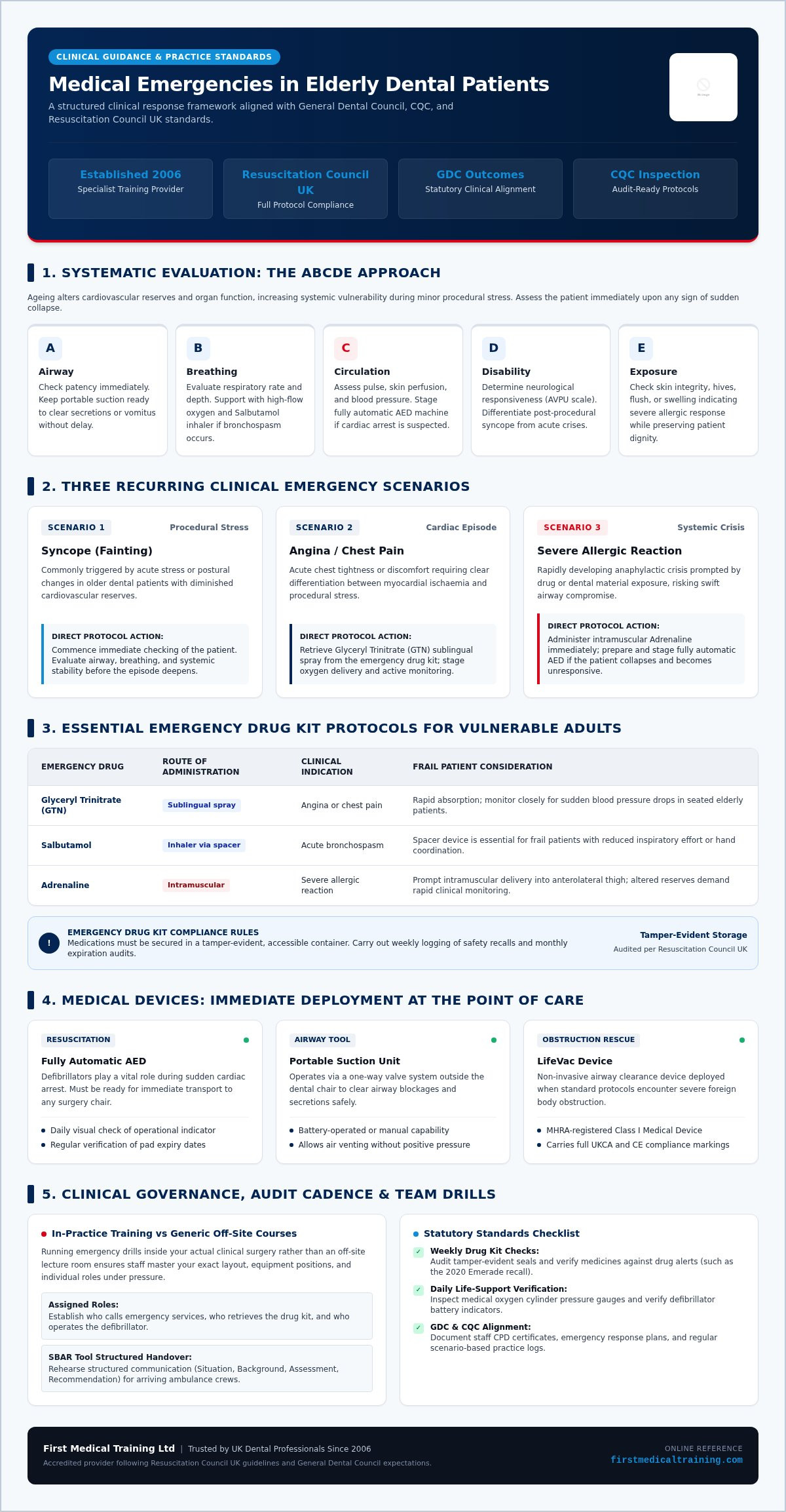
You must categorise clinical presentations immediately to determine practice readiness and direct your team during an emergency. Three situations recur with older patients, and each points to a concrete next step drawn from the same clinical toolkit:
- Syncope after procedural stress. Begin checking the patient so you evaluate airway, breathing, and systemic stability before the episode deepens.
- Angina or chest pain. Retrieve glyceryl trinitrate from your emergency kit (emergency drug kit) and keep oxygen and monitoring ready while you differentiate myocardial ischaemia from acute stress.
- Severe allergic reaction. Prepare adrenaline for intramuscular use and stage your heart starter machine (fully automatic AED) if the patient becomes Unresponsive.
Recognising the early signs shapes your initial response. Assess the patient, identify the trigger (acute stress, myocardial ischaemia, or a severe drug reaction), and deploy suitable equipment without delay. Read the guide on complete regulatory requirements so your practice aligns with General Dental Council and Resuscitation Council UK standards. Assign clear team roles before the next session.
Why older patients raise emergency frequency in the surgery
Elderly patients experience acute health events in clinical settings more frequently due to age-related physiological vulnerabilities. Ageing alters cardiovascular reserves and organ function, which increases systemic susceptibility during minor procedural stress, so you must account for modified drug metabolism and underlying chronic illnesses at every appointment. To help reduce patient anxiety and create a more supportive clinical environment, you can check out Find Memory Care.
Prioritise structured preparation for your team. You can enrol staff on a comprehensive CPD pathway to maintain readiness, and you should keep your emergency kit fully stocked and accessible. Follow standard regulatory frameworks from the General Dental Council (GDC) and Resuscitation Council UK. Perform checking the patient immediately if an individual shows signs of deterioration; this structured primary survey rapidly evaluates Airway, Breathing, Circulation, Disability, and Exposure. Prompt recognition of sudden collapse limits severe clinical outcomes in vulnerable groups.
Regulatory standards that shape your emergency readiness
UK dental practices must maintain an emergency kit and functional rescue equipment to meet statutory standards. The General Dental Council (GDC), Care Quality Commission (CQC), and Resuscitation Council UK set clear regulatory expectations for clinical safety. Store your basic emergency medications in a tamper-evident, accessible container and check expiration dates weekly.
Regular audit logs for your emergency drug kit prevent stock failures during acute patient care. A 2020 Emerade syringe recall shows how quickly device safety notices change stock compliance requirements. Maintain immediate access to portable suction, medical oxygen, and a heart starter machine. Inspect life support gear daily and audit your stock. Book scenario-based rehearsal so your practice team can rehearse critical protocols. First Medical Training Ltd supports compliance with accredited instruction nationwide.
Maintaining Your Emergency Drug Kit for Frail Patients
Store every emergency kit in a secure, accessible container that complies with Resuscitation Council UK standards. Client experience shows that frail individuals often need altered drug administration routes because of diminished physical reserves, so reviewing clinical protocols helps your team deliver safe, rapid interventions when assessing the patient.
Follow this concise overview for essential emergency medications tailored for vulnerable adults:
| Emergency Drug | Route | Indication |
|---|---|---|
| Glyceryl Trinitrate (GTN) | Sublingual spray | Angina or chest pain |
| Salbutamol | Inhaler via spacer | Acute bronchospasm |
| Adrenaline | Intramuscular | Severe allergic reaction |
Check expiration dates monthly to maintain emergency drug kit compliance across your practice. Consult the 2026 risk-assessment guide to align your clinical protocols with General Dental Council expectations. Keep a portable suction unit nearby to maintain clear airways during unexpected collapse.
Deploying Defibrillators and Medical Devices Fast
Deploying life-saving equipment rapidly requires compliant airway tools and an accessible heart starter machine ready at the point of care. Keeping dedicated airway tools alongside your primary resuscitation kit shortens the gap between collapse and intervention, especially when standard suction fails to clear severe obstructions in frail elderly patients.
Your practice must maintain essential airway tools alongside standard resuscitation gear. A portable suction unit using a one-way valve system supports efficient fluid removal during resuscitation. The LifeVac device is registered as a Class I Medical Device in the UK and carries UKCA and CE marks, confirming compliance with British medical standards; these markings indicate conformity with UK medical device regulations and act as a quality seal for your practice. Log defibrillator maintenance systematically so pads and power status are never an unknown on the day you need them.
Tip: Ensure defibrillator pads and suction units undergo daily functionality checks to prevent delays during cardiac arrest.
Who may hold and give emergency drugs in your practice
Dentists carry primary legal authorisation to administer prescription emergency drugs such as buccal midazolam during acute seizures. Registered dental hygienists and therapists can administer specific emergency medications under standing directions or direct prescription protocols. Dental nurses support the response by preparing equipment and assisting within the scope set out in your written practice protocols and current training.
Practice owners must clearly document every team member's exact scope of authority within those written protocols and assign roles before emergencies occur. Ensure clinical staff complete accredited medical-emergencies CPD so you comply with General Dental Council standards and Care Quality Commission guidelines. First Medical Training Ltd supports practice leaders through tailored learning programmes; verify clinical competencies annually so roles and training remain matched.
Executing Practice-Specific In-Practice Drills
Executing regular drills within your clinic layout ensures staff manage spatial constraints quickly during a crisis. Narrow hallways often slow response times, so rehearsing movement paths removes avoidable delay when an older patient collapses in the chair.
- Map room constraints. Identify tight spaces around the dental chair that hinder access.
- Assign physical roles. Designate who fetches the emergency kit and who stays with the patient.
- Practice transit routes. Move the heart starter machine through your specific corridors.
- Evaluate response times. Time how quickly staff complete checking the patient (ABCDE approach: Airway, Breathing, Circulation, Disability, Exposure).
Conducting in-practice training helps meet Care Quality Commission (CQC) expectations and Resuscitation Council UK guidelines. Booking CPD medical-emergencies training from First Medical Training Ltd supports full General Dental Council (GDC) compliance. Test your layout on a scheduled drill day so timings reflect your real floor plan.
When Off-Site Training Programmes Are Not Suitable
Off-site lectures fail to prepare dental teams for space constraints during real practice emergencies. One recurring client pattern illustrates the gap clearly: staff who trained in large external halls later struggled to manoeuvre a wheelchair-bound elderly patient through a narrow surgery, losing time that on-site rehearsal would have protected.
Problem: generic off-site courses cannot replicate your practice's physical environment, so practice-specific constraints hamper vital care. Action: staff practice navigating tight spaces around the dental chair using your own portable suction unit and emergency drug kit. Outcome: choosing in-practice training means your team rehearses protocols inside the actual clinical environment, which meets General Dental Council expectations and Resuscitation Council UK guidelines more directly than hall-based sessions alone.
Book on-site instruction when your floor plan, chair access, or patient mobility profile makes external venues a poor proxy for the real event.
Managing medical emergencies in elderly dental patients through CPD training
Earn verifiable hours while building emergency management skills through structured team training. Schedule an in-practice training session to rehearse protocols directly within your clinical layout; rehearsing emergency drills in your own practice layout reduces confusion during a real crisis. Practice performing checking the patient (ABCDE approach, a systematic primary survey covering Airway, Breathing, Circulation, Disability, Exposure) using your own equipment, and verify that your emergency kit contains unexpired items.
First Medical Training Ltd has been trusted by UK dental professionals since 2006 to deliver tailored education. This structured approach helps ensure compliance with GDC development outcomes and CQC inspection standards, so you secure verifiable skills while keeping your practice aligned with inspection expectations.
Among the company's Google reviews, a client's specialist (5★) wrote:
"Great training experience. In depth and informative but well presented and delivered in a relaxed manner. Id recommend them."
Hands-on team CPD training supports your practice against GDC standards and CQC inspection guidelines. Request dates that fit your surgery timetable when you are ready to book.
Frequently asked questions
How often do medical emergencies occur in dental practice?
Medical emergencies happen infrequently in dental practices, but systemic health changes in older patients raise the likelihood of an event. Studies show that most dental professionals will encounter several incidents during their careers. Vasovagal syncope remains the most common event, followed by angina, hypoglycaemia, and allergic reactions. Prompt identification using a systematic checking the patient survey supports rapid treatment when a crisis occurs; for safety beyond the clinic, The Wellbeing App provides families with 24/7 monitoring and security.
What guidelines govern emergency management in dentistry?
The Primary Dental Care guidelines from the Resuscitation Council UK set the clinical standards for handling practice emergencies. Your practice must also satisfy the General Dental Council (GDC) enhanced CPD requirements and Care Quality Commission (CQC) inspection criteria. These framework standards require dental teams to maintain functional equipment, keep valid medications, and conduct yearly team training.
What drug doses and routes should be used for each emergency?
Standardised protocols dictate drug selection, administration routes, and dosages based on the specific clinical emergency. Practices must maintain an emergency kit containing essential items like oxygen, salbutamol, aspirin, glyceryl trinitrate, glucagon, midazolam, and adrenaline. Midazolam treats prolonged seizures, whilst adrenaline treats severe anaphylaxis, which is a life-threatening allergic reaction requiring immediate intramuscular injection. Always follow the explicit instructions inside your standard clinical flowcharts.
Which staff can hold and administer emergency drugs?
Authority follows role, training, and your documented practice protocols. The registered dentist retains ultimate clinical oversight and primary authorisation for prescription emergency medicines used in acute events. Registered hygienists and therapists may administer specific emergency medications under standing directions or prescription protocols; dental nurses prepare equipment and assist within the scope defined for your team. Non-registered team members must understand their specific support roles within the dental emergency response plan rather than independent drug administration.
What are the training requirements for medical emergencies?
All clinical staff must complete annual training in medical emergencies and basic life support to keep their professional registration valid. This instruction should include hands-on practice with cardiopulmonary resuscitation and a heart starter machine. First Medical Training Ltd delivers accredited CPD courses directly inside your clinic so your entire team can rehearse realistic emergency scenarios using your own equipment.
Ensuring Safe Emergency Care for Senior Dental Patients
The same decisions you opened with (recognition, kit readiness, clear authorisation, and drills in your own rooms) determine how safely you manage collapse in older adults. Ensure your clinical team reviews resuscitation protocols, checks resuscitation equipment, and verifies drug expiry dates every week. First Medical Training Ltd has provided accredited dental emergency and CPD courses across the UK since 2006. In 2026, maintaining full compliance with Resuscitation Council UK guidelines and General Dental Council outcomes remains essential for practice safety.
Equip your practice with compliant skills by booking the expert Medical Emergencies in a Dental Practice Course. To discuss custom training schedules for your team, request a personalised quote through our site today.