

Airway Management Equipment: A Professional Buying Guide for 2026

Having a kit bag full of high-tech gear is meaningless if your team cannot instinctively select the correct tool during the high-pressure seconds of a respiratory crisis. Effective airway management is not simply about owning the latest adjuncts; it is about ensuring every piece of equipment matches the specific competency level of your responders and the unique demands of your clinical environment.
It is common to feel overwhelmed by the sheer variety of sizes and types of adjuncts available today. You likely want to ensure your setup is fully compliant with Resuscitation Council UK guidelines without overspending on unnecessary features that complicate your response. We understand the need for a kit that is easy to organise and even easier to use when every second counts.
This guide provides a professional roadmap for 2026, helping you select reliable tools that guarantee patient safety and regulatory compliance. We will break down exactly when to use specific adjuncts and how to build a streamlined, dependable emergency kit that builds confidence in your team's ability to act in any scenario.
Key Takeaways
- Understand why maintaining a patent airway is the absolute priority in the ABCDE assessment and the foundation of successful resuscitation.
- Learn how to distinguish between Oropharyngeal and Nasopharyngeal adjuncts to provide the most appropriate support based on a patient's gag reflex.
- Discover the clinical advantages of using a Bag Valve Mask (BVM) versus a pocket mask for manual ventilation in various emergency scenarios.
- Optimise your practice by standardising airway management equipment across all treatment rooms to ensure a rapid, seamless response under pressure.
- Gain insights into meeting Resuscitation Council UK guidelines whilst balancing clinical reliability with cost-effective procurement strategies.
Understanding Airway Management in Modern Medical Emergencies
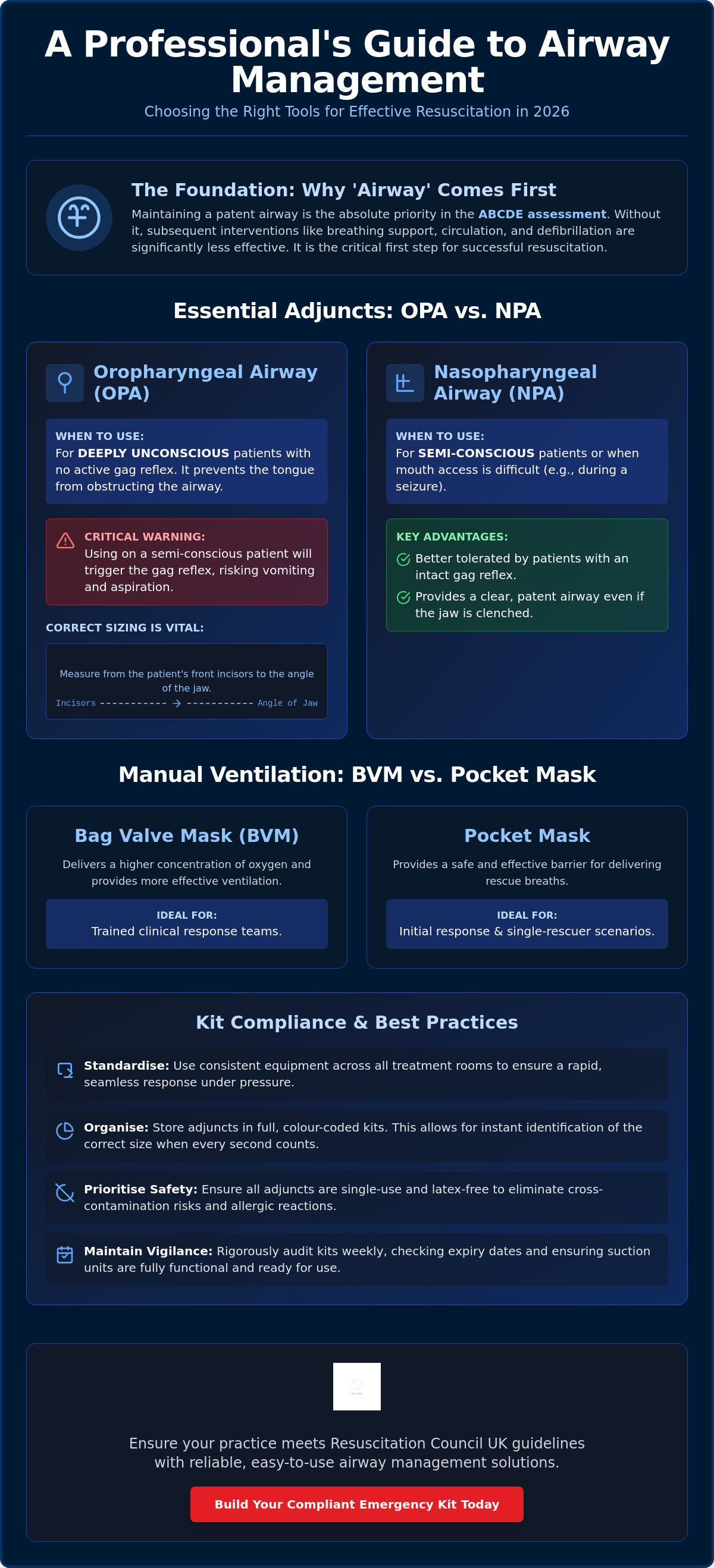
Airway management isn't just a technical skill; it's the literal lifeline of resuscitation. Without a patent airway, every subsequent intervention, from chest compressions to defibrillation, becomes significantly less effective. It forms the "A" in the ABCDE assessment, acting as the primary gatekeeper for oxygenation. For a comprehensive overview of airway management, one must look at both the manual techniques and the mechanical adjuncts designed to keep this passage clear. When the airway is compromised, the clock starts ticking; your ability to react with the right equipment determines the patient's prognosis.
In a clinical dental surgery, the risks are uniquely heightened. Unlike a general office workplace where a first aider might only deal with a simple collapse, dental teams often manage patients who are supine, sedated, or coping with fluids in the oral cavity. Airway adjuncts don't just facilitate breathing; they provide a physical barrier against aspiration. Ensuring you have the right equipment on hand is the difference between a controlled response and a chaotic crisis. Your choice of tools must reflect the specific risks of your environment, balancing portability with clinical depth to ensure patient safety remains the priority.
The ABCDE Approach and Airway Priorities
The "A" comes first because the brain can only survive for a few minutes without oxygen. A compromised airway can manifest as noisy breathing, such as snoring, gurgling, or stridor in a conscious patient, or complete silence in an unconscious one. Whilst basic manoeuvres like the head tilt chin lift or jaw thrust are your first line of defence, they are often difficult to maintain during a prolonged incident or whilst preparing other equipment. This is where adjunct-assisted management becomes vital. It transitions the responder from exhausting manual intervention to a stable, mechanical solution that allows for consistent, effective ventilation.
Regulatory Standards for UK Practices in 2026
Staying compliant isn't just about passing an inspection; it's about unwavering patient safety. The Resuscitation Council UK (RCUK) provides specific equipment lists that every clinical environment should follow to the letter. For dental professionals, this ties directly into your GDC CPD requirements for medical emergencies. Your kit must be more than just present; it must be rigorously audited. Checking expiry dates on adjuncts and ensuring your suction units are functional are weekly necessities, not monthly afterthoughts. A well-maintained kit ensures that when you reach for a tool under pressure, it works exactly as intended without hesitation.
Essential Airway Adjuncts: Choosing Between OPA and NPA
Selecting the right adjunct is a pivotal moment in airway management. The Oropharyngeal Airway (OPA), commonly known as the Guedel airway, is the primary choice for patients who are deeply unconscious. It effectively prevents the tongue from falling back and obstructing the epiglottis. However, it is vital to remember that an OPA will trigger a gag reflex and likely lead to vomiting in patients who aren't fully unresponsive. In these instances, the Nasopharyngeal Airway (NPA) is the preferred tool. It is better tolerated by semi-conscious patients and provides a clear path for ventilation even when the mouth cannot be easily opened, such as during a seizure.
Efficiency in a crisis depends on how your equipment is organised. Storing loose adjuncts in a drawer leads to confusion and delay when seconds are precious. We recommend investing in full colour-coded kits that allow for instant identification of the required size. For 2026, all adjuncts should be single-use and latex-free to eliminate cross-contamination risks and allergic reactions. When selecting these products, ensure they meet the FDA recognized consensus standards for safety and material quality to guarantee they perform reliably under pressure.
Sizing and Fitment: Getting it Right Every Time
Measuring correctly is non-negotiable for clinical safety. For an OPA, you must measure from the angle of the jaw to the front incisors. An incorrectly sized device is dangerous; one that is too small will fail to clear the tongue, whilst one that is too large can push the epiglottis over the laryngeal opening or cause soft tissue damage. A compliant surgery kit must contain a full range of sizes, typically from 00 for infants through to size 4 for larger adults. This diversity ensures you can treat any patient safely, regardless of their age or physical build.
Supraglottic Devices and Advanced Options
Many clinical teams are now adopting second-generation supraglottic devices, such as the i-gel, as part of their advanced airway management strategy. These devices are remarkably easy to insert compared to traditional intubation tools, making them ideal for non-anaesthetists in an emergency. They provide a superior seal and significantly reduce the risk of gastric aspiration. Whilst basic adjuncts remain essential, these advanced tools offer a higher level of security during prolonged resuscitation efforts, especially when waiting for emergency services. If you are reviewing your current stock, consider our professional airway management equipment to ensure your practice remains at the forefront of patient care.
Oxygen Delivery and Ventilation: BVMs vs Pocket Masks
Ventilation is the logical progression once you've secured a patent passage. Whilst pocket masks are an excellent tool for reception staff or initial first responders, they cannot match the clinical efficacy of a Bag Valve Mask (BVM). A BVM is the gold standard for manual ventilation in clinical settings, allowing for precise control over tidal volume and oxygen concentration. For those seeking a comprehensive guide to airway management, understanding the mechanical advantage of a BVM is essential. It provides the pressure needed to overcome airway resistance, which is something a simple pocket mask often lacks during prolonged resuscitation.
Effective airway management relies on more than just the bag; it requires a high-concentration oxygen reservoir. Without this, you're merely circulating room air at approximately 21% oxygen. By integrating a reservoir and a high-concentration valve, you can deliver close to 100% oxygen to the patient. In the current clinical climate of 2026, the industry has shifted decisively toward single-use, disposable BVMs. These eliminate the complex decontamination protocols required for reusable models, significantly reducing the risk of cross-infection whilst ensuring the equipment is always sterile and ready for immediate use.
Selecting the Right BVM for Your Team
Your practice must carry adult, paediatric, and infant sizes to remain compliant and safe. A one-size-fits-all approach is clinically dangerous, as excessive tidal volumes can cause gastric inflation or barotrauma in smaller patients. Look for BVMs with a 360-degree swivel connector, which allows the operator to move around the patient without losing the seal. A textured grip is also vital for maintaining control in slippery or high-stress environments. Ensure your chosen models feature standard ISO connectors to guarantee compatibility with your existing oxygen cylinders and tubing.
Suction Devices: Clearing the Way for Ventilation
A clear airway is the prerequisite for successful ventilation. If the passage is blocked by vomit, blood, or secretions, no amount of manual pressure will help. Whilst battery-powered units offer high flow rates, a manual suction pump is an indispensable fail-safe for every emergency bag. It doesn't rely on batteries or charging, making it perfectly reliable even after months of storage. Your suction kit should include Yankauer catheters and wide-bore tips. These are essential for rapidly clearing thick fluids that would otherwise clog standard tubing, ensuring the airway remains clear for subsequent ventilation steps. For practices looking to source a broader range of specialised medical equipment and supplies, IMT Medical Devices serves as a reliable global wholesaler of high-quality clinical tools.
Key Considerations for Procurement: Compliance and Storage
In a medical crisis, muscle memory is your greatest asset. If the emergency kit in Surgery 1 is organised differently from the one in Surgery 3, your response time will inevitably suffer. Standardising your airway management tools across the entire practice ensures that every clinician, regardless of their usual workstation, can locate essential adjuncts instantly. This uniformity reduces cognitive load during high-stress scenarios, allowing the team to focus entirely on the patient rather than searching through unfamiliar pouches.
Storage solutions must prioritise the "Ready-to-Use" factor. Whilst wall-mounted brackets are excellent for visibility, integrated emergency grab bags are often superior for airway kits because they allow the entire suite of equipment to be brought to the patient's side immediately. We recommend choosing bags that allow for pre-lubricated adjuncts or have lubricant sachets physically attached to the devices. This small detail can save vital seconds. Crucially, your procurement strategy must align with your team's training; there is no clinical benefit to purchasing advanced supraglottic devices if your staff have not yet completed the relevant training to use them safely.
Organising Your Emergency Airway Bag
A well-organised bag follows a logical clinical flow, typically separated into Airway, Breathing, and Circulation compartments. Using clear-fronted, colour-coded pouches within the main bag allows for rapid visual identification of gear without the need to rummage. This structured approach is a cornerstone of professional readiness. To ensure your kit remains fully compliant throughout the year, we recommend using a dental practice emergency preparedness checklist to audit your stock and verify that every component is in its correct place.
Avoiding Common Procurement Mistakes
One of the most frequent errors we see is purchasing individual adjuncts rather than comprehensive, colour-coded sets. Individual pieces often lack the visual cues needed for rapid size selection and are harder to track during audits. Many practices also inadvertently neglect paediatric requirements. If your practice treats families, your kit must contain the full range of smaller adjuncts and BVM sizes mandated by RCUK guidelines. Finally, always account for the shelf-life of sterile items. Sterile adjuncts and water-based lubricants often have different expiry dates; failing to track these can lead to a kit that is technically present but clinically non-compliant. To ensure your practice is equipped with the highest standard of gear, explore our professional range of Airway Management Equipment today.
Professional Airway Solutions from First Medical Training Ltd
Professional readiness is a combination of high-calibre gear and the confidence to use it effectively under pressure. At First Medical Training Ltd, our curated collection of airway management equipment is specifically selected to meet the rigorous demands of UK clinical and dental environments. We don't simply stock products; we provide tools that have been vetted for their reliability, ease of use, and strict adherence to Resuscitation Council UK guidelines. This ensures that when you reach for an adjunct in a crisis, you are using equipment that has been chosen by experts for its clinical performance.
Dental professionals nationwide trust our solutions because they are designed for the practical realities of a busy surgery. Whether you are managing a paediatric emergency or an adult respiratory collapse, our gear provides the tactile feedback and precision required for a successful outcome. By sourcing your kit through our specialised online store, you ensure that every valve, mask, and adjunct is fully compliant with 2026 standards. First Medical Training Ltd acts as a bridge between complex regulatory requirements and the real-world application of life-saving skills.
Maintaining these high standards of clinical readiness is a commitment shared by leading providers across various medical disciplines; for example, London Veterinary Surgeries employs similar rigorous protocols to ensure patient safety within their independent practices in London.
Standout Products for Your Emergency Kit
- Complete Guedel Airway Kits: These kits feature six colour-coded sizes, allowing your team to identify the correct adjunct instantly. This visual system reduces hesitation and ensures a faster response during the critical first minutes of an emergency.
- Disposable Bag Valve Masks: Our high-quality, latex-free BVMs are available for all age groups. They provide effective manual ventilation whilst maintaining the highest levels of infection control through their single-use design.
- Manual Suction Units: These units are lightweight, reliable, and easy to clean. They serve as a vital fail-safe for your practice, ensuring you can clear an airway even if power or batteries fail in a portable unit.
Upgrade Your Practice Readiness Today
Owning the right equipment is only half the battle. To truly guarantee patient safety, your team must be proficient in the latest resuscitation protocols and equipment handling techniques. You can bundle your new equipment with our Medical Emergencies in a Dental Practice Course to bridge the gap between procurement and clinical application. This integrated approach ensures that your staff won't just have the tools; they'll have the expert knowledge to use them with absolute certainty.
First Medical Training Ltd provides dedicated support for practice managers and lead clinicians, helping you select the most appropriate airway management solutions for your specific patient demographic. We pride ourselves on being a dependable partner in your professional development. Browse our full Airway Management collection and secure your equipment today to ensure your practice is prepared for any emergency scenario.
Future-Proof Your Practice Readiness
Effective airway management is the cornerstone of patient safety. By standardising your kits and selecting adjuncts that match your team's specific training level, you create a safer, more predictable environment for every responder. We've explored how prioritising single-use BVMs and maintaining colour-coded OPA sets ensures your practice remains compliant with the latest Resuscitation Council UK 2026 standards whilst streamlining your emergency response.
First Medical Training Ltd has been a trusted partner for UK dental practices since 2006. We pride ourselves on our expert-led integration of equipment and training, ensuring you have the tools and the confidence to act when it matters most. You don't have to navigate these requirements alone; we're here to act as your seasoned guide in professional development.
Take the next step in securing your clinical excellence. Shop the full range of professional Airway Management equipment and ensure your team is equipped for success. Your commitment to high standards today builds the confidence needed to save lives tomorrow.
Frequently Asked Questions
What are the essential airway adjuncts required for a UK dental surgery?
A compliant UK dental surgery must carry a range of Oropharyngeal Airways (sizes 0 to 4), Nasopharyngeal Airways (sizes 6 to 7), a Bag Valve Mask with an oxygen reservoir, and a functional suction unit. These tools form the core of your airway management kit as specified by the Resuscitation Council UK. You should also include water-based lubricant and various mask sizes to ensure you can treat any patient demographic safely.
Is a Bag Valve Mask (BVM) better than a pocket mask for dental emergencies?
A Bag Valve Mask is superior for clinical ventilation because it allows for significantly higher oxygen concentrations and better tidal volume control. Whilst a pocket mask is an excellent, portable tool for reception staff or initial first aid, it relies on the rescuer's exhaled air. In a clinical setting, the BVM is the gold standard as it integrates directly with high-flow oxygen cylinders to deliver nearly 100% oxygen.
How often should I replace the equipment in my airway management kit?
You must replace all single-use adjuncts immediately after they've been used in a clinical scenario. For unused equipment, you should conduct weekly audits to check expiry dates, as sterile packaging for OPAs and NPAs typically has a shelf life of three to five years. If the integrity of the sterile seal is compromised at any point, the item is no longer clinical-grade and must be replaced immediately.
Can non-clinical staff use Oropharyngeal Airways (OPAs)?
Oropharyngeal Airways should only be used by staff members who have received specific clinical training, such as those who've completed a Dental Immediate Life Support (ILS) course. Using an OPA requires a precise understanding of how to measure and insert the device without causing soft tissue trauma or worsening an obstruction. Non-clinical staff should focus on basic manoeuvres and using a pocket mask until clinical help arrives.
What is the difference between an OPA and an NPA?
The primary difference lies in the patient's level of consciousness and the presence of a gag reflex. An OPA is inserted into the mouth and is only suitable for deeply unconscious patients; it will likely cause vomiting in anyone else. An NPA is inserted through the nostril and is much better tolerated by semi-conscious patients, making it a versatile tool for airway management during seizures or trismus.
Do I need different airway equipment for paediatric patients?
Yes, carrying paediatric-specific equipment is a mandatory requirement for any practice that treats children. This includes smaller Guedel airway sizes (00, 0, and 1) and a dedicated paediatric Bag Valve Mask. Using adult-sized equipment on a child is clinically dangerous and can lead to significant lung barotrauma or ineffective ventilation due to a poor mask seal on a smaller face.
What should I look for when buying a manual suction device?
Look for a device that is lightweight, portable, and capable of generating high vacuum pressure without relying on batteries or a power source. It should feature a wide-bore Yankauer tip to ensure it can clear thick fluids like vomit or blood without clogging. Reliability is the most important factor; a manual pump acts as your essential fail-safe if your primary electronic suction unit fails during a crisis.
Is training mandatory before purchasing advanced airway equipment?
Whilst you can technically purchase the gear, clinical guidelines and professional indemnity requirements dictate that you must be trained before using advanced tools. Courses like Medical Emergencies in a Dental Practice ensure your team can use their equipment safely and effectively. Purchasing advanced adjuncts without the corresponding training creates a significant clinical risk and may lead to non-compliance during practice inspections.