

Airway Management for Dental Professionals: 2026 Guide

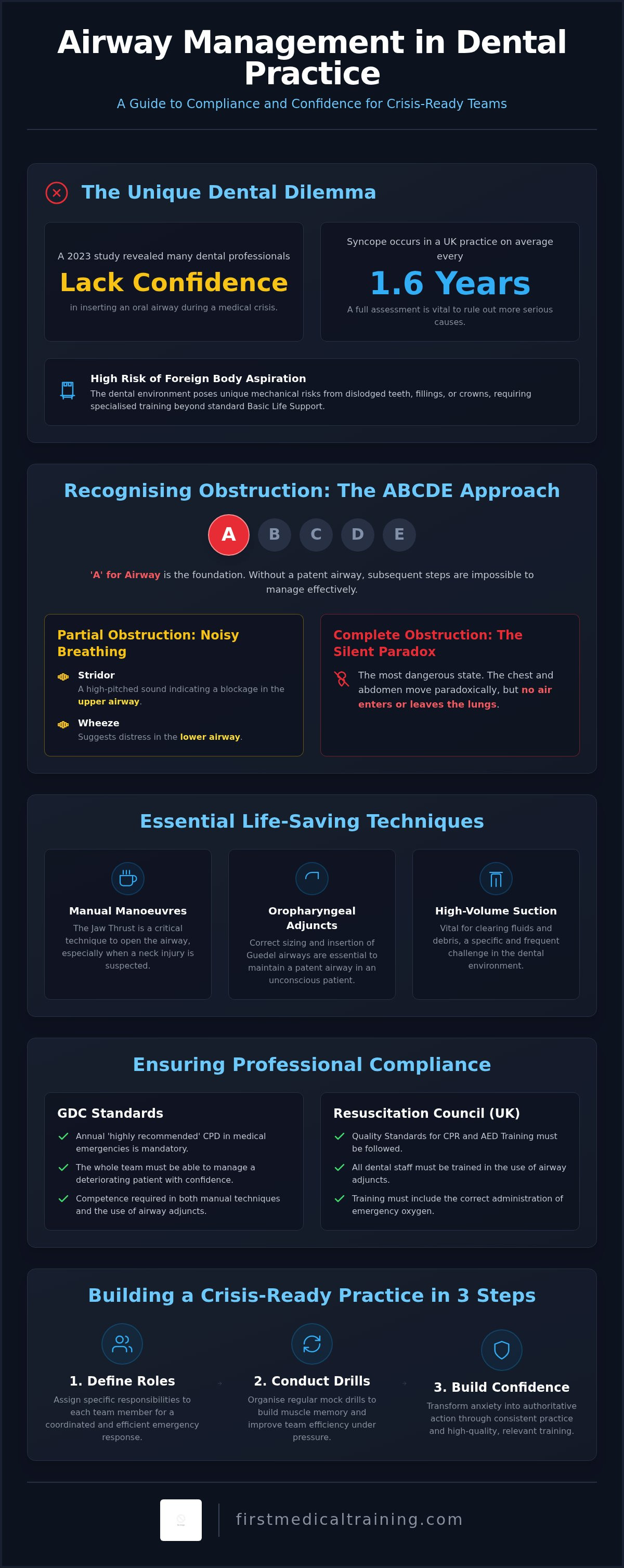
Did you know that while syncope occurs roughly every 1.6 years in a UK practice, a 2023 study revealed that many dental professionals still lack the confidence to insert an oral airway during a crisis? It's a sobering statistic that highlights why comprehensive airway management training for dental professionals is more than just a box-ticking exercise for the GDC. You likely feel the weight of responsibility that comes with patient safety, especially when it involves the anxiety of a potential collapse or confusion over which adjuncts your team should use. We understand that keeping up with annual CPD requirements whilst maintaining clinical excellence is a significant balancing act.
This 2026 guide is designed to bridge the gap between regulatory theory and real-world application, ensuring you can manage airway emergencies with steady, authoritative confidence. You'll master the essential life-saving skills and current regulatory requirements needed to protect your patients effectively. We will walk you through the 2025 Difficult Airway Society guidelines, the correct use of emergency oxygen, and the practical steps to ensure your entire team is crisis-ready and fully compliant with Resuscitation Council (UK) standards.
Key Takeaways
- Identify the unique risks of foreign body aspiration in the dental chair and the clinical procedures required to prevent or relieve a life-threatening obstruction.
- Implement the ABCDE assessment tool to swiftly recognise the difference between partial and complete airway blockages using indicators like stridor and wheeze.
- Master essential manual techniques, such as the Jaw Thrust, and learn the correct sizing and insertion protocols for oropharyngeal adjuncts.
- Access high-quality airway management training for dental professionals to ensure full compliance with the latest Resuscitation Council (UK) standards and GDC requirements.
- Organise your practice into a crisis-ready team by defining specific roles and conducting regular mock drills to build collective confidence and efficiency.
The Vital Importance of Airway Management in Modern Dental Practice
Airway Management involves the specific series of manoeuvres and medical procedures performed to prevent or relieve airway obstruction, ensuring a patient's ventilation remains uncompromised. In the dental surgery, this isn't just a theoretical skill; it's a critical clinical requirement. The dental setting poses unique mechanical risks that aren't typically found in general medical environments. The constant presence of foreign bodies, such as dislodged teeth, fragments of fillings, or crowns, creates a high risk for aspiration. At First Medical Training Ltd, we understand that these specific hazards require a level of preparedness that standard first aid courses simply don't cover.
Every dental professional carries a legal and ethical obligation to remain competent in emergency response. Maintaining your skills in line with the GDC CPD requirements for medical emergencies is a cornerstone of professional registration. High-quality airway management training for dental professionals provides the technical foundation needed to act decisively when a patient collapses, ensuring you can protect their airway effectively until emergency services arrive on the scene.
GDC Standards and Resuscitation Council (UK) Alignment
The GDC mandates that all registered dental professionals undertake annual "highly recommended" CPD in medical emergencies. This requirement ensures that the whole team can manage a deteriorating patient with confidence. The clinical standard is clear: you must be able to maintain a patent airway using both manual techniques and appropriate adjuncts. The Resuscitation Council (UK) Quality Standards for CPR Training state that all dental healthcare staff should be trained in the use of airway adjuncts and the administration of emergency oxygen to ensure patient safety remains the priority during a crisis.
Why Basic BLS is Often Insufficient for Dental Surgeries
Standard Basic Life Support (BLS) often focuses heavily on cardiac arrest and chest compressions. Whilst these are vital skills, they are secondary if the primary issue is a physical airway obstruction. In a dental chair, a patient's position and the presence of fluids or debris mean that simple compressions are often insufficient. Specialised airway management training for dental professionals addresses these gaps by teaching the use of high-volume suction and specific adjuncts like Guedel airways. This focused approach builds the clinical confidence that First Medical Training Ltd has championed for over two decades, ensuring your team is ready for the realities of modern dental practice.
Recognising and Assessing Airway Obstruction: The ABCDE Approach
The ABCDE approach provides a structured, life-saving sequence for managing any deteriorating patient. In the high-pressure environment of a dental surgery, having a systematic framework prevents the "freeze" response and ensures no critical step is missed. Whilst the "A" stands for Airway, it is the foundation upon which the rest of the assessment sits; without a patent airway, subsequent steps like "B" (Breathing) and "C" (Circulation) become impossible to manage effectively. Professional airway management training for dental professionals emphasises that assessment must be continuous, as a patient's status can change in seconds.
Recognising the nature of the obstruction is your first priority. A partial obstruction often presents with noisy breathing. You might hear stridor, which is a high-pitched sound indicating a blockage in the upper airway, or a wheeze, suggesting lower airway distress. The most dangerous state, however, is the "silent paradox." This occurs during a complete obstruction where the patient's chest and abdomen move in opposite directions as they struggle to breathe, but no air actually enters or leaves the lungs.
It is vital to differentiate these signs from a simple faint. Whilst syncope is the most common emergency in practice, assuming a patient has "just fainted" without a full assessment is a clinical risk. You can find detailed guidance on this in our syncope management dental training guide. If the patient does not recover immediately upon being placed in a supine position, or if their breathing sounds laboured, you must escalate to a full ABCDE assessment immediately.
Identifying the Cause: From Tongue Displacement to Foreign Bodies
The "Look, Listen, and Feel" technique is the gold standard for assessing patency. Look for chest movement, listen for breath sounds at the mouth, and feel for air on your cheek. In a dental setting, the cause is often mechanical. The tongue is the most common culprit, especially in sedated or unconscious patients, but you must also consider "lost" materials like crowns, bridges, or implant components. Hypoxia occurs when the body's tissues are deprived of adequate oxygen supply, leading to rapid cellular damage and potential organ failure if the airway is not secured within minutes. This underscores the importance of the ADA Guidelines for Sedation and Anesthesia which emphasise constant monitoring of patient ventilation during clinical procedures.
The ABCDE Framework in the Dental Surgery
Adapting this framework for the dental chair requires team synchronicity. Whilst the dentist focuses on the "A" priority, the dental nurse should be simultaneously monitoring vital signs and preparing suction or oxygen. If you're looking to sharpen these team dynamics, our Medical Emergencies in a Dental Practice Course provides hands-on practice for these exact scenarios. Effective airway management training for dental professionals ensures that every team member knows exactly when to transition from assessment to immediate intervention, moving from "A" to "B" only once the airway is secured.
Essential Airway Management Techniques: From Manual Manoeuvres to Adjuncts
Moving from assessment to intervention requires a calm, methodical application of clinical skills. Whilst the ABCDE approach identifies the problem, the following techniques provide the clinical solution. Effective airway management training for dental professionals focuses on a tiered response, starting with simple manual manoeuvres before escalating to mechanical adjuncts. The objective is always to establish and maintain a patent airway with the least invasive method possible, ensuring the brain receives a continuous supply of oxygenated blood until the crisis is resolved.
Manual Manoeuvres: The First Line of Defence
The head tilt-chin lift is the most common technique used to clear a tongue-base obstruction. In a dental chair, this is performed by placing one hand on the patient's forehead and the fingertips of the other hand under the point of the chin, gently lifting to extend the neck and open the passage. If you suspect a spinal injury or are treating a patient with limited neck mobility, the jaw thrust is the safer, more appropriate alternative. This involves placing your fingers behind the angles of the mandible and pushing the jaw forward. It's a physically demanding manoeuvre that must be maintained with steady pressure until the airway is secure or professional help arrives.
Utilising Airway Adjuncts and Emergency Oxygen
When manual manoeuvres are insufficient, mechanical adjuncts become necessary to maintain patency. Understanding the essentials of airway management involves mastering the use of Oropharyngeal (Guedel) airways. These devices are sized from the patient's incisors to the angle of the jaw; an incorrect size can worsen an obstruction or trigger a gag reflex. For those trained in Dental Immediate Life Support (ILS), Supraglottic Airway Devices (SADs) like the i-gel offer a more definitive solution by creating a seal around the laryngeal opening. Regardless of the adjunct used, high-volume suction must be ready to clear blood or secretions, and emergency oxygen should be administered via a Bag-Valve-Mask (BVM) at a flow rate of 15 litres per minute. BVM ventilation is always most effective as a two-person technique to ensure an airtight seal.
Choking Management: The Role of Anti-Choking Devices
Choking remains a significant risk during dental procedures due to the presence of small materials and fluids. You should follow the Resuscitation Council (UK) choking algorithm: encourage coughing, followed by five back blows and five abdominal thrusts. To provide an additional layer of safety, many practices now include the LifeVac anti-choking device in their emergency kit. This non-invasive suction device can be used when standard protocols fail or cannot be performed due to patient positioning. It's equally vital to have a clear protocol for choking incidents occurring in the waiting room, ensuring every staff member knows how to respond. Comprehensive airway management training for dental professionals ensures these protocols are second nature for the entire practice team.
Building a Crisis-Ready Team: Roles and Emergency Equipment
A medical emergency is a high-stakes environment where technical skill must meet clinical leadership. Whilst individual competence is vital, the survival of a patient often hinges on how well the team functions as a single unit. Comprehensive airway management training for dental professionals should therefore move beyond individual skill and focus on the collective. By defining clear roles before an incident occurs, you eliminate the confusion that often leads to delays in treatment. It's about creating a synchronised response where every staff member knows exactly where to stand and what to touch.
When a patient collapses, the dentist naturally assumes the role of Team Leader. This person is responsible for the primary clinical decision-making and overseeing the airway interventions discussed earlier. Simultaneously, the dental nurse acts as the Airway Assistant. This role is pivotal; the nurse must prepare the suction, set up the emergency oxygen, and have the adjuncts ready without being prompted. To ensure your practice is fully equipped for these roles, refer to our dental practice emergency preparedness checklist, which outlines the minimum standards for 2026 compliance.
Synchronised Response: Who Does What?
Effective crisis management extends to the front desk. The receptionist’s role is to call 999 immediately, providing the operator with clear details whilst ensuring the practice entrance is clear for paramedics. Within the surgery, the team must use "closed-loop" communication. This means when the dentist asks for a specific Guedel airway, the nurse confirms the request aloud before handing it over. This simple technique prevents errors and ensures the Team Leader knows their instructions have been followed. If your team hasn't practised these roles recently, you can book a Medical Emergencies in a Dental Practice Course with First Medical Training Ltd to run through these scenarios in your own clinical environment.
Maintaining Your Airway Management Kit
The best airway management training for dental professionals is useless if the equipment fails. You should implement a rigid schedule for equipment checks. Oxygen cylinders must be checked weekly to ensure they are full, and all adjuncts, such as i-gels and Guedel airways, must be checked for expiry dates. We recommend using a dedicated "Emergency Grab Bag" rather than scattered drawers. The bag should be organised logically, with airway equipment in the first accessible compartment. A well-organised emergency kit does more than just ensure compliance; it provides a significant psychological boost to team morale, knowing that the tools for success are exactly where they should be. Regular "mock drills" help cement this organisation, ensuring that even under extreme stress, the team can locate and deploy life-saving equipment in seconds.
Professional Training Solutions: Meeting GDC Standards with First Medical Training Ltd
Achieving clinical excellence requires more than just reading a guide; it demands hands-on experience led by experts who understand the unique pressures of the dental environment. First Medical Training Ltd has been a trusted partner in this field since 2006. With a legacy spanning two decades of providing specialised airway management training for dental professionals, we bridge the gap between rigorous GDC standards and the practical realities of your daily practice. Our primary solution, the Medical Emergencies in a Dental Practice Course, is specifically designed to transform your team into a confident, crisis-ready unit.
For practices that perform conscious sedation, we offer specialised Dental Immediate Life Support (ILS) Training. This advanced session focuses on the higher-level skills required when patients are in a state of reduced consciousness, ensuring you're prepared for the specific airway challenges that sedation can present. By choosing in-practice training rather than generic off-site courses, your team learns in the environment where they actually work, using their own equipment and navigating their own surgery layout. This contextual learning is far more effective than training in a distant hotel conference room.
Tailored Training for the Whole Dental Team
Every dental surgery is different, which is why First Medical Training Ltd doesn't believe in a one-size-fits-all approach. We adapt our training scenarios to your specific floor plan, ensuring your receptionist knows the best route for paramedics and your nurses know exactly where the oxygen is kept in each room. You'll get hands-on practice with the latest airway adjuncts and high-fidelity manikins, building the muscle memory needed for a real emergency. Each participant receives verifiable CPD certificates that align perfectly with GDC requirements, making your annual portfolio submission straightforward and stress-free.
Booking Your 2026 Compliance Session
Organising a group session at your practice location is a simple and efficient way to ensure the entire team is on the same page. Because the GDC recommends at least two hours of medical emergency-related CPD annually, early booking is essential to maintain your compliance schedule and avoid last-minute rushes. It's better to be a year early than a day late when it comes to life-saving skills. Don't wait for a near-miss to identify gaps in your team's readiness. Secure your team’s airway management training today and gain the peace of mind that comes from being truly prepared for any crisis.
Ensuring Clinical Readiness for 2026 and Beyond
Effective airway management is the cornerstone of patient safety in the dental surgery. By mastering the ABCDE assessment and perfecting the use of manual manoeuvres and adjuncts, you move beyond basic compliance to true clinical competence. A crisis-ready team relies on clear roles and a well-maintained emergency kit; this ensures every second counts when a patient's breathing is compromised. Professional airway management training for dental professionals provides the hands-on experience necessary to handle these high-pressure scenarios with steady reliability.
First Medical Training Ltd offers GDC and Resuscitation Council (UK) aligned courses, delivered by expert instructors with over 20 years of experience. We bring the training directly to your surgery, allowing your team to practise in their own clinical environment. Book Your Medical Emergencies in a Dental Practice Course today to secure your annual CPD and build a safer, more resilient practice. You have the dedication to protect your patients; we are here to provide the expertise and confidence to help you succeed.
Frequently Asked Questions
Is airway management training mandatory for all UK dental staff?
Airway management training is mandatory for all UK dental professionals registered with the GDC. This requirement includes dentists, dental nurses, and hygienists, as medical emergencies fall under the "highly recommended" CPD category. Regular training ensures that every team member can act decisively during a patient collapse. Failing to maintain these skills can lead to regulatory non-compliance and, more importantly, compromises patient safety during a life-threatening event in the surgery.
How often should dental professionals update their airway management skills?
You should update your airway management skills at least once every year to maintain clinical proficiency. The GDC recommends a minimum of two hours of medical emergencies CPD annually. Frequent refresher sessions are vital because life-saving skills can degrade quickly without regular practice. Annual training ensures your team remains familiar with the latest Resuscitation Council (UK) guidelines and feels confident using emergency equipment like oxygen cylinders and airway adjuncts.
What is the difference between BLS and ILS for dental practices?
The primary difference lies in the level of intervention and the specific equipment used. BLS focuses on chest compressions and AED use, whilst ILS includes advanced techniques like airway adjuncts and emergency oxygen. Comprehensive airway management training for dental professionals often moves into the ILS territory. This is especially true for practices performing sedation, where the ability to manage a compromised airway with mechanical aids is a core clinical requirement.
Can dental nurses use Guedel airways and other adjuncts?
Dental nurses can and should use Guedel airways if they have received the appropriate training and feel competent to do so. In many emergency protocols, the nurse takes on the role of the "Airway Assistant." This involves selecting the correct size of adjunct and assisting with its insertion under clinical supervision. Training ensures the nurse understands the indications for use and can support the dentist effectively during a rapid ABCDE assessment.
What emergency airway equipment is required in a UK dental surgery?
UK dental surgeries must carry a specific set of emergency airway equipment to meet safety standards. This includes a portable oxygen cylinder with a flow meter, a Bag-Valve-Mask (BVM), and a range of oropharyngeal (Guedel) airways. You also require portable suction to clear secretions and an AED. Keeping this kit in a dedicated "Grab Bag" ensures that all necessary tools are accessible within seconds when an airway emergency occurs in the chair.
Does First Medical Training provide verifiable CPD for these courses?
First Medical Training provides fully verifiable CPD certificates for all our medical emergency and ILS courses. These certificates are aligned with GDC standards and Resuscitation Council (UK) guidelines. When you complete our airway management training for dental professionals, you receive documentation that clearly states the learning outcomes. This makes it simple to record your hours and demonstrate your professional compliance during your five-year GDC cycle.
What should I do if a patient aspirates a crown during a procedure?
You must immediately stop the procedure and encourage the patient to cough vigorously to clear the object. If the patient is unable to clear the crown and shows signs of obstruction, follow the Resuscitation Council (UK) choking algorithm. Even if the patient appears fine after a suspected aspiration, you must refer them to a hospital for an urgent X-ray. This is essential to confirm the location of the object and rule out serious respiratory complications.
How do we manage an airway emergency for a patient in a dental chair?
Most airway emergencies are managed by placing the patient in a supine position to improve cerebral blood flow. Once reclined, you should use the head tilt-chin lift or jaw thrust manoeuvre to open the airway. Clear any visible debris with high-volume suction and prepare to administer emergency oxygen. Continuous monitoring using the ABCDE approach is vital until the patient recovers or the emergency services arrive to take over clinical care.