

Choosing the Best Dental Emergency Drug Kit: A 2026 Professional Buyer’s Guide

Your clinical expertise is only as effective as the tools at your disposal when a patient’s life is on the line. It's a sobering reality that many practitioners feel more anxiety about a CQC inspection or a misplaced expiry date than the medical emergency itself. You aren't alone if you find the distinction between mandatory and recommended items confusing, or if the thought of tracking dozens of consumables feels like a full-time job. Selecting the right dental emergency drug kit shouldn't be a source of stress, yet it's the foundation of a safe, compliant surgery.
This 2026 buyer’s guide promises to demystify the procurement process, helping you master GDC compliance whilst building genuine clinical confidence. We will examine the core medications required by current standards, including the increasing importance of naloxone and the shifting costs of adrenaline auto-injectors. By the end of this article, you'll have a clear roadmap to streamline your inventory management and ensure your team is prepared to act with precision during any crisis.
- Understand the 2026 GDC and RCUK standards so it's clear your practice meets all CQC inspection requirements.
- Evaluate drug delivery formats to choose a dental emergency drug kit that matches your team's clinical readiness.
- Master airway management by selecting the correct oxygen delivery consumables and high-concentration reservoir masks.
- Don't let the "expiry date trap" compromise your readiness; learn to organise a rolling replacement schedule instead.
- Identify the essential clinical consumables that support a safe and professional response to any medical emergency.
Compliance Standards for Dental Emergency Drug Kits in 2026
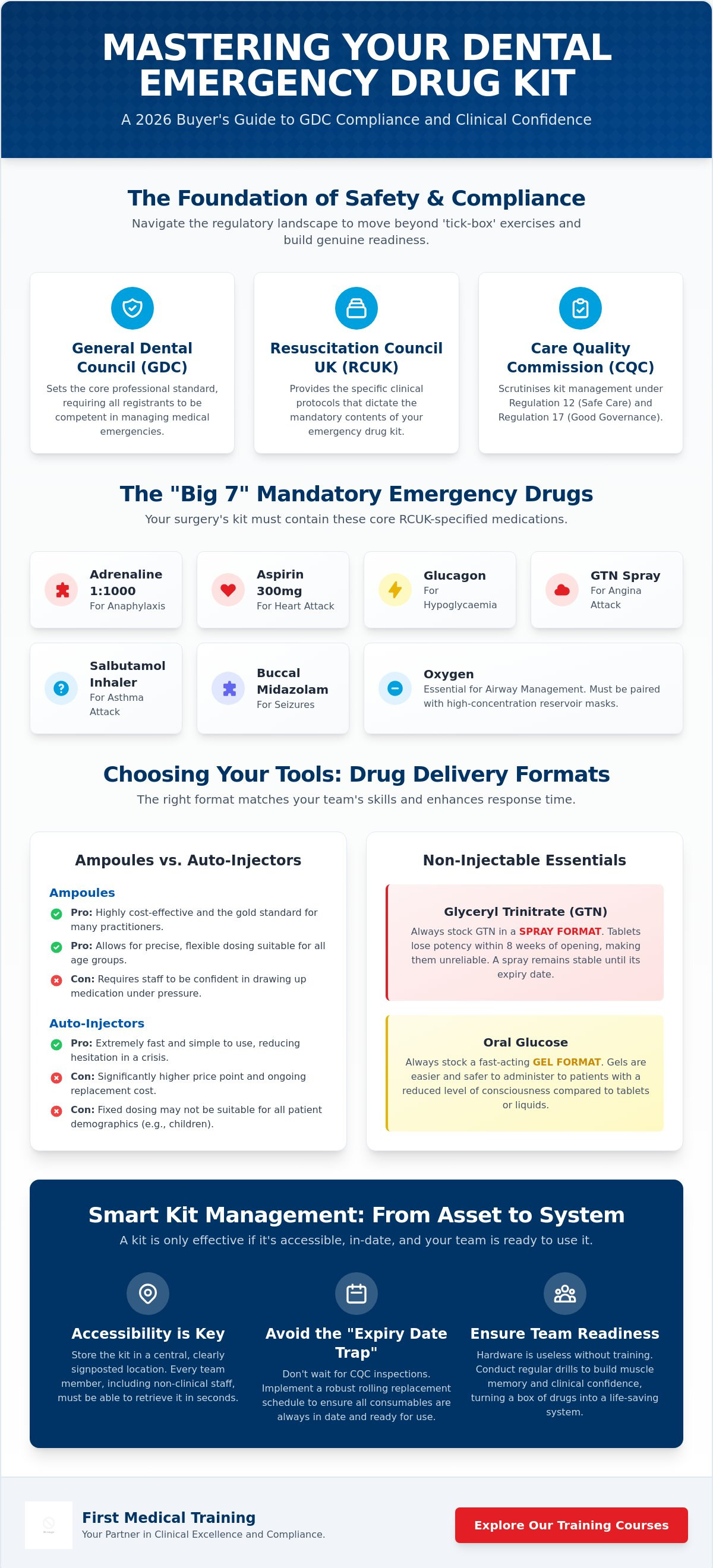
Understanding the regulatory landscape is the first step toward clinical excellence. The General Dental Council (GDC) expects every registrant to be competent in managing medical emergencies. This isn't a vague suggestion; it's a core professional requirement. Whilst the GDC sets the professional standard, the Resuscitation Council UK (RCUK) provides the specific clinical protocols that dictate the contents of your dental emergency drug kit. In 2026, the Care Quality Commission (CQC) continues to scrutinise how practices manage these assets under Regulation 12, which focuses on safe care, and Regulation 17, which covers good governance. An inspector won't just look for the presence of a kit. They'll check that drugs are in date, accessible within seconds, and that staff understand what constitutes a medical emergency in a clinical setting.
Treating compliance as a "tick-box" exercise is a dangerous behaviour that compromises patient safety. It creates a false sense of security that can crumble during a real crisis. True readiness comes from choosing high-quality, reliable consumables that your team feels confident using. When every second counts, the tactile quality of a syringe or the clarity of an ampoule label matters. Clinical confidence is built on the reliability of your equipment, ensuring that your focus remains entirely on the patient rather than struggling with a poorly designed kit.
Mandatory vs Recommended Emergency Drugs
The RCUK guidelines specify a core list of drugs that must be present in every surgery. These "Big 7" medications are designed to address the most common life-threatening events, from anaphylaxis to cardiac distress. Your dental emergency drug kit must contain Adrenaline (1:1000), Aspirin (300mg), Glucagon, Glyceryl Trinitrate (GTN) spray, Salbutamol, Buccal Midazolam, and Oxygen. Adrenaline is arguably the most critical. Many practitioners prefer the ampoule format for intramuscular injection because it allows for precise, flexible dosing across different age groups. If your practice performs conscious sedation, your requirements expand significantly to include reversal agents like Flumazenil and enhanced monitoring equipment.
Regulatory Alignment and Your Practice Standards
Aligning your equipment with the principles taught in a medical emergencies in dental practice course ensures that your hardware matches your team's skills. A kit is useless if it's locked in a cupboard or stored in a remote office. It must be kept in a central, known location that is clearly signposted. Every team member, from the lead clinician to the newest receptionist, should be able to locate and retrieve the kit without hesitation. Regular drills and a structured protocol turn a collection of drugs into a functional, life-saving system that satisfies both GDC standards and CQC inspectors.
Core Drugs and Consumables: A Comparative Selection Guide
Choosing the right delivery format for your medications is just as vital as the drugs themselves. Whilst international guidelines, such as the American Dental Association recommendations, provide a baseline for what to stock, UK practitioners must navigate the practicalities of administration. You'll typically choose between ampoules, pre-filled syringes, and auto-injectors. Ampoules are the most versatile and cost-effective option for a dental emergency drug kit, but they require a team that is confident in drawing up medication under pressure. Auto-injectors offer speed but come with a significantly higher price point and fixed dosing that might not be appropriate for every patient age group.
Delivery preferences also extend to non-injectable drugs. For instance, Glyceryl Trinitrate (GTN) should always be stocked in a spray format. GTN tablets have a notoriously short shelf life once the seal is broken, often losing potency within eight weeks. A spray remains stable until its expiry date, ensuring reliability when managing a suspected angina attack. Similarly, oral glucose should be stocked as a fast-acting gel. Gels are easier to administer to a patient who may be uncooperative or have a reduced level of consciousness compared to traditional tablets or liquids.
Adrenaline and Anaphylaxis Management
Adrenaline 1:1000 (1mg/1ml) ampoules remain the gold standard for treating anaphylaxis in the dental surgery. To administer this effectively, your dental emergency drug kit must include the correct needles and syringes. A 1ml or 2ml syringe is ideal for precision. For the injection itself, a 23G (blue) needle is typically used for intramuscular delivery in adults, although a 21G (green) needle might be required for patients with more adipose tissue. It's a wise strategy to stock at least three ampoules. Anaphylaxis often requires repeat doses every five minutes if the initial injection doesn't resolve the symptoms before the ambulance arrives.
Diabetes and Cardiac Support Consumables
Managing a hypoglycaemic event requires a tiered approach. If the patient is conscious and able to swallow, Glucogel is the most efficient consumable. However, if they become unconscious, your team must be trained to use a GlucaGen HypoKit for intramuscular injection. For cardiac events, ensure your Aspirin is the 300mg dispersible variety; this formulation allows for faster absorption when chewed. Finally, a Salbutamol inhaler is only half the solution. You must include a compatible spacer device, as patients in respiratory distress often struggle to co-ordinate their breathing with a standard metered-dose inhaler. Ensuring your team is proficient with these tools is easy with bespoke dental emergency training that focuses on practical application.
Airway Management and Oxygen Delivery: Choosing the Right Consumables
Effective airway management is the cornerstone of resuscitation. Without a patent airway and adequate oxygenation, even the most precisely administered drugs will fail to stabilise your patient. Oxygen is frequently the most used "drug" in any medical crisis, yet it is often the one where consumables are most overlooked. Your dental emergency drug kit must go beyond just providing a cylinder; it requires a range of delivery systems to suit different clinical scenarios. For a breathing patient in distress, a simple face mask is insufficient. You must stock high-concentration reservoir masks, often called non-rebreather masks, which can deliver oxygen concentrations approaching 100% when used correctly.
When a patient stops breathing, the clinical requirements shift immediately to positive pressure ventilation. Every practice needs to decide between pocket masks and self-inflating bags (BVMs). Whilst a BVM is the professional standard for delivering high-flow oxygen during CPR, it often requires two clinicians to maintain an effective seal. A pocket mask is a reliable alternative for a lone responder or smaller teams. Regardless of your choice, these items must be single-use. Reusable versions present a significant infection control risk and require rigorous decontamination protocols that are rarely practical in a busy dental surgery.
Maintaining a patent airway in an unconscious patient often requires mechanical assistance. Oropharyngeal (Guedel) airways are essential for preventing the tongue from obstructing the posterior pharynx. You must stock a full range of sizes from 0 to 4. This ensures you can provide safe care to everyone from a small child to a large adult. A kit that only contains "average" sizes is a liability during a paediatric emergency.
Oxygen Cylinders and Delivery Hardware
Your portable oxygen supply must be capable of delivering a flow rate of at least 15 litres per minute. In a dental setting, a "CD" size cylinder is the standard, providing approximately 460 litres of oxygen. This gives you roughly 30 minutes of usage at maximum flow, which is usually enough time for emergency services to arrive. Check your tubing regularly to ensure it hasn't become brittle. Secure, "star-lumen" tubing is the best choice because it's kink-resistant, ensuring the oxygen flow isn't accidentally cut off if the patient moves or is repositioned.
Auxiliary Airway Consumables
A clear airway is impossible if the patient's throat is obstructed by fluid, vomit, or blood. Portable suction is a mandatory requirement, and it must be paired with the correct manufacturer-specific Yankauer catheters. These rigid suction tips allow you to clear the oropharynx quickly and effectively. Additionally, don't overlook the importance of spacer devices for your salbutamol inhalers. A "one size fits all" approach fails here; you need spacers that can be used with a mask for patients who cannot follow instructions. Maintaining these airway supplies is a vital part of your dental practice emergency preparedness. Including these consumables in your dental emergency drug kit ensures your team is equipped for more than just the "Big 7" drug administrations.
Managing Your Emergency Kit: Avoiding Common Procurement Mistakes
Managing a dental emergency drug kit requires more than a one-off purchase. It demands a disciplined approach to inventory management and a culture of clinical readiness. One of the most frequent pitfalls is the "expiry date trap." This occurs when a practice buys a complete kit and forgets about it until an inspection looms. Because different medications and consumables have varying shelf lives, you'll find that items expire at different intervals. Organising a rolling replacement schedule, rather than waiting for the entire kit to time out, ensures you're never left without a critical drug during a crisis.
Storage errors are another common mistake that can compromise drug efficacy. Adrenaline, for instance, is light-sensitive and must be kept in its original packaging. Glucagon is a particularly frequent point of confusion during inspections. Whilst it can be stored at room temperature for up to 18 months, it must be kept in a refrigerator to reach its maximum shelf life. If you choose room temperature storage, you must clearly mark the new, shortened expiry date on the box. Failure to do this is a common reason for CQC non-compliance.
You must also resist the temptation to "cannibalise" the emergency kit. Taking a pair of gloves or a 2ml syringe for a routine procedure might seem harmless, but it breaks the integrity of your emergency response. A missing item during an emergency is a preventable failure. The solution is simple: apply tamper-evident seals to your kit and implement a weekly verification checklist. This check shouldn't just look for the kit's presence; it should verify that the seal is intact and that the oxygen cylinder is sufficiently full.
Restocking and Inventory Strategies
Bulk-buying needles and syringes might look like a cost-saving measure, but it often leads to unnecessary waste when an entire batch expires simultaneously. Using a single, reliable supplier for all your dental consumables simplifies the procurement process and makes it easier to track batches. This becomes especially important during national drug shortages or recalls. A trusted partner will proactively inform you of any issues, allowing you to maintain compliance without the stress of last-minute sourcing.
Training and Kit Familiarisation
Equipment is only as effective as the hands that use it. Regular "kit drills" are essential for ensuring your team can retrieve the dental emergency drug kit and prepare a dose of adrenaline within seconds. Every staff member must know the kit's exact location and be familiar with its internal layout. This readiness is a fundamental component of cardiac arrest management in dental practice. If you want to ensure your team's skills match your high-quality kit, consider booking a Medical Emergencies in a Dental Practice Course to bridge the gap between procurement and performance.
Stocking Your Surgery: Top Dental Consumables for Emergency Readiness
The clinical effectiveness of your dental emergency drug kit is intrinsically linked to the quality of the peripheral consumables that support it. Whilst the pharmacological agents are the primary tools for stabilisation, the success of an intervention often depends on the reliability of the "supporting cast." In a high-pressure scenario, the last thing a clinician needs is a glove that tears or a syringe with unclear graduations. Precision and durability in these basic items allow your team to focus entirely on the patient's recovery rather than struggling with substandard equipment.
High-quality personal protective equipment (PPE) is the first line of defence for your team. During the adrenaline-fuelled moments of a medical crisis, responders need nitrile gloves that offer superior tactile sensitivity and a secure grip, even in wet conditions. Similarly, high-filtration masks are essential. They protect the staff whilst ensuring that communication remains clear and unobstructed. Even simple items like sterile gauze and cotton rolls are vital; they are frequently required to manage minor oral bleeding or to ensure a clear field of view when clearing a patient's airway. Reliability in these basic supplies prevents minor logistical hurdles from escalating into clinical complications.
Post-emergency protocols are equally important for practice continuity and regulatory compliance. Once the patient has been transferred to the care of the ambulance service, the surgery must be returned to a safe, sterile state. This requires medical-grade disinfectant wipes and sprays that are effective against a broad spectrum of pathogens. Having a dedicated stock of infection control consumables within or alongside your dental emergency drug kit ensures that cleanup is handled systematically, allowing the practice to resume normal operations with minimal delay.
Standout Products for Your Dental Practice
Precision is paramount when every second counts. Your surgery should be stocked with sterile, single-use syringes and needles that are specifically chosen for emergency use. Using high-quality, clearly marked 1ml and 2ml syringes ensures that drug dosages are drawn up accurately under stress. We also recommend keeping high-filtration masks and protective eyewear in a dedicated "responder pack" attached to your kit. This ensures that the team is protected the moment they arrive at the patient's side, rather than wasting precious seconds searching for PPE in different cupboards.
Why Choose First Medical Training for Your Consumables?
The range at First Medical Training is curated by medical training experts who understand the practical realities of emergency response. We select our supplies based on clinical reliability and ease of use in a crisis. Supporting dental practices with compliant, high-quality items is our core mission, acting as a bridge between your training and your real-world readiness. To ensure your surgery is equipped with the best tools for the job, you can browse our full range of dental consumables and emergency supplies today.
Building Clinical Excellence and Compliance
Maintaining a dental emergency drug kit is more than a regulatory hurdle; it's a commitment to patient safety that defines your professional standard. We've explored how GDC compliance and clinical confidence are built on the foundation of high-quality consumables and a methodical approach to inventory management. By avoiding the "expiry date trap" and selecting the right delivery formats, you ensure your team is never left guessing during a crisis. True readiness is about bridging the gap between having the right tools and having the confidence to use them.
We've been a trusted partner for dental professionals since 2006, offering expert-selected consumables designed for clinical compliance and reliability. With national delivery available on all essential emergency supplies, keeping your surgery stocked has never been more straightforward. Shop our complete range of dental consumables and emergency supplies to ensure your practice remains at the forefront of patient care. You've the skills; we'll provide the tools to help you save lives with confidence.
Frequently Asked Questions
What drugs are mandatory in a UK dental emergency drug kit?
Your dental emergency drug kit must contain seven core medications as specified by the Resuscitation Council UK. These include Adrenaline (1:1000), Aspirin (300mg dispersible), Glucagon (1mg), Glyceryl Trinitrate (GTN) spray, Salbutamol inhaler (100mcg/dose), Midazolam (buccal), and Oxygen. Having these items is a non-negotiable requirement for GDC compliance and patient safety during a crisis.
How often should I check the expiry dates on my emergency drugs?
Weekly checks are the professional standard for maintaining a dental emergency drug kit. It's best to incorporate this into a Friday afternoon or Monday morning routine. During this check, you should verify that all drug seals are intact, expiry dates are clearly visible, and the oxygen cylinder is sufficiently full to deliver a high flow rate if needed.
Do I need an AED if I have a full emergency drug kit?
Yes, an Automated External Defibrillator (AED) is a mandatory requirement for all UK dental practices. Whilst a drug kit manages various medical crises, an AED is the only effective treatment for a patient in a shockable cardiac arrest rhythm. Resuscitation Council UK guidelines state that every practice must have an AED available for immediate use by the team.
Can I use an auto-injector instead of adrenaline ampoules?
You can use auto-injectors, but adrenaline ampoules are generally preferred in a clinical setting for their dosing flexibility. Auto-injectors provide a fixed dose that may not be appropriate for every patient age or weight. Ampoules are also significantly more cost-effective and allow the clinician to draw up the exact volume required for the specific emergency scenario.
Should Glucagon be stored in the fridge in a dental surgery?
Glucagon should ideally be stored in a refrigerator between 2°C and 8°C to ensure it reaches its maximum shelf life. If you choose to store it at room temperature, its lifespan is reduced to 18 months. You must clearly mark the shortened expiry date on the packaging if it's removed from the fridge to remain compliant during a CQC inspection.
What size needles are best for intramuscular adrenaline injections?
A 23G (blue) needle is the standard choice for adult intramuscular (IM) adrenaline delivery. It's long enough to reach the muscle mass of the vastus lateralis without being overly invasive. For patients with more adipose tissue, you should keep a 21G (green) needle in your kit to ensure the medication is delivered deep into the muscle for rapid absorption.
Is a portable oxygen cylinder a legal requirement for dentists?
Yes, a portable oxygen cylinder is a mandatory requirement for all dental surgeries. It must be a "CD" size cylinder or larger, capable of delivering a flow rate of at least 15 litres per minute through a high-concentration reservoir mask. Fixed oxygen lines aren't sufficient because the equipment must be able to follow the patient if they're moved.
How many staff members need to be trained to use the emergency kit?
Every member of the dental team, including non-clinical staff like receptionists, must be trained to support a medical emergency. The GDC requires all registrants to complete annual CPD in medical emergencies. This ensures that even if the clinician is occupied, another team member knows how to retrieve the kit and prepare the necessary equipment or drugs.