

Choosing the Right First Aid Kits: A Comprehensive 2026 Buying Guide

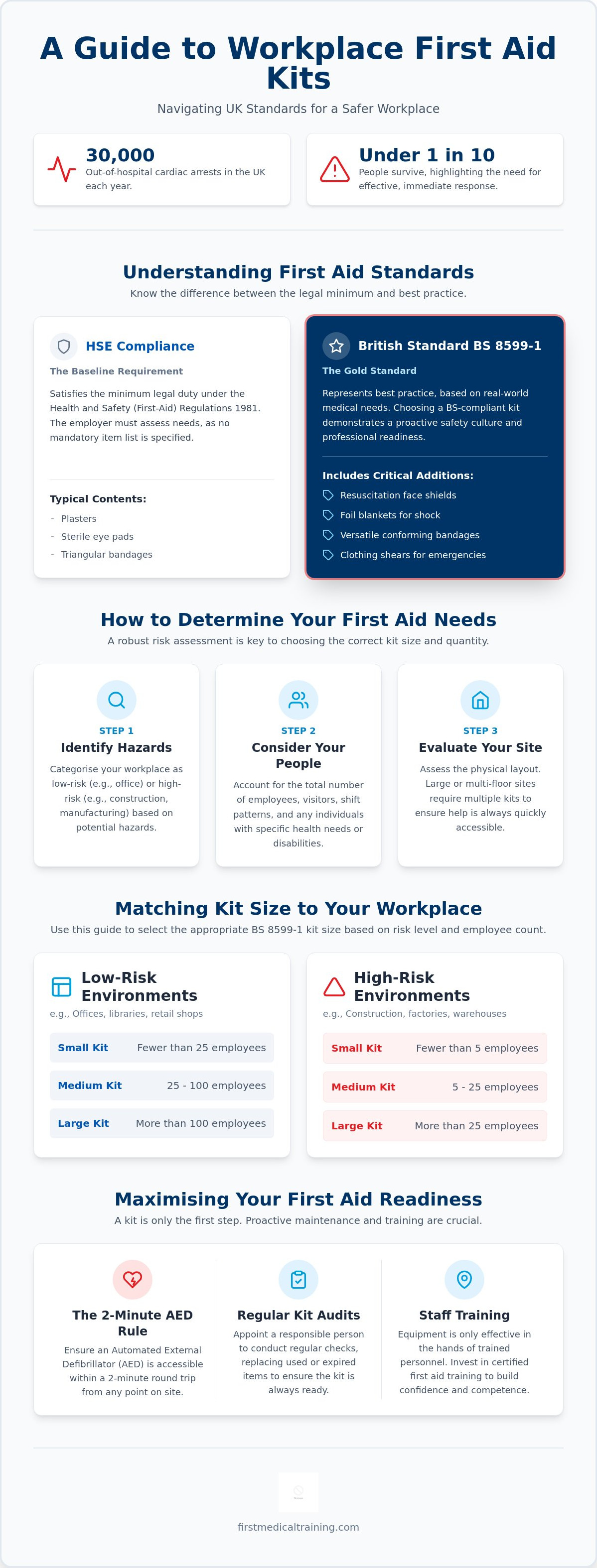
Did you know that there are approximately 30,000 out-of-hospital cardiac arrests in the UK every year, yet the survival rate remains less than one in ten? This sobering statistic highlights why having the correct first aid kits and emergency equipment is a matter of life and death rather than just a tick-box exercise for health and safety. Since the updated British Standard BS 8599-1:2019+A1:2026 came into force on 30 April 2026, the focus has shifted from simple employee headcount to a more nuanced, risk-based approach.
It's easy to feel confused by the differences between HSE requirements and British Standards, or to worry about being caught out by an inspector for having the wrong kit size. We understand that you want to protect your team without getting bogged down in dense regulatory jargon. This guide provides a clear roadmap to help you select the most effective medical supplies for your specific environment. You'll learn how to conduct a proper risk assessment, understand the new "two-minute AED rule," and gain the confidence to choose equipment that truly supports a fast response in a crisis.
Key Takeaways
- Understand the distinction between basic HSE requirements and the superior BS 8599-1:2019+A1:2026 standards to ensure your workplace exceeds legal minimums.
- Learn how to conduct a robust risk assessment that accounts for specific environmental hazards, from quiet office spaces to high-risk industrial sites.
- Identify the correct size and quantity of first aid kits needed for your premises, ensuring every staff member is within reach of life-saving supplies.
- Discover the critical "two-minute AED rule" and why your choice of medical equipment must be integrated with a scheduled maintenance and training programme.
- Master the art of kit maintenance by implementing regular audits that prevent out-of-date components from compromising your emergency response.
Understanding First Aid Kit Standards: HSE vs British Standards
Under the Health and Safety (First-Aid) Regulations 1981, every UK employer has a legal duty to provide "adequate and appropriate" equipment, facilities, and personnel. This ensures employees can receive immediate attention if they are injured or taken ill at work. However, the law doesn't specify a mandatory list of items. Instead, it places the responsibility on you to conduct a thorough risk assessment. This flexibility is helpful but can lead to confusion when you're trying to choose between basic HSE compliance and the more rigorous British Standards.
HSE Compliance: The Baseline
HSE-compliant kits serve as the entry-level requirement for workplace safety. They typically contain basics like plasters, sterile eye pads, and triangular bandages. While these satisfy the bare minimum, they often fall short in high-pressure or high-risk environments where complex injuries occur. A First aid kit designed only to HSE minimums might not include the specialised tools needed for modern workplace hazards. For any business with five or more employees, your first aid needs assessment must be documented in writing. This document justifies why you chose a specific kit size and quantity based on your unique workplace risks.
British Standard (BS) Kits: Why They Matter
The British Standard (BS-8599-1:2019+A1:2026) is the gold standard because it's based on real-world medical evidence and evolving safety needs. BS-8599-1:2019+A1:2026 is the definitive benchmark for workplace first aid provision in 2026, shifting the focus from simple headcounts to a comprehensive risk-based assessment. These kits are categorised into small, medium, and large sizes, making it easier to scale your provision as your team grows.
Unlike basic HSE kits, BS-compliant first aid kits include critical additions like:
- Resuscitation face shields to protect the responder during CPR.
- Foil blankets to manage body temperature and treat shock.
- Conforming bandages that are more versatile than traditional triangular ones.
- Specific shears for cutting through clothing in an emergency.
Choosing a BS kit demonstrates a commitment to a proactive safety culture. It moves your business beyond mere compliance and towards a state of professional readiness. By equipping your site with first aid kits that meet these higher standards, you ensure your first aiders have the right tools to manage everything from a minor cut to a life-threatening trauma. This transition from "legal minimum" to "best practice" builds trust amongst your staff and confirms your role as a responsible, prepared employer.
Categorising First Aid Kits: Matching the Kit to the Environment
A first aid kit is only as effective as its suitability for the environment it serves. Selecting the right equipment requires more than just picking a box off a shelf. You must consider the physical layout of your site, the specific hazards present, and the accessibility of the supplies during a high-pressure situation. High-visibility green cases are the industry standard for a reason; they ensure that even a panicked bystander can locate life-saving tools instantly. Durability is equally vital. Kits stored in workshops or vehicles need robust, impact-resistant cases that protect sterile contents from dust, moisture, and rough handling.
Workplace and Office Solutions
For most professional settings, the size of your first aid kits is determined by your risk level and staff headcount. In a low-risk office, a small kit typically covers up to 25 people, whilst a large kit is designed for over 100. However, layout matters as much as numbers. If your office spans multiple floors, a single large kit in the basement is insufficient. You should aim for a kit on every level to ensure help is never more than a minute away.
Deciding between wall-mounted kits and portable grab bags depends on your operational needs. Wall-mounted stations provide a permanent, recognisable "safety hub," whilst portable bags are superior for larger sites where a responder needs to carry supplies directly to a casualty. For those working in clinical settings, you can find more tailored advice in our guide on first aid at work for dental practices, which addresses the specific medical nuances of that sector.
Whilst UK regulations are our primary focus, looking at international OSHA requirements can provide useful context for firms managing safety across different global territories, as it highlights the universal importance of matching supplies to specific workplace hazards.
Specialised Response: Burns and Trauma
Standard first aid kits are excellent for general injuries, but certain environments demand specialised intervention. Kitchens and laboratories should always be equipped with dedicated Burns Kits. These don't just contain bandages; they feature hydrogel dressings that actively cool the skin and stop the burning process, which is something a standard dressing cannot do.
In high-risk sectors like construction or heavy manufacturing, Trauma Kits are a necessity. These are designed to manage catastrophic bleeds and severe injuries that require more than a simple plaster. They often include haemostatic agents, which use chemical properties to clot blood faster, and specialised trauma dressings. If your risk assessment identifies a potential for major injury, ensure your equipment matches that gravity. To ensure your team is fully prepared, you might consider browsing our range of emergency equipment curated by medical experts.
The Risk Assessment: How to Determine Kit Size and Quantity
Determining the correct provision of first aid kits for your premises is a process that begins with a robust risk assessment. It isn't simply about counting heads. You must evaluate the nature of the work being performed and the specific hazards your team faces daily. For instance, a small graphic design studio with ten employees presents a vastly different risk profile than a metal fabrication workshop with the same number of staff. The HSE guidance on first aid at work emphasises that employers must consider these variables to ensure their provision is truly adequate.
Headcount and Hazard Levels
The British Standard framework provides clear parameters for kit selection based on both headcount and hazard levels. Low-risk environments, such as shops, libraries, or standard offices, can typically rely on a single small kit for up to 25 people. However, in high-risk settings like construction sites, warehouses, or chemical processing plants, that same small kit is only suitable for up to 5 employees.
As your organisation scales, the requirements shift accordingly:
- Medium Kits: Suitable for 25 to 100 people in low-risk areas, or 5 to 25 people in high-risk zones.
- Large Kits: Necessary for every 100 employees in low-risk settings, or for every 25 employees in high-risk environments.
Don't forget to account for the general public and visitors. If your site frequently hosts guests, your assessment should reflect the total number of people on-site at any given time, not just your permanent staff. Preparedness means being ready for any individual who might suffer an injury whilst on your property.
For developers and site managers, ensuring safety starts even before a building is occupied; you can explore Transport Statements from specialists like ML Traffic Engineers UK to address access and traffic safety during the planning phase.
Strategic Placement and Visibility
Physical placement is just as critical as the contents themselves. A distance to kit rule of thumb is that no employee should ever be more than 60 seconds away from a first aid station. In multi-storey buildings, this usually means having at least one kit on every floor to avoid the delay of stairs or lifts. Hiding first aid kits in a locked cupboard or a cluttered storeroom can waste precious seconds during a cardiac arrest or severe bleed.
Ensure all kits are stored in a central, well-lit location with clear, unobstructed access. High-visibility signage is essential so that even a temporary contractor or a new visitor can find help without hesitation. This level of organisation is a core component of dental practice emergency preparedness, where professional standards demand that equipment is both accessible and logically organised for rapid deployment. A well-placed kit is a sign of a workplace that takes its duty of care seriously.
Standout First Aid Kits: Our Professional Recommendations
Selecting first aid kits is a critical decision that bridges the gap between your written risk assessment and a real-world emergency response. At First Medical Training Ltd, we draw on 20 years of medical emergency expertise to curate a range that prioritises durability, compliance, and rapid access. These aren't just generic collections of medical supplies. They are professional systems designed to function flawlessly when every second counts.
Top Picks for Workplace Compliance
Our BS-compliant workplace range is the backbone of safety for office and retail environments across the UK. These kits feature impact-resistant, high-visibility casing that can withstand the rigours of a busy workplace. In a crisis, a flimsy box that cracks or spills its contents is a liability. Our cases are designed to stay shut when they should and open easily when needed.
Training professionals favour these kits because the internal organisation is methodical. You won't find yourself digging through piles of loose plasters to find a resuscitation shield or a foil blanket. Everything has its place. This logical layout is specifically designed to support the skills and confidence taught in our Medical Emergencies in a Dental Practice Course. When your equipment matches your training, the transition from bystander to responder is seamless and efficient.
Portable and Specialist Solutions
Protection shouldn't stop at the office door. For staff who spend their time on the road, our Vehicle First Aid Kits are essential. These compact units are designed to fit securely in glove boxes or boots, ensuring mobile workers are never without basic medical support. For environments with higher heat risks, such as commercial kitchens or laboratories, our Specialist Burns Kits provide hydrogel dressings that are vital for immediate cooling and pain relief.
For high-risk industrial sites or remote locations, we recommend our Trauma Kits. These are comprehensive "grab bags" built for rapid response to major bleeds and severe injuries. Each kit in the First Medical Training Ltd collection is selected for professional reliability, ensuring you have the same quality of gear used by emergency services. To ensure your facility is fully equipped with the latest life-saving technology, you can explore our professional range of emergency equipment today.
Maintenance and Training: Maximising Your First Aid Readiness
Owning high-quality first aid kits is only the first step in building a resilient workplace. To ensure these tools remain effective, you must implement a robust maintenance programme. Sterile items like dressings and bandages have definitive "Use By" dates, after which their sterility cannot be guaranteed. Using an out-of-date dressing on an open wound increases the risk of infection and could leave your organisation vulnerable during a health and safety inspection. Maintenance is a legal necessity that ensures your equipment remains "adequate and appropriate" for its intended purpose.
Regular Audits and Refilling
We recommend a quarterly audit schedule to verify the integrity of your supplies. During these checks, you should confirm that all sterile seals are intact and that no items have reached their expiry. A common issue in many workplaces is the "invisible depletion" of supplies. This happens when staff members "borrow" a plaster or a pair of gloves for a minor incident but fail to report the use. Over time, this leaves the kit insufficient for a major emergency.
- Use a dedicated checklist to ensure your kit remains BS-8599-1 compliant.
- Check that the casing remains durable, clean, and easy to open.
- Immediately restock any items used during an incident to maintain full readiness.
- Ensure the kit is still in its designated, highly visible location.
Creating a culture where every staff member knows the location of the kit and feels responsible for its upkeep is vital. If a kit is moved or used, it should be a priority to return it to its designated station and notify the appointed person for restocking. This collective awareness ensures that help is never delayed by an empty box or a missing kit, a standard of readiness also maintained by 24-hour facilities like Streatham Hill Veterinary Surgery.
The Role of Professional Training
A kit is a collection of tools, but it's the training that provides the confidence to use them. Having the most advanced trauma dressings is of little value if your team is hesitant to open the box during a crisis. Professional training demystifies the contents of your first aid kits, turning a passive piece of equipment into a life-saving asset. It bridges the gap between having the gear and having the skill to apply it correctly under pressure.
For those in clinical environments, this synergy is even more critical. High-quality equipment must be backed by verifiable dental CPD to meet professional standards and ensure patient safety. When your team understands exactly how to use every component of their kit, they can act with the quiet confidence of an expert. Ready to equip your team? Browse the full range of professional first aid kits from First Medical Training Ltd here.
Building a Culture of Professional Readiness
Selecting the right first aid kits is a fundamental step in fulfilling your duty of care and ensuring your team is prepared for the unexpected. True compliance in 2026 requires a shift from simple headcounts to a detailed risk assessment that accounts for your specific environment and the latest British Standards. By choosing equipment that exceeds the legal minimum, you aren't just ticking a box; you're investing in a resilient safety culture where every responder has the tools they need to act with confidence.
Our range is expertly curated by medical training veterans with 20 years of expertise, ensuring every component meets the rigorous demands of healthcare and dental professionals nationwide. We prioritise durable, easy-to-identify emergency cases that stand up to real-world use. When you combine high-quality equipment with regular audits and certified training, you transform your workplace from a space of potential risk into a centre of preparedness. Take the lead in your organisation's safety today.
Shop our professional range of BS-compliant First Aid Kits and equip your team with the gold standard in medical response.
Frequently Asked Questions
What is the difference between an HSE and a BS-8599-1 first aid kit?
HSE kits provide the basic items required by law to meet the bare legal minimum. British Standard (BS-8599-1) kits are more comprehensive and are considered the gold standard for modern workplaces. They include additional supplies like resuscitation face shields and foil blankets that aren't mandatory in basic HSE kits. Choosing a BS-compliant kit ensures your organisation is prepared for a wider range of medical scenarios beyond simple minor injuries.
How often should I check and replenish my workplace first aid kit?
You should conduct a full audit of your first aid kits at least once every three months. This quarterly check ensures that all sterile seals remain intact and that no items have reached their expiration dates. Additionally, you must replenish any items immediately after they are used. Even if only a single plaster is taken, the kit should be restocked to maintain full readiness for the next emergency.
Do I need a first aid kit in my company car or delivery vehicle?
Yes, providing first aid equipment for mobile workers and delivery drivers is a legal requirement under the Health and Safety (First-Aid) Regulations 1981. A dedicated vehicle kit is designed to be compact and durable enough to withstand the vibrations and temperature changes of road travel. It ensures that staff who work away from a central hub have the same level of protection as those in a fixed office or warehouse.
How many first aiders do I need for my office headcount?
The number of trained personnel required depends on your specific risk assessment and the nature of your work. In a low-risk office environment, the general guideline is to have at least one first aider for every 50 employees. However, if your workplace is high-risk, you'll need at least one first aider for every 25 people. Always ensure you have enough cover to account for staff holidays, sick leave, and shift patterns.
Can I use a domestic first aid kit for my small business?
No, domestic kits are generally unsuitable for commercial environments because they lack the specific quantities and types of supplies required by UK workplace regulations. A business must provide a kit that is "adequate and appropriate" for its specific risks and employee numbers. Workplace-specific kits are designed with professional-grade materials and logical organisation, which is essential for ensuring your business remains compliant during a health and safety inspection.
What are the essential items that must be in a workplace first aid kit?
While there is no single mandatory list, a standard workplace kit should contain sterile plasters, eye pads, triangular bandages, and safety pins. You also need large and medium-sized sterile unmedicated wound dressings and disposable gloves. If you opt for a British Standard kit, you'll also have additional essentials like cleansing wipes, foil blankets, and resuscitation face shields to provide a significantly higher level of care during a crisis.
Do first aid kits expire, and what happens to the items inside?
Yes, many components within first aid kits have expiration dates, particularly sterile dressings, bandages, and eye wash. Once these items pass their "Use By" date, the manufacturer can no longer guarantee they are free from bacteria. Using expired items on a casualty increases the risk of infection and can lead to legal non-compliance. During your quarterly audits, you must replace any out-of-date stock to ensure the kit remains safe for use.
Where is the best place to store a first aid kit in a large building?
First aid kits should be stored in a central, easily accessible location that is clearly signposted with a white cross on a green background. In a large or multi-storey building, you should follow the "60-second rule," ensuring a kit is reachable within one minute from any point on the floor. Avoid locking kits in cupboards or hiding them in staff rooms. Instead, place them in high-traffic areas where they are visible to everyone.