

CPD Requirements for Dentists UK: The 2026 Enhanced CPD Compliance Guide

The most significant risk to your professional registration isn't found in a complex surgical case, but in the quiet moments you spend navigating the MyGDC portal to manage the cpd requirements for dentists uk. It's understandable if you feel a sense of unease regarding the latest GDC mandates, especially when balancing clinical hours with the need for meticulous record-keeping. You aren't alone in finding the distinction between verifiable and general activities confusing, or in worrying that an unexpected audit might find your documentation lacking.
This guide provides a definitive roadmap to mastering the 2026 framework, transforming a bureaucratic hurdle into a streamlined strategy for clinical excellence. We'll demystify the 100-hour verifiable cycle and the specific requirements for your Personal Development Plan. You'll learn how to efficiently manage mandatory topics like Medical Emergencies and Dental ILS, ensuring your team is prepared for a crisis whilst maintaining a stress-free compliance schedule that protects both your patients and your career.
Key Takeaways
- Understand the core shift from simple hours-based logging to the outcome-focused Enhanced CPD framework that prioritises patient safety and professional reflection.
- Clear the confusion surrounding cpd requirements for dentists uk by following our structured roadmap for the 100-hour verifiable cycle and the new MyGDC portal.
- Ensure your practice remains compliant by mastering the GDC's highly recommended topics, including the mandatory 10-hour Medical Emergencies requirement.
- Learn how to design a Personal Development Plan that effectively bridges the gap between regulatory compliance and high-quality clinical outcomes.
- Discover the benefits of a hybrid training approach to manage the development needs of a multi-disciplinary dental team without disrupting clinical hours.
Understanding Enhanced CPD (ECPD) for UK Dental Professionals
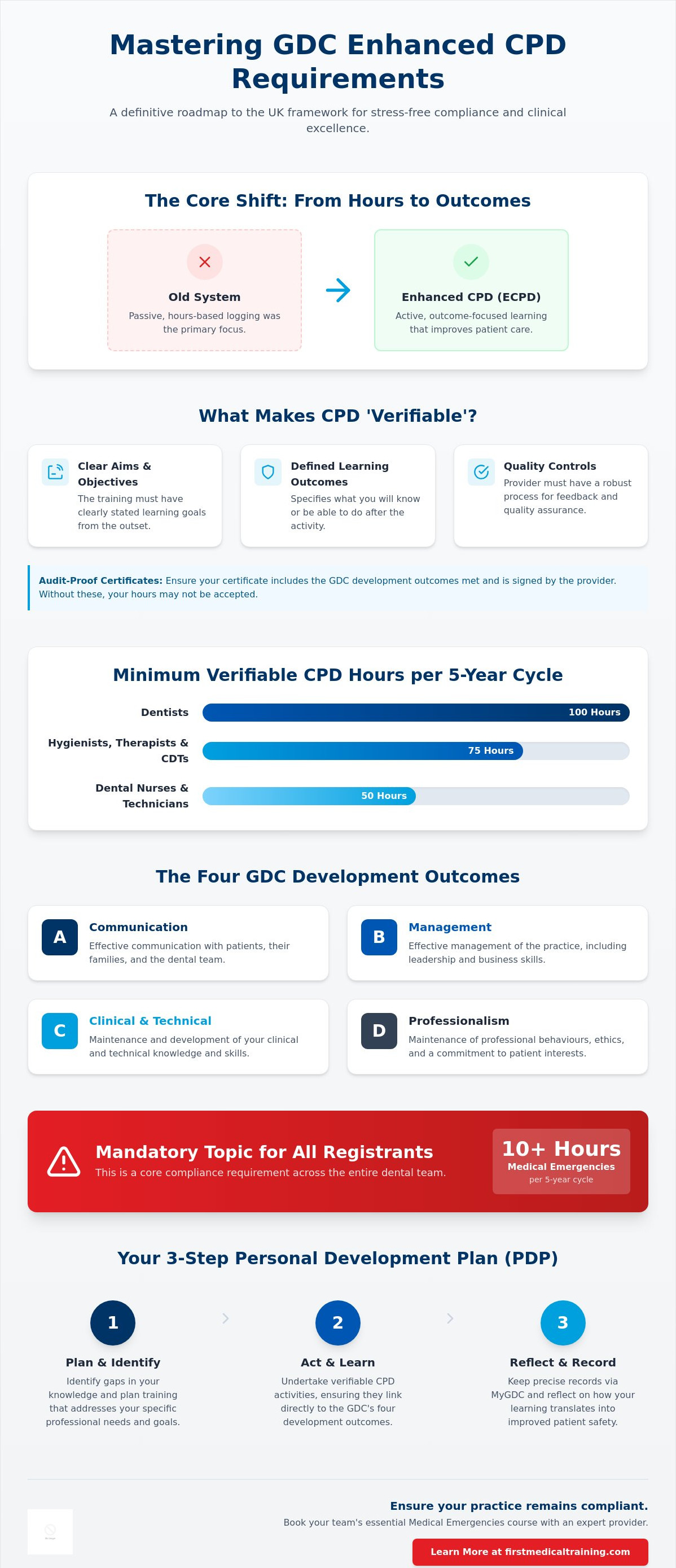
Enhanced CPD represents a fundamental shift in how the General Dental Council (GDC) views professional growth. Since the 2018 reforms, the focus has moved away from a passive, hours-based system towards a model rooted in tangible outcomes. It's no longer enough to simply attend a lecture and collect a certificate. The current framework demands that you actively demonstrate how your learning translates into improved patient care and safer clinical environments. For those managing the cpd requirements for dentists uk, this means every hour spent in training must be purposeful, reflective, and documented with precision.
The GDC requires every registrant to maintain a Personal Development Plan (PDP) to act as a strategic roadmap for their five-year cycle. This isn't just a bureaucratic hurdle; it's a tool designed to help you identify specific gaps in your knowledge and plan training that addresses them. By linking your learning to professional standards, you're essentially building a portfolio of clinical excellence. A deep Understanding Enhanced CPD (ECPD) allows you to move beyond compliance and towards a more rewarding career path where your skills stay sharp and relevant.
The Four GDC Development Outcomes
To ensure a holistic approach to professional development, the GDC categorises all verifiable CPD into four distinct outcomes. Your PDP should ideally reflect a balance across these areas over your cycle:
- Outcome A: Effective communication with patients, their families, and the wider dental team.
- Outcome B: Effective management of the dental practice, including leadership skills and business environments. To support this, Davis & Co LLP offers strategic guidance on business profitability and financial health for UK practice directors.
- Outcome C: Maintenance and development of your clinical and technical knowledge.
- Outcome D: Maintenance of professional behaviours and a commitment to ethical principles.
While these outcomes are specific to dental practice, many professionals also seek to broaden their commercial acumen. For those interested in mastering complex investment analysis, Financial Modelling University offers specialised online courses that provide advanced skills in financial structures and modelling.
Verifiable vs General CPD: What counts in 2026?
As of 2026, the GDC only requires you to record and submit verifiable CPD. General (non-verifiable) CPD, such as reading journals or informal discussions, is still valuable for your own growth, but it no longer appears on your annual GDC statement. To count as verifiable, your training must meet three strict criteria: it must have clear learning aims, defined outcomes, and a robust quality control process. When you receive a certificate, it must include the GDC development outcomes you've met and a signed declaration from the provider. Without these specific details, your hours might not stand up to an audit, potentially putting your registration at risk.
Breakdown of CPD Hours by Dental Role and Cycle
Understanding the specific numbers behind your registration is the first step toward a stress-free compliance plan. Every dental professional in the UK operates on a five-year fixed cycle, which begins on 1 January following your initial registration. Tracking your progress is now managed through the MyGDC portal, which replaced the eGDC system in March 2026. This digital shift streamlines the process, but the responsibility to maintain accurate records remains firmly with the registrant. To meet the cpd requirements for dentists uk, you must ensure your verifiable hours are spread reasonably across the cycle to avoid a last-minute rush.
Hourly Requirements by Professional Title
The GDC scales verifiable hour requirements based on your professional role and the scope of your clinical responsibilities. These targets ensure that every member of the multi-disciplinary team remains current in their field:
- Dentists: 100 hours of verifiable CPD per 5-year cycle.
- Dental Hygienists, Therapists, and Clinical Dental Technicians: 75 hours of verifiable CPD.
- Dental Nurses and Dental Technicians: 50 hours of verifiable CPD.
If you work in a dual role or change your registration type mid-cycle, your requirements will be calculated on a pro-rata basis. For example, if you move from being a dental nurse to a dental hygienist, your hourly target will adjust for the remaining years of your cycle. It's a pragmatic system that reflects your changing professional standing. To stay ahead of these targets, many practices find that booking a Medical Emergencies in a Dental Practice Course for the whole team is the most efficient way to bank hours whilst meeting core requirements.
Managing Your 5-Year Cycle Statement
Every year, you must submit an annual statement by 28 January, even if you have completed zero hours in that specific year. However, the 'rule of 10' is a critical safeguard you cannot ignore. You must complete at least 10 hours of verifiable CPD in any two-consecutive-year period. This prevents registrants from leaving all their learning until the final months of their cycle. Failing to meet these minimums or missing the submission deadline can lead to serious regulatory action. The grace period is a final opportunity to rectify hour shortfalls before registration is revoked. By aligning your training with the GDC Highly Recommended Topics, you ensure that your hours are not just numerous, but also relevant to the high standards expected of modern UK dentistry.
GDC Highly Recommended Topics: The Core of Compliance
While reaching your total hour target is a regulatory necessity, the General Dental Council prioritises specific subjects that have a direct impact on patient safety and professional standards. These are known as 'Highly Recommended' topics. They form the backbone of the cpd requirements for dentists uk, ensuring that every registrant remains competent in high-risk areas of practice. Unlike elective clinical training, these core subjects require regular updates to reflect the latest evidence-based protocols and legislative changes. Safety isn't a static goal; it's a continuous process of refinement.
For a standard five-year cycle, the GDC sets out clear hourly expectations for several key areas. Radiography and radiation protection require at least 5 hours of verifiable CPD, specifically for those who take or process radiographs. Similarly, disinfection and decontamination also demand a minimum of 5 hours. By spreading these requirements across your cycle, you ensure your practice remains a sterile, safe environment for both your patients and your team. These aren't just boxes to tick. They are the fundamental pillars of a well-run dental surgery.
Medical Emergencies: The Annual Gold Standard
The GDC recommends that all dental professionals complete at least 10 hours of medical emergencies training in every five-year cycle. However, the gold standard for clinical safety is to complete at least 2 hours of this training every single year. This consistent approach ensures that life-saving skills, such as basic life support and the use of an automated external defibrillator, remain instinctive. Relying on training from four years ago is a risk no professional should take. In a crisis, your team needs to act with immediate, calm precision.
A comprehensive Medical Emergencies in a Dental Practice Course is often the most effective way to meet these annual targets. Many practices now opt for Dental Immediate Life Support (ILS) as it provides more advanced techniques for managing airway obstructions and cardiac events. By committing to annual updates, you align your practice with the most rigorous General Dental Council (GDC) CPD requirements, protecting your registration whilst significantly enhancing patient outcomes.
Legal and Ethical Issues & Safeguarding
Professionalism extends beyond clinical skill. The GDC also highlights the importance of legal and ethical issues, including complaints handling and patient consent. Understanding the latest frameworks for safeguarding children and vulnerable adults is now a requirement for the entire dental team, not just the lead clinician. As we move through 2026, there is an increasing emphasis on mental health awareness within the dental environment. Recognising the signs of stress or burnout in both colleagues and patients is becoming a vital component of modern professional development, reflecting a more holistic approach to the human element of dental care.
Creating a Compliant Personal Development Plan (PDP)
A Personal Development Plan (PDP) serves as the strategic heart of your five-year cycle. It's the document that transforms a collection of certificates into a coherent narrative of professional growth. To satisfy the cpd requirements for dentists uk, your PDP must be established at the start of your cycle and updated as your clinical needs evolve. The GDC framework relies on three distinct pillars: Identify, Plan, and Do. By following this structure, you ensure that every training hour you log is relevant to your specific scope of practice and contributes directly to the safety of those in your care.
Organising your documentation is just as vital as the learning itself. Maintain a digital or physical CPD folder that includes your PDP, your activity log, and every certificate of completion. This level of organisation makes a potential GDC audit a straightforward, stress-free process rather than a cause for panic. If you're looking to fill a specific gap in your emergency protocols and strengthen your PDP, you can book a Medical Emergencies in a Dental Practice Course to ensure your team is fully prepared and compliant.
Identifying Your Learning Needs
Effective planning begins with honest self-assessment. Rather than choosing courses based on convenience, use clinical audits, peer reviews, and patient feedback to pinpoint genuine gaps in your knowledge. If an audit reveals a trend in your radiographic quality, for example, your PDP should reflect a specific goal to improve your imaging techniques. You must find a balance between the GDC's 'Highly Recommended' topics and your personal interests in specialist areas like restorative dentistry or orthodontics. To streamline this process, you can align your goals with GDC Recommended CPD Courses that are specifically designed to meet these regulatory standards.
The Art of Reflective Practice
The GDC places immense value on reflection. For every verifiable activity you complete, you must record a reflective statement that answers two key questions: what did you learn, and how will this change your clinical behaviour? Concise, impactful reflections are far more effective than lengthy summaries. An inspector wants to see that you've considered the impact of the training on your daily work. Reflection is the bridge between theoretical knowledge and improved patient safety in the dental chair. Without this critical step, your CPD remains a passive exercise rather than an active improvement of your professional standards.
Choosing the Best CPD Provider for Your Dental Team
Selecting a training partner is one of the most consequential decisions you'll make in your five-year cycle. It isn't merely about finding the lowest price or the most convenient location. The quality of your provider directly impacts the strength of your GDC evidence and your team's ability to respond to a clinical crisis. When evaluating options to meet the cpd requirements for dentists uk, you should prioritse organisations that combine regulatory expertise with deep clinical backgrounds. A high-quality provider doesn't just offer hours; they offer the certainty that your training will withstand the scrutiny of a random audit.
While online modules are excellent for theoretical topics like legal ethics or complaints handling, certain skills demand a physical presence. A hybrid approach often yields the best results for a busy practice. Team-based training is particularly effective for dental practice emergency preparedness, as it allows the entire staff to practice their specific roles in a coordinated response within their own clinical environment. Always check the credentials of your instructors. You want seasoned professionals who understand the practical realities of a dental surgery, not just theorists who haven't stepped into a clinical bay in years.
Why Practical Emergency Training Beats Online-Only
You cannot learn to save a life by clicking through a slideshow. Practical emergency training builds the muscle memory required to act decisively when a patient collapses in your chair. By simulating cardiac arrests, airway obstructions, or anaphylaxis in your own surgery, you familiarise yourself with your specific emergency drugs and equipment. This removes the hesitation that often occurs when using kit that has sat in a cupboard for months. The psychological benefit of team-wide confidence is immeasurable. When every nurse, hygienist, and dentist knows exactly where the AED is and how to deploy it, the practice becomes a significantly safer environment for everyone.
The Importance of Accredited Certificates
Every piece of verifiable CPD must be backed by a compliant certificate. The GDC is incredibly strict about what must be included on these documents. At a minimum, your certificate must show the date of the activity, the full title of the course, the specific GDC development outcomes met, and the name of the lead instructor or organisation. For medical emergency training, it's essential that the curriculum aligns with the latest Resuscitation Council UK (RCUK) guidelines. Anything less could leave your registration vulnerable during a review. Your professional development is an investment in your career and your patients' safety. To ensure you meet every standard with confidence, book your team's annual medical emergency training with First Medical Training.
Securing Your Professional Future through Clinical Excellence
Mastering the cpd requirements for dentists uk is less about counting hours and more about fostering a culture of continuous improvement. By shifting your focus toward the GDC's development outcomes and maintaining a proactive Personal Development Plan, you protect your registration whilst elevating the standard of care in your practice. Effective compliance relies on the bridge between theoretical knowledge and real-world application, particularly when managing high-stakes scenarios like medical emergencies. Meticulous record-keeping and reflective practice ensure that your professional development is both transparent and impactful.
Since 2006, we've acted as a trusted partner for dental professionals, delivering specialised training that meets the highest regulatory standards. Our courses are accredited by leading medical bodies and remain strictly aligned with Resuscitation Council UK (RCUK) guidelines, providing you with the authoritative evidence needed for a successful GDC audit. We understand the practical realities of the dental surgery and provide the tools necessary to keep your team ready for any crisis.
Proactive planning today guarantees a secure and successful five-year cycle for your entire team.
Frequently Asked Questions
How many CPD hours does a dentist need per year in the UK?
A dentist must complete a minimum of 100 hours of verifiable CPD over a five-year cycle. While this averages out to 20 hours annually, the GDC requires that you complete at least 10 hours of verifiable CPD in any two-consecutive-year period. This rule ensures that you maintain a steady pace of learning rather than leaving all your professional development until the end of your cycle.
What happens if I don't meet my GDC CPD requirements by the end of my cycle?
Failing to meet your hourly targets or missing the annual statement deadline puts your professional registration at risk. The GDC may grant a grace period to rectify shortfalls, but this is a final opportunity before you are removed from the register. If your registration is revoked, you'll need to undergo a formal restoration process, which involves paying fees and proving you've met all outstanding requirements.
Is medical emergency training mandatory for dental nurses every year?
The GDC highly recommends that all dental professionals, including dental nurses, complete at least 2 hours of medical emergency training every year. This consistent approach ensures that life-saving skills remain current and effective for the whole team. For those managing the cpd requirements for dentists uk, ensuring the entire practice attends an annual session is the most reliable way to maintain high safety standards.
Can I count 'reading dental journals' as verifiable CPD?
Reading dental journals typically counts as general CPD rather than verifiable CPD. For an activity to be verifiable, it must have clear learning aims, defined outcomes, and a robust quality control process with a valid certificate from the provider. Since 2026, general CPD is no longer recorded in your GDC statement, so you should focus on structured training that provides the necessary evidence for an audit.
How do I write a reflective statement for my GDC CPD record?
You should write a reflective statement by focusing on how a specific training activity has influenced your clinical practice. Start by identifying the knowledge or skills you gained and then explain how you'll apply these to improve patient care. A concise paragraph for each activity is sufficient. It serves as the bridge between theoretical learning and the practical safety of your patients in the chair.
What are the GDC 'Highly Recommended' topics for 2026?
The highly recommended topics include medical emergencies, disinfection and decontamination, and radiography and radiation protection. The GDC also suggests focusing on legal and ethical issues, safeguarding, and complaints handling. Newer recommendations for 2026 place a stronger emphasis on mental health awareness and the early detection of oral cancer to support a more holistic approach to patient health and team wellbeing.
Do I need to submit my CPD certificates to the GDC every year?
You don't need to submit your actual certificates annually; you only need to submit a statement of your completed hours via the MyGDC portal. However, you must keep your certificates and your Personal Development Plan for at least five years after your cycle ends. The GDC may perform a random audit at any time, requiring you to produce this evidence to prove you've met the cpd requirements for dentists uk.
How many hours of radiography CPD are required for dental hygienists?
Dental hygienists who take or process radiographs should complete a minimum of 5 hours of verifiable CPD in radiography and radiation protection during each five-year cycle. This requirement ensures that you remain up to date with safety protocols and the latest imaging techniques. If your role doesn't involve radiography, this topic isn't mandatory, but it remains a highly recommended area for maintaining a broad professional skill set.