

GDC Recommended CPD Courses: A Comprehensive Guide to Dental Compliance in 2026

An audit letter from the General Dental Council shouldn't be the catalyst that forces you to review your professional development plan. In reality, staying ahead of compliance is often the difference between a confident practice and one overshadowed by regulatory anxiety. Identifying and completing high-quality gdc recommended cpd courses is about more than just ticking boxes; it's about building a proactive safety culture that protects both your patients and your professional registration.
We understand that finding time for meaningful training whilst managing a busy surgery is a constant challenge. It's easy to feel confused by the distinction between verifiable and general hours or the specific requirements for your 2026 cycle. This guide provides a clear roadmap for your five-year cycle, giving you the certainty that your training meets every GDC standard. We'll provide a detailed breakdown of highly recommended topics, from medical emergencies to disinfection, and help you choose the best training formats to keep your entire dental team compliant and capable.
Key Takeaways
- Understand how to structure a robust Personal Development Plan (PDP) that aligns with the GDC’s Enhanced CPD requirements for your specific dental role.
- Identify the core subjects within gdc recommended cpd courses, distinguishing between "Highly Recommended" topics like medical emergencies and "Recommended" areas like safeguarding.
- Discover why the GDC suggests at least two hours of medical emergency training annually and how hands-on, in-practice sessions prevent critical "skill fade."
- Learn how to integrate mental health awareness and safeguarding into your training schedule to support a more holistic and patient-centred clinical environment.
- Gain a practical strategy for mapping out your five-year CPD cycle to ensure consistent compliance and avoid a stressful rush for verifiable hours at the end of the period.
Understanding the GDC Enhanced CPD Scheme and Recommended Topics
The Enhanced CPD scheme is the regulatory framework designed to ensure every dental professional maintains their skills through a structured, reflective approach. Managed by the General Dental Council (GDC), this scheme moved away from the old "general" hours model in 2018. Identifying the right gdc recommended cpd courses starts with understanding your Personal Development Plan (PDP). This document is your roadmap; it's where you identify your learning needs based on your specific role and the patients you serve. Without a PDP, your CPD hours aren't considered valid under current standards.
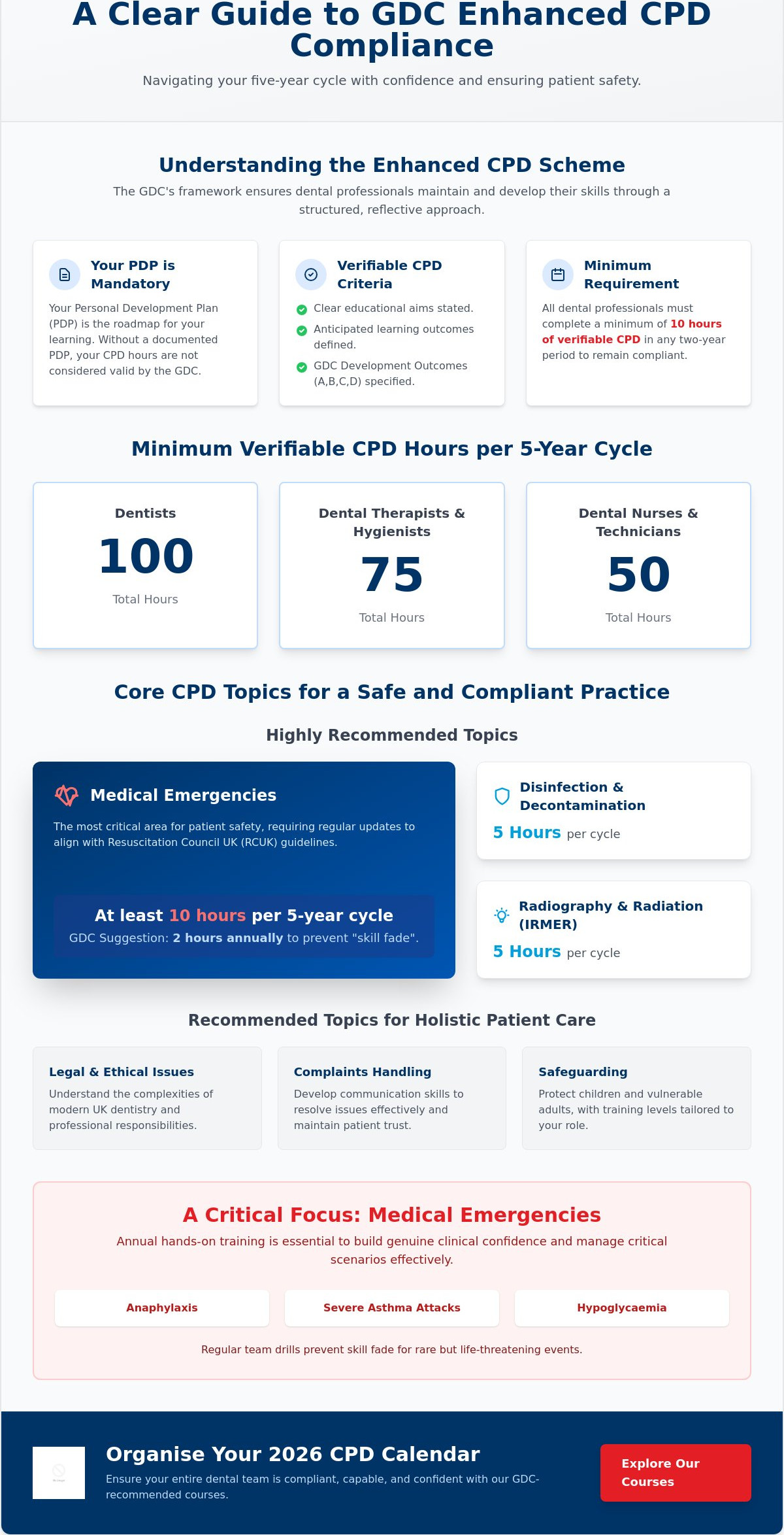
To count as "verifiable," your training must meet strict criteria. Every certificate you receive needs to state the educational aims, the anticipated learning outcomes, and the specific GDC development outcomes (A, B, C, or D) addressed. If a certificate lacks these details, it won't satisfy an auditor. By 2026, most registrants will be well into their five-year cycles, making it vital to track your progress. Dentists are required to complete 100 hours, whilst dental therapists and hygienists need 75. Dental nurses and technicians must complete 50 hours. Regardless of your title, you must finish at least 10 hours of verifiable CPD in any two-year period.
The "Highly Recommended" Core Topics
The GDC identifies specific subjects as "highly recommended" because they are fundamental to patient safety. Medical emergencies is the most critical, with a requirement for at least 10 hours per five-year cycle. We suggest aim for two hours of annual training to keep these life-saving skills fresh. Disinfection and decontamination requires five hours per cycle to maintain clinical standards. For dentists and therapists who take X-rays, radiography and radiation protection (IRMER) also demands five hours per cycle. Choosing high-quality gdc recommended cpd courses in these areas ensures your practice remains a safe environment for everyone.
The "Recommended" Training Areas
Beyond the core clinical subjects, the GDC suggests several "recommended" topics that support a holistic approach to patient care. These include legal and ethical issues, where you'll explore the complexities of modern UK dentistry. Complaints handling is equally important, focusing on professional communication to resolve issues before they escalate. Safeguarding children and vulnerable adults is a mandatory focus, with training levels (1, 2, or 3) depending on your level of responsibility. These topics ensure your practice isn't just clinically sound, but also ethically robust and patient-centred.
Deep Dive: Medical Emergencies and Dental Immediate Life Support (ILS)
Medical emergencies represent the most critical category of gdc recommended cpd courses. While some topics allow for a flexible approach, emergency response requires immediate, precise action. The GDC suggests at least 10 hours of verifiable training per five-year cycle, ideally broken down into two hours annually. This isn't just a regulatory hurdle. It ensures that your entire team's knowledge remains current with the latest Resuscitation Council UK (RCUK) guidelines. When a patient's life is on the line, there's no room for hesitation or outdated protocols.
The RCUK sets the gold standard for resuscitation in the UK, providing the evidence-based frameworks that underpin all professional medical training. Aligning your learning with these standards ensures your practice meets the necessary GDC development outcomes, particularly those focusing on clinical skills and patient safety. By maintaining this annual rhythm, you ensure that life-saving skills stay sharp and that your practice remains a safe environment for every patient who walks through the door.
Managing Critical Scenarios in the Chair
A comprehensive medical emergencies in dental practice course goes far beyond basic chest compressions. You must be prepared for a range of acute issues, including anaphylaxis, severe asthma attacks, and hypoglycaemia. These events are rare, which is precisely why they're dangerous. Without regular practice, skills fade. Annual team drills are essential to build genuine clinical confidence. They allow you to test your emergency drugs and equipment within your own surgery environment, ensuring every staff member knows their exact role. This hands-on approach demystifies complex procedures and empowers your team to act decisively in a crisis.
The Role of Dental ILS in 2026
By 2026, the distinction between Basic Life Support (BLS) and Dental Immediate Life Support (ILS) has become increasingly significant for modern practices. While BLS provides a foundation, ILS is often the expected standard for clinics performing conscious sedation or complex surgical procedures. It covers advanced airway management and the sophisticated use of an Automated External Defibrillator (AED) in a dental setting. First Medical Training ensures these sessions align with both GDC and RCUK standards, providing a higher level of readiness. If you're looking to elevate your team's response capabilities, booking a dedicated Medical Emergencies in a Dental Practice Course is a proactive step toward total clinical safety.
Recommended Topics for a Holistic Practice: Safeguarding and Mental Health
A truly effective Personal Development Plan (PDP) extends beyond clinical hand-skills to address the human element of dentistry. Whilst the core subjects ensure technical safety, the broader range of gdc recommended cpd courses focuses on the welfare of both the patient and the practitioner. The GDC Enhanced CPD Scheme encourages this holistic approach, recognising that a clinician's ability to communicate, empathise, and identify vulnerability is just as vital as their surgical precision. By diversifying your training, you create a practice environment that is resilient, ethical, and deeply patient-centred.
Broadening your learning objectives also yields significant internal benefits. A well-rounded CPD plan that addresses softer skills and mental wellbeing has been shown to reduce staff turnover and improve patient rapport. When your team feels supported and equipped to handle the emotional complexities of modern dentistry, they perform better and stay in their roles longer. This stability directly translates to a higher standard of care and a more positive reputation for your surgery.
Mental Health First Aid for Dental Teams
The dental surgery is a high-pressure environment where stress and burnout can easily take root amongst colleagues. It's becoming increasingly clear that staff mental health is inextricably linked to patient safety outcomes. A distracted or overwhelmed professional is more likely to make errors or miss subtle clinical cues. Implementing a framework through Mental Health First Aid for Dental Practices allows your team to recognise the early signs of struggle in themselves and others. This training provides practical steps to offer support, fostering a culture of steady reliability and mutual care that protects your practice's most valuable asset: its people.
Safeguarding and Legal Compliance
Safeguarding is a critical "Recommended" topic that requires constant vigilance and regular updates. To meet the Intercollegiate Document requirements for 2026, every staff member must understand their specific reporting obligations for children and vulnerable adults. This isn't a static field; UK legislation and best practices evolve, making it essential to revisit this training frequently. Navigating the legal and ethical complexities of patient confidentiality whilst ensuring vulnerable individuals are protected is a delicate balance. High-quality gdc recommended cpd courses in safeguarding provide the clarity needed to act decisively and legally, ensuring your practice remains a safe haven for every member of the community.
Online vs. In-Practice Training: Choosing the Right Format
Selecting the most effective delivery method for your gdc recommended cpd courses requires a pragmatic look at the learning outcomes you need to achieve. Whilst digital platforms offer undeniable convenience, they aren't a universal solution for every compliance requirement in a modern dental surgery. A balanced approach for your 2026 budget involves distinguishing between theoretical knowledge that can be absorbed remotely and practical skills that demand physical presence. Relying solely on "on-demand" modules for high-stakes clinical scenarios can lead to a dangerous "skill fade" where the ability to act in a crisis diminishes over time.
Your dental practice emergency preparedness is significantly enhanced when training happens within your actual clinical environment. This allows your team to navigate the physical layout of the surgery and locate emergency equipment under pressure. The goal is clinical effectiveness, not just cost-efficiency. By choosing the right format for the right topic, you ensure that your team isn't just ticking boxes but is genuinely prepared to handle any situation that arises in the chair.
When to Choose Online CPD
Remote learning is ideal for theoretical topics that don't involve manual dexterity or team-based physical response. Subjects such as legal and ethical issues, complaints handling, or professional communication are well-suited to online modules. This format allows individual staff members to complete their required hours at their own pace without disrupting the surgery schedule. Online courses also serve as an excellent "refresher" between more intensive, in-person training sessions, keeping compliance topics at the forefront of your team's minds throughout the year without the need for additional travel or downtime.
The Irreplaceable Value of In-Practice Training
For core clinical requirements, nothing replaces the value of hands-on practice. Building muscle memory through physical interaction with AEDs, airway adjuncts, and emergency drugs is vital for a successful cardiac arrest management scenario. These sessions foster team cohesion, teaching staff to work together seamlessly when seconds count. An on-site instructor provides tailored advice, assessing your specific surgery layout and ensuring your emergency kits are correctly organised. This level of personalised feedback is impossible to replicate in a digital environment. To ensure your team meets the highest standards of safety, you should book professional training sessions that bring the expertise directly to your surgery.
Organising Your 2026 CPD Calendar with First Medical Training
Success in dental compliance is rarely the result of a last-minute scramble for hours. It requires a disciplined, methodical approach to your five-year cycle. By mapping out your requirements early, you avoid the common pitfall of professional development anxiety as your submission deadline approaches. High-quality gdc recommended cpd courses should be spaced logically across your calendar; this ensures that learning is continuous and impactful rather than a box-ticking exercise at the end of the term.
Booking group training sessions for your entire dental team is one of the most efficient ways to manage this schedule. It ensures that every staff member, from the lead clinician to the dental nurse, receives the same high standard of instruction simultaneously. This collective approach not only streamlines your administration but also builds a shared language of safety within the practice. When everyone understands the protocol for a medical emergency or a safeguarding concern, the surgery operates with a level of steady reliability that patients can sense and trust.
Choosing a training provider that understands the nuances of the 2026 standards is essential. First Medical Training provides GDC-compliant, verifiable certificates that clearly state learning aims, outcomes, and development outcomes. Beyond the education itself, we help you bridge the gap between knowledge and action by equipping your surgery with life-saving technology. Integrating tools like the Automated External Defibrillator (AED) Training Course and the LifeVac Anti-Choking Device into your practice ensures that your team has the physical resources to match their clinical skills.
Bespoke Training Solutions for Modern Surgeries
Every dental practice has unique needs based on its patient demographic and the specific treatments offered. We specialise in tailoring our Medical Emergencies and ILS courses to fit your surgery's specific environment. Many practices find it efficient to combine multiple gdc recommended cpd courses into a single, intensive training day. For example, pairing Medical Emergencies with Safeguarding training maximises your team's time whilst fulfilling multiple core requirements. Our approach is professional, authoritative, and designed to demystify complex procedures, leaving your team feeling empowered rather than overwhelmed.
Next Steps for Compliance and Confidence
Your immediate priority should be a thorough review of your current Personal Development Plan against the GDC 2026 recommendations. Identify any gaps in your "Highly Recommended" topics and check that your medical emergency training is up to date for the current year. Maintaining verifiable compliance is a continuous journey that requires a dependable partner. Take the first step toward a more organised and confident practice today by reviewing your training needs. View our full range of GDC-compliant dental CPD courses to secure your practice's future and ensure the highest standards of patient safety.
Securing Clinical Excellence for 2026 and Beyond
Navigating the requirements of the Enhanced CPD scheme doesn't have to be a source of stress. By maintaining a structured Personal Development Plan and prioritising hands-on training for high-stakes clinical scenarios, you ensure your practice remains both compliant and safe. We've explored how the right mix of gdc recommended cpd courses, from medical emergencies to safeguarding, builds a resilient team culture. Practical, in-person sessions are the most effective way to combat skill fade and guarantee that every staff member can act decisively in a crisis.
First Medical Training has been a trusted partner in dental education since 2006. We provide accredited, specialised training including Dental Immediate Life Support (ILS) and Mental Health First Aid for Dental Practices. As suppliers of the LifeVac anti-choking device, we are committed to providing the tools and knowledge necessary for total patient safety. Don't wait for your next audit to review your training standards. Book Your GDC-Compliant Medical Emergencies Course Today and gain the peace of mind that comes with expert-led professional development. Your commitment to high-quality training is the ultimate investment in your patients' care and your team's professional confidence.
Frequently Asked Questions
What are the GDC "Highly Recommended" CPD topics for 2026?
The GDC identifies three core subjects as "Highly Recommended" for every five-year cycle: Medical Emergencies, Disinfection and Decontamination, and Radiography and Radiation Protection. Dentists and therapists must complete at least five hours each in decontamination and radiography. Medical emergencies requires at least 10 hours per cycle. These subjects are prioritised because they form the foundation of clinical safety and professional standards in every UK surgery.
How many hours of Medical Emergencies CPD do I need per year?
You should aim to complete at least two hours of Medical Emergencies training every year. While the GDC requires a minimum of 10 hours across your five-year cycle, spreading this out annually prevents dangerous skill fade. Regular practice ensures your team remains confident using emergency drugs and equipment, such as an AED, ensuring you're always prepared for a crisis in the chair.
What makes a CPD course "verifiable" for the GDC?
Verifiable CPD must include clear educational aims, anticipated learning outcomes, and a process for participant reflection or feedback. The certificate you receive must state the date, the number of hours, and which GDC development outcomes the training addressed. Choosing gdc recommended cpd courses from established providers ensures your documentation meets these strict criteria, protecting you during a potential GDC audit.
Is Mental Health First Aid a GDC recommended topic?
Whilst Mental Health First Aid isn't explicitly a "Highly Recommended" core subject, it's strongly encouraged under the GDC's broader recommendation for topics that support patient and staff wellbeing. It aligns with development outcomes focused on communication and effective team management. Many modern practices now include this in their PDPs to help colleagues recognise signs of stress and burnout in a high-pressure environment.
Do dental nurses need the same CPD courses as dentists?
Dental nurses focus on the same "Highly Recommended" core topics but have a lower total hour requirement. Nurses must complete 50 hours of verifiable CPD per five-year cycle, whilst dentists must complete 100 hours. Both roles must prioritise medical emergencies and safeguarding. However, the specific depth of training in areas like radiography or clinical skills will vary based on their individual daily responsibilities and PDP goals.
Can I do all my GDC recommended CPD online?
You can complete the theoretical parts of gdc recommended cpd courses online, but the GDC values hands-on training for practical, life-saving skills. Medical emergencies and ILS are most effective when practiced in person. This build muscle memory and tests team coordination. A blended approach is often best: use digital modules for legal or ethical updates whilst maintaining clinical safety through annual in-practice drills.
What happens if I fail to meet my GDC CPD requirements?
Failing to meet your CPD requirements can lead to the GDC removing your name from the professional register. This means you'd be legally unable to practise dentistry in the UK. If you're struggling to meet your targets, you must contact the GDC immediately to explain your situation. Maintaining a proactive Personal Development Plan is the most reliable way to avoid these serious regulatory consequences.
How often should a dental team undergo ILS training?
Dental teams should undergo Dental Immediate Life Support (ILS) training at least once every year. This frequency follows Resuscitation Council UK guidelines and ensures that advanced skills, such as airway management and AED use, remain sharp. Annual sessions allow the entire team to practice together in their own clinical environment, ensuring everyone knows their exact role when a patient's life is at risk.