

Defibrillator Training for Dental Practice: The 2026 Guide to Compliance and Clinical Excellence

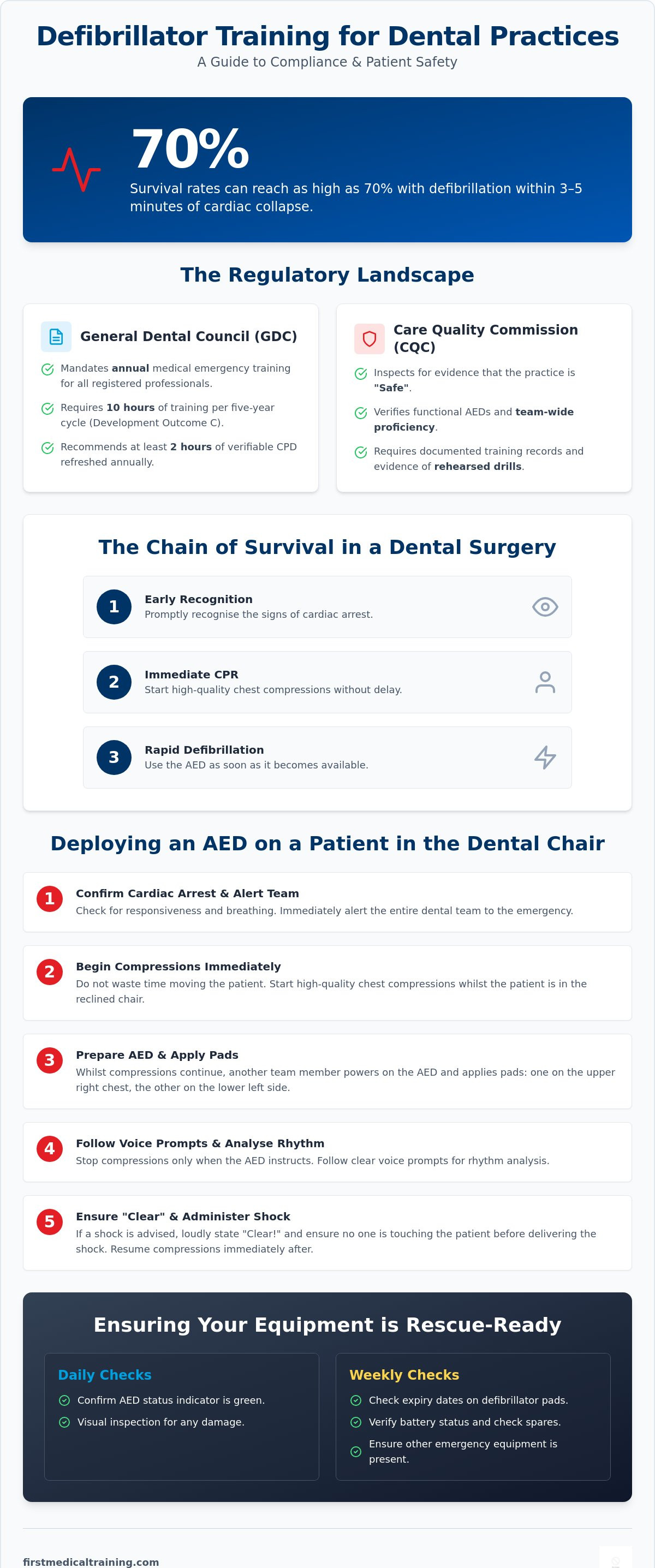
Did you know that defibrillation within three to five minutes of a cardiac collapse can lead to survival rates as high as 70%? In a high-stakes clinical environment, securing the right defibrillator training for dental practice is about more than just meeting a mandate; it is about the choreography of a life-saving response. Many clinicians feel a genuine sense of anxiety at the thought of managing a cardiac arrest whilst a patient is in the dental chair, often struggling to distinguish between standard BLS and the specific requirements of Dental Immediate Life Support (ILS).
It is perfectly normal to feel overwhelmed by the pressure of annual GDC verifiable CPD requirements and the latest CQC standards. This guide will help you master the 2026 regulatory landscape and clinical protocols to ensure your surgery remains fully compliant. We will explore how to integrate AED use into your daily practice, manage your records via the MyGDC portal, and empower your entire team to act with steady, professional confidence during a medical emergency. By the end of this article, you will have a clear roadmap for achieving clinical excellence and protecting both your patients and your professional registration.
Key Takeaways
- Understand the latest GDC mandates and Resuscitation Council UK standards that require annual medical emergency training for all registered dental professionals.
- Master the essential protocols of defibrillator training for dental practice to manage cardiac emergencies effectively within the unique physical constraints of a clinical surgery.
- Learn the specific step-by-step techniques for deploying an AED whilst a patient is reclined in the dental chair to ensure rapid, safe intervention.
- Establish a robust maintenance routine with daily and weekly checklists to guarantee your AED and emergency equipment are always rescue-ready.
- Discover how clinical-led training sessions can transform regulatory compliance into a confident, coordinated team response that prioritises patient safety.
The Regulatory Landscape of Defibrillator Training for Dental Practices
Compliance in a dental surgery isn't a static box to tick; it's a dynamic commitment to patient safety. The General Dental Council (GDC) mandates annual medical emergency training for all registered professionals because a crisis doesn't wait for a convenient time. These standards are underpinned by the Resuscitation Council UK (RCUK), which provides the definitive clinical framework for primary dental care in the United Kingdom. Central to this preparedness is the Automated External Defibrillator (AED), a device that can mean the difference between life and death during a cardiac arrest. Understanding how these regulations intersect is the first step toward clinical excellence.
GDC Enhanced CPD and Development Outcome C
The GDC's Enhanced CPD framework categorises defibrillator training for dental practice under Development Outcome C. This specific outcome focuses on the maintenance and development of your knowledge and skills within your field of practice. To remain compliant, all dental professionals must complete at least 10 hours of medical emergencies training within every five-year cycle. However, the GDC highly recommends that at least two hours of this verifiable CPD is refreshed annually. This isn't just about collecting certificates. It's about ensuring that life-saving skills stay sharp and that the entire team can operate as a cohesive unit when every second counts. Relying on general first aid knowledge isn't enough; the GDC expects training that is specifically relevant to the dental environment.
CQC Inspections and Emergency Preparedness
When the Care Quality Commission (CQC) assesses a practice, they look for evidence that the service is "Safe." Inspectors verify that the practice is not only equipped with a functional AED but that every team member, including non-clinical staff, is proficient in its use. Documentation is vital. You must be able to present training records that prove your staff have undergone regular, practical drills. Integrating comprehensive defibrillator training for dental practice into your broader dental practice emergency preparedness protocols demonstrates a culture of proactive safety. The CQC expects to see that your emergency equipment is checked regularly and that your team response is rehearsed. This specialised focus distinguishes dental CPD from standard workplace first aid, as it accounts for the clinical complexities of a surgery setting, such as managing a patient who is physically restricted by the dental chair.
Core Components of a Comprehensive Dental AED Training Programme
Effective resuscitation in a clinical setting requires a structured approach that adapts the standard "Chain of Survival" to the specific environment of a dental surgery. This chain begins with early recognition of cardiac arrest, followed by immediate chest compressions and rapid defibrillation. By adhering to the General Dental Council guidance on medical emergencies, practices can ensure they possess both the necessary equipment and the expertise to intervene successfully. Chaos is the enemy of survival; a well-rehearsed team knows exactly who fetches the AED, who starts compressions, and who manages the airway.
Safe operation of the device is a central pillar of defibrillator training for dental practice. Staff must be proficient in pad placement, typically positioning one pad on the upper right sternum and the other at the heart's apex on the lower left side. Whilst the AED is being prepared and pads are applied, high-quality chest compressions must continue without interruption to maintain cerebral perfusion. Once the device begins its rhythm analysis, the operator must ensure a "clear" protocol is strictly followed, confirming that no team member is in contact with the patient before a shock is delivered. Modern units provide clear voice prompts to guide the team through these high-pressure moments, but clinical confidence only comes through regular, hands-on practice.
Beyond Basic Life Support (BLS)
While BLS provides a foundation, dental teams are increasingly moving towards Immediate Life Support (ILS) standards. This higher level of training introduces the use of a Bag-Valve-Mask (BVM) and airway adjuncts, which are significantly more effective than mouth-to-mask ventilation when combined with supplemental oxygen. Rapid defibrillation remains the priority, ideally achieved within the first 3-5 minutes of collapse to maximise survival chances. Investing in a specialised medical emergencies in a dental practice course allows the whole team to rehearse these advanced skills using the specific equipment found in their own emergency kits.
The Role of Defibrillation in Cardiac Arrest Management
An Automated External Defibrillator delivers a precise electrical charge that stops the heart's chaotic ventricular fibrillation, allowing its natural internal rhythm to restart. Modern AEDs are designed with sophisticated safety features that prevent a shock from being delivered if a shockable rhythm is not detected. This removes the burden of diagnosis from the responder, allowing them to focus on the technical execution of the rescue. Ultimately, clear team communication is the most critical factor in successful defibrillation. Every member should know how to interpret voice prompts and coordinate their actions to ensure that life-saving shocks are delivered with minimal delay.
Clinical Scenarios: Deploying an AED in the Dental Chair
A cardiac arrest in a dental surgery rarely occurs in a spacious, clear environment. Most often, the patient is already reclined in the dental chair, surrounded by high-speed handpieces, suction tubes, and clinical cabinetry. This physical reality is why generic first aid courses often fail to prepare a team for the actual event. Effective defibrillator training for dental practice must address the logistical hurdles of the surgery floor. When a patient collapses, the team must act with drilled precision to transform a restricted clinical space into a life-saving environment within seconds. Precision is the antidote to panic in these high-pressure moments.
The "Patient in the Chair" Challenge
Effective chest compressions require the patient to be on a firm, flat surface. If the patient is in a modern dental chair, the immediate priority is to lower the chair to its lowest possible position and ensure it is fully reclined into a supine position. Whilst some historical debates suggested moving every patient to the floor, the Resuscitation Council UK Quality Standards acknowledge that modern dental chairs often provide a stable enough platform if properly positioned. Moving a dead-weight patient in a confined surgery space frequently leads to significant delays in CPR and potential injury to staff. Safe pad placement is equally critical; the team must ensure the chest is dry and clear of any clinical debris before the AED is attached. If the chair's design or the patient's position prevents effective, deep compressions, only then should a coordinated move to the floor be considered.
Co-ordinating the Team Response
Success depends on a structured 4-person response model. The lead clinician typically oversees the scene, whilst the second person manages the airway using supplemental oxygen and a BVM. The third person provides continuous chest compressions, and the fourth member fetches the emergency kit, calls 999, and operates the AED. This division of labour prevents the bystander effect where everyone assumes someone else has initiated the emergency call. It's also vital to consider the waiting room scenario. Your defibrillator training for dental practice should include drills for responding to visitors or family members who may collapse in non-clinical areas. For a deeper look at these protocols, refer to our cardiac arrest response dental team guide. Finally, ensure a clear handover protocol is in place. When the ambulance crew arrives, the lead clinician should provide a concise report including the number of shocks delivered and the time of collapse.
Maintaining Compliance and Equipment Readiness in the Surgery
Possessing an Automated External Defibrillator is a fundamental requirement, but its presence alone does not guarantee safety. A device is only as effective as the maintenance schedule that supports it. In the high-pressure environment of a dental practice, equipment can easily be overlooked amongst the daily demands of patient care. Establishing a rigorous routine for checking your emergency kit ensures that when a crisis occurs, your tools perform exactly as intended. This level of diligence is a hallmark of a practice committed to clinical excellence and robust GDC compliance; modern surgeries like Dental11 serve as a prime example of how such standards are maintained in a professional environment.
One often overlooked legal and safety consideration is the registration of your device with "The Circuit," the national defibrillator network. By ensuring your AED is registered, you allow emergency services to see its location and status in real-time, potentially helping bystanders nearby in a community emergency. Within the surgery, your internal defibrillator training for dental practice should include a clear protocol for who is responsible for these checks. If you need to upgrade your current kit or require professional advice on placement, you can browse our range of emergency equipment and defibrillators to ensure your surgery meets the highest standards.
AED Maintenance Protocols for Dental Practices
Your morning surgery setup should always include a visual check of the AED's status indicator light. Most modern units perform self-tests and will display a green tick or a flashing light to signal they are rescue-ready. If the indicator changes colour or emits a "chirp," the battery or pads may need urgent attention. It's vital to keep spare electrode pads, including paediatric pads, within the emergency kit at all times. Electrode pads have a typical shelf-life of 2-5 years, after which the conductive gel can dry out, rendering them ineffective during a shock. Monitoring these expiry dates must be a documented part of your weekly practice meetings.
Mock Drills and Scenario-Based Learning
Technical readiness is only half the battle; your team must also be mentally prepared. Running "no-notice" cardiac arrest drills is the most effective way to test your team's response times and identify any bottlenecks in your protocol. These drills should focus heavily on the "platinum minute," the first 60 seconds from the recognition of collapse to the application of AED pads. Using training AEDs that mimic the practice’s actual equipment allows staff to become familiar with the specific voice prompts they will hear in a real emergency. After every drill or real-world event, conduct a structured debrief. This allows the team to process the emotional impact of the crisis whilst refining their clinical workflow for the future.
Elevating Practice Safety with First Medical Training
Choosing a training provider is a decision that impacts the safety of your patients and the legal standing of your registration. First Medical Training bridges the gap between regulatory theory and clinical reality through our specialised medical emergencies in dental practice course. Our instructors come from active clinical backgrounds, often serving as paramedics or advanced healthcare practitioners. This means they don't just teach from a manual; they bring real-world experience of cardiac arrests and medical crises into your surgery. This depth of knowledge ensures that your defibrillator training for dental practice is grounded in the practicalities of emergency response.
We believe that training should be a supportive experience that builds team confidence rather than an overwhelming technical lecture. By simplifying the CPD recording process, we provide verifiable certificates that meet every GDC requirement; this allows you to focus on patient care. Our methodical approach respects your time and ensures that every minute of the session adds tangible value to your professional development.
Our Dental ILS and AED Solutions
Every dental practice has a unique layout and a specific patient demographic. We tailor our course content to reflect these realities, whether you're a high-street general practice or a specialist sedation clinic. Effective emergency response involves more than just the AED; it's about the integration of all your life-saving tools. This includes training on the LifeVac anti-choking device UK and the correct administration of emergency drugs. We ensure that every staff member, from the receptionist who coordinates with the 999 operator to the specialist clinician, understands their specific role in the rescue chain.
Why Professional In-Practice Training Wins
Practising in your own clinical environment is a game-changer for team preparedness. There's a significant psychological benefit to rehearsing a cardiac arrest response in the exact room where it might occur. It allows us to identify "blind spots" in your surgery layout, such as restricted access to the AED or difficult positioning around a specific dental chair. These practical insights are impossible to gain in a generic classroom setting. Booking your 2026 update now ensures you stay ahead of regulatory shifts and maintain the clinical confidence required to protect your patients. We act as your dependable partner, turning rigorous compliance into a seamless part of your practice’s daily excellence.
Securing Clinical Excellence and Patient Safety
Mastering defibrillator training for dental practice is the cornerstone of a safe clinical environment. We have explored the necessity of annual GDC compliance, the technical nuances of deploying an AED in a restricted surgery space, and the vital importance of rigorous equipment maintenance. These elements combine to transform a potential crisis into a managed, professional response that protects both your patients and your practice’s reputation.
At First Medical Training, we bring two decades of expertise, founded in 2006, to help your team bridge the gap between regulatory requirements and real-world application. Our expert instructors draw on their active clinical experience to deliver training that is practical, accessible, and deeply reassuring. Every attendee receives a GDC-compliant verifiable CPD certificate, ensuring your practice remains fully documented and inspection-ready. Our methodical approach respects your time whilst building the genuine confidence your team needs to save a life.
Don't wait for an emergency to test your preparedness. Book your in-practice Dental AED and Medical Emergencies training today and empower your staff to act with certainty. Protecting your patients and your professional registration starts with a single, proactive step toward clinical excellence.
Frequently Asked Questions
Is it a legal requirement for every dental practice to have an AED?
Yes, it is a mandatory requirement for all clinical dental areas to have immediate access to an Automated External Defibrillator. Both the Resuscitation Council UK and the General Dental Council state that an AED must be available to manage cardiac emergencies. This ensures that the practice can provide the highest standard of care and meet the necessary safety criteria during a CQC inspection.
How often do dental staff need to undergo defibrillator training?
All staff must undergo practical defibrillator training for dental practice annually. While the GDC requires 10 hours of medical emergencies CPD over a five-year cycle, the recommended best practice is to complete at least two hours of this training every year. Regular updates ensure that the team's skills remain sharp and that everyone is familiar with the specific equipment kept on-site.
Can dental receptionists use the AED or is it only for clinicians?
Yes, every member of the team, including non-clinical personnel like receptionists, should be trained to use the AED. In a crisis, the receptionist is often the person who retrieves the emergency kit or coordinates with the ambulance service. Ensuring they are confident in basic life support and AED operation creates a more robust and coordinated team response within the surgery.
Does the GDC accept online-only AED training for verifiable CPD?
No, the GDC and RCUK prioritise hands-on, practical training over online-only modules for medical emergencies. Verifiable CPD must have clear learning aims and defined outcomes, which are best achieved through in-practice rehearsals. Practising with physical equipment in your actual clinical environment is essential for building the muscle memory required to act effectively during a real-world cardiac arrest.
What is the difference between BLS and ILS training for dental teams?
Basic Life Support (BLS) covers the fundamentals of CPR and AED use, whilst Immediate Life Support (ILS) includes advanced skills like airway management with adjuncts and bag-valve-masks. ILS is increasingly the industry standard for practices offering sedation or complex procedures. It provides a more comprehensive framework for managing a deteriorating patient until the ambulance crew arrives to take over.
Should we use paediatric pads for children in the dental surgery?
You should use paediatric pads for children under the age of eight if they are available in your emergency kit. These pads reduce the energy level of the shock to a safer level for a child's smaller body. If paediatric pads aren't available, the Resuscitation Council UK guidelines state that standard adult pads can be used as a life-saving alternative for children.
What happens if the AED fails during a medical emergency?
If the AED fails, you must immediately revert to providing continuous, high-quality chest compressions and rescue breaths. Whilst modern units are highly reliable and perform daily self-tests, mechanical issues can occur. This is why documented daily checks of the status indicator light are critical. If you have followed all maintenance protocols, your focus remains on manual resuscitation until professional help arrives.
How much time should we allocate for an annual medical emergency update?
You should allocate at least two hours for your annual medical emergency update to ensure a thorough review of all protocols. This time allows for a mix of theoretical knowledge and practical mock drills within the surgery. Comprehensive defibrillator training for dental practice ensures that every staff member feels empowered and ready to respond to a variety of clinical scenarios without hesitation.