

Dental Medical Emergency Certificate: The 2026 Guide to GDC Compliance and Clinical Confidence

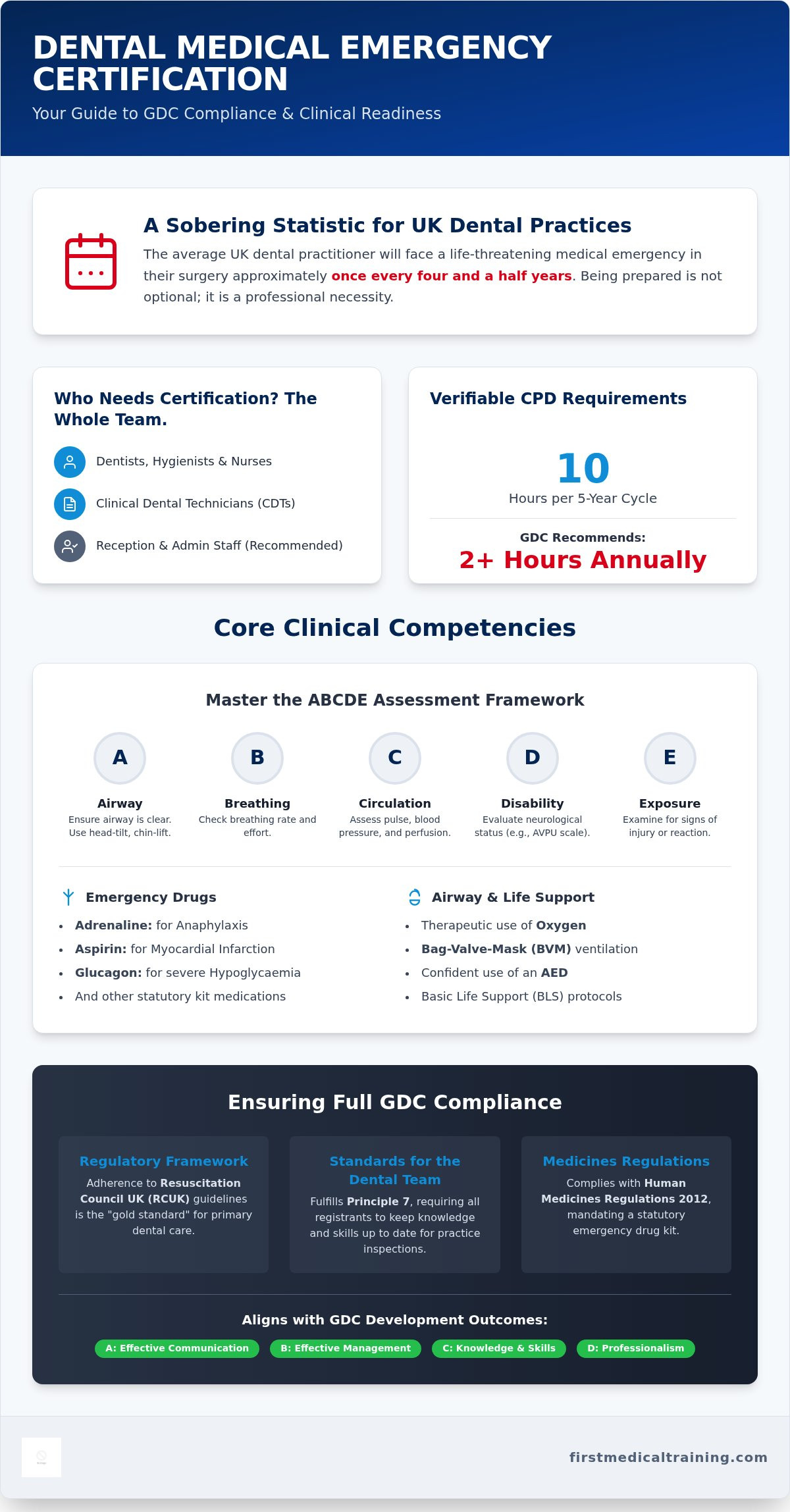
Did you know that the average UK dental practitioner will face a life-threatening medical emergency in their surgery approximately once every four and a half years? It's a sobering statistic that explains why the pressure to maintain your dental medical emergency certificate often feels like more than just a regulatory box-ticking exercise. We understand the genuine anxiety that comes with the thought of a patient collapse or the stress of ensuring every team member meets the GDC's stringent 2026 standards during an inspection.
Mastering these essential requirements is about more than avoiding professional sanctions; it's about building the clinical confidence to act when seconds count. In this guide, we'll clarify exactly how to secure your dental medical emergency certificate whilst fulfilling your 10-hour verifiable CPD cycle. You'll learn about the latest Resuscitation Council UK protocols, the role of modern tools like the LifeVac device, and how to organise a well-coordinated team response. We're here to bridge the gap between complex regulations and practical, life-saving readiness in your practice.
Key Takeaways
- Identify the essential components of a GDC-compliant training programme to ensure your practice is always prepared for an unannounced inspection.
- Master the ABCDE assessment framework to transform a high-pressure patient collapse into a structured, clinical response.
- Learn how to secure a verifiable dental medical emergency certificate that validates your team's ability to perform Basic Life Support and use an AED with confidence.
- Establish a robust practice protocol that ensures every staff member knows their role whilst maintaining emergency drug kits and oxygen supplies.
- Align your professional development with GDC Development Outcomes A, B, C, and D to meet and exceed annual retention requirements.
Understanding the Dental Medical Emergency Certificate Requirements in 2026
A dental medical emergency certificate is more than a simple document stored in a compliance folder; it represents a commitment to patient safety and clinical readiness. In the eyes of the General Dental Council (GDC), this certification serves as verifiable evidence that a practitioner possesses the current knowledge and practical skills required to manage a life-threatening crisis. Whilst clinical work often focuses on what constitutes a dental emergency, such as a fractured tooth or acute pulpitis, the medical emergency certificate specifically addresses systemic collapses like anaphylaxis, cardiac arrest, or status epilepticus.
The GDC expects all registrants to follow the standards set by the Resuscitation Council UK (RCUK). These guidelines are considered the "gold standard" for primary dental care, providing a structured framework for resuscitation and emergency drug administration. Maintaining an up-to-date dental medical emergency certificate is a professional necessity. It ensures that when a crisis occurs, the response is methodical rather than reactive.
The Legal Framework: GDC and Resuscitation Council UK
The GDC enforces medical emergency standards through Principle 7 of the Standards for the Dental Team. This requires all registrants to be "competent and keep their knowledge and skills up to date." During practice inspections, evidence of annual training is a primary focus. Failure to produce a valid dental medical emergency certificate can lead to serious regulatory consequences. Furthermore, the Human Medicines Regulations 2012 mandate that dental practices maintain a statutory emergency drug kit. Compliance isn't just about having the drugs on site; it's about the certified ability of the team to use them safely under pressure.
Who Needs Certification in the Dental Team?
Every clinical member of the team must hold a valid certificate. Dentists, dental hygienists, and dental nurses are required to complete at least 10 hours of verifiable CPD in medical emergencies per five-year cycle. The GDC strongly recommends that at least two of these hours are completed annually. Clinical Dental Technicians (CDTs) also require certification, though they have a more limited role regarding the administration of specific emergency drugs compared to dentists.
It's also vital to include reception and administrative staff in these training sessions. Whilst they may not administer adrenaline, they are often the first to call emergency services or retrieve the AED. A truly prepared practice ensures that every individual, regardless of their role, is part of a coordinated response plan. This whole-team approach is what transforms a chaotic incident into a managed clinical event.
Core Clinical Competencies: What Your Certification Must Cover
Securing your dental medical emergency certificate requires demonstrating proficiency in several high-stakes skills. It isn't enough to simply understand the theory; you must show that you can apply these techniques under the pressure of a real-world crisis. A systematic approach is the bedrock of crisis management, ensuring that no critical step is missed when a patient's life is at risk.
The ABCDE Assessment Strategy
The ABCDE approach is the universal language of rapid patient assessment. It stands for Airway, Breathing, Circulation, Disability, and Exposure. This systematic framework allows you to identify life-threatening conditions in a logical sequence. For instance, if a patient collapses in the chair, you first ensure the airway is clear before checking their breathing rate or pulse. In a practice-based scenario, this might involve quickly reclining the chair to a supine position and using the head-tilt, chin-lift manoeuvre to maintain patency. This structured thinking transforms a chaotic moment into a series of manageable clinical actions.
Emergency Drugs and Airway Management
A GDC-compliant emergency kit is your first line of defence. Your training must cover the administration of essential drugs, including adrenaline for anaphylaxis, aspirin for myocardial infarction, and glucagon for severe hypoglycaemia. Beyond the drugs themselves, mastering airway management is vital. This includes the therapeutic use of oxygen and the correct application of bag-valve-mask (BVM) ventilation. Whilst drugs are important, manual airway opening manoeuvres often provide the most immediate benefit. Our Medical Emergencies in a Dental Practice Course provides the hands-on experience needed to handle these tools with certainty.
Basic Life Support (BLS) remains the core of your dental medical emergency certificate. Performing CPR in a dental surgery presents unique challenges, particularly regarding the stability of the dental chair. Current RCUK guidance suggests that whilst CPR can be started in a modern, stable dental chair in the supine position, a firm surface like the floor is often preferable for effective chest compressions. Additionally, every clinical area must have immediate access to an Automated External Defibrillator (AED). Your certification should prove that every team member can deploy the AED safely and efficiently, as early defibrillation significantly increases survival rates.
Finally, the toolkit for managing choking emergencies has evolved. Whilst the traditional Heimlich manoeuvre is still taught, many modern practices now include the LifeVac anti-choking device. This non-invasive suction tool provides an additional layer of safety, especially for patients where traditional abdominal thrusts might be difficult to perform. Integrating these modern tools into your practice protocol ensures your team is prepared for every eventuality.
GDC Compliance vs Clinical Excellence: Beyond the Minimum
Attaining a dental medical emergency certificate is often viewed as a regulatory hurdle, yet the distinction between basic compliance and clinical excellence is significant. While the GDC sets the floor for professional standards, true excellence involves moving beyond the minimum requirements to ensure your team is genuinely prepared for a crisis. In 2026, the expectations for verifiable Continuing Professional Development (CPD) remain rigorous, focusing on a practitioner's ability to prove their ongoing competence through structured learning.
The 2026 CPD Requirements for Dental Professionals
The GDC categorises medical emergencies as a highly recommended topic. All registrants must complete a minimum of 10 hours of verifiable CPD in this area every five-year cycle. Although this averages to two hours per year, the GDC strongly advises that these sessions are conducted annually. For a certificate to be considered verifiable, it must include clear learning aims, anticipated outcomes, and a robust quality assurance process. Relying on a single session at the end of a cycle doesn't just risk non-compliance; it allows vital, life-saving skills to degrade over time.
Mapping Training to GDC Development Outcomes
Effective training doesn't just teach CPR; it aligns with the four GDC Development Outcomes to create a holistic approach to patient care:
- Outcome A: Focuses on effective communication with patients and the wider dental team during a high-pressure medical event.
- Outcome B: Addresses the management of the surgery environment and the coordination of staff roles when a patient collapses.
- Outcome C: Ensures the maintenance of clinical knowledge, such as the correct dosage of emergency drugs and the use of airway adjuncts.
- Outcome D: Upholds ethical standards by ensuring every patient receives the highest level of emergency care possible.
When choosing your training, it's essential to understand the difference between Basic Life Support (BLS) and Dental Immediate Life Support (ILS). While BLS covers the fundamentals of chest compressions and AED use, more advanced training provides a deeper dive into the pharmacology of the emergency drug kit and the use of advanced airway adjuncts. This advanced certification is often the preferred choice for practices looking to bridge the gap between simple compliance and genuine clinical confidence.
Finally, the method of delivery matters. Passive online learning often fails to translate into action during a real-life crisis. Annual simulation training, where the team physically practices in their own surgery environment, is far more effective. It allows you to identify practical obstacles, such as the placement of your oxygen cylinder or the accessibility of the drug kit, which might be overlooked in a digital module. Prioritising hands-on experience ensures that your dental medical emergency certificate represents a team that is ready to act, not just one that has read the manual.
Organising Your Practice for Medical Emergency Readiness
While your individual dental medical emergency certificate proves your personal competence, it's the practice-wide protocol that saves lives. Clinical confidence is often undermined by a lack of environmental organisation. If the AED is tucked away in a locked cupboard or the oxygen cylinder is empty, even the best-trained clinician will struggle. Readiness is a collective responsibility that requires every member of the staff to understand their specific role within the surgery's unique layout.
The Emergency Equipment Audit
Equipment maintenance is a non-negotiable aspect of GDC compliance. You should implement a weekly audit to verify drug expiry dates and AED battery status. The Resuscitation Council UK emphasises that all clinical areas must have "immediate access" to life-saving tools. This means your kit shouldn't just be on the premises; it must be reachable within seconds. Integrating modern safety tools like the LifeVac anti-choking device into your surgery provides a reliable backup for airway obstructions. Regular checks ensure that your oxygen masks haven't perished and that your suction units are fully functional and charged.
Team Dynamics and Crisis Management
Resuscitation is a team sport. In a crisis, the dentist should focus on the patient whilst others manage the logistics. One staff member should be designated to call 999 with a clear script, another to fetch the AED, and a third to record the timings of drug administration. This coordination is perfected through syncope management dental training, which teaches the team how to stabilise a patient early. When the ambulance arrives, a concise handover using a structured framework ensures that the paramedics have the precise information they need to continue life-saving care without delay.
Securing a dental medical emergency certificate is only half the battle; the other half is ensuring those skills can be applied in your specific surgery environment. In-practice training allows you to identify physical bottlenecks, such as a narrow doorway or a heavy equipment trolley, that might hinder a response. By practising in your own environment, you build the specific muscle memory needed to act without hesitation. If you're ready to move beyond basic compliance, you can enquire about our tailored in-practice courses to bring your whole team up to speed.
Securing Your Verifiable CPD with First Medical Training
First Medical Training has served as a trusted partner for UK dental practices since 2006. We understand that clinical education is most effective when it's delivered by those who respect the practical realities of your working day. Our role is that of a seasoned mentor, providing the steady reliability you need to ensure your team doesn't just hold a dental medical emergency certificate but feels truly empowered to use it. We've spent two decades refining our approach to demystify complex protocols and build genuine clinical confidence.
Accredited Training Solutions for 2026
Our medical emergencies in dental practice course is designed to be both authoritative and accessible. We specialise in Dental ILS courses that bridge the gap between basic life support and advanced resuscitation techniques. During a session, you can expect hands-on practice that mirrors the high-pressure environment of your own surgery. This practical focus is essential for validating your dental medical emergency certificate through annual updates that keep skills sharp and compliant.
We also recognise that modern care extends beyond physical stabilisation. Addressing mental health first aid dental practice requirements allows your team to support the emotional wellbeing of both patients and colleagues. By integrating these specialised skills, we help you maintain a high level of dental practice emergency preparedness that covers every aspect of patient safety. Our instructors bring a wealth of industry experience, ensuring that the training you receive is current, relevant, and fully aligned with 2026 GDC standards.
Booking Your Practice Training Session
Organising a group session for your entire practice is the most efficient way to meet your GDC CPD requirements in a single day. In-practice training offers minimal disruption to your patient schedule whilst ensuring that every staff member is familiar with the specific location of your emergency equipment. It creates a well-coordinated team dynamic that is impossible to replicate through individual online modules. You'll gain the peace of mind that comes with having an expert guide lead your team through realistic emergency simulations.
Don't leave your compliance to the final months of a CPD cycle. Contact us today to book your 2026 training session and ensure your practice remains a safe, confident environment for every patient who walks through your door.
Empowering Your Team for Clinical Readiness
Maintaining your dental medical emergency certificate isn't just about meeting the GDC's 10-hour CPD requirement; it's about the peace of mind that comes from knowing your team is truly prepared. We've explored how a systematic ABCDE approach and clear role allocation transform a high-pressure collapse into a managed clinical event. By prioritising annual, hands-on simulations in your own surgery, you bridge the gap between theoretical knowledge and life-saving action. It's this commitment to excellence that defines a modern, patient-centred practice.
First Medical Training offers accredited courses led by seasoned medical professionals with over 20 years of expertise in dental emergency education. We guarantee full GDC and Resuscitation Council UK compliance, ensuring your practice remains a safe environment for everyone. Book your GDC-compliant Medical Emergencies Course today to secure your certification and build a more resilient, well-coordinated team. You have the dedication to care; we provide the tools to protect it.
Frequently Asked Questions
Is a medical emergency certificate a legal requirement for UK dental practices?
Holding a valid dental medical emergency certificate is a professional requirement for all GDC registrants. While it isn't a "law" in the criminal sense, failing to maintain this certification constitutes a breach of Principle 7 of the GDC Standards for the Dental Team. This principle mandates that all clinical staff remain competent and keep their skills up to date. Practice owners must ensure every team member has verifiable evidence of this training.
How often must the dental team renew their medical emergency training?
The GDC highly recommends that dental professionals renew their medical emergency training annually. Specifically, you must complete at least 10 hours of verifiable CPD in this area during every five-year cycle. To ensure clinical confidence doesn't fade, the GDC suggests at least two of these hours are completed each year. This regular frequency ensures that the team stays familiar with the latest Resuscitation Council UK protocols and can act effectively.
Does the GDC accept online-only medical emergency certificates?
While the GDC accepts online CPD, online-only training is generally considered insufficient for meeting the full clinical requirements of the profession. Resuscitation Council UK standards emphasise the importance of hands-on, practical skills for Basic Life Support and AED use. A certificate that doesn't involve physical practice on manikins fails to prepare the team for the physical reality of a resuscitation attempt, which is why in-practice, face-to-face training is the gold standard.
What is the difference between BLS and ILS for dental professionals?
Basic Life Support (BLS) focuses on the core skills of chest compressions, rescue breaths, and using an AED. Immediate Life Support (ILS) builds upon these fundamentals by introducing advanced airway management, the administration of emergency drugs, and structured team leadership during a cardiac arrest. For many dental teams, ILS provides a higher level of clinical confidence, as it covers the specific pharmacology and equipment found in a modern surgery's statutory emergency drug kit.
What drugs must be included in a GDC-compliant emergency drugs kit?
A GDC-compliant kit must include a specific set of medications as outlined by the Resuscitation Council UK. These essential drugs include Adrenaline (1:1000), Aspirin (300mg), and Glucagon (1mg). Your kit should also contain Glyceryl trinitrate spray, Salbutamol, and Midazolam for managing seizures. Having these drugs is only half the requirement; your team must be trained to administer them correctly as part of your dental medical emergency certificate curriculum.
Can dental receptionists count medical emergency training towards their CPD?
Yes, dental receptionists can and should count this training towards their professional development. Although non-clinical staff aren't registered with the GDC, their involvement is vital for a coordinated practice response. Many receptionists have dual roles or are training as dental nurses, making this training an important part of their professional record. Including them in annual sessions ensures they can confidently manage emergency calls and coordinate with paramedics when they arrive.
What happens if a dental practice fails a GDC inspection regarding emergency training?
Failing to produce evidence of current emergency training during an inspection can lead to serious consequences. The GDC may require the practice to undertake immediate remedial action, and individual registrants could face fitness to practise investigations. In severe cases of non-compliance, where patient safety is deemed at risk, the practice might face temporary suspension. Maintaining an up-to-date dental medical emergency certificate is the simplest way to demonstrate that you meet professional standards.
Are AEDs mandatory in all UK dental surgeries in 2026?
Yes, having an Automated External Defibrillator (AED) on-site is mandatory for all UK dental surgeries in 2026. Both the GDC and the Resuscitation Council UK state that all clinical areas must have immediate access to an AED. This requirement ensures that if a patient or staff member suffers a sudden cardiac arrest, defibrillation can be delivered within the critical first few minutes, which significantly increases the chances of a successful resuscitation.