

Dental Receptionist First Aid Training: The Essential 2026 Guide to Patient Safety

If a patient were to collapse in your waiting room tomorrow morning, would you know exactly how to lead the response before the clinical team arrives? As the first point of contact, you're the non-clinical first responder whose actions in those initial sixty seconds can define a patient's outcome. It's natural to feel a sense of anxiety about these high-pressure moments, especially when you're also trying to manage the requirements for dental receptionist first aid training and GDC verifiable CPD targets. You aren't alone in wondering where the line sits between clinical requirements and your own responsibilities at the front desk.
This guide explores how specialised training empowers you to handle medical emergencies and maintain GDC compliance with steady confidence. We'll demystify the 2026 standards for AED operation, explain your specific role during a crisis, and outline the pathway to gaining a GDC-compliant certification. By the end of this article, you'll have a clear, pragmatic framework for managing the waiting room and supporting your team during any medical event.
Key Takeaways
- Learn why the dental receptionist is the practice's first line of defence and how to define your role as a non-clinical first responder during a medical crisis.
- Understand the differences between specialised dental receptionist first aid training and standard EFAW courses to ensure your certification meets GDC requirements.
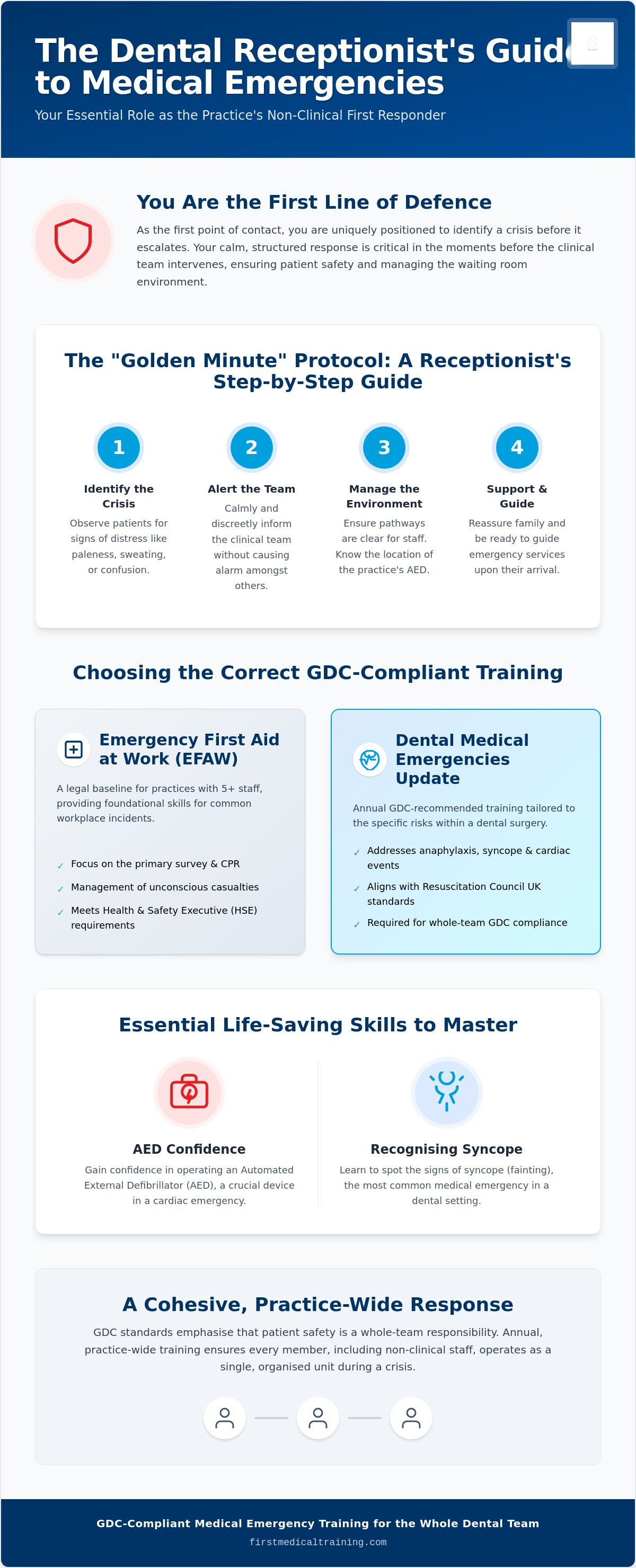
- Discover the "Golden Minute" protocol for managing a patient collapse, including how to alert the clinical team without causing alarm in the waiting room.
- Gain confidence in using an Automated External Defibrillator (AED) and learn to recognise the signs of syncope, the most common dental emergency.
- Explore the advantages of practice-wide training to ensure a cohesive, organised response that aligns with Resuscitation Council UK standards.
The Critical Role of a Dental Receptionist in Medical Emergencies
In a busy practice, the receptionist is often the only person who observes a patient's physical state before they enter the clinical environment. You are the first line of defence. Whilst the dentists and nurses are occupied with procedures, you are the one monitoring the waiting room for signs of distress. Effective dental receptionist first aid training transforms a front-of-house professional into a capable non-clinical first responder who can identify a crisis before it escalates. This role isn't about replacing clinical staff; it's about providing the immediate, structured support that keeps a patient safe during the critical minutes before help arrives.
Understanding essential first aid principles allows you to bridge the gap between a patient collapsing and the arrival of the emergency kit. Your presence provides a vital psychological anchor. When a receptionist remains calm and methodical, it reduces the anxiety felt by the patient's family and prevents a ripple effect of panic amongst other waiting patients. You are the conductor of the practice's emergency response, ensuring the clinical team is alerted whilst the environment remains controlled and safe.
Managing the Environment and Patient Triage
Triage begins the moment a patient checks in. You might notice a patient looking unusually pale, sweating, or appearing confused. These subtle cues are often the first warnings of a vasovagal syncope or a more serious cardiac event. Beyond observation, you are responsible for the physical environment. This means keeping thoroughfares clear, ensuring the practice's AED is accessible, and guiding emergency services to the correct location without delay. Clear, concise communication with the clinical team is your most powerful tool in these moments.
Meeting GDC Standards for Non-Clinical Staff
The General Dental Council's 2026 standards emphasise that patient safety is a whole-team responsibility. Although you don't work chairside, your actions fall within the GDC 'Scope of Practice' regarding emergency response. The GDC recommends that all staff members, including non-clinical personnel, participate in annual medical emergencies training. Completing a dedicated medical emergencies in dental practice course ensures you meet these CPD requirements whilst building a culture of safety. This annual commitment keeps your skills sharp and ensures the entire practice operates as a single, cohesive unit when it matters most.
Choosing the Correct First Aid Training for Dental Front-of-House
Identifying the right course is a common hurdle for practice managers and receptionists alike. You need to balance the legalities of the Health and Safety Executive (HSE) with the professional standards set by the General Dental Council (GDC). Effective dental receptionist first aid training isn't a "one size fits all" solution; it requires a strategic blend of statutory workplace skills and sector-specific clinical knowledge. While your clinical colleagues focus on advanced life support, your role requires a firm grasp of foundational safety and practice-wide coordination.
The choice usually falls between a general Emergency First Aid at Work (EFAW) course and a dental-specific Medical Emergencies update. For most practices with five or more employees, having at least one staff member with a current, one-day EFAW certificate is a legal baseline. This provides the foundational confidence to manage common workplace injuries, whilst the dental-specific training ensures you can assist effectively during a clinical crisis. You might find our Emergency First Aid at Work Course is the ideal starting point for your team's compliance journey.
EFAW vs. Dental Medical Emergencies: Which do you need?
The 1-day EFAW course is designed for low-to-medium risk environments. It focuses on the primary survey, CPR, and managing unconscious casualties. In contrast, the annual Medical Emergencies update is tailored to the specific risks of a dental surgery, such as anaphylaxis or cardiac events related to treatment. Integrating both ensures your practice follows robust dental practice risk management protocols by assigning clear, non-clinical tasks to the front-desk team. This dual approach creates a gold standard for first aid at work for dental practices, where every staff member knows their exact position in the emergency chain.
Verifiable CPD and Compliance in 2026
To meet GDC requirements, your training must be "verifiable." This means it must have clear learning outcomes, provide a certificate of attendance, and be delivered by a recognised provider. In 2026, the Resuscitation Council UK (RCUK) standards place a heavy emphasis on practical, hands-on experience. Online-only courses often fall short of these requirements because they cannot assess your physical ability to perform CPR or operate an AED. Keeping a precise training log with your certificates is essential for CQC inspections and your own professional development portfolio. Choosing a provider that understands the nuances of the dental sector ensures your time is spent on relevant, life-saving skills rather than generic scenarios.
How to Manage a Medical Emergency: A Receptionist's Protocol
When a medical emergency occurs in the waiting room, the first sixty seconds are known as the "Golden Minute." This is the period where your actions as a receptionist dictate the pace and efficiency of the entire practice's response. Whilst your clinical colleagues are trained for advanced intervention, your role is to provide the critical foundation that allows them to work effectively. Comprehensive dental receptionist first aid training ensures you don't just react, but lead with a structured plan that prioritises patient safety from the very first second.
You are the vital link in the "Chain of Survival." Your primary responsibility is to coordinate the arrival of help whilst maintaining a calm environment. This involves more than just picking up the phone; it's about managing the flow of people and information during a high-stakes event. Practical dental receptionist first aid training focuses heavily on these communication protocols, ensuring that the clinical team is alerted without causing a wave of panic amongst other waiting patients.
Step-by-Step: The First 60 Seconds
- 1. Assess the scene: Quickly check for immediate dangers like electrical hazards or spilled liquids that could harm you or the patient.
- 2. Alert the team: Use the practice's internal "crash" button or a pre-agreed silent signal. Avoid shouting "emergency" across the desk, as this can incite unnecessary alarm in the waiting area.
- 3. Call 999: Be prepared to provide the practice's full address, postcode, and a clear status of the patient. Tell the operator if the patient is breathing or if you suspect a cardiac arrest.
- 4. Fetch the AED: You must know the exact location of the Automated External Defibrillator and the emergency oxygen cylinder. Bring them to the patient's side immediately.
Managing Other Patients and Bystanders
A medical collapse is a public event that can be distressing for everyone in the room. You must take control of the environment. Direct other patients to a different area of the practice to maintain the casualty's privacy and dignity. If the patient is breathing but unresponsive, place them in the recovery position to keep their airway clear until the clinical team or paramedics take over.
Assign a specific person, such as a colleague or a calm bystander, to wait at the practice entrance. Their job is to guide the ambulance crew directly to the scene without delay. Finally, once the patient is in professional care, ensure you maintain a clear log of events. Recording the time of the collapse, the time 999 was called, and when the AED was applied is essential for the emergency services and for your practice's post-incident review.
Essential Life-Saving Skills for the Dental Reception Team
Possessing a theoretical understanding of emergency protocols is a vital start, but the ability to execute specific life-saving skills is what truly protects your patients. Clinical staff are trained in advanced airway management and drug administration, yet the receptionist often remains the first person to witness the onset of a crisis. High-quality dental receptionist first aid training focuses on the most frequent events, such as fainting, whilst preparing you for the rarest, most critical scenarios like cardiac arrest. Building these practical skills ensures that your response is instinctive rather than hesitant.
Fainting, or vasovagal syncope, remains the most common dental emergency, often triggered by anxiety or the sight of a needle. Whilst it is usually self-correcting, your role is to manage the patient's airway and prevent injury from a fall; for patients requiring professional rehabilitation following a physical incident, Functional Movement Physio offers expert clinical support. Beyond syncope, you must be alert to the signs of anaphylaxis, which can occur rapidly if a patient has an undiagnosed allergy to materials or medications used in the surgery. Recognising a mounting rash or wheezing at the front desk allows for an immediate clinical intervention before the situation becomes life-threatening.
AED Confidence and Cardiac Arrest Response
Modern Automated External Defibrillators are designed to be used by anyone, regardless of their clinical background. One of the biggest fears for non-clinical staff is the worry of "accidentally" shocking a patient, but these devices only deliver a charge if they detect a shockable heart rhythm. Your role during a cardiac arrest is to retrieve the AED and prepare the patient whilst your colleagues begin compressions. The Chain of Survival represents the vital sequence of steps, from early recognition to post-resuscitation care, that must occur in rapid succession to save a life during a cardiac emergency. To build these practical skills in a supportive environment, you can book an accredited Automated External Defibrillator (AED) Training Course to empower your entire front-of-house team.
Managing Choking and Allergic Reactions
Choking is a high-stress event that requires an immediate, physical response. You must be able to distinguish between a mild obstruction, where the patient can still cough, and a severe obstruction where they cannot breathe. For many practices, the LifeVac anti-choking device provides an additional layer of safety, offering a non-invasive way to clear an airway when standard protocols like back blows or abdominal thrusts are not possible. Having this equipment at the reception desk ensures that you have a reliable tool to assist patients of all ages, including those in wheelchairs or with physical frailties, providing a higher standard of care for the whole community.
Organising Practice-Wide Training with First Medical Training Ltd
While individual learning has its place, a medical emergency is never a solo performance. Training the whole team together ensures that the transition from the waiting room to the surgery is seamless. When you invest in dental receptionist first aid training as part of a collective practice session, you eliminate the confusion that often occurs during a live crisis. Everyone learns the same protocols, uses the same equipment, and understands exactly who is responsible for each task in the emergency chain. This shared experience breaks down the silos between clinical and non-clinical staff; it creates a unified front that prioritises patient safety above all else.
First Medical Training Ltd has been a trusted partner for dental teams since 2006. With a 20-year history of excellence, we understand that a surgery's physical layout is just as important as the medical theory. Our instructors don't just teach from a manual; they act as seasoned mentors who help you navigate the practical realities of your specific workplace. We believe that education should be high-impact and memorable, ensuring that the skills you learn stay with you long after the session ends. This approach ensures that every member of the team feels empowered to act when the "Golden Minute" begins.
In-Practice Training vs. External Courses
Practising a rescue scenario in your own waiting room builds superior muscle memory compared to a generic classroom setting. You'll learn exactly where your AED is kept and the fastest route to the emergency oxygen whilst navigating your actual furniture and thoroughfares. This on-site approach minimises practice downtime and ensures every staff member, from the senior partner to the newest receptionist, is familiar with your specific emergency drugs and equipment. It makes the training relevant to the space where you work every day, ensuring that your response is fast and coordinated.
Long-Term Compliance and Support
Compliance shouldn't be a source of stress or a last-minute scramble for certificates. We help you set up annual reminders for your team's medical emergency renewals, ensuring you never miss a GDC verifiable CPD target. Beyond physical safety, we also offer specialised Mental Health First Aid for Dental Practices to support the long-term wellbeing and resilience of your team. Contacting First Medical Training Ltd for a bespoke training plan is the final step in moving from simple compliance to true professional readiness. Booking your annual 2026 medical emergency update ensures your team remains at the forefront of patient safety standards.
Empower Your Front-of-House Team for Emergency Excellence
A well-prepared reception team is the backbone of patient safety in any dental surgery. By embracing your position as a non-clinical first responder, you transform the waiting room into a secure environment where every second is put to good use. High-quality dental receptionist first aid training does more than just tick a compliance box; it provides the steady confidence needed to lead during a crisis. Whether it is managing a common fainting episode or coordinating the retrieval of life-saving equipment, your actions provide the critical foundation for the clinical team's intervention.
Since 2006, First Medical Training Ltd has acted as a seasoned mentor to dental practices across the UK. We provide GDC-compliant verifiable CPD and are specialist suppliers of the LifeVac anti-choking device, ensuring your team has both the knowledge and the tools to save lives. It is time to move beyond the anxiety of the unknown and embrace a proactive culture of care. Book your specialised Dental Receptionist First Aid Training with First Medical Training Ltd today and ensure your practice is ready for any eventuality. You have the power to make a life-saving difference from the moment a patient walks through your door.
Frequently Asked Questions
Is first aid training mandatory for dental receptionists in the UK?
Yes, dental receptionist first aid training is essential for both workplace safety and regulatory compliance. The Health and Safety Executive (HSE) requires every practice to have adequate first aid provision, whilst the General Dental Council (GDC) expects all staff members to be competent in managing medical emergencies. This ensures a safe environment for both the public and the clinical team.
How often should dental receptionists update their medical emergency training?
You should update your skills annually to stay in line with GDC recommendations and Resuscitation Council UK standards. Although some first aid certificates last for three years, the GDC specifically recommends that all staff members complete at least two hours of medical emergencies CPD every year. This ensures that your response remains fast, accurate, and instinctive during a crisis.
What is the difference between EFAW and a dental medical emergencies course?
The Emergency First Aid at Work (EFAW) course is a one-day statutory qualification that covers general workplace injuries and basic life support. In contrast, a dental medical emergencies course is specifically tailored to the clinical environment. It focuses on scenarios you are more likely to encounter in a surgery, such as syncope, anaphylaxis, or cardiac events related to dental treatment.
Can a dental receptionist use an AED without clinical supervision?
You can safely use an Automated External Defibrillator (AED) without a dentist or nurse being present. These devices are designed for use by anyone and provide clear, step-by-step voice prompts to guide you through the process. The AED will only deliver a shock if it detects a specific heart rhythm, meaning you don't need to worry about accidentally harming a patient.
Does first aid training for receptionists count towards GDC verifiable CPD?
Yes, dental receptionist first aid training counts as verifiable CPD provided it is delivered by a recognised training provider. To meet GDC standards, the course must have clear learning outcomes and you must receive a certificate of attendance. This documentation is vital for your professional development portfolio and is often requested during practice inspections.
What should a dental receptionist do if a patient collapses in the waiting room?
Your first action is to assess the scene for danger and immediately alert the clinical team using the practice's emergency signal. You must then call 999 and retrieve the AED and emergency oxygen. Whilst the clinical team takes over the casualty's care, your role shifts to managing the waiting room and ensuring other patients are moved to a private area.
Should dental receptionists be trained in Mental Health First Aid?
It's highly beneficial for receptionists to undergo Mental Health First Aid training given the high levels of anxiety often associated with dental visits. Being able to recognise the signs of a panic attack or a mental health crisis allows you to support patients more effectively. It helps create a more compassionate and supportive environment for everyone who enters the practice.
What emergency equipment should a dental receptionist be familiar with?
You must know the exact location and basic operation of the AED, the emergency oxygen cylinder, and anti-choking devices like LifeVac. In a high-pressure situation, you are often the person responsible for retrieving this equipment. Being familiar with these tools ensures there is no delay in providing life-saving intervention whilst the clinical team prepares the patient.