

Emergency First Aid at Work: 2026 Compliance Guide

What if the difference between a life saved and a tragic outcome in your workplace was simply the quality of a single day’s training? Many professionals feel a nagging anxiety that their current certification is merely a tick-box exercise, leaving them unprepared for the raw reality of a medical crisis. It's a common concern, especially when you're trying to balance complex HSE regulations with specific GDC requirements. You want to know that if a colleague collapses, you'll act with precision rather than hesitation. Choosing the right emergency first aid at work course is about more than just staying legal; it's about the peace of mind that comes from genuine competence.
We understand that your time is valuable and your responsibility is great. This 2026 compliance guide promises to help you master the life-saving skills required to protect your team and meet every regulatory standard with confidence. You'll learn how to secure a valid three-year EFAW certificate while building the practical skills to use an AED and perform CPR effectively. We will explore the latest BS 8599-1:2026 standards, clarify your legal duties, and provide a clear roadmap to becoming a capable, high-impact first aider in any professional environment.
Key Takeaways
- Understand how the Health and Safety (First-Aid) Regulations 1981 apply to your specific environment to ensure your workplace meets the statutory minimum requirements for 2026.
- Gain insight into the core curriculum of an accredited emergency first aid at work course, including the DRABC primary survey and practical resuscitation techniques.
- Learn how to align your first aid training with GDC requirements, creating a seamless transition between basic life support and specialised medical emergency protocols.
- Identify the critical timeline for certification validity and the importance of annual skills refreshers in preventing skill fade during a real-life crisis.
- Discover why selecting a training provider with a 20-year history in the healthcare sector ensures your team receives relevant, clinical-focused instruction.
Understanding the Emergency First Aid at Work (EFAW) Requirement
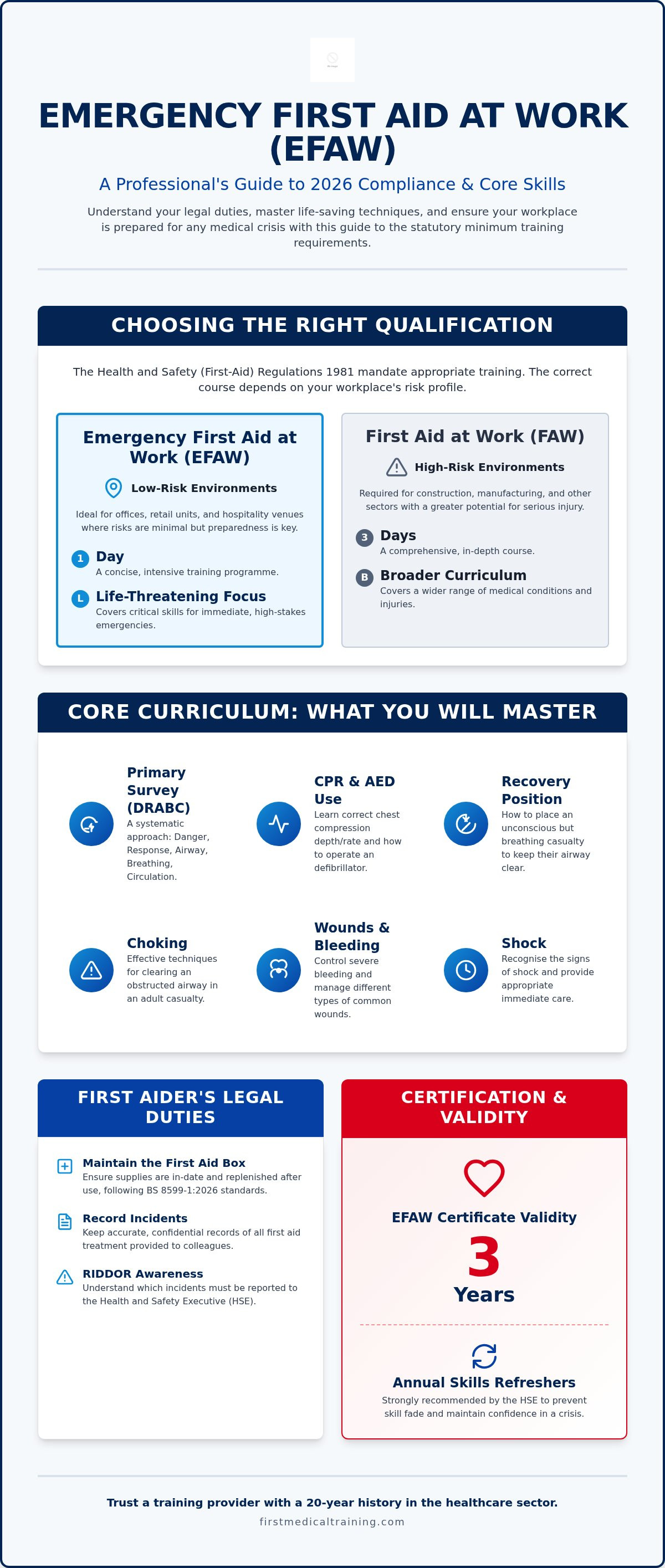
Under the Health and Safety (First-Aid) Regulations 1981, employers have a non-negotiable legal obligation to provide adequate and appropriate equipment, facilities, and personnel. For many businesses, the 1-day emergency first aid at work course represents the statutory minimum required to meet these standards. It's designed to ensure that if someone is injured or falls ill at work, they receive immediate attention. To understand the foundations of these life-saving skills, one might ask, What is First Aid? In a workplace context, it's the initial assistance provided before professional medical help arrives.
Whilst both qualifications are vital, they serve different risk profiles. The EFAW is a concise, one-day programme focused on life-threatening emergencies. In contrast, the three-day First Aid at Work (FAW) course covers a broader range of medical conditions and injuries, making it the requirement for high-risk environments like construction or manufacturing. Every business must determine its prescribed number of first aiders based on a thorough risk assessment. For a low-risk workplace with between 25 and 50 employees, at least one person must have completed an emergency first aid at work course. If your team is smaller, you might only require an Appointed Person to take charge of arrangements, though many small businesses still opt for full training to ensure maximum safety.
Who is the EFAW Course Designed For?
This qualification is ideal for workplaces with low-hazard profiles, such as offices, retail units, and hospitality venues. It's perfectly suited for organisations where a full three-day course might exceed the actual risk level. In the healthcare sector, dental receptionists and non-clinical staff often start with this qualification. It provides them with the fundamental skills to support clinical colleagues during a crisis, ensuring a coordinated response across the entire practice team. By prioritising this training, you ensure that every member of staff, not just the clinicians, can act with confidence.
Legal Responsibilities of the Workplace First Aider
A designated first aider holds a significant duty of care whilst acting in an emergency capacity. This doesn't mean you're expected to perform miracles. Instead, it means you're expected to act reasonably and within the scope of your training. Beyond immediate response, your role involves practical management of safety resources. This includes:
- Maintaining the first aid box: You must ensure supplies are in date and replenished immediately after use, following the BS 8599-1:2026 standards.
- Incident Recording: You're responsible for keeping accurate, confidential records of all treatment provided.
- RIDDOR Awareness: You should understand which incidents must be reported to the HSE under the Reporting of Injuries, Diseases and Dangerous Occurrences Regulations.
By fulfilling these duties, you protect both your colleagues and your organisation's legal standing. It's a role that requires a steady hand and a clear understanding of your professional boundaries.
Core Curriculum: What is Taught in a 1-Day EFAW Course?
An effective emergency first aid at work course starts with the Primary Survey. This is the DRABC protocol: Danger, Response, Airway, Breathing, and Circulation. It's a systematic approach that ensures you don't miss critical life-threatening issues in the heat of the moment. Once the scene is safe, the course moves to the high-stakes skill of Cardiopulmonary Resuscitation (CPR). You'll learn the precise depth and rate of chest compressions required for adult casualties, alongside the management of unconscious patients. Placing a casualty in the recovery position is a simple yet vital act that keeps the airway clear and prevents aspiration whilst you wait for professional help.
Whilst specific UK regulations were covered previously, aligning with international standards like the OSHA First Aid Guidelines ensures a robust understanding of workplace safety principles.
Beyond life support, the curriculum addresses common incidents that occur in low-risk environments. You'll learn to manage:
- Burns and scalds: Distinguishing between different burn depths and applying correct cooling techniques immediately.
- Minor haemorrhage: Treating grazes and small wounds to prevent infection and promote healing.
Advanced Life-Saving Skills and 2026 Standards
The 2026 standards place a renewed emphasis on managing catastrophic bleeding. You'll explore modern protocols, including the correct use of tourniquets and haemostatic dressings when direct pressure fails to stem the flow. Another cornerstone is the Automated External Defibrillator (AED). These devices are now central to the chain of survival in the workplace. Training demystifies the voice prompts and pad placement, giving you the confidence to use one without delay. Recognising the early signs of shock is equally critical; it's a progressive condition where the circulatory system fails, leading to rapid patient deterioration if not managed correctly.
Airway Management and Choking Protocols
Choking remains a terrifying prospect in any environment. Training covers the standard sequence of five back blows followed by five abdominal thrusts to clear an obstructed airway. In complex clinical settings where patients may have mobility issues, we also discuss the role of the LifeVac Anti-Choking Device as an additional safety measure. When attending an emergency first aid at work course, clinical confidence is built through repetitive manikin practice, which transforms theoretical knowledge into a reliable physical response. If you work in a clinical environment, consider how these skills bridge the gap to a medical emergencies in a dental practice course.
Professional Context: EFAW for Dental and Healthcare Practices
In a clinical setting, a generic emergency first aid at work course often fails to address the unique challenges of patient care. For dental professionals, this training must be viewed through the lens of the GDC CPD requirements for medical emergencies. Whilst the EFAW provides the foundational life-saving skills required by law, it acts as a critical stepping stone to more advanced medical emergencies in a dental practice. It's not just the clinicians who need this expertise. Receptionists and administrative staff are frequently the first to encounter a patient in distress in the waiting room. By equipping them with EFAW certification, you ensure a robust first line of defence that supports the clinical team during those vital first minutes of an incident.
The HSE First Aid at Work Guidance confirms that whilst certificates are valid for three years, annual refreshers are strongly recommended. In a healthcare environment, this isn't just a suggestion; it's a matter of clinical safety. Skill fade happens quickly. Maintaining high levels of competence ensures that response remains instinctive rather than hesitant. Regular practice within the team environment builds a culture of safety and readiness that benefits both staff and patients alike.
First Aid in the Clinical Environment
Applying first aid in a surgery requires adapting standard protocols to a confined space. For example, managing syncope and fainting involves more than just a recovery position; it requires understanding patient positioning in the dental chair to ensure cerebral perfusion. An EFAW course tailored for healthcare providers teaches staff how to integrate basic life support with the practice’s existing emergency drug kits and oxygen equipment. This synergy ensures that every team member knows their role, from the moment a patient feels faint to the arrival of the ambulance. Practical drills in the surgery help demystify the use of equipment, making the transition from theory to practice seamless.
Verifiable CPD and Compliance
Compliance is a cornerstone of professional practice. When selecting an emergency first aid at work course, you must ensure it provides verifiable CPD hours that satisfy regulatory bodies. Documenting this training is essential for successful CQC or HIS inspections, as it proves that your staff are competent and your practice is safe. Aligning your team's training with a comprehensive dental practice emergency preparedness strategy demonstrates a commitment to patient safety that goes far beyond simple legal box-ticking.
Certification and Validity: Maintaining Your Standards
Once you complete an emergency first aid at work course, your certificate remains valid for exactly three years. However, validity doesn't always equal proficiency. The HSE strongly recommends that all first aiders attend annual half-day "skills refreshers" to combat the very real danger of skill fade. In a high-pressure medical crisis, muscle memory is your greatest asset. Without regular practice, the ability to recall specific CPR ratios or AED protocols diminishes significantly. Maintaining your standards is about ensuring that when the time comes to act, your response is instinctive and accurate.
You must organise your requalification training before your current certificate expires. There is no grace period for first aid certification. If your qualification lapses, you are no longer legally considered a designated first aider in the eyes of the law. It's also vital to monitor changes in your workplace hazard level. If your organisation expands or introduces more dangerous equipment, you may need to transition from a 1-day EFAW to a more comprehensive 3-day qualification to ensure your team remains fully protected and compliant.
Choosing an Accredited Training Provider
Selecting the right partner for your emergency first aid at work course requires careful consideration. You should look for a provider that offers more than just a certificate. Accredited training is most effective when delivered by instructors with genuine clinical backgrounds who understand the practical realities of emergency response. First Medical Training Ltd has been established since 2006, bringing nearly 20 years of specialised expertise to every session. This longevity provides the quiet confidence that your training isn't just a "tick-box" exercise but a high-impact educational experience that builds real-world competence.
On-Site vs. Centre-Based Training
Training in your own environment offers distinct advantages for identifying specific risks within your surgery or office layout. Group bookings are an efficient way to organise a consistent standard of instruction across your entire team. It ensures that everyone is familiar with the same protocols and equipment. It's also essential to verify that the training equipment used, such as manikins and AED trainers, is modern and well-maintained. This focus on quality equipment ensures that the skills you learn are directly transferable to a real-life emergency. Aligning your team's training with a dental practice emergency preparedness strategy ensures you remain compliant and ready to act when it matters most. To maintain these essential standards, arrange your accredited training today.
Why Choose First Medical Training Ltd for Your EFAW Certification?
Selecting a training partner is a critical decision for any practice manager or business owner. First Medical Training Ltd has been a steady presence in the industry since 2006, providing a level of reliability that only comes with decades of experience. Whilst many providers offer a generic emergency first aid at work course, our approach is built on a deep understanding of the healthcare and dental sectors. We recognise that your environment has specific clinical risks that a standard office-based course simply cannot address. Our instructors are industry veterans who speak your language, ensuring that the training is both relevant and immediately applicable to your daily operations.
Our role as a comprehensive safety partner means we provide more than just education. As established suppliers of life-saving equipment, including the LifeVac Anti-Choking Device and professional-grade defibrillators, we ensure your team is trained on the exact tools they will use in a crisis. This integration of high-quality equipment with expert instruction creates a seamless safety net for your organisation. We prioritise methodical, purposeful communication, respecting your professional schedule whilst delivering high-impact content that meets every national standard.
Empowering Your Team Through Confidence
We believe that the most effective first aiders are those who feel truly empowered to act. Our 1-day EFAW sessions move far beyond simple box-ticking exercises to build genuine clinical confidence amongst your staff. The atmosphere in our training rooms is supportive and encouraging, designed to reduce the anxiety often associated with emergency response. First Medical Training Ltd demystifies complex medical procedures by breaking them down into logical, manageable segments that any team member can master. This transformation from a hesitant bystander to a capable responder is the hallmark of our educational philosophy.
Booking Your National EFAW Course
Maintaining compliance across a national organisation requires a streamlined and efficient approach. We have refined our certification process to ensure that your practice remains fully aligned with current regulations without unnecessary administrative delays. Whether you are booking for a small private surgery or a large national healthcare group, we provide the same level of disciplined, focused service. Secure your training date with a partner that understands the gravity of your role and the human element of care. Book your Emergency First Aid at Work course today to ensure your team is prepared for any eventuality.
Securing Your Workplace Safety for 2026 and Beyond
Building a culture of safety requires more than just meeting the statutory minimums we've discussed. It's about the transition from theoretical knowledge to decisive action when it matters most. By completing an emergency first aid at work course, you aren't just ticking a box for compliance; you're equipping your team with the skills to save a life. Whether you're managing a busy dental surgery or a corporate office, the right training provides a foundation of clinical confidence that lasts well beyond the initial session.
First Medical Training Ltd has been a trusted partner in professional development since 2006. We combine our specialist dental and healthcare knowledge with nationally recognised certification to ensure your practice remains both safe and compliant. Our instructors bring real-world experience to every session, ensuring your team is ready for the practical realities of emergency response. Don't leave your safety standards to chance. Enquire about our Emergency First Aid at Work Course today to secure your 2026 training date and protect your staff with confidence.
Frequently Asked Questions
What does EFAW stand for?
EFAW stands for Emergency First Aid at Work. It is the statutory minimum qualification for designated first aiders in low-risk workplace environments. This one-day course provides individuals with the essential skills needed to manage a casualty in an emergency until professional medical help arrives. It focuses on life-saving interventions and basic injury management, ensuring that businesses remain compliant with the Health and Safety (First-Aid) Regulations 1981.
How long does an emergency first aid at work course take?
An emergency first aid at work course is a single-day qualification, involving at least six hours of guided learning. This intensive format allows participants to cover the core curriculum, including CPR and wound management, without significant time away from their professional duties. It's an efficient solution for busy teams who need to meet legal requirements whilst gaining the confidence to act decisively during a medical crisis in the workplace.
Is an EFAW certificate valid for 3 years?
Yes, the EFAW certificate is valid for exactly three years from the date of issue. Once this period concludes, you must complete a requalification course to maintain your status as a designated first aider. To prevent skill fade, the Health and Safety Executive (HSE) strongly recommends attending a half-day annual refresher. This ensures that your practical knowledge of life-saving protocols remains sharp and your response to emergencies stays instinctive.
Can I do an EFAW course online?
You cannot complete a fully accredited EFAW qualification purely online. Whilst some theoretical elements can be delivered via e-learning, the HSE requires a practical, face-to-face assessment to verify your competence in skills like CPR and the recovery position. Real-world emergencies require physical intervention, so practising on manikins under the supervision of a qualified instructor is essential for building the clinical confidence needed to save a life.
What is the difference between EFAW and First Aid at Work (FAW)?
The primary difference lies in the duration and depth of the training. EFAW is a one-day course designed for low-risk environments, focusing on emergency life support. FAW is a more comprehensive three-day course suited for high-risk workplaces, such as construction sites or factories. FAW covers a wider range of medical conditions and chronic illnesses, providing a deeper level of clinical knowledge for environments where the risk of serious injury is higher.
How many first aiders do I need in my workplace?
The number of first aiders required depends on your specific risk assessment. For low-risk environments like offices, you typically need at least one EFAW-trained person for every 25 to 50 employees. If your workplace is high-risk, you'll need one FAW-trained person for every 50 employees. Always consider staff holidays and shift patterns to ensure you have adequate coverage at all times to meet your legal duty of care.
Does EFAW cover the use of an AED?
Yes, modern EFAW training includes the use of an Automated External Defibrillator (AED) as standard. Participants learn how to safely deploy the device, follow the voice prompts, and integrate its use with chest compressions. Given that using an AED within the first few minutes of a cardiac arrest significantly increases survival rates, this is a vital component of the emergency first aid at work course curriculum for all professional sectors.
What happens if my first aid certificate expires?
If your certificate expires, you are no longer legally recognised as a designated first aider. You must complete a full one-day requalification course to regain your certification. There is no grace period for expired certificates, so it's essential to organise your training before the three-year validity ends. Allowing your qualification to lapse could leave your organisation in breach of health and safety regulations and without adequate emergency cover for your team.