

Staff Wellbeing Training for Dental Practices: A Comprehensive Resource Guide for 2026

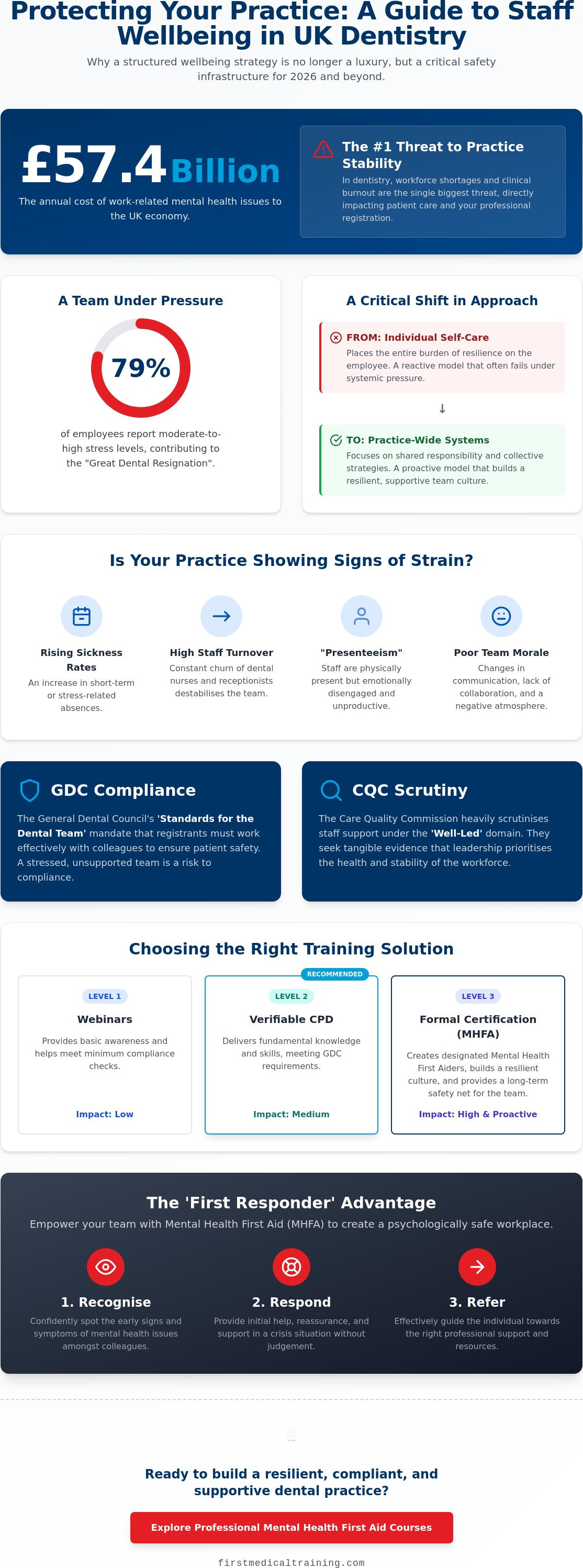
Did you know that work-related mental health issues now cost the UK economy a staggering £57.4 billion annually? In the high-pressure environment of a modern surgery, workforce shortages and clinical burnout have become the single biggest threat to practice stability. You likely feel the weight of this daily, whether it's through rising sickness rates amongst your dental nurses or the constant anxiety of meeting GDC "fitness to practise" standards. Establishing a formal staff wellbeing training dental practice strategy is no longer a luxury; it's a critical safety infrastructure that protects both your staff and your professional registration.
We understand that maintaining a calm, productive workplace feels difficult whilst you're juggling patient care and CQC inspections. This comprehensive 2026 guide will show you how to implement a robust wellbeing strategy that reduces recruitment costs and fosters a resilient, supportive team. We'll explore the latest Mental Health First Aid options, examine how to provide clear evidence of staff support for regulators, and provide the practical tools you need to transform your practice culture into one of steady reliability and clinical excellence.
A soothing physical environment also plays a vital role in reducing workplace stress; to see how bespoke art can transform your professional space, you may visit First4Frames Gallery for expert framing and print options.
Key Takeaways
- Distinguish between individual self-care and structured, practice-wide systems designed to identify and mitigate psychological stressors in the surgery.
- Navigate the different tiers of professional education to ensure your training choices provide verifiable CPD whilst delivering genuine practical value to the team.
- Adopt a 'first responder' mentality through Mental Health First Aid to recognise and address signs of crisis amongst colleagues before they lead to burnout.
- Learn the essential steps to organise a staff wellbeing training dental practice programme that addresses specific team pain points and secures long-term retention.
- Align your practice with CQC and GDC expectations by creating clear evidence of your commitment to staff welfare and clinical excellence.
What is Staff Wellbeing Training in a Dental Context?
In the high-intensity environment of modern dentistry, staff wellbeing training dental practice initiatives represent much more than a simple human resources "add-on". It's a structured educational approach designed to help clinical and administrative teams identify, manage, and mitigate the unique psychological stressors found in the surgery. This training moves beyond the concept of individual self-care, which often places the entire burden of resilience on the employee. Instead, it focuses on practice-wide systems and collective strategies that support a team under pressure.
As we move through 2026, the dental sector continues to face significant workforce shortages. With recent data showing that 79% of employees report moderate-to-high stress levels, the "Great Dental Resignation" has evolved into a permanent struggle for staff retention. A proactive approach is now essential for survival. When a team feels psychologically safe, they're better equipped to deliver high-quality clinical care. There's a direct, documented link between the mental state of a dental professional and the safety of the patient in the chair. This systemic approach mirrors broader workplace wellness strategies that have been proven to reduce long-term burnout across healthcare sectors.
The GDC and CQC Perspective on Wellbeing
Regulatory bodies no longer view staff mental health as a private matter. The General Dental Council (GDC) emphasises in its 'Standards for the Dental Team' that registrants must work effectively with colleagues to ensure patient safety. Similarly, the Care Quality Commission (CQC) heavily scrutinises staff support under the 'Well-Led' domain of their inspections. They look for tangible evidence that leadership prioritises the health and stability of their workforce. Effective staff wellbeing training dental practice programmes serve as vital evidence that a practice meets the rigorous 2026 GDC and CQC requirements for a safe, supportive, and compliant professional environment.
Identifying the Need for Training in Your Practice
Recognising the need for professional intervention before a crisis occurs is a hallmark of strong leadership. Common indicators that your team requires support include rising sickness rates, "presenteeism" where staff are physically present but emotionally disengaged, and a high turnover of dental nurses or receptionists. The cost of inaction is significant. Recruitment churn and the loss of experienced staff can destabilise a practice's financial health and reputation. Moving from a reactive model, where you only address issues after a staff member resigns, to a preventative model ensures your team remains resilient. To support this, many practice owners explore NLP Practitioner Certification to gain advanced communication and resilience-building tools. This transition involves:
- Monitoring patterns: Tracking subtle changes in team morale or communication styles.
- Assessing workload: Identifying if administrative burdens or clinical quotas are reaching unsustainable levels.
- Implementing formal training: Providing the team with the vocabulary and tools to support one another safely.
Comparing Wellbeing Resources: CPD, Webinars, and Certifications
Selecting the appropriate training format is a strategic decision that balances time, budget, and the depth of impact required. It's about results. In 2026, the market offers a spectrum ranging from low-touch webinars to intensive certifications. For many practices, the starting point is often verifiable CPD. This ensures you meet regulatory obligations whilst gaining fundamental knowledge. However, to truly combat the high stress levels reported in the 2026 Christie & Co report, many principals are moving towards formal certifications that establish designated Mental Health First Aiders within the surgery. These individuals act as a permanent safety net for the team.
The choice between formats depends on your practice goals. If you're looking to meet basic compliance, a webinar might suffice. If you're looking to reduce recruitment churn and build a resilient culture, a more hands-on staff wellbeing training dental practice programme is necessary. Formal certification provides a level of steady reliability that shorter sessions cannot match. It empowers staff to act with confidence when a colleague is in crisis, mirroring the precision required during a medical emergency.
Verifiable CPD for Mental Health
The GDC expects dental professionals to keep their skills and knowledge up to date through regular, recorded learning. Integrating wellbeing into your annual Personal Development Plan (PDP) cycle ensures that staff support is viewed with the same professional gravity as clinical skill-building. You can find detailed guidance on aligning these sessions with GDC CPD requirements for medical emergencies, as many of these topics overlap with the stress management required during crisis response. Annual refreshers are particularly effective. They prevent knowledge decay and signal to the team that their mental health remains a permanent priority.
In-Practice Training vs. Online Learning
Online learning offers flexibility for busy NHS and private practices. It's an excellent tool for individual dental professionals seeking immediate support or foundational theory. However, the psychological benefits of whole-team training in the surgery are difficult to replicate on a screen. In-person sessions allow for role-playing and the demystification of complex interpersonal dynamics. Adopting a structured Mental Health Wellness Framework often works best when delivered through a hybrid approach. You might use online modules for theory and in-person workshops for practical application. This ensures that your training is both efficient and deeply impactful. For teams ready to commit to this level of support, our Mental Health First Aid for Dental Practices offers a comprehensive solution that bridges the gap between theory and real-world application.
The Role of Mental Health First Aid in the Dental Surgery
Mental Health First Aid (MHFA) provides the framework for an immediate, effective response to psychological distress within the clinical environment. It isn't about diagnosis or long-term therapy. Instead, it's about providing immediate support to a colleague in distress until professional help can be accessed or the crisis resolves. Integrating MHFA into your staff wellbeing training dental practice strategy ensures that your team is equipped with a "first responder" mentality. Just as you're trained to identify the early signs of syncope or anaphylaxis, MHFA empowers you to recognise the subtle shifts in a colleague's behaviour that signal a mental health crisis.
This approach directly complements a traditional medical emergencies in dental practice course. Whilst physical first aid addresses the body, MHFA addresses the invisible crises that can be just as disruptive to surgery operations. By establishing a designated "Mental Health Lead" within your practice hierarchy, you create a clear pathway for support. This role acts as a bridge between the frontline staff and the leadership team, ensuring that wellbeing concerns are escalated and managed with the same professional gravity as clinical risks.
Core Competencies of a Dental Mental Health First Aider
A trained Mental Health First Aider possesses a specific set of skills tailored for high-pressure environments. Non-judgmental listening is the most critical competency. In a fast-paced surgery, communication is often transactional and hurried. MHFA teaches staff how to listen without bias, providing a safe space for colleagues to express concerns without fear of professional repercussions. Furthermore, these individuals are experts at signposting. They understand the boundaries of their role and know exactly where to direct a colleague for professional help, whether through the NHS, private counselling, or dental-specific support charities. This ensures the surgery remains a place of work whilst still offering a robust safety net for those amongst the team who are struggling with common dental triggers, such as high UDA targets or difficult patient interactions.
MHFA as a Clinical Safety Tool
There's a significant relationship between clinician wellbeing and the reduction of clinical errors. A practitioner suffering from burnout or acute stress is statistically more likely to experience lapses in concentration. By training staff to monitor and support each other's mental state, you're effectively adding another layer of clinical safety to your practice. Additionally, a regulated and supported team is better equipped to manage anxious or phobic patients. When a dental nurse or dentist can regulate their own emotional response to a high-stress situation, it has a calming effect on the patient in the chair. Mental Health First Aid serves as the psychological equivalent to physical first aid in the workplace, providing the essential stabilisation required to keep both the team and the patients safe during periods of intense pressure.
How to Organise and Implement a Wellbeing Training Strategy
Implementing a successful staff wellbeing training dental practice strategy requires the same clinical precision as a complex surgical procedure. It cannot be an afterthought or a "tick-box" exercise performed at the end of a long clinical day. To build a truly resilient team, you must move through a logical, sequential process that identifies specific needs and provides measurable solutions. Start by conducting a confidential "wellbeing audit". This allows staff to highlight their primary stressors, whether it's the pressure of Band 2 re-banding or the physical toll of high patient volumes, without fear of judgment. Once you have this data, securing buy-in from the Principal Dentist and Senior Partners becomes straightforward. You're no longer asking for a "perk"; you're presenting a business case for practice stability.
The next step is selecting a training provider that understands the 2026 dental landscape. Generalised corporate training often fails because it doesn't account for GDC standards or the unique rhythm of a dental surgery. Schedule your sessions during protected time. Expecting staff to engage with mental health topics after a nine-hour shift leads to "after-hours fatigue" and resentment. Finally, codify your approach into a living "Wellbeing Policy". This document should evolve as your team grows, ensuring that the support systems you build today remain effective for years to come.
Budgeting and Resource Allocation
Justifying the financial investment in training is simple when you compare the cost of a course to the cost of losing a single experienced dental nurse. Between recruitment fees, locum cover, and lost clinical time, the price of staff turnover is immense. Effective resource allocation also includes time. You must factor in 10-minute "Wellbeing Huddles" and allow the Mental Health Lead the capacity to offer support. During your regular dental practice emergency preparedness reviews, take the opportunity to audit your mental health resources alongside your physical emergency kits. This ensures your psychological safety net is always as ready as your AED.
Maintaining Momentum Post-Training
Training shouldn't be forgotten once the certificates are issued. To maintain momentum, the designated Wellbeing Lead must keep staff support on the weekly meeting agenda. This keeps the vocabulary of mental health fresh amongst the team. Measure your impact through anonymous staff surveys and by monitoring retention data over six-month intervals. If you're ready to secure your team's future and reduce the risk of burnout, book your Mental Health First Aid for Dental Practices training with our expert team today.
Professional Mental Health First Aid for Dental Teams with First Medical Training Ltd
Choosing a training partner requires absolute confidence in their understanding of your specific professional environment. At First Medical Training Ltd, our specialised staff wellbeing training dental practice programmes are built on a foundation of clinical excellence. We recognise that a psychological crisis in the surgery requires the same methodical, calm response as a physical medical emergency. Our dual expertise in providing both clinical emergency education and mental health support creates a uniquely robust training experience. We don't just teach theory; we provide a pragmatic framework that allows your team to act with certainty when it matters most.
Our "seasoned mentor" approach is what sets us apart from generic providers. Our trainers are industry veterans who understand the physical and emotional layout of a dental surgery. They know the pressure of a running-over clinical diary and the specific stressors associated with maintaining GDC standards. This first-hand experience ensures that our staff wellbeing training dental practice sessions are grounded in reality rather than abstract concepts. We offer flexible, in-practice delivery options, ensuring your training fits seamlessly around your clinical commitments without causing further disruption to your schedule.
Why Choose First Medical Training Ltd?
With a 20-year history of supporting dental professionals across the UK, First Medical Training Ltd has established itself as a trusted partner in professional development. Our approach is authoritative yet reassuringly confident, designed to demystify sensitive topics and build genuine capability amongst your staff. We believe in a holistic approach to dental safety. By integrating mental health awareness with physical emergency preparedness, we help you create a workplace that is truly safe for both staff and patients. This unified strategy ensures that your practice isn't just compliant, but genuinely resilient in the face of modern workforce challenges.
Taking the Next Step for Your Team
Investing in your team's mental health is a significant step towards long-term practice stability. When you book a consultation with First Medical Training Ltd, we'll work with you to understand the specific needs of your surgery. You can expect practical, functional, and clear guidance that avoids unnecessary fluff. Our sessions are designed to be engaging and empowering, leaving your team with the confidence to support one another effectively. Don't wait for burnout to impact your clinical outcomes or staff retention rates. Book your staff wellbeing training today and take the first step towards a calmer, more productive workplace.
Securing the Future of Your Dental Team
The landscape of 2026 dentistry demands more than just clinical precision; it requires a culture of steady reliability and mutual support. Implementing a robust staff wellbeing training dental practice strategy is the most effective way to protect your team from burnout and ensure long-term practice stability. By establishing Mental Health First Aiders and integrating wellbeing into your annual PDP cycle, you meet GDC and CQC requirements whilst fostering a workplace where staff feel empowered to excel. This proactive approach transforms wellbeing from a vague concept into a critical safety infrastructure.
We've been specialist dental training providers since 2006, delivering GDC-compliant verifiable CPD that is trusted by practices nationwide. Our goal is to bridge the gap between rigorous regulatory standards and the human element of care. We provide you with the practical tools to manage psychological crises with the same confidence as medical emergencies. It's about building a team that is resilient, focused, and capable of maintaining excellence under pressure.
Enquire about Mental Health First Aid for your Dental Practice today. Taking this essential step ensures your surgery remains a supportive environment where your staff and your patients can truly thrive.
Frequently Asked Questions
Is staff wellbeing training mandatory for UK dental practices in 2026?
Staff wellbeing training is not explicitly mandatory as a standalone legal requirement, but it is practically essential for meeting GDC Standards and CQC "Well-Led" criteria. Regulators expect clear evidence that you are supporting your team's mental health to ensure patient safety. Failing to provide this support can be viewed as a failure in leadership and a significant risk to clinical excellence.
How many verifiable CPD hours can my team earn from wellbeing training?
The number of hours depends on the specific course, but most comprehensive sessions provide between 3 and 7 hours of verifiable CPD. This learning aligns with GDC development outcomes, particularly those focused on effective communication and leadership within the dental team. Always verify that your training provider issues certificates that meet the GDC’s requirements for your professional portfolio.
What is the difference between a Mental Health Lead and a Mental Health First Aider?
A Mental Health Lead focuses on the strategic implementation of a staff wellbeing training dental practice policy, whilst a Mental Health First Aider provides immediate crisis support. The Lead manages the "wellbeing audit" and secures resources from the Principal. The First Aider acts as the "first responder" who uses non-judgmental listening to assist colleagues in acute distress.
Can wellbeing training really help with staff retention in a competitive market?
Yes, investing in your team significantly improves retention by reducing the burnout that leads to high recruitment churn. With 79% of employees reporting high stress levels in 2026, a supportive culture makes your surgery a more attractive workplace. This proactive approach reduces the substantial costs associated with recruitment fees, locum cover, and lost clinical time.
How do I support a staff member who is struggling with their mental health right now?
You should lead with non-judgmental listening and immediately signpost the individual to professional resources, such as their GP or a dental-specific charity. Avoid attempting to diagnose or treat the issue yourself as this can blur professional boundaries. It's vital to ensure they know the practice is a safe, supportive environment whilst they seek the necessary clinical help.
Does wellbeing training cover patient mental health or just staff?
Most staff wellbeing training dental practice programmes focus on the internal team, but the emotional regulation skills learned are highly effective for managing anxious patients. When your staff feel supported and regulated, they can handle patient distress with greater patience and empathy. This creates a calmer clinical environment that directly improves the patient experience and clinical outcomes.
What should be included in a dental practice wellbeing policy?
A robust policy should include clear reporting lines for mental health concerns, a commitment to regular training, and a list of external support resources. It should also outline how the practice manages workload, stress, and "protected time" for support. This document serves as vital evidence for CQC inspectors that you are running a safe and well-led workplace.
How often should wellbeing training be refreshed for the team?
We recommend that wellbeing knowledge is refreshed annually to maintain a resilient culture and prevent skills decay. Frequent updates ensure that new staff members are integrated into your support systems and that the vocabulary of mental health remains current. Regular touchpoints move wellbeing from a one-off event to a permanent, core value of your dental surgery.