

How to Convince Your Boss You Need Better First Aid Training in 2026

What if the generic tick-box certificate hanging in your staff room leaves your team completely unprepared during a real crisis? If you find yourself wondering how to convince my boss we need better first aid training, you aren't alone. It's frustrating to watch emergency procedures stagnate, especially when you understand that hesitation during a sudden collapse can cost lives. Yet, translating genuine safety concerns into commercial arguments often feels daunting when you anticipate immediate resistance regarding budget and lost staff hours.
You shouldn't have to carry that worry in silence. In this guide, you'll discover how to build an objective, compliance-focused business case that your leadership team will respect. We'll examine updated UK workplace standards, introduce structured communication tools like the SBAR framework, and provide practical guidance to gain management approval for accredited instruction that establishes true emergency readiness across your entire organisation.
Key Takeaways
- Audit your current emergency readiness to uncover critical gaps between bare minimum compliance and actual workplace hazards.
- Master how to convince my boss we need better first aid training by linking your proposal directly to UK statutory regulations and leadership liability protection.
- Counter management objections regarding lost working hours by presenting flexible options like on-site in-practice training that minimise disruption.
- Adopt the professional SBAR tool to pitch your proposal with structured, evidence-backed clarity that managers respect.
- Select an accredited provider led by frontline clinical professionals to ensure your team gains measurable, life-saving competence.
Identify the Gaps in Your Current Workplace First Aid Provision
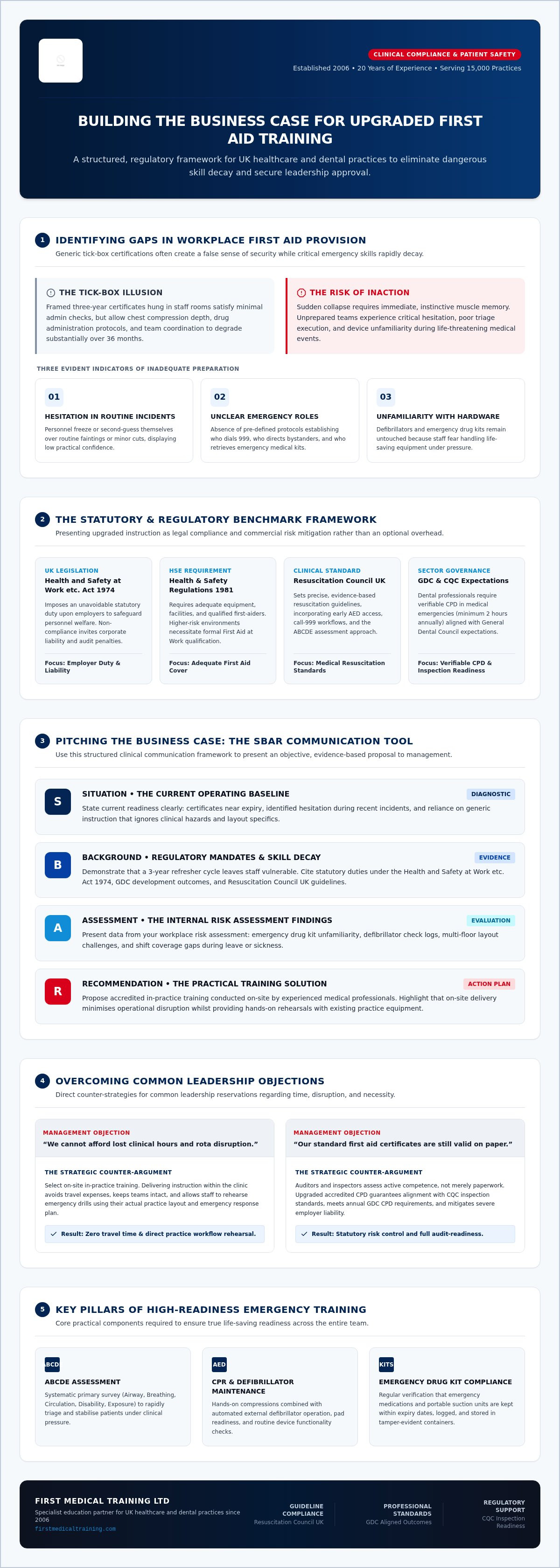
Holding a wall of framed certificates often creates a false sense of security. While basic courses cover foundational first aid principles, they rarely prepare personnel for fast-moving clinical or operational crises. Three years between refreshers allows critical skills to decay rapidly. Chest compression depth degrades, medication protocols blur, and staff lose the instinctive muscle memory required to act without panic. Reviewing your recent incident logs and near-miss reports will often expose subtle response delays that could prove disastrous during a sudden collapse. Learning how to convince my boss we need better first aid training begins with diagnosing these silent vulnerabilities before an inspector or an emergency does.
Recognising the Signs of Inadequate First Aid Preparation
True emergency capability fails long before an ambulance arrives. Watch for these daily indicators across your team:
- Hesitation during minor incidents: Staff freeze or second-guess themselves over routine faintings or cuts, demonstrating low practical confidence.
- Unclear emergency roles: No clear protocol establishes who calls 999, who manages bystanders, and who retrieves life-saving gear when someone collapses.
- Unfamiliarity with emergency hardware: Life-saving tools like the emergency drug kit or defibrillators remain untouched because employees fear operating unfamiliar devices under pressure.
Conducting an Internal First Aid Needs Assessment
You cannot persuade management with subjective impressions; you need documented evidence. Execute an internal audit using a formal Risk assessment that evaluates your building layout, occupancy rates, and practical working conditions.
Examine specific environmental hazards that generic courses overlook, such as clinical sedation, hazardous substances, or multi-floor lone working areas. Audit your personnel records to map out certificate expiry dates and identify shifts with inadequate coverage. Presenting this diagnostic data clearly proves that your current setup leaves the business vulnerable, establishing the first critical milestone in how to convince my boss we need better first aid training.
Build a Clear Business Case Grounded in Regulatory Compliance
Convincing a decision-maker requires shifting the conversation from an emotional plea to statutory risk mitigation. Under the Health and Safety at Work etc. Act 1974, employers bear an unavoidable legal duty to protect the welfare of their workforce. Neglecting emergency readiness exposes leadership to severe legal penalties, corporate liability, and reputational damage following a serious incident. When you articulate how to convince my boss we need better first aid training, frame upgraded instruction as commercial risk control rather than an optional expense. High-quality preparation protects brand integrity, prevents costly operational downtime, and provides the verifiable documentation required during external audits.
Meeting Statutory HSE and Industry Standards
In Great Britain, the Health and Safety (First-Aid) Regulations 1981 require employers to provide adequate equipment, facilities, and qualified personnel. A standard one-day Emergency First Aid at Work course introduces basic life support, yet higher-risk commercial environments often demand comprehensive First Aid at Work certification. International benchmarks like OSHA regulatory requirements also emphasise tailoring emergency planning to physical work hazards rather than settling for minimal cover. For specialised healthcare environments, explore this structured pathway for first aid at work for dental practices to ensure your operational protocols align with statutory obligations.
Clinical and Sector-Specific Compliance Expectations
Standard commercial guidance is insufficient for clinical environments. Practices must adhere to strict sector-specific benchmarks:
- Resuscitation Council UK guidelines: Mandate precise, evidence-based resuscitation protocols, including immediate call-999 actions and early defibrillation workflows.
- GDC development outcomes: Require registered dental professionals to complete verifiable CPD in medical emergencies, with at least two hours completed annually. Check the gdc cpd requirements medical emergencies guide to confirm statutory compliance targets.
- CQC inspection frameworks: The Care Quality Commission expects every practice to maintain an on-site AED and demonstrate regular emergency scenario rehearsals.
Demonstrating compliance with these rigorous frameworks gives your proposal authority. If your organisation needs accredited, regulation-compliant instruction, explore expert-led courses at firstmedicaltraining.com to protect your team and patients alike.
Overcome Common Management Objections Regarding Cost and Disruption
Proposing safety upgrades inevitably triggers managerial resistance around two primary pain points: lost operational hours and financial budgets. Leaders often view emergency education as a disruptive line-item expense rather than an investment in operational stability. To make headway on how to convince my boss we need better first aid training, you must anticipate these hesitations and dismantle them with practical commercial alternatives. Reframing the discussion around risk mitigation and business continuity transforms your pitch into a constructive operational proposal.
Addressing Worries About Lost Working Hours
Managers frequently worry that booking multi-day off-site courses will leave rotas depleted and disrupt client appointments. You can resolve this issue by researching flexible learning delivery before your meeting:
- Propose on-site in-practice training: Bringing accredited trainers directly to your premises eliminates travel time and keeps colleagues accessible during routine operating hours.
- Highlight rota resilience: Upskilling multiple team members ensures sickness or annual leave will not leave the workplace legally vulnerable or short-staffed.
- Suggest scheduled protected time: Suggest running group training during scheduled administrative windows or dedicated practice development afternoons to avoid cancelling appointments.
Reframing Training from an Expense to Risk Mitigation
When leadership challenges the budget, shift their perspective toward asset protection. Resources on building the business case for workplace readiness demonstrate that swift, competent intervention directly protects an organisation from severe financial fallout. Unprepared teams expose the company to costly legal claims, regulatory sanctions, and extended sick leave following an avoidable complication.
Prompt, high-calibre CPR training prevents permanent hypoxic damage during a cardiac event, saving lives and limiting negligence liabilities. Robust, verifiable compliance records can also reassure professional indemnity underwriters regarding your practice risk profile. Mastering how to convince my boss we need better first aid training means showing that the cost of professional instruction is negligible compared to the commercial catastrophe of an unmanaged crisis.
Pitch Your First Aid Proposal Using the SBAR Communication Framework
Approaching leadership with vague anxieties rarely secures funding. Managers respond to structured, objective communication that pinpoints problems and presents turnkey solutions. Originally developed in military and high-stakes healthcare environments, the SBAR tool (Situation, Background, Assessment, Recommendation) provides the ideal vehicle to state your case cleanly. Applying this framework is the most reliable strategy when working out how to convince my boss we need better first aid training without creating professional friction.
Structuring Your SBAR Case for Maximum Impact
Organise your pitch into four logical stages to keep the meeting focused on risk management:
- Situation: State the immediate operational vulnerability clearly. Explain that while the business maintains nominal certification, the team lacks practical, up-to-date competence to manage serious medical emergencies or cardiac events.
- Background: Outline factual data. Detail upcoming qualification expiries, documented near misses, changes in equipment, or shifts where trained personnel are absent.
- Assessment: Share findings from your recent workplace Risk assessment. Explain that relying on basic, historical instruction leaves the organisation legally exposed under current UK standards.
- Recommendation: Propose an accredited training session tailored directly to your operational environment, covering team-based CPR, AED operation, and critical incident workflows.
Presenting Actionable Next Steps to Your Manager
Never hand your manager an open-ended problem that adds to their workload. Present a concise, one-page brief that answers logistical questions before they are asked. Share this checklist on dental practice emergency preparedness to benchmark your current setup against recommended protocols.
Volunteer to coordinate delegate lists, gather quotes, and handle venue scheduling to remove friction. Finally, ask for a defined review date, giving them time to consider the evidence while keeping the safety initiative moving forward. Taking total ownership of the process demonstrates professional leadership and removes every practical hurdle in how to convince my boss we need better first aid training.
Ready to upgrade your team's emergency response capabilities? Book an accredited, expert-led course through firstmedicaltraining.com to secure verifiable compliance and real clinical confidence.
Select an Accredited Training Provider That Delivers Real Confidence
Recommending the right training partner represents the final, decisive step in your pitch. Low-cost courses often rely on passive presentations and generic handouts, leaving teams anxious when facing an actual casualty. Real competence demands an accredited partner whose instructors possess active frontline clinical experience. They don't just teach theory; they guide your team through high-pressure simulations using the systematic ABCDE approach. When establishing how to convince my boss we need better first aid training, demonstrating that your chosen provider guarantees verifiable compliance ensures executive buy-in.
Essential Accreditations and Clinical Standards to Look For
To satisfy regulatory scrutiny, ensure your shortlisted provider meets strict educational and clinical criteria:
- Resuscitation Council UK compliance: Courses must align with the latest resuscitation guidelines, including immediate call-999 sequences and automated defibrillator protocols.
- Verifiable CPD and GDC outcomes: Healthcare and dental teams require verifiable CPD that directly satisfies GDC development outcomes for medical emergencies.
- Practical feedback technology: Quality providers use training manikins equipped with real-time CPR feedback to measure compression depth and ventilation accuracy objectively.
- Specialised hardware coverage: Ensure the curriculum includes hands-on practice with medical emergency equipment, including portable suction units and emergency drug kit protocols.
The Distinct Operational Advantages of In-Practice Training
Rather than sending staff off-site to unfamiliar conference rooms, arrange on-site in-practice training within your everyday working environment. Rehearsing in your actual clinical spaces allows the entire team to practise navigating confined areas, retrieving real emergency devices, and testing communications during a simulated collapse.
This contextual practice ensures every team member knows the exact storage locations for oxygen and emergency drugs, turning a theoretical protocol into an instinctual response. Trusted since 2006, First Medical Training Ltd supports around 15,000 dental practices worldwide with close to 500 expert staff members. Choosing an established specialist reassures your manager that the investment delivers full CQC inspection readiness, measurable competence, and peace of mind. Knowing how to convince my boss we need better first aid training ultimately hinges on presenting a vetted, industry-proven partner ready to deliver tangible results.
Take the Lead in Protecting Your Workplace
Securing the emergency training your team genuinely needs doesn't have to be an uphill battle. When you understand how to convince my boss we need better first aid training, the conversation moves away from vague anxieties toward undeniable risk mitigation. By auditing internal hazards, structuring your pitch with the SBAR tool, and highlighting flexible delivery that protects operational hours, you demonstrate to leadership that readiness is an investment in business resilience.
Partnering with the right provider ensures your team gains genuine, life-saving competence rather than a superficial attendance certificate. Trusted by UK organisations nationwide since 2006, First Medical Training delivers fully accredited courses adhering strictly to Resuscitation Council UK guidelines. Our seasoned medical professionals conduct practical instruction directly on-site at your premises, eliminating travel downtime while building lasting clinical confidence.
Take the initiative today. Explore accredited first aid and medical emergency courses with First Medical Training and give your colleagues the practical skills to act decisively when it matters most.
Frequently Asked Questions
How can I convince my boss to pay for first aid training?
Frame your request around operational risk control, statutory duty, and team productivity rather than an overhead cost. When researching how to convince my boss we need better first aid training, present an internal needs assessment alongside the structured SBAR communication tool. Propose on-site delivery to eliminate travel downtime. Demonstrating that high-quality instruction prevents expensive legal liabilities and protects organisational reputation makes funding the course a straightforward commercial priority for leadership.
Is workplace first aid training a legal requirement in the United Kingdom?
Yes, UK legislation mandates appropriate first aid provision across all working environments. Under the Health and Safety (First-Aid) Regulations 1981, employers must provide adequate equipment, facilities, and qualified personnel based on an internal risk assessment. In healthcare sectors, regulatory bodies like the GDC and CQC introduce additional mandatory standards, requiring staff to hold verifiable life support certificates and complete regular medical emergency training.
What happens if a workplace fails to provide adequate first aid training?
Non-compliance exposes leadership to formal enforcement notices, severe financial penalties, and personal legal liability under the Health and Safety at Work etc. Act 1974. In the event of a workplace casualty, poor emergency management can result in costly negligence claims and invalidated insurance coverage. For clinical practices, failing inspection standards can trigger immediate regulatory sanctions, public inspection warnings, or suspended operating registrations from the CQC.
How often should staff refresh their first aid training?
Standard First Aid at Work certificates require renewal every three years, though annual refresher sessions are strongly advised to combat rapid skill decay. For healthcare and dental teams, regulatory expectations are considerably higher. General Dental Council standards require dental professionals to complete verifiable medical emergencies CPD annually, totalling ten hours per five-year cycle. Regular scenario practice ensures teams maintain immediate muscle memory for real crises.
Can our team complete first aid training on-site at our own premises?
Yes, on-site in-practice training is available across the UK and provides the most practical learning experience. Bringing professional clinical instructors directly to your premises removes external travel expenses and eliminates unnecessary rota disruption. Rehearsing emergency scenarios within your everyday workspace ensures every colleague knows the exact layout, equipment storage spots, and operational protocols needed to respond swiftly during an incident.
What is the difference between Emergency First Aid at Work and specialised medical emergency training?
A standard one-day Emergency First Aid at Work course covers baseline injury management, wound care, and adult resuscitation for lower-risk commercial settings. Specialised medical emergency training, such as Dental Immediate Life Support, addresses acute clinical emergencies. It teaches systematic ABCDE assessments, medical drug administration, airway management tools, and defibrillator operation tailored specifically to higher-risk patient care environments.
How does better first aid training help during a regulatory inspection?
Accredited instruction supplies verifiable documentation that satisfies official auditors and inspectors. During CQC assessments or HSE inspections, officials review training logs, emergency drug kit compliance, and team scenario rehearsals. Demonstrating that your staff complete accredited courses aligned with Resuscitation Council UK standards proves proactive duty of care. Understanding how to convince my boss we need better first aid training protects your organisation from avoidable compliance failures.