

Immediate Life Support for Dentists: 2026 Clinical Guide

Generic hospital resuscitation drills fail the moment an acute medical emergency occurs inside a confined dental operatory. Managing a deteriorating patient in the dental chair requires precise chair-side choreography rather than detached classroom theory. If you've ever felt uncertain about the exact requirements for immediate life support for dentists, or experienced anxiety about coordinating your team during a sudden airway obstruction, you aren't alone. Balancing General Dental Council expectations with Care Quality Commission compliance audits creates genuine pressure for modern clinical teams.
You can master the clinical protocols, regulatory standards, and practical skills required for immediate life support in UK dental surgeries to lead your team with steady confidence. This clinical guide outlines the dental immediate life support syllabus, essential equipment criteria, and practical airway management techniques you need to protect your patients and satisfy all professional standards.
Key Takeaways
- Master the distinct clinical scope of immediate life support for dentists, bridging the critical gap between basic life support and advanced operatory intervention.
- Apply a structured abcde approach adapted for the dental chair to resolve acute airway compromise and medical deterioration without delay.
- Establish rigorous checking schedules for your emergency drug kit and resuscitation gear to satisfy Care Quality Commission inspection standards.
- Rehearse practical team choreography to ensure clear, calm delegation between clinicians, dental nurses, and reception staff during a sudden collapse.
- Align your verifiable CPD with General Dental Council outcomes and Resuscitation Council UK guidelines through focused in-practice training.
Understanding Immediate Life Support for Dentists in 2026
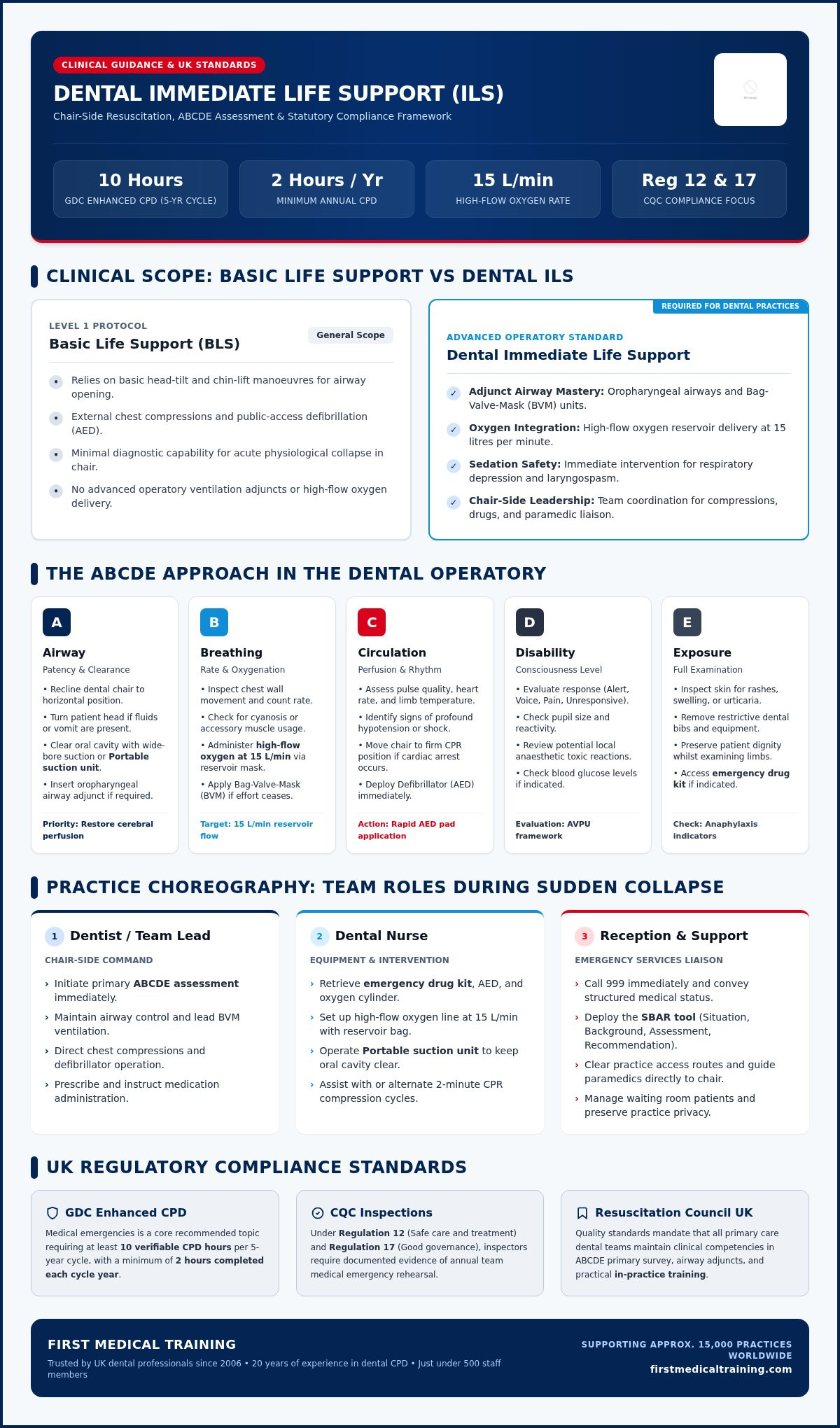
Dental emergencies present unique clinical challenges that standard first aid simply cannot resolve. Dental Immediate Life Support represents an advanced resuscitation protocol developed specifically for the primary care operatory. While general basic life support focuses on basic chest compressions and public-access defibrillation, immediate life support for dentists equips clinicians to manage acute physiological collapse, compromised airways, and systemic medical deterioration before ambulance crews arrive.
Resuscitation Council UK quality standards require dental teams to maintain high-level competencies in clinical assessment and advanced airway maintenance. These requirements become non-negotiable when delivering high-risk procedures. Under national conscious sedation guidelines, practices providing intravenous or inhalation sedation must ensure their clinical team holds verified ILS competencies to manage sudden respiratory depression or laryngospasm safely.
Basic Life Support Versus Immediate Life Support
The clinical distinction between Basic Life Support (BLS) and Dental ILS centres on diagnostic capability and airway intervention. BLS relies on basic head-tilt, chin-lift manoeuvres and external chest compressions. In contrast, immediate life support for dentists demands the mastery of adjunct airway devices, including oropharyngeal airways and bag-valve-mask (BVM) ventilation linked to high-flow oxygen. Clinicians must apply the ABCDE assessment framework to evaluate breathing rates, pulse quality, and consciousness levels continuously. You must also assume immediate team leadership during cardiorespiratory arrest, coordinating chest compressions in the chair whilst delegating emergency drug preparation and paramedic liaison.
Regulatory Compliance Under GDC and CQC Standards
Meeting UK regulatory standards requires verifiable evidence of clinical competence across your whole team:
- General Dental Council (GDC) Enhanced CPD: Medical emergencies remains a core recommended topic requiring at least 10 verifiable CPD hours per 5-year cycle, with the GDC recommending at least 2 hours completed every cycle year.
- Care Quality Commission (CQC) Requirements: Under Regulation 12 (Safe care and treatment) and Regulation 17 (Good governance), inspectors require proof of annual medical emergency updates for all staff.
- Clinical Governance and Audits: Hands-on, practical scenario rehearsal provides tangible compliance documentation during CQC inspections, validating that staff can operate emergency gear without hesitation.
Participating in annual in-practice training ensures your practice satisfies these GDC outcomes while embedding calm, instinctive life-saving reflexes across the entire surgery.
The ABCDE Approach Adapted for the Dental Operatory
Applying the standard abcde approach inside a dental surgery requires specific adjustments for the operatory layout. Dental patients face unique emergency triggers, including injected local anaesthetics, swallowed foreign bodies, and supine vasovagal collapses. Using a disciplined primary survey ensures your team identifies life-threatening physiological deterioration before it degenerates into cardiac arrest. According to the Resuscitation Council UK quality standards for primary dental care, every member of the dental team must be capable of executing this systematic assessment smoothly.
Mastering immediate life support for dentists means knowing how to adapt each step of the ABCDE framework when working around dental chairs, overhead delivery units, and oral fluids.
Airway and Breathing Management in the Chair
When a patient deteriorates acutely, assess airway patency immediately while adjusting chair position. If the patient faints or loses consciousness, recline the dental chair into a fully horizontal position to restore cerebral perfusion. If a foreign body, dental material, or blood compromises the airway, turn the patient's head to the side and clear the oral cavity using wide-bore high-volume aspiration or an independent Portable suction unit. For complete upper-airway foreign body airway obstructions that do not respond to chest thrusts or back blows, deploy appropriate airway clearance tools without delay.
Assess breathing by inspecting chest wall movement, checking respiratory rate, and noting signs of cyanosis or accessory muscle use. Provide high-flow oxygen at 15 litres per minute through an oxygen reservoir mask for severely hypoxic patients. If respiratory effort falters or ceases entirely, establish an airtight seal using a pocket mask or a self-inflating bag-valve-mask connected to high-flow oxygen, delivering 10 to 12 breaths per minute.
Circulation, Disability, and Exposure Assessments
Circulatory collapse requires immediate clinical intervention. Assess central pulse rate, peripheral skin temperature, and capillary refill time by pressing a fingertip for five seconds; colour should return within two seconds. If the patient is pulseless, begin immediate chest compressions directly in the reclined chair and summon the automated external defibrillator.
For conscious, deteriorating patients, proceed through disability and exposure checks:
- Disability: Assess level of consciousness using the AVPU scale (Alert, Voice, Pain, Unresponsive). Test blood glucose levels using a finger-prick glucometer to rule out acute hypoglycaemia.
- Emergency kit access: Retrieve the practice emergency drug kit to prepare condition-specific medications, such as intramuscular adrenaline for anaphylaxis or buccal midazolam for prolonged epileptic seizures.
- Exposure: Loosen restrictive collars or neckwear to facilitate unhindered breathing while maintaining patient dignity with blankets.
Communicate findings to 999 dispatchers using the structured SBAR tool (Situation, Background, Assessment, Recommendation). Delivering precise physiological data ensures paramedics arrive prepared for immediate critical handover. Rehearsing these practical scenarios alongside seasoned clinicians through Dental Immediate Life Support (ILS) Training ensures your surgical team reacts with coordinated speed when minutes matter most.
Essential Equipment for Dental Immediate Life Support
Executing resuscitation protocols requires immediate access to functional, standardised emergency hardware. Regulators expect primary care dental practices to maintain dedicated resuscitation kits that operate independently of fixed chair utilities. Compliance audits by the Care Quality Commission assess whether dental teams keep their medical gear fully operational, inspected, and readily accessible. Reviewing the Care Quality Commission dental emergency equipment requirements confirms that practices must maintain specific airway tools, defibrillators, oxygen supplies, and emergency medications on site.
Achieving total Emergency drug kit compliance demands rigorous operational management. The practice emergency drug kit must reside in a centralised, tamper-evident container known to every team member. Appoint a dedicated staff member to conduct documented weekly inspections. These checks verify that drug ampoules remain within expiry dates, tamper seals stay intact, and your medical oxygen cylinder maintains at least 400 to 460 litres of gas (a size CD or D cylinder) with a regulator capable of delivering a constant 15 litres per minute.
Airway Adjuncts and Suction Devices
Effective airway control during immediate life support for dentists relies on properly sized equipment ready for instant deployment:
- Oropharyngeal Airways: Stock sizes 0 through 4 to accommodate paediatric and adult anatomies, measuring from the incisors to the angle of the mandible before insertion.
- Supraglottic Devices and Masks: Keep clear anatomical face masks and self-inflating bag-valve-mask units equipped with oxygen reservoir bags ready for emergency ventilation.
- Portable Suction Unit: Maintain a battery-powered or manual Portable suction unit fitted with wide-bore Yankauer suckers. Mains-powered chair aspirators fail during electrical cuts or when treating patients away from the delivery unit.
- Anti-Choking Devices: Supplement standard protocols with manual suction apparatus featuring a patented one-way valve system, which prevents foreign objects from being pushed further down the trachea.
Automated External Defibrillator Operation and Maintenance
Survival chances drop rapidly following sudden cardiac collapse. Modern defibrillators feature real-time CPR feedback technology, providing verbal and visual correction to keep compressions at the required 5 to 6 cm depth and 100 to 120 per minute rate.
Establish strict Defibrillator maintenance procedures. Check the unit's status indicator weekly and log pad expiration dates alongside battery life. Ensure the kit contains adult and paediatric pads, clothing shears to remove restrictive dental bibs or garments quickly, and a prep razor to clear chest hair for solid pad adhesion. Register your defibrillator on The Circuit network so emergency services retain full visibility of your device's operational readiness.
Practice Choreography: Training the Dental Team for Sudden Collapse
Operating in a dental surgery during an acute collapse feels fundamentally different from handling a medical event in a hospital corridor. Physical space is restricted. Overhead lights, bracket tables, and delivery carts create genuine barriers around the casualty. Delivering effective immediate life support for dentists relies entirely on deliberate choreography rather than ad-hoc individual effort. Regulators at the GDC explicitly mandate that at least two trained individuals must be immediately on hand during all clinical treatments to handle sudden collapse seamlessly.
Creating an airtight Dental emergency response plan transforms panic into structured, rehearsed muscle memory. When a patient deteriorates, every staff member must step into an assigned, operational post without hesitation.
Role Allocation During In-Surgery Resuscitation
Dividing duties clearly prevents duplicated effort and eliminates gaps in patient care:
- The Dental Surgeon (Team Leader): Stays beside the patient's head or torso, initiating high-quality chest compressions or ventilations while directing team interventions. Compressions can be delivered safely with the patient remaining horizontal inside the fully reclined chair.
- The Dental Nurse: Secures the airway using adjuncts, connects high-flow oxygen, attaches the defibrillator pads, and prepares medications from the emergency drug box.
- The Receptionist or Second Colleague: Dials 999 immediately, communicates patient observations via the SBAR format, prints medical histories, and meets the ambulance crew at the entrance to direct paramedics straight to the operatory.
The Advantage of In-Practice Emergency Simulations
Classroom lectures cannot replicate the physical obstacles of your actual dental practice. Delivering in-practice training directly inside your clinical rooms allows your team to rehearse medical collapse using your actual furniture, room layouts, and emergency equipment. This hands-on process exposes unexpected blind spots, such as tight door clearances for stretchers, tangled oxygen tubing, or locked emergency cabinets.
Practising sudden collapse drills on site ensures your staff identify and resolve equipment access bottlenecks long before facing a real patient crisis. Review our detailed Dental Practice Emergency Preparedness Guide to review audit checklists and streamline surgery workflows. To establish seamless chair-side coordination and empower your surgical staff, book in-practice Dental Immediate Life Support (ILS) Training delivered directly in your own surgery by experienced medical professionals.
Securing Verifiable CPD and Accredited Training Solutions
Selecting the right educational partner determines whether your emergency training merely satisfies paperwork or genuinely prepares your clinical team for acute crises. When booking verifiable CPD in immediate life support for dentists, practices must evaluate both educational rigour and regulatory alignment. The General Dental Council expects CPD to match distinct quality criteria, including clearly stated aims, verifiable outcomes, and documented educator credentials.
Relying solely on downloadable online certificates or generic video modules leaves practices exposed during CQC audits. Regulators require tangible evidence that clinicians and dental nurses have demonstrated physical competency in airway rescue, defibrillation, and emergency drug administration within the preceding twelve months.
Selecting an Accredited Dental CPD Provider
Scrutinise your training provider's clinical qualifications and medical background before booking. Effective instructors must possess genuine frontline healthcare experience and a deep understanding of dental operatory limitations. Ensure every syllabus maps directly to GDC Development Outcome C (maintenance and development of knowledge and skill within your field of practice) and complies with Resuscitation Council UK quality matrices.
For practices seeking complete clinical governance, the Medical Emergencies in a Dental Practice Course delivers practical, hands-on instruction covering patient assessment, medical kit deployment, and acute scenario management for the entire team.
Why Practices Partner with First Medical Training Ltd
First Medical Training Ltd has served as a dedicated education partner for dental professionals since 2006. With two decades of specialised dental CPD experience, our organisation supports approximately 15,000 dental practices worldwide. Backed by just under 500 members of staff, we deliver accredited courses directly to clinical premises nationwide.
Practices rely on our training programmes because we prioritise operational reality over tick-box compliance:
- In-Practice Excellence: Training takes place directly inside your clinical operatories, allowing staff to practise emergency roles using their everyday layouts and real emergency equipment.
- Medical Professional Delivery: Courses are taught exclusively by experienced medical professionals who demystify complex emergency response algorithms.
- Audit Assurance: Every completed course delivers verifiable CPD aligned with GDC standards, ensuring confident CQC audit readiness.
Consult our GDC CPD Requirements for Dentists Guide to confirm your team's cycle hours. Securing accredited, in-practice education in immediate life support for dentists protects your patients, strengthens your team choreography, and safeguards your clinical registration year after year.
Strengthen Your Practice Preparedness and Clinical Confidence
Mastering immediate life support for dentists transforms unpredictable medical crises into structured, rehearsed responses. Adapting the systematic ABCDE survey to the dental operatory, maintaining compliant emergency hardware, and embedding clear team roles ensure your practice responds to sudden collapse without delay.
Delivering specialised medical and dental education across the UK since 2006, First Medical Training stands as a trusted partner supporting approximately 15,000 dental practices worldwide. Our accredited training programmes align rigorously with Resuscitation Council UK standards and GDC development outcomes, giving your whole team complete clinical governance assurance.
Protect your patients and empower your surgical staff with hands-on, practical expertise. Book your accredited in-practice Dental Immediate Life Support training with First Medical Training to build lasting emergency readiness directly within your own clinical surgeries.
Frequently Asked Questions
Is immediate life support training mandatory for all UK dentists?
Yes, immediate life support training is mandatory for UK dentists providing conscious sedation and strongly recommended across general primary dental practice. Resuscitation Council UK quality standards state dental teams must possess resuscitation skills beyond basic CPR. While standard basic life support satisfies minimum baseline compliance for un-sedated routines, providing sedation without verified ILS competencies breaches clinical guidelines and invalidates professional indemnity.
Can dental nurses and receptionists participate in the same Dental ILS course?
Yes, training the whole practice team together is the gold standard for clinical safety. Regulators require at least two trained staff members present during treatment, making dental nurse competency vital. Receptionists learn crucial supportive duties, including managing 999 calls, structuring emergency communications, and greeting paramedic crews. Involving all administrative and clinical staff ensures complete team cohesion during an operatory collapse.
How much time must dental professionals allocate to medical emergencies CPD annually?
Dental professionals must complete at least 10 verifiable CPD hours in medical emergencies per five-year cycle, with the GDC recommending at least two hours each year. Completing an annual course in immediate life support for dentists fulfils this requirement cleanly. It satisfies GDC Development Outcome C and supplies regular documented evidence that your emergency skills remain sharp.
What happens if a dental practice fails to complete annual resuscitation training before a CQC inspection?
Failing to maintain annual resuscitation training records triggers immediate regulatory scrutiny under CQC Regulation 12 (Safe care and treatment) and Regulation 17 (Good governance). Inspectors can issue requirement notices, downgrade your practice assessment, or suspend registration if staff cannot demonstrate emergency readiness. Ensuring every clinician holds an up-to-date certificate prevents non-compliance breaches during unannounced inspection audits.
Can Dental ILS training be completed entirely through online learning modules?
No, immediate life support for dentists cannot be achieved purely through e-learning modules. While theoretical principles can be reviewed online, Resuscitation Council UK guidelines and the CQC demand assessed practical competence. Clinicians must physically demonstrate chest compressions, bag-valve-mask ventilations, and airway adjunct insertions on manikins within a clinical environment to gain accredited, verifiable certification.
Is an automated external defibrillator legally required in every UK dental surgery?
Yes, clinical standards set by the Resuscitation Council UK require all primary dental premises to maintain immediate access to an operational automated external defibrillator. If a practice doesn't own a defibrillator, it must conduct an extensive risk assessment proving an external unit is deployable within three minutes of collapse. In practice, CQC inspectors expect every surgery to hold its own registered, maintained unit.
What airway management devices must dentists be competent in using during ILS emergencies?
Dentists must demonstrate competence in sizing and inserting oropharyngeal airways (sizes 0 to 4) and managing bag-valve-mask systems connected to high-flow oxygen. Clinicians must also master pocket masks with oxygen ports and independent portable suction units with wide-bore Yankauer tips. These tools allow teams to maintain airway patency, manage regurgitation, and ventilate deteriorating patients effectively until paramedic assistance arrives.