

LifeVac Anti-Choking Devices: 2026 Buyer's Guide

What would you do if the standard back blows and abdominal thrusts failed to clear a life-threatening obstruction during a choking emergency? It is a scenario that causes genuine anxiety for parents, carers, and health professionals alike, particularly when you realise that traditional protocols aren't always successful. You want the certainty of a backup plan that is both proven and easy to deploy whilst under extreme pressure.
In this 2026 buyer's guide, you will discover how to choose the right lifevac anti-choking devices to protect your home or workplace when every second matters. We understand the scepticism that can surround medical equipment, so we will break down the latest MHRA and FDA classifications that have solidified these devices as a trusted second-line treatment. By the end of this article, you will have total clarity on which kit fits your specific environment, ensuring you are fully prepared to act as a capable responder in a crisis. We will compare the different versions available and explain how this non-invasive suction technology provides a vital fail-safe for your safety toolkit.
Key Takeaways
- Learn how the unique one-way valve technology ensures that obstructions aren't pushed further into the lungs during an emergency.
- Compare the standard Home Kit and the compact Travel Kit to find the best fit for your kitchen or your next family holiday.
- Understand how lifevac anti-choking devices act as a proven fail-safe when traditional back blows and abdominal thrusts don't work.
- Discover how to integrate these devices into professional environments like dental surgeries and care homes to manage high-risk choking scenarios.
- See why pairing your life-saving equipment with accredited training from industry veterans ensures your team is ready to act with confidence.
What are LifeVac Anti-Choking Devices and How Do They Work?
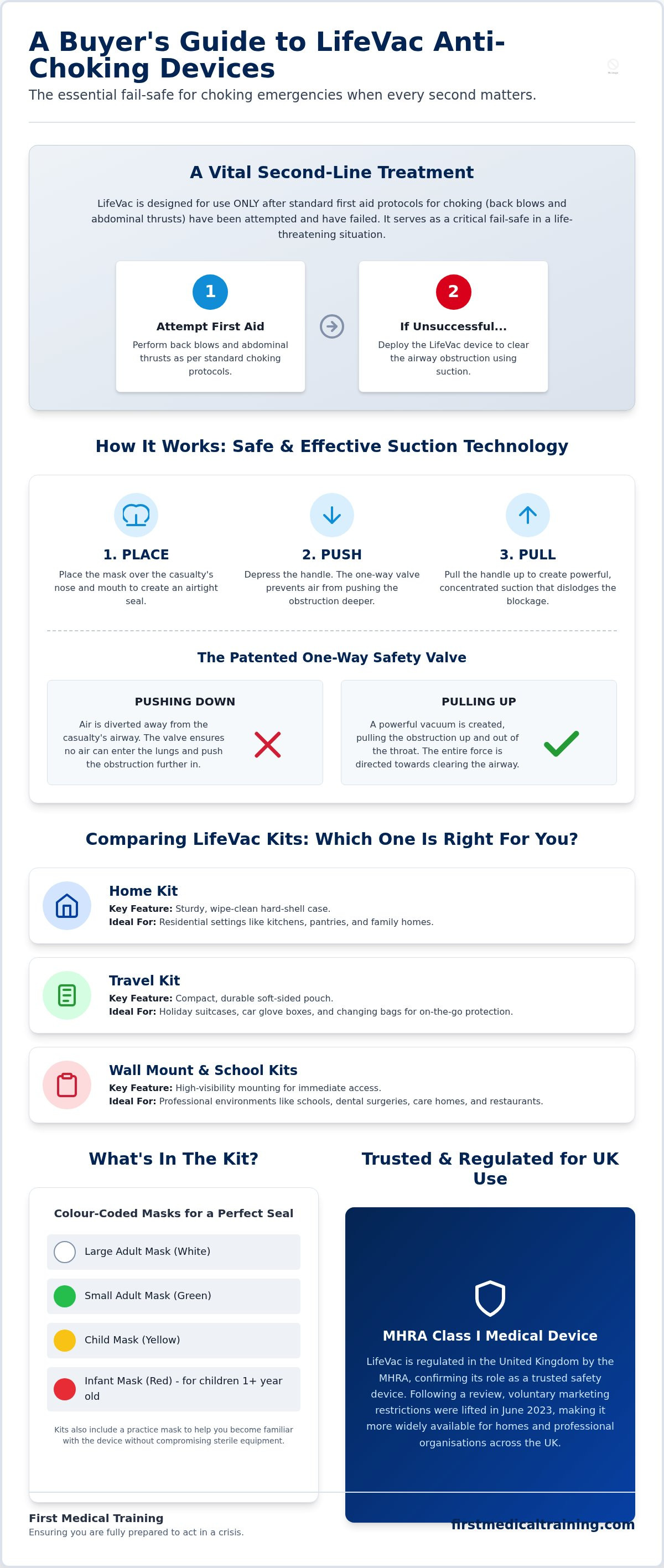
A LifeVac device is a non-invasive, portable suction unit designed specifically to clear an upper airway obstruction when standard protocols prove unsuccessful. It operates as a manual pump, creating a powerful vacuum to dislodge food or objects from the throat. Unlike invasive medical equipment, it does not enter the casualty's body, making it accessible for both trained professionals and laypeople in an emergency.
In the context of Choking and First Aid, these tools are strictly defined as a second-line treatment. This means they are deployed only after traditional methods, such as back blows and abdominal thrusts, have failed to resolve the situation. In 2026, lifevac anti-choking devices are widely recognised as an essential fail-safe for households and high-risk environments like dental surgeries or care homes.
The Physics of Suction: Why Design Matters
The efficacy of the device relies on its ability to generate significant negative pressure without causing further harm. When the bellows are depressed, the patented valve system ensures that no air is forced into the casualty's airway. This prevents the obstruction from being pushed deeper into the trachea, which is the primary risk with inferior, non-regulated suction tools. The patented one-way valve acts as a safety-critical barrier that prevents air from being pushed into the casualty's lungs during the downward stroke of the device. Upon the upward pull, the device creates a concentrated suction force that is often sufficient to pull the blockage clear in a single motion.
UK Safety Standards and 2026 Compliance
In the United Kingdom, LifeVac is classified as a Class I Medical Device and is regulated by the MHRA. It's vital to understand that previous voluntary marketing restrictions were lifted in June 2023, allowing these devices to be more readily available across the wider UK market. This regulatory shift reflects a growing confidence in the device's role within a comprehensive safety strategy, provided it remains a secondary response to established basic life support protocols.
Many schools and care homes now include lifevac anti-choking devices as part of their standard emergency kits to protect vulnerable groups. At First Medical Training, we have supplied these devices since their introduction to the UK, ensuring they meet the rigorous standards expected by healthcare professionals. Choosing a device backed by professional training providers ensures that your equipment isn't just a purchase, but a reliable component of your broader health and safety compliance.
Comparing LifeVac Kits: Which One is Right for You?
When you decide to invest in lifevac anti-choking devices, the primary factor to consider is the environment where the equipment will be stored. While the patented suction technology remains identical across the range, the packaging and mounting options are tailored for specific scenarios. Selecting the right version ensures that the device is accessible and ready for immediate deployment when seconds are critical.
A vital component of every kit is the set of colour-coded masks. These are designed to provide an airtight seal on casualties of different sizes. Most standard kits include:
- White: Large Adult mask
- Green: Small Adult mask
- Yellow: Child mask
- Red: Infant mask (suitable for children aged one year and older)
Home vs. Travel: Choosing Your First Device
The Home Kit is the standard choice for residential settings. It is housed in a sturdy, hard-shell case that is easy to wipe clean and fits neatly into kitchen cupboards or pantries. In contrast, the Travel Kit uses a compact, soft-sided pouch. This durable design is perfect for holiday suitcases, car glove boxes, or changing bags. Many families adopt a multi-device strategy, keeping a Home Kit in the kitchen and a Travel Kit in the car to ensure they are never without a backup plan. Each kit comes with a practice mask, allowing you to familiarise yourself with the suction mechanism without compromising the sterile masks intended for emergency use.
Professional and School Kits
For high-traffic environments like restaurants, staff rooms, or educational settings, the Wall Mount Kit is the most effective option. This version prioritises visibility; it ensures that every member of staff knows exactly where the life-saving equipment is located. Schools often opt for the specialised School Kit, which is configured to handle high-density environments where children of various ages are present.
The move toward including these devices in professional settings is supported by rigorous data. A Clinical Study on Suction Devices demonstrates how this technology functions as a reliable intervention when standard protocols fail. For business owners, choosing a wall-mounted solution helps meet health and safety requirements whilst providing peace of mind to both employees and clients. If you are looking to secure your workplace or practice, you can browse the available LifeVac Anti-Choking Device kits to find the best fit for your specific floor plan.
Essential Features and Selection Criteria
Selecting the right equipment for your safety toolkit requires an understanding of how specific features translate into real-world performance. When evaluating lifevac anti-choking devices, the primary consideration is accessibility. The device is engineered for simplicity, allowing individuals with no formal medical background to act decisively. Its intuitive design minimises the risk of user error, which is a critical factor when panic sets in during a choking event. Evidence for this ease of use is supported by a 2022 case series published by the National Institutes of Health, which documented successful outcomes across various emergency settings.
Longevity and maintenance are equally important. Unlike many medical tools that require complex calibration, the suction unit itself is remarkably durable and does not have a set expiry date. However, the masks are the components that require your attention. You should check them periodically for any signs of wear to ensure they maintain their structural integrity. Another unique feature is the ability for self-administration. If you are alone and find yourself choking, the device can be placed against your own face and operated effectively, providing a vital layer of protection for those who live or work in isolation.
The Importance of Colour-Coded Masks
Speed is the most valuable currency in a crisis. The colour-coded mask system allows you to identify the correct size for a casualty in a matter of seconds, whether they are an infant, a child, or an adult. As children grow or as the demographics of your workplace change, you can simply update the masks in your kit rather than replacing the entire unit. Achieving a perfect mask fit is the single most important factor for suction success during an airway clearance attempt. Without an airtight seal against the skin, the vacuum cannot generate the negative pressure required to dislodge the obstruction.
Training and Readiness Resources
Possessing the hardware is only half of the solution; confidence comes from familiarity. Most modern kits now include QR codes that link directly to instructional videos, providing a quick refresher for family members or staff. We recommend conducting regular 'dry-runs' with the practice mask included in your kit to build muscle memory. Integrating LifeVac into your annual emergency first aid at work course UK ensures that your team is not just equipped, but truly ready to respond. This holistic approach bridges the gap between having the equipment and having the capability to save a life.
Integrating LifeVac into Professional Environments
In professional settings, the duty of care extends beyond simply following a basic checklist. It involves preparing for the moment when standard procedures aren't enough to save a life. lifevac anti-choking devices have become a standard addition to the emergency medical kits of surgeries, care homes, and schools across the UK. These environments house individuals who may be at a higher risk of choking due to age, medical conditions, or the specific nature of the procedures being performed.
LifeVac in the Dental Surgery
Dental procedures carry inherent risks. Patients are often reclined in a chair, making it difficult to perform effective back blows if a crown, bridge, or cotton roll becomes lodged in the airway. Integrating this device into your dental practice emergency preparedness protocols provides a non-invasive fail-safe. It allows staff to act whilst the patient is still in the chair, saving precious seconds that would otherwise be lost trying to reposition them. This level of readiness is essential for maintaining the high standards expected in modern dentistry.
Care home managers face similar challenges. Dysphagia is a common condition amongst elderly residents, making every mealtime a potential hazard. By having lifevac anti-choking devices readily available in dining areas, staff can intervene quickly when traditional methods fail. This proactive approach is often viewed favourably by inspectors and insurers alike, as it demonstrates a commitment to resident safety that goes beyond the bare minimum requirements. It provides staff with the confidence to manage high-risk residents with a higher degree of certainty.
Workplace Health and Safety Compliance
Compliance isn't just about having the right gear; it's about how that gear is managed and documented. Your first aid risk assessment should reflect the presence of suction-based airway clearance tools. We recommend using the Wall Mount Kit for maximum visibility in high-traffic areas like staff rooms or school cafeterias. Ensure that the device is recorded in your emergency equipment log and that all staff members know its exact location. If you are ready to upgrade your facility's safety standards, you can order the full range of LifeVac equipment through our accredited supply channel.
Regarding liability, carrying a regulated Class I medical device is a responsible safety measure. Since these tools are used as a second-line treatment, they complement existing first aid protocols rather than replacing them. Documentation of staff orientation and regular equipment checks will further solidify your practice's standing during health and safety audits. It shows that you have considered every possible outcome in an emergency scenario.
How to Purchase: Why Choose First Medical Training?
Deciding where to source your emergency equipment is just as critical as the choice of the device itself. In an industry where reliability can be a matter of life or death, you need a supplier that understands the clinical reality of life-saving interventions. First Medical Training acts as more than just a retailer; we're an established UK medical training provider that has been at the forefront of emergency response education since 2006. This pedigree ensures that every piece of equipment we stock is vetted by professionals who actually teach these procedures.
The First Medical Training Advantage
Our history is deeply rooted in professional development, particularly through our highly regarded medical emergencies in dental practice course solutions. We've spent two decades ensuring that dental teams and healthcare workers are compliant and confident. When you purchase lifevac anti-choking devices from us, you're guaranteed a genuine, MHRA-regulated product. We don't deal in unverified alternatives because we understand that safety-critical equipment must perform perfectly every time it's called upon. Our team provides professional after-sales support, bridging the gap between simply owning a device and being fully prepared to use it.
Buying from a training specialist also means you have direct access to medical emergency experts. If you're unsure which kit configuration suits your specific facility, our advisors are available to provide pragmatic, experience-led guidance. We also prioritise fast UK delivery to ensure your home, school, or surgery is protected without unnecessary delay. We know that once you've identified a gap in your safety protocols, you want to close it as quickly as possible with equipment you can trust.
Next Steps for Your Safety Plan
The first step in upgrading your readiness is to conduct a thorough review of your current first aid provisions. Look for gaps in your choking response, especially in areas where food is consumed or where high-risk individuals are present. Integrating lifevac anti-choking devices into your kits provides that essential second-line fail-safe we've discussed throughout this guide. Once your audit is complete, you can easily secure the necessary equipment through our streamlined online shop. Don't wait for an emergency to reveal a weakness in your safety plan; take action whilst you have the time to prepare properly. Browse the full LifeVac collection and secure your kit today.
Secure Your Environment with Confidence
Integrating lifevac anti-choking devices into your safety protocol is a proactive step toward managing high-risk emergencies with certainty. These MHRA Regulated Class I Medical Devices provide a vital secondary response when traditional methods fail. Whether you are protecting a busy dental surgery or your own family dining table, having a reliable suction-based tool ensures you aren't left without options during a crisis.
Thousands of UK care homes and schools already trust this technology to safeguard those in their care. By sourcing your equipment through First Medical Training, you are supported by a team that has led the industry since 2006. We even offer a free replacement device if your unit is used in a documented emergency, ensuring your protection is never interrupted. Protect your home or practice: Shop the LifeVac Anti-Choking Collection.
Taking the time to prepare now builds the confidence you'll need to act decisively later. You now have the knowledge to choose the right kit and the understanding of how it fits into your broader safety plan. Ensure your environment is fully protected today.
Frequently Asked Questions
Is LifeVac safe to use on infants and small children?
LifeVac is safe for use on children aged one year and older who weigh at least 22lbs (approximately 10kg). The kit includes a red-coded paediatric mask specifically designed for smaller facial structures. It's vital to follow these age and weight guidelines to ensure the mask creates an effective suction seal without causing injury to a developing airway.
Does the LifeVac device replace the Heimlich manoeuvre?
No, the device is designed to complement rather than replace standard Basic Life Support (BLS) protocols. You should always attempt back blows and abdominal thrusts first as your primary response. lifevac anti-choking devices are strictly second-line interventions, intended for use only when these traditional methods have failed to clear the obstruction.
Can I use a LifeVac device on myself if I am alone and choking?
Yes, you can use the device on yourself if no one else is available to help. Position the mask over your nose and mouth to ensure a tight seal, then push the bellows down and pull up firmly. This capability makes it an essential safety tool for individuals who live alone or work in isolated professional environments.
How many times can a LifeVac device be used?
The device is intended for single use in a real-world emergency to maintain hygiene and structural integrity. After a successful save, the unit should be replaced to ensure future reliability. First Medical Training provides a free replacement for lifevac anti-choking devices used in documented emergencies, ensuring your home or practice remains protected without additional cost.
Is LifeVac officially approved for use in the UK by the MHRA?
Yes, it is officially classified as a Class I Medical Device in the UK and is regulated by the MHRA. Following the lifting of voluntary marketing restrictions in June 2023, the device is available for wider use across the UK market. This classification confirms it meets the necessary safety and performance standards for a suction-based airway clearance tool.
What should I do if the LifeVac fails to clear the obstruction?
If the device does not clear the blockage, you must immediately return to standard choking protocols and ensure emergency services are on their way. Continue alternating back blows and abdominal thrusts whilst waiting for paramedics to arrive. The device acts as a fail-safe, but it shouldn't delay calling 999 or performing traditional life-saving techniques.
Do the masks in the LifeVac kit expire?
The suction unit itself does not have an expiry date, but the masks should be replaced every two to three years. Over time, the medical-grade plastic may become stiff or discoloured, which can compromise the airtight seal required for effective suction. Regular checks of your emergency equipment will ensure the masks remain pliable and ready for immediate use.
Can LifeVac be used on someone with a beard or facial hair?
Yes, it can be used on individuals with facial hair, though achieving a seal may require firmer pressure against the skin. You must press the mask firmly to minimise air gaps caused by the beard. In a life-threatening situation, the priority is to create the strongest possible vacuum to dislodge the object from the airway.