

LifeVac for Schools and Care Homes: Enhancing Choking Safety Protocols

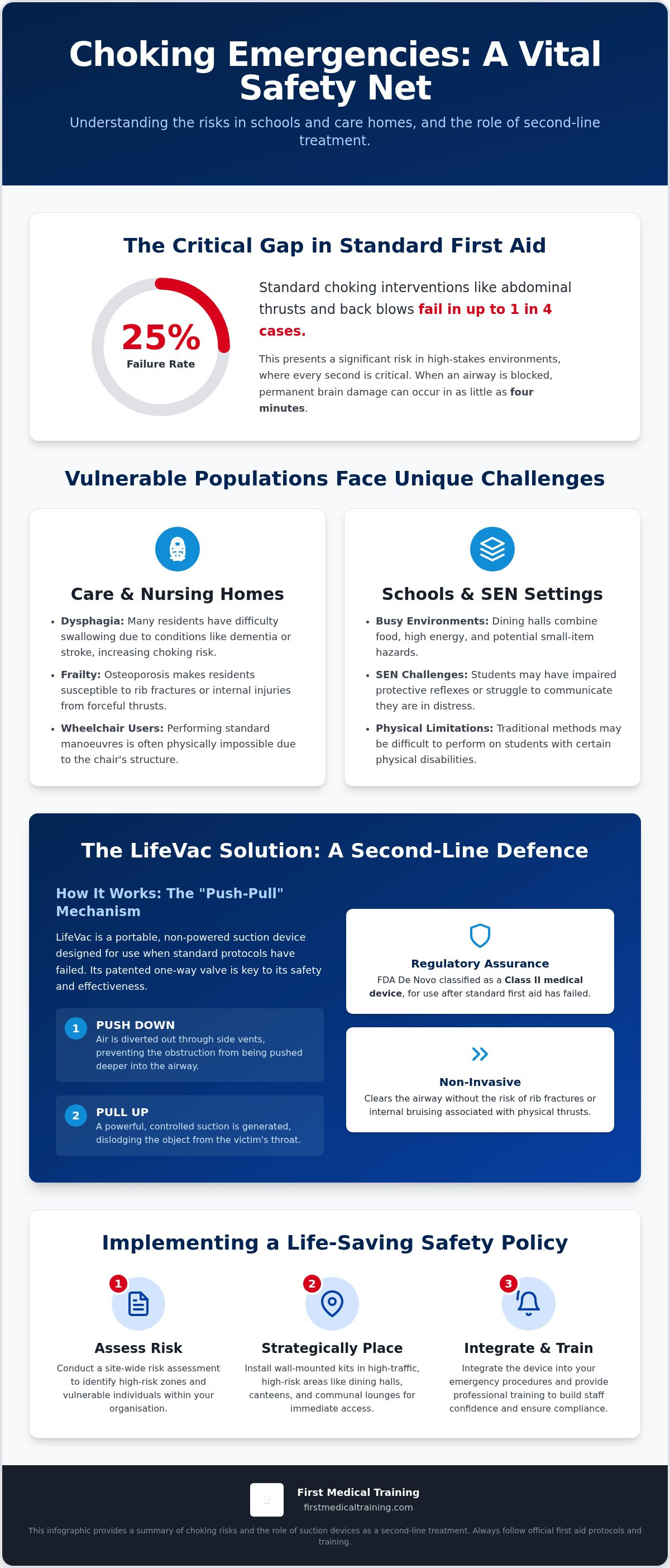
Did you know that standard choking interventions like the abdominal thrust fail in approximately 20 to 25 per cent of cases? For professionals in high-stakes environments, this statistic represents a worrying gap in emergency response. Implementing lifevac for schools and care homes provides a necessary second-line defence that addresses these specific vulnerabilities. You already understand the immense responsibility of protecting those in your care, yet the anxiety remains: what happens if the back blows don't work? This is particularly critical when managing residents with dysphagia or students in wheelchairs, where traditional physical manoeuvres are often difficult or impossible to perform effectively.
In this article, you'll discover how this regulated suction device enhances your existing emergency procedures and ensures compliance with modern health and safety standards. We will examine the practical role of LifeVac as a second-line treatment, its recent regulatory milestones, and how it builds the confidence your staff need to save lives during a choking emergency. By the end of this guide, you'll have a clear understanding of how to bridge the gap between standard protocols and life-saving results, ensuring your facility remains a safe environment for everyone.
Key Takeaways
- Identify the specific choking risks associated with dysphagia and physical disabilities that make standard first aid challenging in care and SEN settings.
- Understand the non-invasive mechanism of the LifeVac device and how its one-way valve prevents air from pushing an obstruction further into the airway.
- Learn why lifevac for schools and care homes is an essential safety net for individuals where traditional abdominal thrusts or back blows are physically impossible.
- Discover how to conduct a site-wide risk assessment to strategically place emergency equipment in high-risk zones like dining rooms and communal areas.
- Recognise the value of integrating life-saving hardware with professional training to build staff confidence and ensure full compliance with safety standards.
Understanding the Choking Risk in Schools and Care Homes
Choking is an immediate, life-threatening emergency that demands a response within seconds. When an airway is completely obstructed, the brain is deprived of oxygen, and permanent damage can occur in as little as four minutes. This narrow window leaves no room for error or hesitation. For those responsible for vulnerable populations, the implementation of lifevac for schools and care homes serves as a vital safety net when standard protocols are physically impossible to perform.
Dysphagia and Vulnerable Residents in Care Homes
Many care home residents live with dysphagia, a condition that makes swallowing difficult and significantly increases the risk of choking. This is often linked to neurological conditions such as Parkinson's, dementia, or the aftermath of a stroke. Mealtimes are high-risk periods where staff must remain hyper-vigilant. However, the physical reality of the residents themselves complicates standard first aid. Frail or osteoporotic individuals are at a high risk of sustaining rib fractures or internal injuries from traditional back blows or abdominal thrusts. Additionally, for residents who use wheelchairs, performing a traditional abdominal thrust is often physically impossible due to the chair's structure, leaving staff in a desperate position if the obstruction doesn't clear.
Choking Safety in Educational Environments
Schools present a different but equally complex set of challenges. In a busy dining hall, the combination of food, small toys, and high energy creates a constant hazard. This risk is amplified in Special Educational Needs (SEN) settings. Students with physical disabilities or cognitive impairments may not have the same protective reflexes as their peers, or they might struggle to communicate that they're in distress. Rapid response is essential. Providing lifevac for schools and care homes gives teachers and support staff a non-invasive tool that doesn't require the same physical strength or positioning as standard manoeuvres. This level of preparation offers profound reassurance to both staff and parents, knowing that the school has a reliable contingency plan if initial first aid attempts fail.
What is the LifeVac Anti-Choking Device?
The LifeVac is a portable, non-powered suction apparatus designed to rescue a choking victim when standard manoeuvres, such as back blows or abdominal thrusts, have proven unsuccessful. It's a simple yet highly effective piece of emergency equipment that requires no electricity or complex assembly. This makes it an ideal addition to the first aid inventory within lifevac for schools and care homes, where rapid, decisive action is paramount. The device functions as a second-line treatment, providing a final safety net when time is running out.
On March 6, 2026, the FDA granted De Novo classification for the device, formally categorising it as a Class II medical device. This FDA Safety Communication underscores its role as a second-line treatment, intended for use only after traditional first aid protocols have failed to clear the airway. This regulatory milestone provides schools and care providers with the assurance that they're implementing a tested, recognised solution within their safety frameworks.
The "Push-Pull" Mechanism Explained
The efficacy of the device lies in its patented one-way valve system. When the plunger is depressed, air is diverted away from the patient's airway, preventing the obstruction from being pushed further down the throat. Upon pulling the plunger back, a powerful vacuum is created, generating enough suction to dislodge the object. This non-invasive approach is particularly beneficial for frail individuals or those with physical limitations; it clears the airway without the risk of rib fractures or internal bruising often associated with high-impact physical thrusts.
LifeVac Kit Components for Organisations
To ensure broad compatibility across different age groups, the device is supplied with interchangeable masks. These include paediatric sizes for children aged one and older, as well as adult masks for staff and older residents. For professional environments, the wall-mounted kit is often the preferred choice. It's designed for high visibility and immediate access in communal areas like dining halls or nursing stations, ensuring it can be deployed in seconds.
The device is built for durability and has a long shelf life, making it a cost-effective safety investment for any institution. If you're looking to enhance your facility's emergency response capabilities, you can find the LifeVac Anti-Choking Device through our professional equipment range. This ensures your team is equipped with a tool that has a documented success rate of 1,724 lives saved globally as of August 2026.
Why Standard First Aid Protocols May Fall Short in Care Settings
Standard first aid protocols, whilst essential, are designed for the average healthy adult. In professional care environments, you're rarely dealing with the average. When a resident begins to choke, the adrenaline spike in staff members can lead to a "freeze" response, especially if initial back blows don't work. The Heimlich manoeuvre fails in approximately 20 to 25 per cent of cases, leaving a dangerous gap in emergency response. This is where lifevac for schools and care homes becomes a critical third-tier intervention. It's used only when standard protocols fail, providing a clear path forward when a situation turns critical.
Challenges with Wheelchair and Bed-Bound Patients
Positioning is the primary hurdle when treating someone in a wheelchair or a specialised care bed. Standard abdominal thrusts require the responder to stand behind the patient and wrap their arms around the waist. For a resident in a high-back wheelchair or someone who is bed-bound, this is often physically impossible. Attempting to lift or move a choking patient out of their chair during an emergency is dangerous and wastes precious seconds. The LifeVac device bypasses this issue entirely. It can be applied whilst the patient remains in their seat or reclined, allowing the responder to act immediately without the need for risky physical handling.
Managing Frailty and Medical Comorbidities
The physical force required for effective back blows and abdominal thrusts can be devastating for a frail elderly person. Those with osteoporosis or brittle bones are at a high risk of rib fractures, whilst those with recent abdominal surgeries or cardiovascular issues may suffer significant internal trauma from the pressure of a thrust. A non-invasive suction approach provides a safer alternative for these high-risk groups. It generates the necessary pressure to clear the airway without impacting the skeletal structure or internal organs. Adopting this specialised equipment mirrors the dental practice emergency preparedness mindset, where having the right tools for specific patient needs is non-negotiable. By integrating these devices into your safety strategy, you're providing a tailored response that respects the physiological realities of the people in your care.
Implementing LifeVac Within Your Organisation’s Safety Policy
Integrating lifevac for schools and care homes into a professional safety policy requires a systematic approach. It isn't enough to simply own the equipment; it must be part of a broader emergency response framework. Begin by conducting a site-wide risk assessment to identify high-risk choking zones. These are typically areas where food is consumed or where residents with known swallowing difficulties congregate. By mapping these locations, you can ensure that life-saving tools are always within reach during the critical four-minute window mentioned earlier.
Establishing a clear protocol for deployment is essential. Staff must understand that the device is a second-line treatment, intended for use only after standard back blows and abdominal thrusts have failed to clear the airway. This hierarchy of intervention ensures that your team follows established first aid guidelines whilst having a reliable contingency plan ready for immediate use.
Strategic Placement and Signposting
To further support these safety frameworks, many facilities look for external expertise in care management and staff education. The Direct Care Training & Resource Center Inc provides specialised consulting and training services designed to help long-term care providers maintain the highest standards of safety and compliance.
Centralising your kits in high-traffic areas is vital for reducing response times. In a school setting, the dining hall and staff rooms are primary locations. For care homes, nursing stations and communal lounges should be prioritised. Clear, high-visibility signage is necessary so that even temporary or agency staff can locate the device without delay. If your organisation organises off-site trips or educational visits, portable kits should be assigned to the lead first aider. This maintains a consistent level of protection regardless of the location. Furthermore, for organisations exploring advanced safety surveillance, such as using drones for site monitoring during these trips, Transport Canada drone pilot training offers an example of the rigorous standards required for technical safety compliance.
Hands-on familiarity is the best way to prevent the "freeze" response during a crisis. We recommend developing simple, quarterly training drills that allow employees to practice the application of the device. Using practice masks and a trainer device helps staff understand the feel of the suction and the correct placement on the face. This builds the muscle memory needed to act decisively under pressure. For facilities that provide dental care or medical services, ensure your training aligns with the GDC CPD requirements for medical emergencies to maintain full regulatory compliance.
A well-prepared team is a confident team. To ensure your staff are fully equipped to handle any airway obstruction, you can purchase the LifeVac Anti-Choking Device directly from our specialist range, ensuring your equipment meets the highest professional standards.
Securing Your Facility with First Medical Training Ltd
Hardware alone is insufficient without the confidence to deploy it effectively. By selecting First Medical Training Ltd as your supplier, you gain access to a partnership built on two decades of experience in the UK medical emergency sector. We recognise that compliance is a continuous process, not a one-off purchase. Our role is to ensure your staff are not only equipped with high-quality hardware but are also mentally prepared to navigate a crisis. This expert-led approach differentiates a professional safety strategy from a simple equipment list.
We provide the clinical context required to use these tools safely within the framework of current UK safety guidelines. This ensures that your investment translates into real-world readiness, reducing the likelihood of hesitation when a resident or student is in distress. Partnering with a dedicated training body ensures that your safety protocols remain robust and your equipment is always ready for immediate action.
A Holistic Approach to Emergency Preparedness
Emergency response is most effective when it is viewed as a comprehensive skill set rather than a series of isolated tasks. We advocate for a strategy where airway management is seamlessly integrated with other life-saving techniques. This might involve pairing your equipment with an AED Training Course or aligning it with the latest protocols for cardiac arrest management in dental practice or care environments. When your team understands how various medical emergencies intersect, their overall resilience is significantly strengthened.
Selecting the appropriate equipment shouldn't be left to guesswork. We assist you in determining the correct mask combinations and kit quantities based on your specific headcount and the unique needs of your residents or pupils. Our support extends to long-term maintenance, providing guidance for mask replacements and ensuring your equipment remains in peak condition year after year.
Expert Support for Schools and Care Homes
Meeting the heavy duty of care required in educational and social care settings is a complex task. First Medical Training Ltd serves as a seasoned mentor, helping you navigate the bridge between rigorous regulatory standards and practical daily application. Whether you're overseeing a SEN department or a large-scale residential facility, our professional advice is tailored to your specific operational realities and the vulnerabilities of those in your care.
Investing in lifevac for schools and care homes through a specialist provider guarantees that you're supported by industry veterans who prioritise the human element of care. Don't leave your emergency response to chance. You can purchase the LifeVac Anti-Choking Device from our professional range today, ensuring your facility is protected by the highest standards of medical emergency education and support.
Strengthening Your Emergency Response Strategy
Protecting the most vulnerable requires a shift from reactive first aid to a proactive safety culture. We've explored how a tiered response system, supported by non-invasive technology, can mitigate the risks associated with dysphagia and physical disabilities. By integrating lifevac for schools and care homes, you ensure your facility is prepared for the moment standard methods prove ineffective. This isn't just about meeting a duty of care; it's about providing the highest level of protection for those who rely on your team's ability to act decisively during an airway obstruction.
First Medical Training Ltd has served the healthcare and education sectors since 2006, offering the steady reliability that only comes from decades of specialist focus. We provide the mentorship and equipment necessary to bridge the gap between regulatory requirements and real-world results. Equip your facility with the LifeVac anti-choking device from First Medical Training Ltd to ensure your team has every tool available to save a life. Taking these steps now provides the peace of mind that your staff, parents, and residents deserve.
Frequently Asked Questions
Is the LifeVac device regulated for use in UK schools and care homes?
Yes, it is a CE-marked medical device and registered with the MHRA in the UK. The FDA classification as a Class II device in March 2026 adds further international regulatory weight. It's intended as a second-line treatment once standard Basic Life Support protocols have failed. This positioning ensures that lifevac for schools and care homes aligns with health and safety expectations for high-risk environments.
Can LifeVac be used on someone in a wheelchair or a bed?
Yes, the device is specifically designed to work effectively regardless of the patient's position. Traditional abdominal thrusts are often impossible to perform on individuals in wheelchairs or those who are bed-bound. Because the LifeVac is a non-invasive suction device, it can be applied whilst the person remains seated or lying down. This eliminates the need for dangerous lifting or repositioning during a life-threatening choking emergency, ensuring a faster response.
Does LifeVac replace the need for standard first aid training?
No, it's a secondary intervention that complements existing first aid skills. Standard protocols, such as back blows and abdominal thrusts, must always be attempted first. The device is only deployed if these initial methods fail to clear the obstruction. We recommend that staff continue to attend an Emergency First Aid at Work Course to maintain a comprehensive understanding of all emergency response procedures alongside the use of specialised equipment.
Are there different sizes of LifeVac masks for children and adults?
Yes, every kit includes interchangeable masks to ensure a proper seal for different age groups. The standard kit typically contains a paediatric mask for children and an adult mask for older students or residents. Achieving a tight seal is critical for generating the suction needed to dislodge an obstruction. Using lifevac for schools and care homes ensures that your facility is equipped to protect everyone, from young children to the elderly.
How often do the masks or the LifeVac device need to be replaced?
The device itself doesn't have an expiry date and is built for long-term durability. However, the masks have a shelf life of approximately five years and should be replaced once they reach their expiration date to ensure the material remains flexible enough to create an effective seal. If the device is used in a real emergency, the mask used must be replaced immediately to maintain hygiene and readiness for future incidents.
Can staff use LifeVac without having a medical background?
Yes, the device is designed for use by both laypeople and medical professionals. Its simple push-pull mechanism is intuitive, making it accessible for teachers, care assistants, and support staff who don't have clinical experience. Whilst it's easy to use, we strongly advise that all staff participate in practical drills and training sessions. This builds the confidence and muscle memory required to act effectively under extreme pressure during a choking emergency.
Is there any risk of the device causing internal damage to the patient?
The risk is significantly lower than that of traditional physical manoeuvres. Because the device is non-invasive and doesn't require high-impact thrusts to the abdomen or chest, it avoids the common complications of rib fractures or internal bruising. The patented one-way valve system ensures that air is never pushed into the patient's lungs, only pulled out. This makes it a safer alternative for frail residents or those with medical conditions that increase their vulnerability.
What should we do if the LifeVac is used in a real emergency?
If the device is used to successfully clear an airway, you should follow specific post-incident procedures. First, ensure the patient receives a medical assessment to check for any underlying issues. You should then report the life-saving event to the manufacturer; they often provide a replacement device or mask free of charge for documented saves. Finally, review the incident with your team to identify any lessons for your future safety protocols and training needs.