

Pros and Cons: UK In-House First Aid Training in 2026

Sending your team away to an off-site training suite might seem like the simplest way to protect daily operations, but sterile seminar rooms rarely prepare responders for the actual layouts of their own workplace. Weighing the pros and cons of in-house first aid training means confronting a genuine practical dilemma: is it better to deliver courses on-site, or does hosting an instructor create too much administrative friction? You already understand the frustration of managing rota gaps, balancing staff coverage, and keeping pace with mandatory training requirements.
This guide cuts through the guesswork. Discover the distinct benefits, potential pitfalls, and regulatory considerations of delivering first aid training at your premises versus external venues, fully aligned with Health and Safety Executive and Resuscitation Council UK standards. We examine practical room requirements, the value of rehearsing your dental emergency response plan in situ, and how to maintain high clinical standards without derailing your weekly schedule.
Key Takeaways
- Evaluating the pros and cons of in-house first aid training helps you decide whether site-specific drills offer greater clinical value than sending individuals to generic external venues.
- Delivering courses on-site enables your team to rehearse emergency response plans using your actual workplace layout, emergency drug kit, and portable suction unit.
- Hosting instructors at your facility requires clear operational planning to prevent client interruptions and protect the focus needed during resuscitation assessments.
- Team size dictates whether on-site delivery or external public courses provide the most practical route for maintaining mandatory first-aid coverage.
- Selecting an accredited provider aligned with Resuscitation Council UK guidelines ensures your training satisfies Health and Safety Executive and Care Quality Commission standards.
Understanding In-House First Aid Training Delivery
In-house first aid training involves a certified external tutor delivering regulated instruction directly on your premises. Some managers confuse this model with putting an employee through an instructor qualification. Instead of placing the ongoing burden of assessment and curriculum design on your internal staff, an experienced educator visits your facility to instruct your team. Assessing the pros and cons of in-house first aid training starts by recognising how professional first aid training bridges statutory health and safety duties with daily clinical realities. Carrying out in-practice training transforms familiar treatment rooms, corridors, and reception desks into practical simulation zones, cementing emergency protocols into the exact physical spaces where incidents occur.
On-Site Delivery Versus Public Open Courses
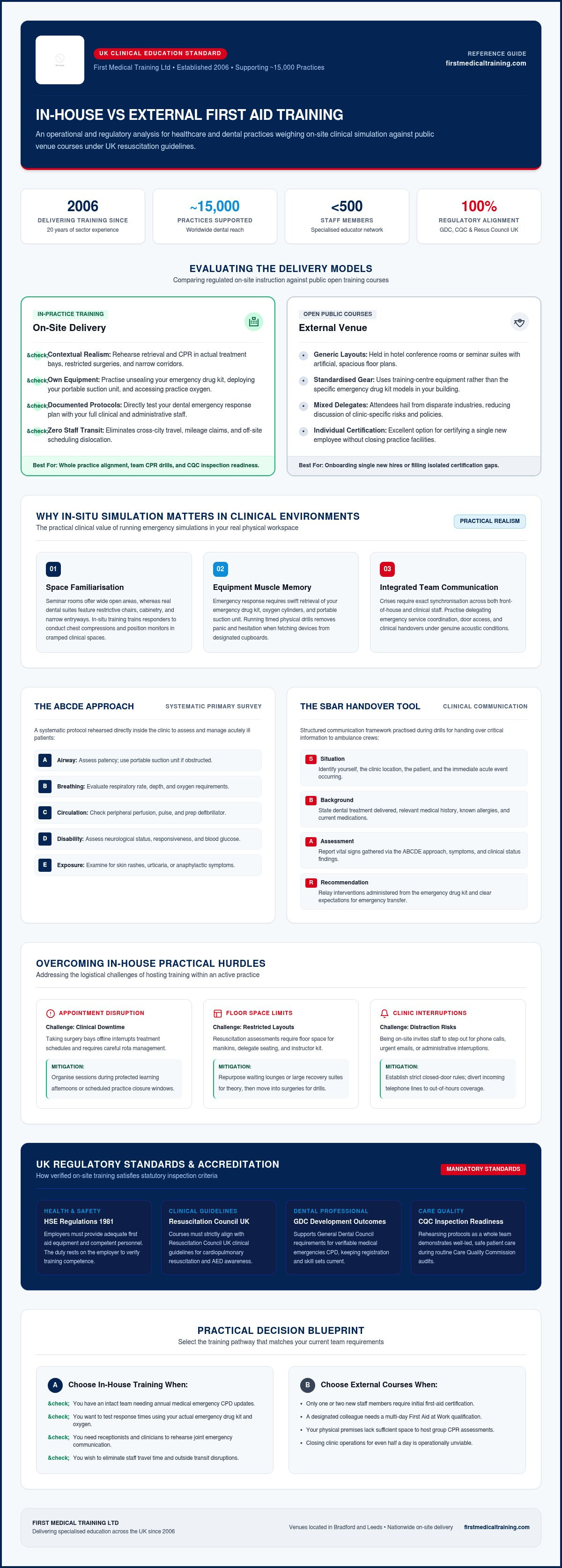
Public open courses gather mixed delegates from diverse industries inside a generic conference room. While suitable for certifying a single new hire, they lack workplace specificity. On-site delivery brings your workforce together for a closed, dedicated session. This format eliminates travel expenses, cross-city transit, and mileage claims, keeping staff within their normal working geography. Team communication improves noticeably during on-site sessions. Colleagues discuss actual workplace hazards openly, ask questions about specific clinic policies, and build genuine collective confidence without the friction often felt in mixed-company seminars.
Regulatory Compliance Under UK Standards
Under the Health and Safety (First-Aid) Regulations 1981, employers must provide adequate and appropriate equipment, facilities, and personnel. Because the Health and Safety Executive no longer approves commercial training providers directly, the responsibility rests on you to verify trainer competence. Delivering courses on-site satisfies this duty when paired with an accredited provider aligned with current Resuscitation Council UK guidelines. For healthcare and dental practices, this training directly supports General Dental Council expectations for medical emergencies verifiable CPD and satisfies Care Quality Commission standards for safe, well-led care. Rehearsing procedures as a complete unit demonstrates clear inspection readiness across every regulatory benchmark.
Key Advantages of In-House First Aid Training
Weighing the pros and cons of in-house first aid training reveals that contextual realism is its single greatest operational benefit. Instead of working through abstract case studies, an on-site instructor tailors practical simulations directly around the hazards identified in your workplace risk assessment. Scheduling training at your own facility also gives you total control over the calendar. You can plan full-day or half-day modules around quiet periods, practice closures, or protected learning afternoons, meeting statutory employer obligations under the Health and Safety (First-Aid) Regulations 1981 without dismantling your clinical appointment book.
Rehearsing Within Your Actual Operational Environment
Real-world treatment bays and clinical facilities rarely match the spacious floor plans of hotel seminar rooms. Delivering courses on-site allows your team to run physical retrieval drills in narrow hallways, compact reception areas, and restricted spaces around surgery chairs. Staff practise locating and opening your actual emergency drug kit and oxygen cylinders under realistic time pressure. Crucially, they verify whether vital devices, such as the portable suction unit, can be swiftly transported and deployed outside standard treatment bays. This hands-on familiarity removes hesitation and builds genuine muscle memory.
Strengthening Whole-Team Emergency Protocols
Managing an acute crisis demands total synchronisation across every job role, from front-of-house receptionists to senior clinical staff. Training together ensures everyone understands their designated role within your documented dental emergency response plan, whether that involves dialling 999, guiding paramedics into the building, or assisting with basic life support.
During these sessions, staff practise the systematic ABCDE approach under your building's genuine lighting, acoustic, and spatial conditions. Teams also rehearse clinical handovers using the structured SBAR tool (Situation, Background, Assessment, Recommendation) to communicate clearly under stress. If you need to certify support staff and ensure clear delegation throughout your premises, completing an Emergency First Aid at Work Course UK provides essential foundational skills. Arranging structured on-site sessions with First Medical Training helps turn theoretical guidelines into calm, coordinated collective action.
Drawbacks and Hidden Challenges of On-Site Courses
A balanced evaluation of the pros and cons of in-house first aid training requires an honest look at operational compromises. Shutting down your facility halts daily appointments, pauses administrative workflows, and creates immediate scheduling backlogs. Workplace hierarchy can also distort the learning environment. A junior receptionist or dental nurse might feel intensely self-conscious performing chest compressions, calling out drill instructions, or running an ABCDE assessment under the watchful gaze of senior practice partners or clinical directors.
Workplace Distractions and Operational Downtime
Physical proximity to daily work invites constant disruption. When courses take place on-site, delegates stepping out for short breaks inevitably encounter ringing reception phones, urgent emails, or arriving delivery drivers. This regular pull back into operational duties fractures concentration during crucial clinical scenarios. As explored in discussions on in house versus outsourced training, external venues provide a clean mental break from workplace demands. To counter local distractions without sending everyone off-site, organisations often adopt split-session delivery, training two separate cohorts across consecutive dates to preserve emergency cover.
Space Constraints and Equipment Limitations
Resuscitation Council UK guidelines mandate rigorous practical assessment, not just theoretical understanding. Delegates cannot master basic life support while perched behind desks; they must work physically on the floor. Delivering courses on-site quickly exposes square-footage limitations in compact premises:
- Floor clearance: Resuscitation practice requires enough open floor area to place multiple full-body manikins side by side, allowing delegates to kneel comfortably without crowding.
- Ventilation and movement: High-intensity chest compressions generate physical heat; small administrative rooms or converted staff rooms often lack the airflow needed for active physical exertion.
- Simulation technology: Off-site training suites frequently offer dedicated audiovisual systems and purpose-built simulation rooms that allow seamless use of real-time CPR feedback monitors.
If your facility lacks a clear, dedicated communal space free from clinical fixtures, forcing practical drills into cramped consulting rooms compromises delegate technique and instructor observation.
Evaluating In-House Versus External Venue Training
Deciding between delivery methods comes down to team size, facility layout, and operational tempo. When evaluating the pros and cons of in-house first aid training, organisations with only one or two delegates often find public open courses more practical. Conversely, practices with larger teams gain far higher educational value from dedicated, closed sessions that unite everyone under one roof.
Direct Comparison of Delivery Models
| Operational Metric | In-House Training | External Public Course |
|---|---|---|
| Environment | Conducted within your actual workspace and layout | Held in a standard external training suite |
| Curriculum Focus | Tailored around your specific risk profile and equipment | Broad, generic syllabus suited to mixed industries |
| Scheduling | Chosen by you to match quiet periods or practice closures | Dictated by the provider's fixed public calendar |
| Best Suited For | Teams of six or more learning together | Certifying single employees or individual new hires |
Sending lone staff members to external venues avoids disrupting the broader workforce. However, whole-team training ensures clinical standards align with the GDC CPD Requirements for Medical Emergencies, giving your organisation uniform audit trails and shared confidence.
Suitability Assessment Checklist for Your Premises
Before confirming an on-site booking, verify that your workplace can accommodate practical life-support teaching effectively:
- Floor space: Confirm a minimum of two to three square metres of clear floor space per candidate to allow unrestricted chest compressions and recovery position drills.
- Acoustic privacy: Select a self-contained room away from customer footfall so delegates can practise emergency communications without embarrassment or noise bleed.
- Dedicated availability: Secure the room exclusively for the session duration, removing any requirement for staff to pack away gear during scheduled breaks.
- Seating and utilities: Ensure comfortable seating for theoretical modules and accessible power outlets for projection and diagnostic training tools.
If your facility provides adequate floor area and privacy, book on-site training with First Medical Training to equip your workforce with compliant, practical life-saving skills.
Selecting an Accredited First Aid Training Provider
Maximising the benefits while minimising the drawbacks requires choosing the right delivery partner. In weighing the pros and cons of in-house first aid training, the quality of your instructor matters just as much as the venue. Since the Health and Safety Executive no longer approves training providers directly, you must carry out thorough due diligence. Ensure any visiting educator holds recognised teaching credentials, active clinical experience, and the ability to tailor basic life support drills to your specific sector.
Essential Provider Due Diligence Steps
Protect your regulatory standing by following a methodical four-step verification check before confirming any booking:
- Accreditation and compliance: Confirm the provider operates a verified quality management system aligned strictly with current Resuscitation Council UK standards.
- Clinical equipment familiarity: Verify that instructors can demonstrate and assess modern medical hardware, including defibrillators and diagnostic response kits.
- Curriculum relevance: In clinical environments, verify that the course syllabus maps directly to the Medical Emergencies in a Dental Practice Course to cover medical crises effectively.
- Verifiable documentation: Demand course certificates that explicitly detail verifiable CPD hours, learning outcomes, and relevant statutory references to satisfy CQC or GDC audit standards.
Organising Your Team for Training Day Success
Thorough preparation ensures your team extracts full value from on-site education. Inform your staff well in advance regarding the physical nature of the practical drills so they arrive wearing appropriate, comfortable clinical attire. Divert practice telephone lines, inform nearby businesses of your training closure, and secure the designated room entirely to eliminate operational interruptions while teaching is underway.
Audit your equipment readiness ahead of the session by running through the Dental Practice Emergency Preparedness Checklist. Doing so ensures your emergency kit, oxygen supplies, and portable suction units are ready for hands-on drills. When you are ready to prepare your workforce for critical incidents, take action to book accredited in-practice first aid training delivered directly to your premises.
Take Control of Your Team's First Aid Readiness
When it's time to weigh the pros and cons of in-house first aid training, success comes down to matching the learning environment with your operational priorities. On-site delivery gives your staff the distinct advantage of rehearsing acute emergencies inside your actual facility, using your everyday equipment and established protocols. Once you protect that dedicated session from operational distractions, the resulting teamwork and clinical competence far exceed what generic external seminars deliver.
Established in 2006, First Medical Training brings two decades of specialist experience to healthcare practices and workplaces across the UK. With nearly 500 expert staff supporting organisations nationwide, every course aligns directly with current Resuscitation Council UK guidelines and GDC development outcomes. Equip your team with the skills to act decisively when seconds count. Book your accredited in-practice training with First Medical Training and secure dependable emergency preparedness for your facility today.
Frequently Asked Questions
Is in-house first aid training fully recognised by the Health and Safety Executive?
Yes, the Health and Safety Executive fully recognises in-house training, provided your chosen provider meets statutory competency criteria. The HSE ceased direct approvals in 2013, placing the legal duty on employers to verify that course content aligns with current Resuscitation Council UK guidelines. When evaluating the pros and cons of in-house first aid training, hosting an accredited tutor on-site satisfies your requirements under the Health and Safety (First-Aid) Regulations 1981 without issue.
How much clear floor space is required to host first aid training on-site?
You should provide at least two to three square metres of clear, unobstructed floor space per candidate. Resuscitation drills require candidates to kneel alongside adult manikins, manage simulated casualties in the recovery position, and operate training defibrillators safely. A standard boardroom, large conference space, or cleared waiting area works well. If furniture cannot be easily moved aside, the room will restrict practical skill demonstrations and compromise formal assessment.
Can our organisation combine clinical staff and office personnel in one session?
Yes, mixing administrative and clinical personnel in one cohort is often beneficial for basic emergency drills. Front-desk staff, dental nurses, and clinicians must collaborate seamlessly during a genuine crisis, from placing 999 calls to handling the portable suction unit. However, clinical staff still need advanced syllabus modules like drug administration and airway management, which you can deliver by extending the session specifically for the clinical team after joint foundational drills conclude.
What happens if our workplace emergency equipment differs from the trainer kit?
Reputable instructors encourage using your own operational devices alongside standard training manikins. While tutors supply training defibrillators and hygienic airway consumables, integrating your practice emergency drug kit, oxygen cylinder, and portable suction unit bridges the gap between theory and reality. Practising with your exact hardware ensures your team discovers layout quirks, expiry issues, or missing adaptors long before facing an actual medical emergency in your surgery bays.
How do we prevent operational disruptions while training our entire team on-site?
Split your workforce into two distinct cohorts or book training across protected practice development half-days. Weighing the operational pros and cons of in-house first aid training means anticipating phone calls and patient arrivals. Divert telephone lines to an answering service, notify patients well in advance of planned closures, and establish strict boundaries so team members aren't pulled away from practical life-support drills to handle everyday administrative tasks.
Does on-site medical emergency training satisfy annual GDC verifiable CPD rules?
Yes, on-site courses fully satisfy General Dental Council requirements if delivered by an accredited provider. The GDC recommends dental professionals complete at least ten hours of medical emergencies CPD per five-year cycle, ideally doing two hours annually. Ensure your provider issues individual certificates detailing clear learning aims, anticipated outcomes, and mapped GDC development outcomes, which confirms compliance for future Care Quality Commission practice inspections.
Is it better to send a single new hire to an external course instead of booking on-site?
Sending a single recruit to an open external course makes far better practical sense than booking an on-site instructor for one person. Public sessions allow individuals to achieve regulated certification without closing your premises or paying for a full instructor day. Reserve dedicated on-site sessions for annual whole-team refreshers, where rehearsing site-specific emergency response plans delivers maximum educational and team-building value.
What credentials should we check before hiring an external first aid instructor?
Check that the instructor holds formal teaching qualifications, such as a Level 3 Award in Education and Training, alongside current clinical experience. Verify that their curriculum complies strictly with Resuscitation Council UK guidelines and that their training organisation maintains accredited quality assurance systems. For medical or dental practices, confirm the instructor understands healthcare-specific protocols, including emergency drug kits and the ABCDE patient assessment framework.