

Reducing Staff Anxiety: Dental Emergency Guide 2026

Did you know that up to 70% of dental practitioners will face a medical emergency this year? Managing a clinical crisis is often the most stressful aspect of practice life, and reducing staff anxiety about dental emergencies is essential for maintaining a safe clinical environment. It's common for team members to worry about freezing during a high-pressure situation or feel unsure about the specific contents of the emergency drug kit. This apprehension usually stems from a lack of regular, hands-on rehearsal rather than a lack of professional skill.
You can transform your team from anxious responders into a coordinated, calm unit by focusing on structured training and clear procedural frameworks. This guide outlines how to implement a reliable dental emergency response plan, use the ABCDE approach effectively, and ensure your practice meets all GDC and Resuscitation Council UK standards for 2026. By the end of this article, you'll understand how to build a culture of preparedness that protects your patients and supports your team's mental wellbeing.
Key Takeaways
- Adopt the ABCDE approach to provide your team with a systematic, reliable framework for assessing deteriorating patients and reducing decision fatigue.
- Prioritise in-practice training to build essential muscle memory by rehearsing emergency scenarios within your own clinical environment using your own equipment.
- Focus on reducing staff anxiety about dental emergencies by establishing a documented dental emergency response plan that assigns clear roles to every team member.
- Maintain emergency drug kit compliance through organised storage and regular audits to ensure staff feel confident and capable when selecting medications.
- Support long-term team resilience by implementing structured post-incident "hot debriefs" and utilising Mental Health First Aid for dental practices.
Understanding the Root Causes of Emergency Anxiety in Dentistry
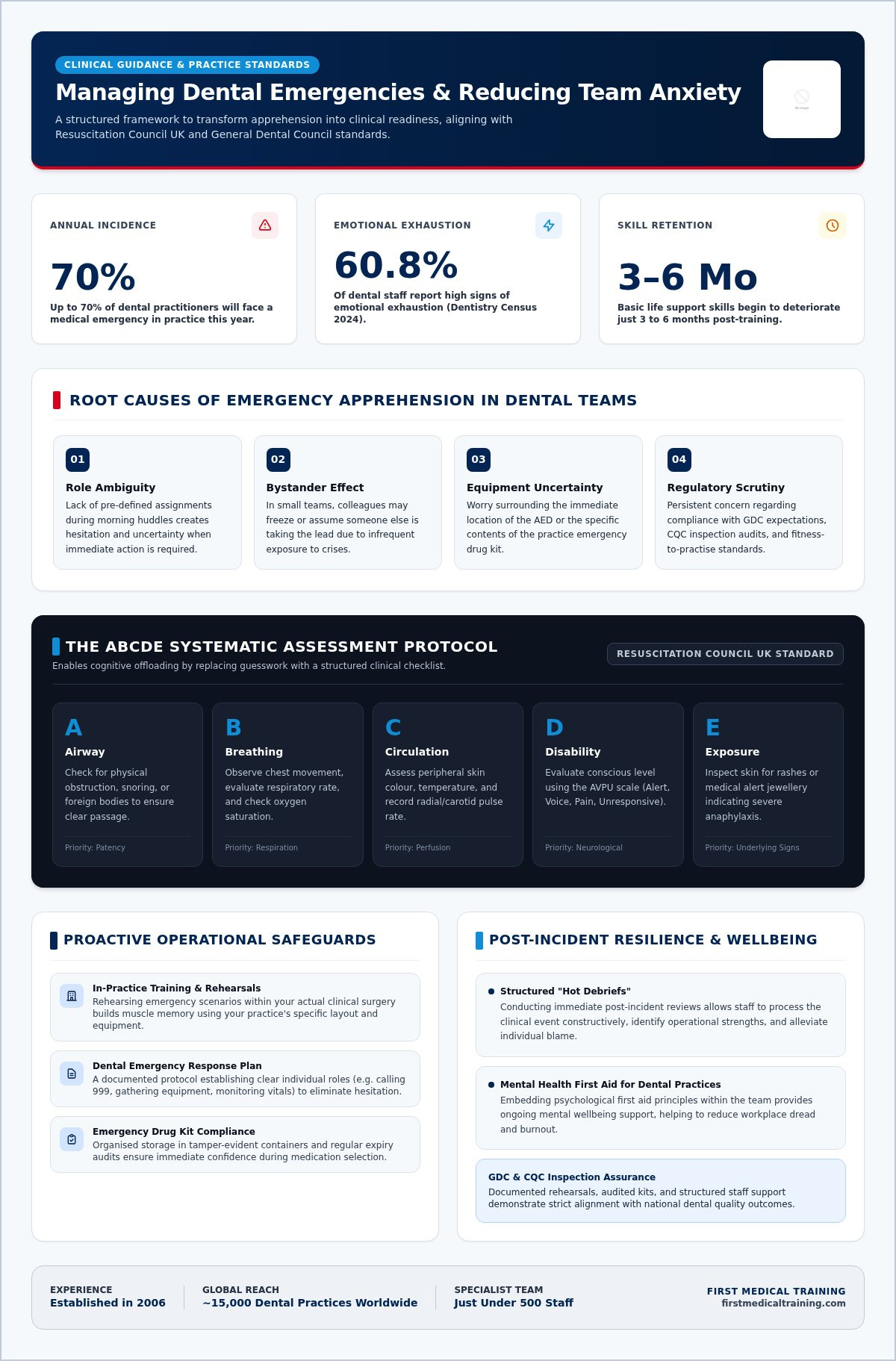
Managing high-stakes clinical crises is a significant source of stress for UK dental teams. According to the Dentistry Census 2024, approximately 60.8% of dental staff show high signs of emotional exhaustion; a figure that is often exacerbated by the fear of managing a sudden patient collapse. For many, the weight of regulatory scrutiny from the General Dental Council (GDC) and the Care Quality Commission (CQC) creates a persistent worry about litigation or fitness-to-practise investigations. This pressure makes reducing staff anxiety about dental emergencies a priority for practice principals who want to maintain a stable, confident workforce.
Small team environments also face the psychological challenge of the bystander effect. In a confined surgery, staff might hesitate or freeze, incorrectly assuming that another colleague is better equipped to take the lead. This hesitation is rarely due to a lack of care; it is a result of infrequent exposure. Research indicates that basic life support skills begin to deteriorate just three to six months after training. When you only face a true emergency once or twice a year, the gap between theoretical knowledge and the ability to act under pressure becomes a significant source of workplace dread.
The Psychology of Crisis Management
When a patient collapses, the human brain naturally enters a "fight, flight, or freeze" state. In a clinical setting, this surge of cortisol can impair logical decision-making and lead to sensory overload. To counter this, successful teams use cognitive offloading. By relying on a systematic ABCDE approach, you remove the need for complex internal processing during a crisis. Following a structured checklist allows the brain to focus on physical actions rather than being overwhelmed by the gravity of the situation.
Identifying Team Anxiety Triggers
Anxiety often centres on specific physical triggers within the practice. Staff frequently worry about being unable to locate the AED in time or feeling confused by the contents of the emergency drug kit. These fears are magnified when roles are not clearly defined during morning huddles. Role ambiguity is the leading cause of team panic because it creates a vacuum where no one feels authorised to act. Without a clear dental emergency response plan, the simple task of calling 999 can be forgotten whilst everyone focuses on the patient, leading to a fragmented and ineffective response. Addressing these triggers is the first step in reducing staff anxiety about dental emergencies and building a resilient clinical team.
Implementing Standardised Protocols: The ABCDE Approach
Standardised protocols serve as the clinical anchor during a crisis. When a patient's condition deteriorates, the most effective way of reducing staff anxiety about dental emergencies is to replace guesswork with a proven algorithmic system. Relying on a mental checklist ensures that no vital steps are missed, even when adrenaline is high. This structured approach is central to the Resuscitation Council UK quality standards, which emphasise that all clinical staff must be proficient in systematic assessment techniques.
Cognitive offloading is the primary benefit of using a protocol. By following a predetermined path, you reduce the mental load on the lead clinician, allowing them to remain focused on the patient's immediate needs. For specific guidance on common incidents, such as vasovagal episodes, you should refer to our guide on syncope management dental training.
Mastering the ABCDE Assessment
The abcde approach is the gold standard for clinical evaluation. It allows you to identify life-threatening problems in order of priority. You should follow these steps in sequence:
- Airway: Check for obstruction or snoring sounds.
- Breathing: Observe chest movement, respiratory rate, and oxygen saturation.
- Circulation: Assess skin colour, temperature, and pulse rate.
- Disability: Evaluate the level of consciousness using the AVPU scale.
- Exposure: Look for rashes or medical alert jewellery that might indicate anaphylaxis.
Assigning specific roles during this process is vital. One nurse can monitor breathing whilst another prepares the emergency drug kit. This division of labour prevents any single team member from becoming overwhelmed. The Resuscitation Council UK favours this systematic approach because it provides a universal language for all healthcare professionals, ensuring a seamless transition of care.
Using the SBAR Tool for Calm Communication
Communication failures are often the root cause of clinical errors during a crisis. The SBAR tool provides a structured framework to ensure that information is relayed accurately to 999 dispatchers and arriving paramedics. It consists of four clear components: Situation, Background, Assessment, and Recommendation. Using SBAR prevents the loss of critical data during a chaotic handover. For example, stating "The patient is a 45-year-old male with a history of asthma who is now wheezing" is far more useful than simply saying "He can't breathe." By mastering these standardised tools, you can significantly contribute to reducing staff anxiety about dental emergencies. If you want to ensure your whole team is prepared, consider booking a Medical Emergencies in a Dental Practice Course.
Reducing Panic Through Regular In-Practice Training
Theoretical knowledge is a necessary foundation, but it rarely survives the first few seconds of a real-world clinical crisis. The most effective method for reducing staff anxiety about dental emergencies is to transition from classroom learning to in-practice training. By conducting drills within your own surgery rooms, your team moves beyond abstract concepts and begins to build physical muscle memory. This practical familiarity ensures that when a patient collapses, your staff don't waste precious seconds orientating themselves or searching for equipment.
The General Dental Council (GDC) mandates a minimum of ten hours of verifiable CPD in medical emergencies every five-year cycle, with a recommendation for at least two hours annually. However, waiting twelve months between training sessions often leads to significant skill decay. Implementing quarterly "mini-drills" keeps response protocols fresh and ensures that CPR training remains instinctive rather than forced. These low-stakes rehearsals allow you to identify gaps in your dental emergency response plan before they impact patient safety.
The Benefits of Training in Your Own Surgery
Rehearsing in your actual clinical environment allows you to test the ergonomics of your response. You must ensure that your Automated External Defibrillator (AED) can reach every chair in the practice and that there are no physical obstructions preventing the use of a portable suction unit. Knowing the exact location of every item in the emergency drug kit reduces "search time" anxiety, which is a primary trigger for team panic. Following CQC guidance on emergency drugs and equipment by performing weekly checks further reinforces this spatial awareness. This process builds team cohesion, as every individual understands how to navigate their specific workspace during a high-pressure event.
Creating Realistic Mock Scenarios
Drills should focus on high-impact events, such as cardiac arrest management in dental practice. Using modern manikins equipped with real-time CPR feedback technology allows staff to see the quality of their compressions instantly. This objective data builds confidence, proving to the team that they are capable of delivering life-saving care. After each scenario, you should conduct a structured debrief to identify any bottlenecks, such as a lack of clear communication or confusion over roles. Resolving these minor issues during practice is a proactive way of reducing staff anxiety about dental emergencies, ensuring your team acts as a coordinated unit rather than a group of anxious responders.
Organising Equipment and the Emergency Drug Kit for Confidence
Physical preparation is the foundation of psychological confidence. When a team knows that their tools are functional and exactly where they should be, the fear of the unknown begins to dissipate. Ensuring that your equipment is logically arranged and clearly labelled is one of the most practical steps you can take toward reducing staff anxiety about dental emergencies. A disorganised cupboard is a significant trigger for panic, especially when a clinician is trying to locate a specific medication whilst under intense pressure.
Maintaining emergency drug kit compliance is not just a regulatory hurdle; it is a safety mechanism for your staff. You should use tamper-evident containers to provide instant visual confirmation that the kit is complete and has not been interfered with since the last audit. Developing a simple monthly checklist to monitor expiry dates and stock levels ensures that you are never caught with out-of-date adrenaline or an empty oxygen cylinder. A standardised kit layout reduces decision paralysis during a crisis by removing the need to search through disorganised supplies, allowing the responder to act instinctively.
Emergency Drug Kit Compliance and Accessibility
Accessibility is just as vital as organisation. Your kit must be kept in a central, unhindered location that is known to every member of the team. You should never lock emergency drugs away during clinical operating hours, as this creates a physical barrier that can lead to fatal delays. By keeping a clear log of weekly checks, you demonstrate to the CQC that your practice is well-governed. This transparency also reassures your nurses and associates that they are working in a safe, compliant environment where equipment readiness is a priority.
The Role of Life-Saving Equipment
Your Automated External Defibrillator (AED) should be the centrepiece of your emergency response. You must ensure the device is visible and accessible to everyone, including receptionists who may be the first to reach a patient in the waiting area. Regular defibrillator maintenance, including checking battery status and pad expiry dates, is essential to ensure the device is ready for immediate use. You should also regularly inspect the one-way valve system on your resuscitation masks to ensure they are clear and functional.
For non-clinical staff, the LifeVac anti-choking device is a reassuring addition to the standard kit. Choking incidents can happen anywhere in the practice, and having a simple, effective tool that requires minimal clinical training builds confidence across the entire workforce. This broader approach to equipment helps in reducing staff anxiety about dental emergencies by empowering every team member to play a role. If your practice needs to refresh its supplies, you can purchase high-quality emergency equipment directly from our accredited store.
Supporting Staff Wellbeing and Long-Term Resilience
The resolution of a clinical crisis isn't the end of the process. For many teams, the psychological impact of a patient collapse lingers long after the ambulance has departed. The adrenaline surge that helps you act during the event often leaves a vacuum of exhaustion and self-doubt. Addressing these emotional after-effects is a vital part of reducing staff anxiety about dental emergencies and ensuring your team feels supported in the long term. To strengthen your practice culture further, you can discover Humanise Solutions and their bespoke leadership development programmes. A practice that ignores the human element of care risks high staff turnover and increased workplace stress.
One of the most effective tools for immediate post-incident support is the "hot debrief." This structured conversation takes place immediately after the event, allowing every team member to share their perspective in a safe, blame-free environment. It serves two purposes: it identifies operational learning points for your dental emergency response plan and provides an essential emotional release. By talking through the event whilst it is fresh, you prevent the build-up of unaddressed worry that often leads to clinical "freezing" in future scenarios.
Clinical crises can be a catalyst for secondary trauma or burnout. Data from the Dentistry Census 2024 revealed that 52% of dental professionals have sought help for mental health issues, highlighting the need for robust support systems within the surgery. Integrating Mental Health First Aid for Dental Practices into your training schedule helps you recognise the early signs of distress in your colleagues. Creating a culture where staff feel safe to discuss their anxieties without judgement is essential for reducing staff anxiety about dental emergencies. When your team knows they won't be left to process a traumatic event alone, their overall confidence and performance improve significantly.
The Confidence of Professional CPD
Long-term resilience is built on the foundation of high-quality education. Whilst online modules have their place, they cannot replicate the security provided by accredited, medical-led in-practice training. First Medical Training Ltd has been a trusted partner for UK dental professionals since 2006, supporting approximately 15,000 practices with specialised education. Our courses are delivered by experienced medical professionals who understand the practical realities of the dental environment. This level of expertise ensures your team is fully prepared to meet the GDC CPD requirements for medical emergencies.
Aligning your training with GDC development outcomes ensures that every staff member feels professionally protected and clinically capable. This sense of security is what transforms a group of individuals into a resilient, coordinated unit. If you are ready to build a more confident team, you can enquire about our in-practice Medical Emergencies training today.
Building a Resilient Dental Team for 2026
Transforming your team from apprehensive bystanders into confident responders requires a shift from passive learning to active, systematic rehearsal. By implementing the abcde approach and the SBAR tool, you give your staff a clear language for crisis management. This structure is the most effective way of reducing staff anxiety about dental emergencies, as it replaces panic with a predictable, clinical algorithm. When every team member knows their specific role and can locate the emergency drug kit instantly, the entire practice environment becomes safer and more supportive.
First Medical Training Ltd has been a trusted partner in dental education since 2006. With two decades of specialist experience, we provide Resuscitation Council UK and GDC compliant training delivered by experienced medical professionals at your premises. Rehearsing in your own surgery ensures that your response plan is perfectly tailored to your physical layout. Don't leave your team's confidence to chance. Book your in-practice Medical Emergencies CPD training with First Medical Training today. You have the skills to protect your patients; we provide the framework to ensure you can use them effectively under pressure.
Frequently Asked Questions
How often should dental staff undergo medical emergency training?
All dental professionals must complete at least 10 hours of verifiable CPD in medical emergencies every five-year cycle. The General Dental Council and Resuscitation Council UK recommend that teams undertake at least two hours of training every twelve months. Regular annual refreshers are vital for maintaining clinical skills and reducing staff anxiety about dental emergencies. This frequency ensures that life-saving protocols remain fresh and that team members feel confident in their ability to act during a crisis.
What is the most common medical emergency in a dental practice?
Syncope, commonly known as a vasovagal faint, is the most frequent medical emergency encountered in UK dental practices. Research indicates it accounts for approximately 60% to 63% of all in-practice incidents. Other common issues include hypoglycaemia, representing about 12% of events, and asthma-related breathing difficulties. Recognising the early signs of a faint using the abcde approach allows your team to manage the situation calmly and prevents the patient's condition from deteriorating further.
Can receptionists and non-clinical staff participate in emergency training?
Yes, it is highly recommended that all members of the dental team, including receptionists and administrative staff, participate in emergency training. Non-clinical staff are often the first people to notice a patient in distress in the waiting area. Training them to use the SBAR tool and providing instruction on equipment like the LifeVac anti-choking device ensures a unified response. This inclusivity builds a stronger culture of safety and helps in reducing staff anxiety about dental emergencies across the whole practice.
What is the SBAR tool and why is it used in dentistry?
The SBAR tool is a structured communication framework consisting of four parts: Situation, Background, Assessment, and Recommendation. It is used in dentistry to ensure that critical clinical information is relayed clearly and concisely to emergency services or colleagues. Using this standardised format prevents data loss during high-pressure handovers to paramedics. It helps clinicians remain focused and provides a reliable script that reduces the chance of communication errors during a chaotic medical crisis.
How does in-practice training differ from external CPD courses?
In-practice training is delivered within your actual clinical environment rather than an external lecture theatre. This allows your team to rehearse using their own equipment and familiarise themselves with the specific layout of their surgery. Rehearsing drills in situ helps identify physical bottlenecks, such as whether a portable suction unit can easily reach every chair. This hands-on approach is far more effective at building muscle memory than theoretical sessions or online-only modules.
What should be included in a GDC-compliant emergency drug kit?
A GDC-compliant emergency drug kit must contain specific medications including adrenaline (1:1,000), dispersible aspirin, glucagon, and oral glucose. It should also feature glyceryl trinitrate (GTN) spray, oromucosal midazolam, medical oxygen, and a salbutamol inhaler with a compatible spacer. CQC guidance emphasises that these drugs must be stored in a central, unhindered location. Maintaining emergency drug kit compliance through weekly checks ensures that all medications are within their expiry dates and ready for immediate use.
How can I support my team after a real-life medical emergency occurs?
Immediate support should begin with a "hot debrief" to allow staff to discuss the event in a safe environment. This process helps identify learning points and provides emotional closure. You should also look for signs of secondary trauma or burnout amongst your colleagues. Implementing Mental Health First Aid for dental practices provides a framework for long-term psychological support. Ensuring that staff feel heard and valued after a crisis is essential for building resilience and maintaining team wellbeing.
Is an AED mandatory for all UK dental practices in 2026?
Yes, all UK dental practices must have immediate access to an Automated External Defibrillator (AED) according to Resuscitation Council UK quality standards. The CQC inspects practices to ensure that this equipment is functional and accessible during clinical operating hours. RCUK guidelines set a target to attempt defibrillation within three minutes of a patient's collapse. Regular defibrillator maintenance, including checking battery life and pad expiry, is a mandatory requirement to ensure the device is always ready to save a life.