

2026 Medical Emergency Update for Dental Practices

Imagine the waiting room door swings open and your next patient collapses before they even reach the clinical chair. In those first few seconds, does your team move with rehearsed precision, or is there a heavy silence as everyone waits for someone else to take charge? Most dental professionals feel a natural flicker of anxiety when considering a real-life crisis, especially whilst trying to balance patient care with the administrative weight of GDC requirements. Staying current with your annual medical emergency update dental training shouldn't feel like a stressful box-ticking exercise that disrupts your surgery schedule or leaves you confused about CPD tracking.
We believe that effective emergency response is a team-based performance, not just a set of individual clinical skills. This guide will help you master your GDC compliance and clinical confidence with a clear roadmap for the 2026 annual medical emergency update requirements. We'll break down the latest 2026 Resuscitation Council UK guidelines, clarify the nuances of verifiable CPD tracking, and show you how to organise whole-practice training that leaves your team feeling calm and capable. You'll move from uncertainty to a state of professional readiness, ensuring your practice remains a safe environment for every patient who walks through the door.
Key Takeaways
- Understand the GDC framework for 2026 and how to satisfy the 10-hour Enhanced CPD requirement within your five-year cycle.
- Master the response protocols for the seven most common clinical crises through an annual medical emergency update dental session that prioritises team-based performance.
- Discover why whole-practice simulation drills are more effective than individual online learning for building genuine team confidence during a patient collapse.
- Ensure your surgery is audit-ready with a definitive 2026 checklist for mandatory emergency drugs and rigorous equipment maintenance schedules.
- Learn how to select an accredited training provider that delivers in-practice education tailored to the specific needs and layout of your dental surgery.
The GDC Framework: Why Annual Medical Emergency Updates are Mandatory in 2026
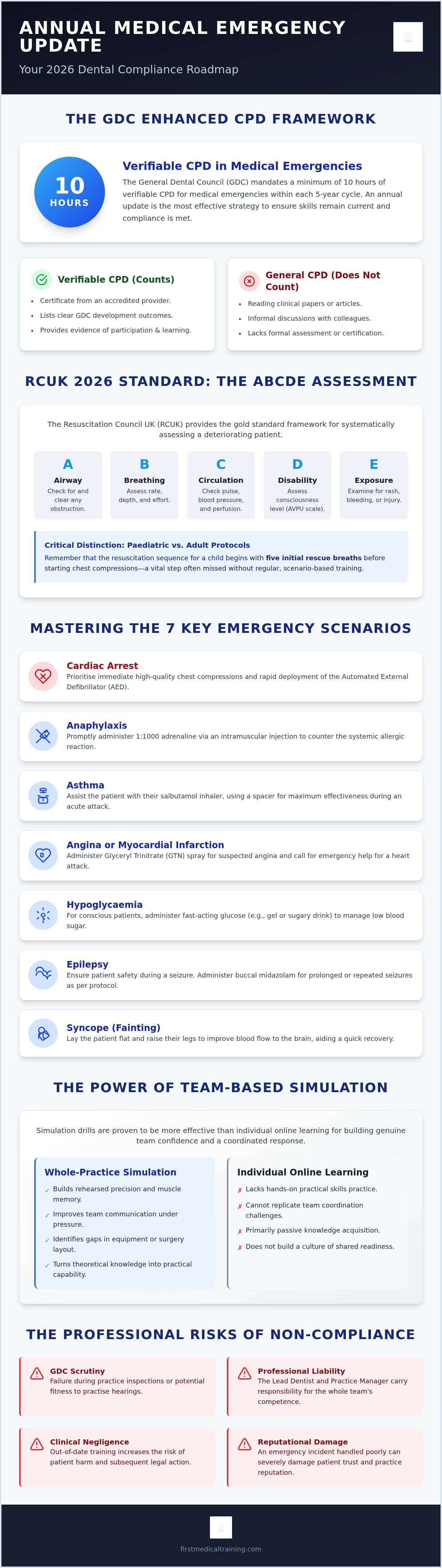
The General Dental Council (GDC) maintains a firm stance on professional readiness. They categorise medical emergencies as a "highly recommended" topic for every member of the dental team. This classification means the regulator expects you to keep your skills current to ensure patient safety. To satisfy the Enhanced CPD scheme, you're required to complete at least 10 hours of medical emergencies training within each five-year cycle. Most practices find that an annual medical emergency update dental session is the most effective way to spread these hours and keep knowledge fresh. This isn't just about ticking boxes; it's about maintaining a safe clinical environment.
During a 2026 audit, the GDC will scrutinise the quality of your learning. You must distinguish between general and verifiable CPD. General CPD, such as reading a clinical paper or having an informal chat in the staff room, is valuable but doesn't count towards the mandatory 10-hour block. Verifiable CPD requires a certificate from an accredited provider that lists the specific GDC development outcomes. It must also provide clear evidence that you actually participated in the training. For a complete breakdown of how to structure your logs to satisfy an inspector, see our guide on GDC CPD requirements for medical emergencies.
The Resuscitation Council UK 2026 Standards
The Resuscitation Council UK (RCUK) provides the clinical backbone for emergency response in primary dental care. Their Quality Standards state that all dental staff should be trained in the ABCDE assessment framework. This systematic approach allows you to identify a deteriorating patient by checking Airway, Breathing, Circulation, Disability, and Exposure in a logical sequence. It's the gold standard for clinical safety. The 2026 standards also highlight the importance of distinguishing between paediatric and adult protocols. For example, the sequence of resuscitation for a child starts with five rescue breaths. This is a critical step that is often overlooked if a team only practises adult-focused scenarios. Regular updates ensure these life-saving distinctions become second nature.
Consequences of Non-Compliance
Lapses in training create significant risks that go beyond clinical outcomes. If a patient collapses in your surgery and your training records are out of date, you face severe professional consequences. During a GDC practice inspection or a fitness to practise hearing, your CPD logs serve as vital evidence of your commitment to safety. The Lead Dentist and Practice Manager carry the professional liability for ensuring the entire team is competent. Beyond the regulatory threat, annual training is a powerful tool for reducing clinical negligence risks. It builds a culture of steady reliability. When a team knows exactly where the emergency kit is and how to use it, they provide a higher standard of care that protects both the patient and the practice's reputation.
Core Clinical Curriculum: Mastering the Big Seven Emergency Scenarios
The clinical heart of any annual medical emergency update dental session is the mastery of the "Big Seven" scenarios. These represent the most likely life-threatening events you will face in a primary care setting. In 2026, the curriculum focuses on cardiac arrest, anaphylaxis, asthma, angina or myocardial infarction, hypoglycaemia, epilepsy, and syncope. Proficiency in these areas ensures that your response is systematic and evidence-based, reducing the risk of clinical errors during high-pressure moments.
Sudden cardiac arrest is the most time-critical event on this list. Your immediate response must prioritise high-quality chest compressions and the rapid deployment of an Automated External Defibrillator (AED). The AED is the only definitive treatment for shockable rhythms; it should be applied as soon as it arrives at the patient's side. Team members must be comfortable following the voice prompts whilst continuing resuscitation efforts. For allergic reactions, identifying the transition from a mild rash to systemic anaphylaxis is vital. This requires the prompt administration of 1:1000 adrenaline via an intramuscular injection into the middle third of the thigh. Early intervention saves lives by reversing airway swelling and supporting blood pressure.
Whilst syncope is the most common cause of collapse in the dental chair, it must never be dismissed without a full assessment. You can find a detailed breakdown of the 2026 protocols for managing faint-related collapses in our syncope management dental training guide.
Asthma, Angina, and Myocardial Infarction
Distinguishing between stable angina and a myocardial infarction (heart attack) is a critical skill for 2026. Angina typically presents as chest tightness that resolves quickly with rest and the patient's GTN spray. If the pain persists for more than five minutes after a second dose of GTN, you must treat it as a heart attack. Call 999 immediately and provide a 300mg aspirin to be chewed, which helps to limit the size of the clot in the coronary arteries. For acute severe asthma, if the patient's inhaler provides no relief or they are too breathless to speak, administer high-flow oxygen and use a spacer for salbutamol whilst awaiting the ambulance crew.
Hypoglycaemia and Epilepsy
Hypoglycaemia often occurs when a diabetic patient has not eaten before an appointment. If they are conscious and able to swallow, Glucogel or a sugary drink is the first line of treatment. If they become unconscious or aggressive, this is a medical emergency that may require IM Glucagon. Use your glucose monitor to verify levels, but do not delay treatment if the patient is symptomatic. When managing a grand mal seizure, your primary goal is to create a "safe environment" by moving sharp equipment and protecting the patient's head from injury. Do not attempt to restrain them or place anything in their mouth. "The recovery position is the essential final step for post-ictal patients to maintain a clear airway once the seizure has ceased."
Refining these clinical responses through a Medical Emergencies in a Dental Practice Course ensures your team moves from theory to practical excellence.
Moving Beyond Theory: The Power of Team-Based Simulation Training
Individual online learning satisfies a basic regulatory requirement; however, it cannot replicate the adrenaline and physical demands of a real-life patient collapse. Effective emergency response is a team-based performance that requires muscle memory and environmental familiarity. When your team participates in an annual medical emergency update dental session, the focus should shift from passive watching to active doing. Simulation training allows you to identify practical hurdles, such as whether the oxygen cylinder actually fits into the corner of your smallest surgery or if the receptionist can hear the dentist's call for help from the front desk.
The psychological benefit of "stress-testing" the team in their own environment is significant. It builds a sense of steady reliability, replacing panic with a structured sequence of actions. By practising in the rooms where you work every day, you move from theoretical knowledge to clinical confidence. Use this 5-step guide to run a successful simulation during your next training day:
- Select a scenario: Choose one of the "Big Seven" conditions, such as anaphylaxis or cardiac arrest.
- Assign role cards: Ensure every staff member, including non-clinical personnel, has a specific set of instructions.
- Utilise real equipment: Use trainer AEDs and mannequins to make the physical actions feel authentic.
- Execute the drill: Run the scenario in real-time without pausing for questions until the end.
- Conduct a structured debrief: Discuss what went well and identify any equipment gaps or communication lags.
Defining Roles: From Reception to the Chair
In a crisis, the receptionist is the vital link between the practice and the emergency services. Their role involves calling 999 with precise information, managing the waiting room to maintain patient privacy, and meeting the ambulance crew at the door to direct them quickly to the scene. Whilst this happens, the dental nurse acts as the equipment lead, retrieving the emergency kit and oxygen whilst the dentist remains with the patient. The dentist must act as the clinical lead, performing the ABCDE assessment and delegating tasks with clear, declarative statements to avoid any ambiguity during the rescue effort.
Communication Under Pressure
Errors in drug administration or task execution often stem from poor communication. To prevent this, your team should adopt "closed-loop communication" during every drill. This involves the leader giving a specific instruction, the team member repeating it back for confirmation, and then stating once the task is complete. For example, if the dentist requests 0.5ml of adrenaline, the nurse confirms the dose before administering it. For the final handover to paramedics, use the SBAR framework: Situation, Background, Assessment, and Recommendation. This structured approach ensures the ambulance crew receives a concise, professional summary, which is essential for the continuity of patient care.
Emergency Equipment and Drugs: The 2026 Audit Checklist
A well-stocked emergency kit is only effective if every item is present, in date, and fully functional. During your annual medical emergency update dental session, the focus often lies on clinical skills, but the physical readiness of your kit is equally vital for GDC compliance. The GDC standards mandate "immediate access" to an Automated External Defibrillator (AED). This means the device should be reachable within minutes, with batteries and pads that are regularly checked. If your AED is stored behind a locked door or in a remote part of the building, you may fail a practice inspection.
To maintain a state of professional readiness, you must implement rigorous check protocols. Daily checks should confirm the AED is showing a "green" status and that the oxygen cylinder is full. Weekly audits should involve a more thorough inspection of drug expiry dates and the integrity of airway management tools. You can find a comprehensive template for these reviews in our dental practice emergency preparedness checklist.
Airway Management and the LifeVac Device
Traditional choking protocols, such as back slaps and abdominal thrusts, are significantly harder to perform whilst a patient is reclined in a dental chair. In a 2026 emergency kit, the LifeVac anti-choking device has become a vital addition for managing airway obstructions when standard manoeuvres are difficult or unsuccessful. Alongside this, your kit must include a range of oropharyngeal airways to maintain a clear path for ventilation. When used with a pocket mask and high-flow oxygen, these tools ensure that even a non-breathing patient receives the necessary support before paramedics arrive.
The "Big 7" Emergency Drugs
Your 2026 kit must contain the following seven mandatory drugs, as specified by the British National Formulary (BNF) and Resuscitation Council UK guidelines:
- Adrenaline (1:1000): For the immediate treatment of anaphylaxis.
- Aspirin (300mg): To be chewed by patients experiencing a suspected heart attack.
- Glucagon and Glucogel: For managing severe hypoglycaemic episodes.
- GTN Spray: To relieve the chest pain associated with angina.
- Salbutamol Inhaler: For the relief of acute asthma attacks.
- Midazolam (buccal): For the management of prolonged status epilepticus.
Oxygen remains the most important "drug" in your arsenal. It's essential for almost every medical emergency, yet it is often the most neglected. Ensure your team knows how to read the regulator and that you have enough spare capacity to provide 15 litres per minute until the ambulance arrives. If you need to refresh your supplies or upgrade your kit, you can browse our range of Emergency Equipment designed specifically for dental practices.
Selecting the Right Update Course: Compliance and Clinical Excellence
Choosing where to book your annual medical emergency update dental training is a decision that impacts both your regulatory standing and your team's morale. Whilst generic off-site courses provide basic information, they often fail to account for the unique layout and specific equipment of your own surgery. In-practice training, such as the sessions provided by First Medical Training Ltd since 2006, allows your team to rehearse in the exact environment where a crisis would occur. We specialise in organising these sessions to minimise surgery downtime, ensuring your practice remains productive whilst meeting the highest standards of clinical excellence.
A modern safety culture also recognises that patient and staff well-being extends beyond physical health. Integrating Mental Health First Aid for dental practices into your training schedule creates a holistic approach to care. This ensures your team is as prepared for a psychological crisis as they are for a cardiac arrest, fostering a workplace built on steady reliability and comprehensive support. It's about moving from a transaction-based training model to a genuine partnership in professional development.
What to Look for in a CPD Certificate
A verifiable CPD certificate is more than just a piece of paper; it's your primary defence during a GDC audit. When reviewing your 2026 documentation, ensure it explicitly states the GDC development outcomes, which typically include criteria A, B, C, and D. You must also verify that the training hours recorded match the actual time your team spent in active simulation. Most importantly, confirm that the content aligns strictly with the Resuscitation Council UK 2026 guidelines. Certificates that lack these details may be rejected by auditors, leaving you with a compliance gap that is difficult to fill retrospectively.
Booking Your 2026 Team Update
The transition from individual compliance to a collective "life-saving practice" status requires a structured approach. By training as a whole team, you move away from isolated knowledge and towards a unified response where everyone knows their role. Having a seasoned mentor guide you through high-pressure scenarios helps demystify complex protocols and builds genuine clinical confidence. It's about moving from a state of anxiety to one of professional readiness. To secure your team’s clinical confidence and ensure you meet every regulatory requirement, consider booking our Medical Emergencies in a Dental Practice Course. This partnership ensures your practice remains a safe, compliant, and supportive environment for both your patients and your staff.
Elevating Your Team's Emergency Response for 2026
Maintaining a safe dental practice requires a shift from passive compliance to active readiness. You've explored the necessity of meeting the 10-hour GDC requirement and the clinical importance of mastering the "Big Seven" scenarios within your own surgery. By prioritising team-based simulation over individual theory, you ensure that every staff member, from the front desk to the chairside, knows exactly how to act when seconds count. Your annual medical emergency update dental training serves as the foundation for this culture of safety, bridging the gap between regulatory checklists and real-world performance.
As an accredited provider with over 20 years of experience in dental CPD, First Medical Training Ltd offers national coverage with expert in-practice trainers. We're here to help you move from anxiety to clinical confidence. Book your 2026 Medical Emergencies in a Dental Practice Course today to secure your team’s professional readiness. Empowering your team with the right skills doesn't just satisfy an auditor; it saves lives. We look forward to helping you build a practice that is prepared for any crisis.
Frequently Asked Questions
Is an annual medical emergency update mandatory for all dental staff?
Yes, the GDC categorises medical emergencies as a "highly recommended" topic for all registrants. This means every member of the clinical team must keep their skills current to ensure patient safety. Whilst not strictly "mandatory" in the legal sense like GDC registration itself, failing to complete an annual medical emergency update dental session can lead to serious professional consequences during an inspection or a fitness to practise hearing.
How many CPD hours are required for the annual medical emergency update?
Under the Enhanced CPD scheme, dental professionals must complete at least 10 hours of medical emergencies training within every five-year cycle. Most practices choose to deliver this as a two-hour verifiable session each year. This approach ensures that the team remains familiar with life-saving protocols and equipment. It also prevents a stressful rush to accumulate hours at the end of a cycle, maintaining a steady baseline of clinical competence.
Does a dental receptionist need to attend the medical emergency training?
Yes, non-clinical staff like receptionists are essential during a crisis. They're often the first to witness a collapse in the waiting room and are responsible for calling 999 and meeting the ambulance. Including them in your whole-team simulation ensures they understand their specific role. A well-trained receptionist can manage the waiting room environment and provide clear information to emergency services, which is critical for a smooth clinical handover.
What emergency drugs must be present in a UK dental practice in 2026?
Every practice must stock a specific set of drugs as defined by the BNF and RCUK. These include Adrenaline (1:1000), Aspirin (300mg), Glucagon, and Glucogel for hypoglycaemia. You also need GTN spray, a Salbutamol inhaler, and buccal Midazolam for seizures. Oxygen is the most frequently used item and must be available with the correct regulators. Regular audits are necessary to ensure these drugs remain in date and ready for immediate use.
Can we do our annual medical emergency update online?
While theoretical knowledge can be gained online, the Resuscitation Council UK and the GDC emphasise the importance of practical, team-based simulation. Physical training allows you to practise chest compressions and the use of an AED in your own clinical environment. Online courses cannot replicate the muscle memory or the communication skills required during a real-life patient collapse. Most practices find that in-person training provides the clinical confidence that digital learning simply cannot match.
What happens if we miss our annual update deadline?
Missing your update creates a significant compliance risk. If the GDC or CQC inspects your practice and finds your training is out of date, you may face formal warnings or a "requires improvement" rating. More importantly, it leaves your team unprepared for a real emergency. You should book a catch-up session as soon as possible to close the gap and ensure your verifiable CPD logs are accurate and audit-ready for 2026.
Is an AED mandatory for all dental practices in 2026?
Yes, the GDC standards require that all dental practices have "immediate access" to an automated external defibrillator. This means the device must be on-site and ready for use within minutes of a cardiac arrest occurring. It's no longer acceptable to rely on a public access AED located elsewhere in the building or down the street. Your AED should be checked weekly to ensure the battery is functional and the pads haven't expired.
What is the "ABCDE" approach in a dental emergency?
The ABCDE approach is a systematic framework used to assess and treat a deteriorating patient. It stands for Airway, Breathing, Circulation, Disability, and Exposure. By following this sequence, you can identify life-threatening problems in order of priority. For example, you ensure the airway is clear before checking the patient's breathing rate. This logical process helps the team stay calm and focused during the high-pressure environment of a medical emergency.