

AED Training for Dental Practices: 2026 Compliance Guide

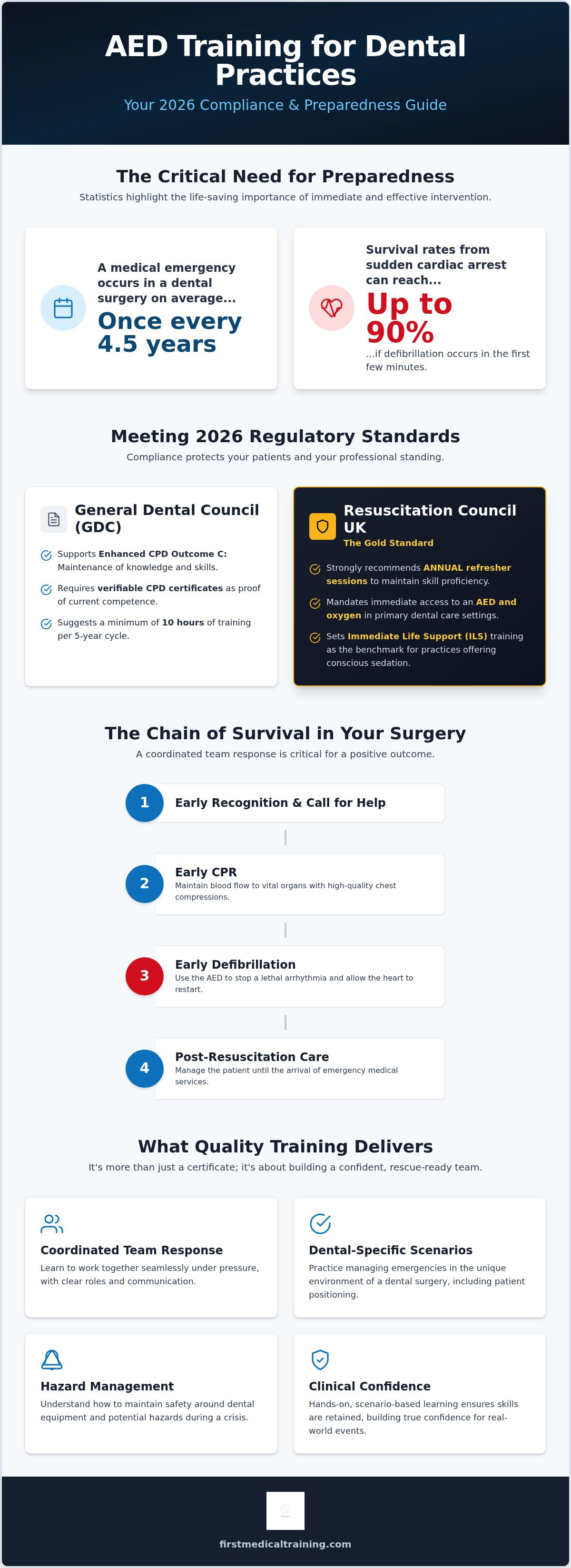
A general dental practitioner is statistically likely to encounter a medical emergency in their surgery once every four and a half years. Whilst we all hope that day never comes, the reality is that sudden cardiac arrest survival rates can reach 90% if defibrillation occurs within the first few minutes. This makes high-quality aed training for dental practices more than just a box-ticking exercise for the CQC; it's a critical clinical safeguard. You've likely felt the pressure of keeping up with evolving GDC standards or wondered if your team's annual refresher is truly enough to maintain clinical confidence during a high-stakes crisis.
We understand that balancing complex regulatory demands whilst running a busy clinic is a significant challenge. This 2026 compliance guide is designed to provide you with the clarity you need to master essential AED protocols and meet GDC requirements with total confidence. You'll learn exactly how to coordinate a rescue-ready team, distinguish between different training levels, and ensure every staff member earns their verifiable CPD hours. By the end of this article, you'll have a clear, actionable roadmap to regulatory compliance and the peace of mind that comes from being truly prepared for the unexpected.
Key Takeaways
- Understand the latest GDC compliance requirements and how regular training supports your Enhanced CPD obligations for 2026.
- Discover why professional aed training for dental practices is a vital clinical safeguard that can increase cardiac arrest survival rates to 90%.
- Learn practical strategies for managing medical emergencies within the surgery environment, including patient positioning and hazard management.
- Explore how hands-on, scenario-based learning ensures your entire team remains rescue-ready and coordinated under high-pressure conditions.
- Master the essential protocols needed to meet the gold standard of care with our comprehensive Medical Emergencies in a Dental Practice Course.
Why AED Training for Dental Practices is Non-Negotiable in 2026
In a clinical environment, an Automated External Defibrillator (AED) is far more than a piece of emergency hardware. Effective aed training for dental practices involves mastering a coordinated team response that bridges the gap between a patient collapsing and the arrival of an ambulance. Dental surgeries present unique risks. The combination of patient anxiety and the physiological stress of local anaesthesia can occasionally trigger cardiac events that require immediate intervention. Training ensures that when the adrenaline spikes, your team doesn't just push buttons but follows a disciplined, life-saving protocol that integrates seamlessly with your clinical workflow.
The legal landscape for 2026 is clear and uncompromising. The General Dental Council (GDC) and the British Dental Association (BDA) maintain that medical emergency preparedness is a core requirement for professional registration. Relying on outdated knowledge or a certificate from several years ago is a professional risk you simply can't afford. Annual updates are strongly recommended by the Resuscitation Council UK to ensure that skills remain sharp and that the latest evidence-based algorithms are applied correctly in the surgery. This ongoing commitment to aed training for dental practices protects your patients and your professional standing.
Meeting GDC Enhanced CPD Outcome C
Outcome C focuses on the maintenance and development of your knowledge and skills within your field of practice. Outcome C in relation to emergency life support skills is defined as the ongoing maintenance of clinical competence to ensure the effective and safe management of medical emergencies. It's not enough to simply attend a session. You must hold a verifiable CPD certificate that proves your participation in a course aligned with current UK standards. This documentation is a vital component of your professional portfolio during CQC inspections, proving that your skills are current and your practice is safe.
Resuscitation Council UK 2026 Quality Standards
The 2026 standards emphasise that primary dental care settings must have immediate access to an AED and oxygen. Whilst the GDC suggests a minimum of ten hours of medical emergencies training per five-year cycle, the Resuscitation Council UK recommends annual refresher sessions as the gold standard. This frequency is essential because CPR and AED skills degrade quickly without regular practice. For practices providing conscious sedation, the shift towards Immediate Life Support (ILS) training is now the expected benchmark for clinical safety. Moving away from the "once every five years" mindset is the first step toward building a truly rescue-ready team that can act with precision during a cardiac arrest.
The Mechanics of Life-Saving: How AEDs Work in a Clinical Setting
An AED is designed to terminate lethal arrhythmias, most commonly Ventricular Fibrillation (VF), by delivering a controlled electric shock. This shock momentarily stops the heart, allowing its natural electrical system to regain a healthy rhythm. Whilst the technology is sophisticated, modern devices are built for high-pressure environments, providing clear voice prompts and visual cues to guide the dental team through every step. Effective aed training for dental practices emphasises that the device is a partner to high-quality CPR, not a replacement. Chest compressions maintain perfusion to vital organs whilst the AED prepares to deliver a shock, completing a critical link in the "Chain of Survival" within your surgery. Although mandates vary, OSHA AED Recommendations highlight that these devices are foundational to a robust workplace first aid plan.
Anatomy of a Dental-Grade AED
A dental-grade unit should feature a paediatric switch or specific child pads, allowing for immediate adjustment when treating younger patients. This is vital for family-centred practices where the patient demographic varies throughout the day. Electrode pads must be placed correctly; for adults, this is usually the upper right chest and lower left side, whereas children may require an anterior-posterior approach. Regular maintenance is non-negotiable. Batteries and pads have strict expiry dates that your team must log and monitor. Modern units perform automatic self-tests to ensure they are rescue-ready, but manual weekly checks remain a hallmark of a well-organised practice. If you are looking to standardise your equipment and protocols, our Medical Emergencies in a Dental Practice Course covers these technical aspects in detail.
The Protocol for Cardiac Arrest in the Chair
When a patient collapses in the dental chair, the team must immediately initiate the DRAB protocol: Danger, Response, Airway, and Breathing. In a clinical setting, you have the advantage of professional equipment like high-volume suction to clear the airway. The dentist or a senior nurse typically assumes the "Team Leader" role, directing specific staff members to call 999 and retrieve the AED. Speed is the deciding factor in survival. The 2026 standard for time-to-shock targets aims for delivery within three minutes of the initial collapse to maximise the chances of a successful outcome. This coordinated response ensures that every second counts, turning a chaotic emergency into a disciplined clinical procedure.
Dental-Specific Challenges: AED Use in the Surgery Environment
Operating an AED in a dental surgery introduces physical variables that generic first aid courses often overlook. The clinical environment is frequently cramped, filled with expensive equipment, and potentially hazardous due to the constant presence of water from high-speed drills and ultrasonic scalers. Effective aed training for dental practices focuses on these environmental realities, ensuring that the team can communicate effectively whilst amongst the noise of high-volume suction units and surgery alarms. Beyond the immediate clinical area, reception staff must also follow established protocols to manage onlookers and clear the waiting room, allowing the clinical team to focus entirely on the patient.
Positioning and Space Constraints
The debate over whether to perform resuscitation in the dental chair or on the floor has been clarified by Resuscitation Council UK guidance for 2026. Whilst modern dental chairs are designed to recline into a stable, flat position, the floor remains the gold standard for providing effective, high-quality chest compressions. However, in many British surgeries, space is at a premium. If the room is too narrow to allow a rescuer to stand beside the patient on the floor, the chair may be the only viable option. Training should involve rehearsing both scenarios to determine the fastest and safest method for your specific surgery layout, ensuring you can recline the chair and remove the headrest without delay.
Pacemakers and Clinical Interference
Clinical interference is another critical factor to consider during a cardiac emergency. Before applying pads, the team must identify implanted devices like pacemakers; pads should be placed at least 2.5cm away from any visible pulse generator under the skin. Metal jewellery or underwired bras can cause electrical arcing during a shock, so these must be managed or removed quickly to prevent burns. Safety also extends to the equipment in use. High-concentration oxygen delivery must be paused, and the mask or tubing moved at least one metre away from the patient's chest before the AED delivers a shock to prevent fire risks. These nuances are why specialised aed training for dental practices is essential for maintaining a safe, rescue-ready environment. If your team hasn't rehearsed these specific scenarios lately, our Medical Emergencies in a Dental Practice Course provides the hands-on practice required to master these challenges.
What to Expect from Professional AED Training for Dental Teams
Professional aed training for dental practices transforms abstract knowledge into instinctive action. Rather than a passive lecture, high-quality training focuses on hands-on practice with dedicated AED trainers. These units mimic the voice prompts and operation of live defibrillators without delivering a shock, allowing your team to build muscle memory safely. Training within your own surgery rooms is particularly valuable; it allows staff to navigate the physical constraints of their specific clinical environment and locate emergency equipment under pressure. Instructors look for a coordinated response where roles are clearly assigned and the time-to-shock is minimised, ensuring every responder is competent and confident.
Choosing in-practice training over a generic external centre offers a significant advantage. It ensures that the scenarios rehearsed are relevant to your patient demographic and the specific layout of your practice. When a trainer observes your team managing a simulated collapse in a narrow corridor or a cramped surgery, they can provide bespoke advice on positioning and equipment access that a generic course simply cannot offer. This practical, site-specific approach is what builds true clinical confidence.
The Training Day Curriculum
A comprehensive session moves logically from Basic Life Support (BLS) to more advanced AED algorithms. The curriculum covers the initial assessment of a collapsed patient, the delivery of high-quality chest compressions, and the seamless integration of the defibrillator. Managing airway obstructions is also a core component, often involving the use of emergency oxygen and specialized equipment. For instance, modern training now includes managing choking incidents, often demonstrating the use of a LifeVac anti-choking device as part of a robust emergency toolkit. This holistic approach ensures your team can handle a wide spectrum of life-threatening situations beyond just cardiac arrest.
Annual Refreshers vs. Initial Certification
The GDC classifies medical emergencies as a "highly recommended" CPD topic, strongly suggesting that dental professionals undertake at least two hours of verifiable training every year. This frequency is vital because of the "forgetting curve" in emergency medicine; life-saving skills are rarely used and can degrade significantly within just six months of training. Annual refreshers keep these skills sharp and ensure the team is updated on any changes to Resuscitation Council UK guidelines. To keep your practice compliant and your team rescue-ready, it's best to organise a single day where the entire staff can update their skills together. If you're ready to secure your 2026 compliance, you can book our Medical Emergencies in a Dental Practice Course to ensure your team meets the gold standard of care.
Choosing First Medical Training for Your Practice Compliance
Since 2006, First Medical Training Ltd has served as a trusted partner for dental practices across the United Kingdom. We've trained thousands of professionals, moving beyond generic first aid to provide specialised clinical education that respects the unique demands of the surgery. Our Medical Emergencies in a Dental Practice Course is designed as the definitive compliance package, ensuring your team meets the 2026 GDC outcomes with absolute certainty. We understand that dental teams have specific workflows and behaviours. We don't just teach theory; we integrate comprehensive aed training for dental practices into the actual rhythm of your clinical day. This holistic approach extends to supporting your practice with Mental Health First Aid and syncope management, ensuring you're prepared for common clinical events alongside the most critical ones.
Tailored In-Practice Solutions
We believe the best place to learn is where you work. Our instructors travel to your surgery to deliver tailored in-practice solutions that eliminate the need for staff travel. This allows First Medical Training Ltd to customise scenarios based on your specific team size and equipment layout. Whether it's navigating a narrow corridor or managing a collapse in a specific surgery room, we ensure the training is relevant to your daily reality. It's essential that everyone, from receptionists to specialists, feels confident in their role. By practising in your own environment, your team develops a level of coordination that external training centres simply cannot replicate. This site-specific focus is a hallmark of effective aed training for dental practices.
The First Medical Training Ltd Difference
The First Medical Training Ltd difference lies in our authoritative yet supportive guidance. As industry veterans with 20 years of experience, we act as mentors who understand the practical pressures of modern dentistry. We provide high-quality equipment, including modern AEDs and anti-choking devices, ensuring your practice is equipped with the best tools for survival. Our commitment goes beyond technical skill; we focus on the human element of care. We aim to build resilience amongst your staff, transforming anxiety into a steady, reliable confidence that protects both your patients and your professional reputation. This methodical approach ensures your practice remains a safe, compliant, and rescue-ready environment.
Ensuring Clinical Excellence and Patient Safety in 2026
Maintaining clinical excellence requires more than just meeting regulatory minimums. By prioritising comprehensive aed training for dental practices, you ensure that your team is prepared to act with precision during the critical first minutes of a cardiac emergency. We've explored how modern defibrillators, annual refreshers, and scenario-based learning in your own surgery rooms create a culture of genuine preparedness. This isn't just about avoiding CQC non-compliance; it's about the peace of mind that comes from knowing every staff member is truly rescue-ready.
First Medical Training Ltd has been a trusted mentor to the dental sector since 2006. Our courses are fully aligned with GDC and Resuscitation Council UK standards, delivered by expert clinical instructors who understand the unique challenges of a busy dental practice. Don't leave your team's emergency response to chance. Book your in-practice AED and Medical Emergencies training today and take the final step toward total clinical confidence. You've built a professional reputation based on care; let's ensure that care remains steadfast during the most high-stakes moments.
Frequently Asked Questions
Is it a legal requirement for dental practices to have an AED?
Yes, having an AED is a mandatory requirement for all UK dental practices under the Resuscitation Council UK Quality Standards. The GDC expects every practice to be equipped to handle medical emergencies, and a functional defibrillator is considered essential equipment. Failure to have an accessible unit can lead to non-compliance during CQC inspections and, more importantly, compromises patient safety during a sudden cardiac arrest.
How often do dental staff need AED training to remain GDC compliant?
The GDC recommends that dental professionals undertake at least two hours of verifiable CPD in medical emergencies every year. Whilst the five-year cycle requires ten hours total, the annual refresher is the gold standard to ensure life-saving skills don't degrade. Regular aed training for dental practices ensures that your team remains rescue-ready and familiar with the latest 2026 resuscitation protocols and clinical guidelines.
Can we use an AED on a patient whilst they are still in the dental chair?
You can use an AED whilst a patient is in the chair, provided the chair is reclined fully and you've cleared any environmental hazards. However, the Resuscitation Council UK suggests moving the patient to the floor if it allows for more effective chest compressions and better access. If space is too restricted, the chair remains a viable platform for defibrillation as long as the headrest is removed.
Is the AED training included in the standard Medical Emergencies course?
Yes, AED instruction is a fundamental part of our Medical Emergencies in a Dental Practice Course. We don't treat it as a standalone skill; instead, we integrate it into wider resuscitation scenarios. This ensures your team understands how the device fits into the full sequence of life support, from the initial collapse through to the arrival of the ambulance crew and the handover to paramedics.
Do receptionists and non-clinical staff need to attend AED training?
All staff members, including receptionists and administrative personnel, should attend training to ensure a coordinated practice-wide response. In a crisis, the person who first identifies the emergency or calls 999 is often a non-clinical staff member. Having everyone participate in aed training for dental practices ensures that the Chain of Survival isn't broken by a lack of knowledge or confidence at the front desk.
What happens if we use an AED on someone who does not actually need a shock?
Modern AEDs are designed with sophisticated internal software that will only deliver a shock if a shockable rhythm, such as Ventricular Fibrillation, is detected. If the patient is unconscious for another reason, the device will simply state "no shock advised" and instruct you to continue CPR. This built-in safety feature means you cannot accidentally shock someone who does not require it, protecting the patient.
Are there specific AED pads required for paediatric patients in a dental surgery?
Yes, paediatric patients ideally require either specific paediatric pads or an AED with a paediatric switch that reduces the energy level of the shock. If your practice treats children, your emergency kit must include these options. In an absolute emergency where paediatric equipment is unavailable, adult pads can be used on children over one year old, but specific paediatric training covers the correct placement for smaller chests.
How many hours of verifiable CPD does an AED training course provide?
A standard session typically provides between two and three hours of verifiable CPD, depending on the specific curriculum covered. Our Dental Immediate Life Support (ILS) Training and Medical Emergencies courses are designed to meet the GDC's Enhanced CPD requirements. Every attendee receives a certificate that clearly states the learning outcomes and the number of hours earned for their professional portfolio and annual GDC declaration.