

Best AED for UK Dental Practice: 2026 Compliance Guide

The average UK dental practitioner will face a life-threatening medical emergency in their surgery once every four and a half years. This statistic highlights why choosing the best aed for dental practice uk isn't just a box-ticking exercise for the Care Quality Commission; it's a vital part of your professional duty of care. We understand the confusion that often surrounds GDC versus RCUK requirements, especially with the 2026 updates to British Standards regarding AED accessibility. You need a device that's simple to use, cost-effective over its lifespan, and guaranteed to function during those critical moments when every second counts.
We agree that keeping up with shifting regulations and worrying about the hidden costs of replacement pads can be overwhelming for busy clinicians. This guide promises to clarify those requirements, helping you select a reliable, compliant defibrillator that suits your surgery's specific needs. We'll examine the top-rated models for 2026, break down the long-term maintenance costs, and show you how to seamlessly integrate this life-saving technology into your team's annual training rhythm. By the end, you'll have the confidence to ensure your practice is fully equipped and your staff are ready to act.
Key Takeaways
- Navigate the latest 2026 GDC and Resuscitation Council UK standards to ensure your surgery meets all regulatory and duty of care requirements.
- Evaluate why real-time CPR feedback and robust IP ratings are critical factors when selecting the best aed for dental practice uk.
- Compare professional-grade models, such as the Zoll AED 3 and HeartSine Samaritan PAD, to determine which device offers the best long-term value for your surgery.
- Establish a fail-safe maintenance routine for checking batteries and pads, ensuring your life-saving equipment is always ready for an emergency.
- Understand the vital link between high-quality hardware and annual team training in building the collective confidence required to handle a cardiac arrest.
UK Regulatory Requirements for AEDs in Dental Practices (2026)
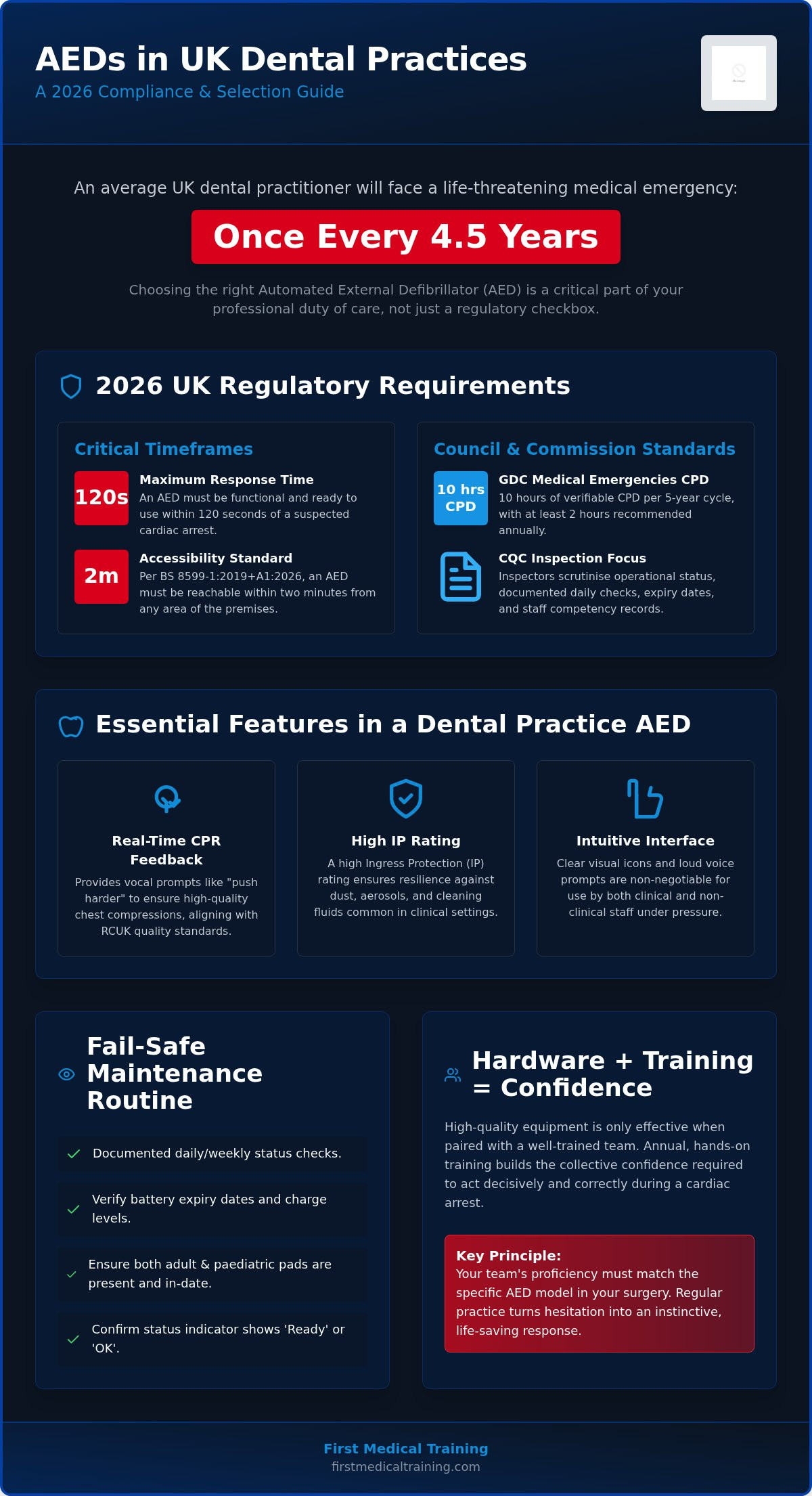
The regulatory landscape for dental surgeries in the UK has shifted significantly. As of 2026, the Resuscitation Council UK (RCUK) and the General Dental Council (GDC) have clarified that having an Automated External Defibrillator (AED) is not merely a recommendation; it's a core component of your clinical duty of care. For those searching for the best aed for dental practice uk, it's essential to understand that compliance isn't just about the hardware. It's about how that device integrates into your practice's wider emergency protocols. Evidence shows that an AED must be functional and ready to use within 120 seconds of a suspected cardiac arrest to meet current standards.
A major update in April 2026 to the British Standard BS 8599-1:2019+A1:2026 now expects AEDs to be reachable within two minutes from any area of the premises. This reinforces the need for strategic placement and functional readiness. Additionally, recent Medical Device Regulations (MDR) updates in the UK have placed stricter requirements on the certification of life-saving equipment. Older, legacy AED models that don't meet these 2026 MDR standards may no longer be considered compliant during a clinical audit. This means surgeries must ensure their equipment is up to date and fully supported by the manufacturer.
The GDC Medical Emergencies Standard
The GDC requires all dental professionals to complete at least 10 hours of verifiable CPD in medical emergencies per five-year cycle, with a strong recommendation for at least two hours annually. This isn't just a paperwork exercise. To meet this standard, your team must be proficient in using the specific equipment kept on-site. If you've recently upgraded your hardware, your medical emergencies in dental practice course should specifically cover the operation of that model. Understanding What is an Automated External Defibrillator (AED)? and how it functions as a semi-automatic or fully-automatic device is the first step in clinical readiness. Annual team-based training ensures that when a crisis occurs, the response is instinctive rather than hesitant.
CQC Inspections and Emergency Preparedness
Care Quality Commission (CQC) inspectors don't just look for the presence of an AED; they scrutinise its operational status. During an inspection, you'll be expected to provide documented daily status checks to ensure battery readiness. Inspectors will check:
- Battery expiry dates and current charge levels.
- The presence of both adult and paediatric pads.
- Staff competency records that match the equipment provided.
- Documented evidence of daily and weekly equipment checks.
A "Good" or "Outstanding" rating now requires more than just owning a device. It demands a culture of readiness. For a complete overview of what's required, you can refer to our dental practice emergency preparedness checklist. Choosing the best aed for dental practice uk means selecting a device that simplifies these compliance tasks through clear status indicators and long-life consumables.
Key Features to Look for in a Dental Defibrillator
Selecting the best aed for dental practice uk requires looking beyond the initial price tag. You need a device that supports your team when adrenaline is high. Real-time CPR feedback is perhaps the most transformative feature in modern AEDs. It provides vocal prompts like "push harder" or "good compressions," ensuring that even under immense pressure, the quality of chest compressions remains high. This feature aligns with the Resuscitation Council (UK) Quality Standards, which emphasise the importance of high-quality CPR in the survival chain.
Clinical settings involve aerosols, dust, and cleaning fluids. A high Ingress Protection (IP) rating ensures your device is resilient against these environmental factors. Beyond durability, the interface must be intuitive. Receptionists or trainees might be the first on the scene while clinicians manage the patient. Clear, visual icons and loud voice prompts are non-negotiable for non-clinical staff. They ensure that every person in the building, regardless of their clinical background, feels empowered to act during a cardiac arrest.
Don't be misled by a low entry price. The "Total Cost of Ownership" is a far more accurate metric for a practice budget. Some models require new pads and batteries every two years, whilst others have a lifespan of up to five years. Calculate these costs over a 10-year period to find the true value for your surgery. If you're unsure which model fits your surgery's budget and clinical needs, our team can help you select the right defibrillators for your specific environment.
Fully-Automatic vs Semi-Automatic AEDs
Choosing between these two types often comes down to your team's confidence levels. A fully-automatic AED delivers the shock itself after a countdown. This removes the psychological burden of having to press a button to deliver a shock to a patient. Conversely, semi-automatic models require the rescuer to press the button when prompted. Some clinical leads prefer this level of control. Consistency is vital. If you manage multiple surgeries, ensure every site uses the same type to avoid confusion during an emergency.
Integrated Paediatric Functionality
Family-oriented practices must be ready for paediatric emergencies. Traditional AEDs often require a physical pad change to switch to a child-safe energy level. In a crisis, this delay is risky and can lead to errors. The best aed for dental practice uk often features a dedicated "child mode" switch or a paediatric key. This allows for an instant transition using the same set of pads. It reduces the stress of finding the correct equipment and ensures the patient receives the appropriate energy level without delay.
Top AED Models for UK Dental Surgeries: A 2026 Comparison
Choosing the right hardware is a critical decision that impacts patient safety and regulatory compliance. Whilst many devices are available on the market, identifying the best aed for dental practice uk involves finding a balance between clinical feedback, ease of maintenance, and long-term reliability. The following models represent the current industry standards for 2026, each offering specific advantages for the unique environment of a dental surgery.
The Zoll AED 3: Why it remains a dental favourite
The Zoll AED 3 is widely regarded as a premium choice for clinical environments. Its high-resolution colour screen provides clear visual prompts, which is particularly useful in a noisy surgery where voice instructions might be harder to hear. One of its standout features is the use of universal pads that are suitable for both adults and children, eliminating the need to store and manage multiple pad types. For practice managers, the WiFi connectivity is a significant benefit; it allows the device to send automated status reports, ensuring that any maintenance issues are flagged before they become a compliance risk. This proactive approach to readiness is a key part of modern cardiac arrest management in dental practice.
HeartSine Samaritan 350P and 500P: The space-saving choice
For smaller surgeries where space on the emergency trolley is limited, the HeartSine Samaritan series is often the best aed for dental practice uk. These devices are exceptionally compact and lightweight. They utilise a unique "Pad-Pak" system, which combines the battery and electrodes into a single cartridge. This means you only have one expiry date to track, significantly simplifying your compliance checks. The 500P model also includes CPR Advisor technology, which provides feedback on the effectiveness of compressions. Adhering to the Resuscitation Council UK Quality Standards is much easier when your equipment simplifies the maintenance process for your team.
Other notable contenders include the Mindray BeneHeart series, known for its rapid "time-to-shock" of approximately 8 seconds, and the Philips HeartStart range, which maintains a reputation for rugged reliability and straightforward maintenance. Both brands offer robust build quality that withstands the rigours of a clinical setting. As a specialist provider, First Medical Training supplies these professional-grade defibrillators to ensure your practice remains compliant. When selecting your device, consider how the specific features of these models will support your team during the high-stress minutes of a medical emergency.
Maintaining Your AED: Compliance, Pads, and Batteries
Owning the hardware is only the first step; maintaining its readiness is what saves lives. Even the best aed for dental practice uk becomes a liability if the battery is depleted or the pads have lost their adhesion. Reliability in a crisis depends entirely on your internal maintenance regime. Establishing a daily and weekly checking routine for your emergency trolley is a non-negotiable requirement for CQC compliance. These checks must be documented, verifying that the device’s self-test indicator is active and all consumables are within their functional window.
There are serious legal implications if an AED is "out of service" during a medical emergency. A failure to provide functioning equipment could be viewed as a breach of your duty of care. To support wider public safety, ensure your device is registered with "The Circuit," the national defibrillator network. This database allows ambulance services to locate the nearest functional AED during a 999 call, potentially allowing your practice to support a life-saving effort in the immediate vicinity.
Shelf Life and Replacement Cycles
Consumables have a finite lifespan that requires careful monitoring. Standard lithium batteries used in professional AEDs typically offer a standby life of two to five years. However, the hydrogel on the pads is more sensitive. This gel is critical for conducting the electrical shock; it degrades over time, eventually drying out and making the pads unable to adhere to the patient's chest. This prevents the device from delivering a shock or accurately analysing the heart rhythm. We recommend organising a central log that lists the expiry dates for every piece of emergency equipment in the practice to avoid any oversights.
MDR and Software Updates
Modern compliance also includes firmware management. Manufacturers may issue software updates to align with the latest Resuscitation Council UK guidelines or to address safety notices. Appointing a "Responsible Person" within your dental team is the most effective way to manage these requirements. This individual should be tasked with checking for manufacturer updates and ensuring the device remains compliant with current Medical Device Regulations (MDR). This level of diligence ensures your equipment is always ready for a real-world crisis. If you need to refresh your team's skills on how to perform these checks and operate the device, consider our Automated External Defibrillator (AED) Training Course.
Why Training is the Critical Component of Your AED Strategy
Even the most advanced technology is limited by the human factor. Whilst you may have invested in the best aed for dental practice uk, its life-saving potential is only realised when your team feels empowered to deploy it. In the high-stress environment of a cardiac arrest, the primary hurdle isn't usually the machine; it's the hesitation of the responder. Realistic training removes this barrier, transforming a piece of equipment from a daunting clinical tool into a familiar partner in emergency care. You don't want your staff's first experience with the device to be during a real-world crisis.
Using a trainer version of your specific AED model provides immense psychological benefits. It allows staff to hear the exact voice prompts they'll encounter and feel the tactile response of the buttons. This familiarity prevents the "freeze" response often seen when people are confronted with unfamiliar alarms or high-pressure situations. By integrating the AED into your wider Basic Life Support (BLS) and Immediate Life Support (ILS) algorithms, you ensure every team member understands their specific role. This includes everything from the person fetching the emergency trolley to the clinician managing the airway.
Annual Medical Emergencies Training
The GDC recommends that the entire dental team participates in annual medical emergencies training. This collective approach ensures that non-clinical staff, such as receptionists and practice managers, are just as capable as the clinical team. Participating in a Medical Emergencies in a Dental Practice Course allows your team to move beyond theory and into scenario-based learning. These realistic simulations build "clinical confidence," ensuring everyone knows how to manage cardiac arrests, seizures, anaphylaxis, and choking incidents within the surgery environment.
The Role of ILS in Modern Dentistry
Modern dentistry is increasingly moving beyond Basic Life Support toward Immediate Life Support (ILS) as the recognised standard. ILS training is vital for dentists and senior clinical staff, as it prepares them to lead the team and manage the patient more effectively during the initial minutes of a crisis before the ambulance arrives. This advanced level of training ensures you are fully compliant with the latest GDC CPD requirements for medical emergencies guide. By combining the best aed for dental practice uk with high-level ILS skills, you create a robust safety net that protects your patients and your professional reputation.
Ensuring Your Practice is Crisis-Ready
Meeting the 2026 GDC and CQC standards requires a proactive approach to emergency equipment and team readiness. By choosing a device with real-time CPR feedback and managing your replacement cycles diligently, you protect both your patients and your professional registration. It's vital to remember that even the best aed for dental practice uk is only one part of a successful resuscitation strategy. Hardware provides the tool, but your team’s collective skill provides the cure.
Since 2006, First Medical Training has acted as a specialist partner for surgeries across the country. Our expert trainers bring real-world medical experience to every session, ensuring your team doesn't just own a defibrillator but knows exactly how to lead a response when every second counts. As an accredited GDC CPD provider, we bridge the gap between complex regulatory requirements and practical clinical confidence.
Take the next step in securing your surgery's safety. Book Your Team’s Annual Medical Emergencies Course and AED Training today to ensure you're fully prepared for any crisis. We're here to support you in building a resilient, capable team that's ready to act with certainty.
Frequently Asked Questions
Is it a legal requirement for a UK dental practice to have an AED?
Whilst there isn't a single statutory law, it's a mandatory requirement enforced by the Care Quality Commission (CQC) under the Health and Social Care Act. The Resuscitation Council UK and the GDC establish these standards for all primary dental care settings. Failing to provide a functional AED would be considered a breach of your clinical duty of care. Consequently, every UK surgery must have one available to ensure patient safety and regulatory compliance.
Can we use an AED on a patient in the dental chair?
You can use an AED whilst a patient is in the chair, but you must ensure they are on a firm, flat surface for effective chest compressions. Most dental teams are trained to lower the chair or move the patient to the floor to facilitate high-quality CPR. The device will still analyse the heart rhythm and deliver a shock regardless of the surface, provided the pads are applied correctly to the patient's bare chest.
What is the difference between a fully-automatic and semi-automatic AED for a surgery?
A fully-automatic AED delivers the life-saving shock itself after a countdown, whereas a semi-automatic model requires the responder to press a button when prompted. Choosing the best aed for dental practice uk often depends on your team's preference. Some clinicians prefer the control of a semi-automatic device, whilst others find the fully-automatic version reduces the psychological pressure on staff during a high-stress cardiac arrest, as the machine manages the timing.
How often should the dental team undergo AED and medical emergency training?
The GDC recommends that all dental professionals complete at least two hours of verifiable CPD in medical emergencies every year. This annual training ensures that your team remains proficient in Basic Life Support (BLS) and the use of your specific AED model. Regular practice prevents skill fade and builds the collective confidence needed to act effectively. We provide tailored courses that help your practice meet these ongoing regulatory requirements whilst demystifying emergency procedures.
Do I need separate paediatric pads for my dental practice AED?
You must have the capability to treat paediatric patients if they attend your surgery. This is achieved either through separate paediatric pads or a dedicated "child mode" switch on the device itself. Adult pads deliver an energy level that is too high for a small child's heart. Modern devices often feature a button that instantly adjusts the shock energy, which is often faster and less prone to error during a paediatric emergency.
What happens if the AED fails during a medical emergency?
If an AED fails due to poor maintenance, such as expired pads or a flat battery, the practice could face significant legal and regulatory consequences. This failure represents a breach of your duty of care to the patient. To mitigate this risk, you must conduct and document daily status checks on your equipment. These documented logs serve as vital evidence for the CQC that you have taken all reasonable steps to ensure equipment readiness.
How much does it cost to maintain an AED over its lifetime?
Maintenance costs vary depending on the model's replacement cycle for consumables. Typically, you will need to replace pads every two to five years and batteries within a similar timeframe. When searching for the best aed for dental practice uk, consider the total cost over a ten-year lifespan rather than just the initial purchase price. Some models offer combined "pad-paks" which can simplify your inventory management and reduce the overall cost of ownership for the surgery.
Should we keep our AED in the waiting room or the clinical area?
Your AED should be stored in a central, easily accessible location that is known to all staff members. The 2026 British Standards specify that the device must be reachable within two minutes from any part of the premises. Many surgeries choose to keep the AED on the emergency drugs trolley within a clinical area, whilst others prefer a wall-mounted cabinet in a central corridor to ensure it's visible and accessible to the entire team instantly.