
Confident Response to Medical Emergencies: A Guide

According to research published in the British Dental Journal, over 50% of dental professionals admit to feeling acute anxiety about managing life-threatening events in their surgeries. If you have ever worried about freezing during a crisis or making an error, understanding how to feel confident responding to medical emergencies does not require an unshakable personality. Instead, true clinical composure stems from relying on clear, repeatable systems that function even when adrenaline takes over.
You already know the demanding pressure of safeguarding patient health whilst satisfying rigorous General Dental Council (GDC) and Care Quality Commission (CQC) standards. That natural dread of causing harm is entirely normal, but it shouldn't dictate your professional readiness. In this guide, you'll learn the structured frameworks and practical strategies that transform emergency anxiety into calm, clinical confidence. We explore the systematic abcde approach, streamline crisis communication using the SBAR tool, and highlight how regular in-practice training turns panic into decisive, coordinated action.
Key Takeaways
- Understand why panic is a predictable physiological reflex, giving you the mental clarity needed for how to feel confident responding to medical emergencies.
- Adopt the systematic abcde approach to eliminate cognitive overload and treat critical life threats in strict order of clinical priority.
- Use the SBAR tool to deliver calm, structured handovers to emergency services without losing vital clinical information during high-stress moments.
- Ensure emergency drug kit compliance and routine equipment checks so you never face uncertainty about whether your life-saving tools are ready to deploy.
- Rehearse emergency scenarios through in-practice training to build team coordination whilst satisfying mandatory GDC CPD requirements.
Understanding the Physiology of Crisis: Why We Feel Anxious
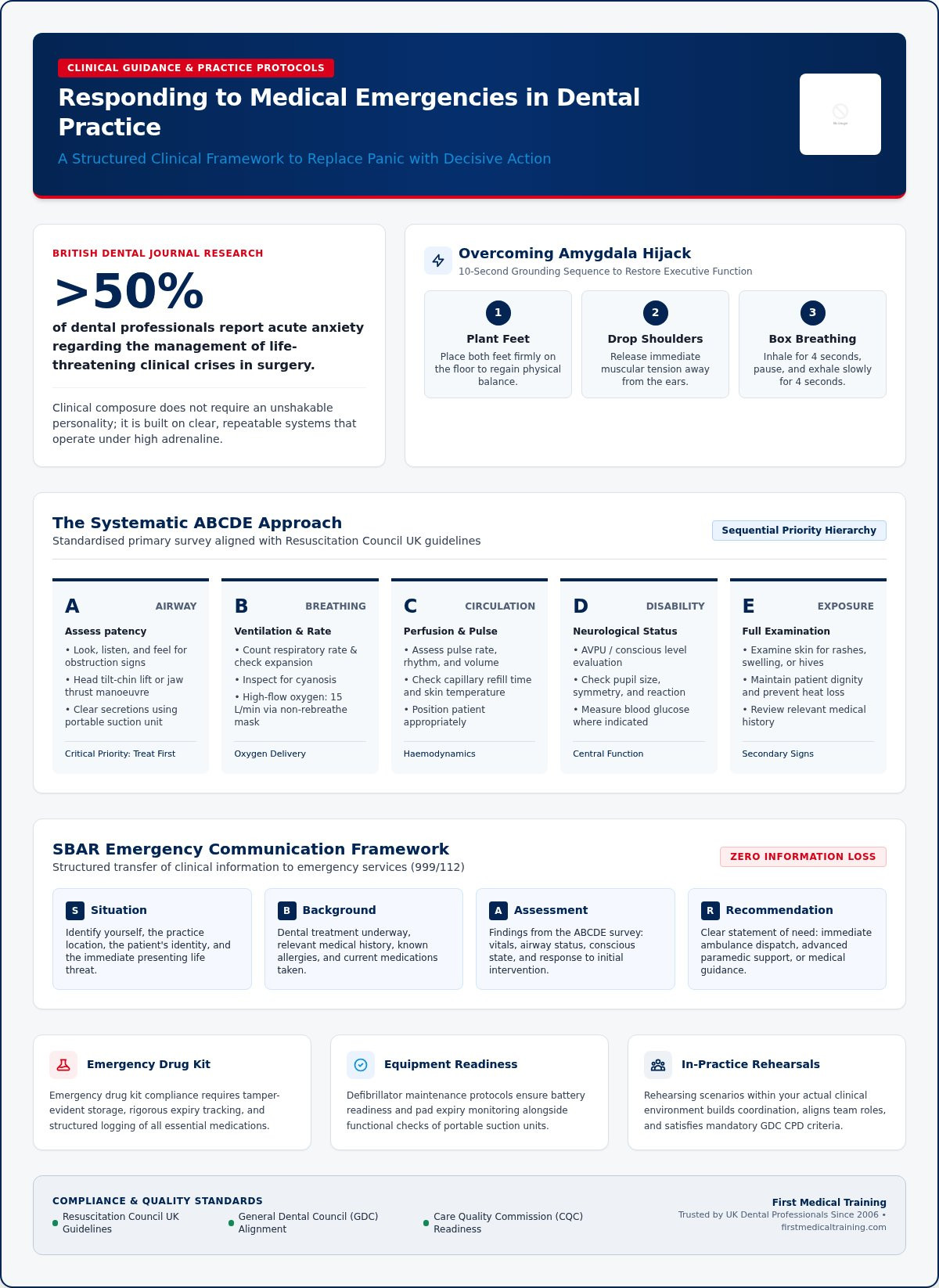
When an acute clinical deterioration happens right in front of you, your body undergoes an instantaneous sympathetic surge. Adrenaline and cortisol flood your bloodstream, elevating your heart rate and narrowing your sensory focus. In clinical practice, this biological reflex often triggers a freeze response. Understanding that this reaction is physiological, rather than a failure of intellect, is fundamental when learning how to feel confident responding to medical emergencies.
There is a distinct gap between clinical competence and psychological confidence. You may understand pharmacology and resuscitation algorithms perfectly during an audit or written exam, yet feel sudden paralysis when a real patient collapses. During high-stress episodes, the brain needs an external scaffolding. Structured clinical frameworks act as an essential safety net, removing the burden of invention and allowing rehearsed clinical protocols to guide your hands.
The Impact of the Amygdala Hijack
Under acute threat, the brain initiates what neuroscientists call an amygdala hijack. The emotional survival centre overrides the prefrontal cortex, which governs nuanced decision-making and rational recall. This biological shortcut prioritises primitive survival over complex diagnostic reasoning, making your mind feel momentarily blank. Experiencing this fog does not mean you lack capability; it simply means your nervous system is reacting to acute stress.
To break this physiological freeze, responders can deploy a simple 10-second grounding sequence before approaching the patient:
- Plant both feet firmly on the floor to reset physical balance and spatial awareness.
- Drop your shoulders away from your ears to release immediate muscular tension.
- Inhale deeply through your nose for four seconds, pause, and exhale slowly through your mouth for four seconds.
This deliberate reset interrupts the adrenaline loop, dampens your fight-or-flight response, and quickly restores prefrontal executive function.
Moving from Anxiety to Authoritative Action
Transforming acute stress into authoritative action relies on deliberate mental rehearsal. When you routinely picture emergency workflows, real-life intervention shifts from an unpredictable ordeal into a familiar series of practical steps. The designated lead responder sets the psychological tone for the entire room by projecting calm composure, giving direct verbal instructions, and allocating specific clinical tasks.
Effective leaders recognise that adrenaline and calm focus can co-exist. You don't need to eliminate nervous energy entirely; you simply channel it into disciplined action. Standardising handovers and team updates through the SBAR communication framework keeps everyone aligned, prevents cognitive overload, and ensures your team operates as a cohesive unit during critical interventions.
Mastering the ABCDE Approach for Systematic Assessment
The abcde approach is a systematic primary survey used to evaluate patients in emergencies. Recognised across the UK National Health Service and firmly aligned with Resuscitation Council UK guidelines, this framework acts as the gold standard for clinical triage. In acute scenarios, responders frequently suffer from attentional narrowing, getting distracted by loud distress or superficial injuries whilst silent, fatal airway compromises develop unchecked. Relying on an ABCED assessment guarantees that you evaluate critical physiology in a disciplined, reproducible hierarchy.
When you understand the mechanics of the physiological stress response, you realise that memory recall deteriorates during acute events. Committing to a sequential algorithm eliminates the guesswork. This methodical routine is precisely how to feel confident responding to medical emergencies, giving your clinical team an unwavering roadmap that preserves life when seconds count.
Step-by-Step Guide to the ABCDE Framework
Work methodically through each stage, resolving life-threatening issues before progressing to the next letter:
- Airway: Look, listen, and feel for signs of obstruction such as stridor, gurgling, or snoring. Clear secretions or foreign bodies promptly using a portable suction unit, and open the airway using a head tilt-chin lift or jaw thrust manoeuvre.
- Breathing: Count the respiratory rate, assess chest expansion, and look for cyanosis. Administer high-flow medical oxygen via a non-rebreathe mask at 15 litres per minute to support tissue oxygenation.
- Circulation: Check radial pulse quality, rate, and capillary refill time. If the patient displays systemic hypotension and urticaria from anaphylaxis, administer 0.5 ml of 1:1000 adrenaline intramuscularly without delay.
- Disability: Assess level of consciousness using the AVPU scale (Alert, Voice, Pain, Unresponsive) and evaluate blood glucose levels to rule out acute hypoglycaemia.
- Exposure: Loosen restrictive clothing to inspect for rashes, swelling, or blood loss, ensuring patient dignity and temperature management remain protected throughout.
Why Order Matters in a Medical Emergency
Hypoxia kills brain cells within minutes, whereas circulatory failure progresses on a different timeline. Evaluating the airway before circulation ensures that oxygen reaches the lungs before you worry about blood pressure or drug delivery. Adhering to this precise sequence shields your working memory from cognitive overload. For general dental teams, engaging in dedicated syncope management dental training reinforces these critical decision pathways for everyday practice. If you want to refine these practical interventions alongside your colleagues, consider booking structured CPD through First Medical Training to practise realistic emergency scenarios together.
Reducing Stress Through the SBAR Communication Tool
Crisis communication easily breaks down when acute stress hits. Shouting unstructured orders across a treatment room breeds confusion and spikes team anxiety. Incorporating the SBAR tool (Situation, Background, Assessment, Recommendation) introduces an immediate conversational structure that eliminates panic. Discovering how to feel confident responding to medical emergencies requires mastering this verbal discipline just as much as physical interventions.
When handing over critical details to 999 call handlers or arriving paramedics, missing vital observations wastes precious time. Standardising your handover via the SBAR communication framework ensures that objective data moves efficiently between professionals. It also allows a designated lead responder to delegate specific interventions without ambiguity, replacing frantic guesswork with disciplined delegation.
The Four Pillars of SBAR
Delivering an SBAR report takes less than sixty seconds when you follow its four distinct stages:
- Situation: State who you are, your location, and the immediate problem.
- Background: Provide relevant medical context, current clinical procedures, and documented history or daily medications such as Levothyroxine.
- Assessment: Detail your objective clinical findings established during your abcde approach, including respiratory rate, pulse quality, and consciousness.
- Recommendation: State precisely what action is required next, whether requesting an emergency drug or asking for urgent advanced paramedic intervention.
Practising SBAR in the Clinical Environment
Rehearsing structured handovers during routine team meetings embeds these habits before an incident occurs. Running two-minute verbal drills normalises rapid information transfer and builds mutual trust across all staff roles. Demonstrating this standard of communication also provides clear evidence of effective clinical governance during Care Quality Commission (CQC) inspections.
Apply this practical script during a 999 ambulance request:
- S: "This is High Street Dental Clinic. We have a 45-year-old male experiencing suspected anaphylaxis."
- B: "The patient was undergoing restorative treatment and has a documented penicillin allergy."
- A: "We note audible inspiratory stridor, respiratory rate of 28 breaths per minute, and severe facial urticaria. We have administered 0.5 ml of 1:1000 adrenaline intramuscularly."
- R: "We require an immediate category-one emergency ambulance response and paramedic airway support."
Confidence Through Readiness: Equipment and Environment
Physical preparedness directly underpins psychological composure. You cannot experience how to feel confident responding to medical emergencies if you harbour doubts about whether your suction unit works or whether your emergency drugs are in date. Knowing that your diagnostic tools and therapeutics are operational frees your mind from unnecessary worry. A disciplined inspection routine transforms passive anxiety into proactive clinical readiness.
Care Quality Commission (CQC) regulations under Regulation 12 (Safe care and treatment) mandate that primary care facilities keep emergency gear readily accessible, logged, and fit for purpose. Meeting emergency drug kit compliance means securing emergency medications inside tamper-evident containers, maintaining detailed expiry logs, and storing drugs at appropriate temperatures. When sudden cardiac arrest occurs, modern automated external defibrillators that provide real-time CPR feedback actively coach your team through chest compressions by monitoring pace and depth, drastically easing rescuer fatigue. For a thorough review of your surgery setup, consult this dental practice emergency preparedness checklist.
Maintaining Your Life-Saving Tools
Routine defibrillator maintenance requires scheduled weekly checks to ensure the status indicator shows active readiness and that paediatric and adult electrode pads remain within their expiry dates. Your portable suction unit must stay fully charged, paired with appropriate Yankauer suckers, tubing, and an intact one-way valve system to prevent backflow during aspiration. Organise your emergency drug kit logically with clear internal dividers and colour-coded labels, allowing any responder to locate ampoules or pre-filled syringes instantly under intense pressure.
The Dental Emergency Response Plan
A written Dental emergency response plan assigns explicit roles to individual team members before an incident takes place:
- Team Leader: Manages the primary clinical assessment, coordinates CPR, and oversees drug administration.
- Support Responder: Fetches the emergency drug kit, medical oxygen, and AED, documenting timestamps and observations.
- Communications Coordinator: Dials 999 using the SBAR format, greets the arriving ambulance crew at the entrance, and escorts them directly to the surgery.
Every clinician and dental nurse must know the exact cupboard and shelf where each emergency device is kept. A clean, orderly clinical environment creates an efficient, orderly emergency response. If your practice needs help auditing protocols or upgrading hardware, explore professional support through First Medical Training to ensure your practice remains compliant and ready to act.
The Role of In-Practice Training in Building Mastery
Reading protocols off a screen provides theoretical clarity, but hands-on rehearsal inside your own clinic turns that theory into instinct. True mastery requires understanding your physical environment: opening the actual emergency kit, operating your portable suction unit in a tight surgery corner, and reclining your dental chair without hesitation. Booking dedicated in-practice training bridges the gap between passive understanding and active composure, showing your whole team exactly how to feel confident responding to medical emergencies.
Rehearsing low-fidelity simulations within your actual working environment eliminates environmental friction during a crisis. When staff practise together using their own equipment, they expose hidden workflow bottlenecks and clarify individual responsibilities before patient care is at risk. Meeting mandatory regulatory obligations becomes straightforward when drills happen on-site, perfectly aligning with GDC CPD requirements for medical emergencies. Established in 2006, First Medical Training Ltd brings two decades of specialist experience to healthcare and dental practices nationwide, delivering courses led by seasoned medical professionals.
Why Online Training Isn’t Enough for Confidence
Physical psychomotor skills demand regular mechanical reinforcement. You cannot build muscle memory for chest compressions or practice opening an obstructed airway by simply clicking through digital slides. Conducting physical CPR training alongside automated external defibrillator deployment gives staff immediate tactile feedback on compression depth and speed. Working face-to-face also strengthens inter-professional trust, ensuring the entire practice responds as an integrated resuscitation unit in line with Resuscitation Council UK standards.
Meeting GDC Development Outcomes
Under the General Dental Council (GDC) Enhanced CPD scheme, medical emergencies remain a core subject requiring at least 10 verifiable hours per five-year cycle, with a recommendation of at least two hours completed annually. High-quality practical education directly satisfies GDC Development Outcomes A, B, and C:
- Outcome A: Sharpens verbal communication, leadership, and structured SBAR handovers during emergency handoffs.
- Outcome B: Strengthens clinical team coordination, delegating critical tasks without role confusion.
- Outcome C: Enhances technical competence in basic life support, airway management, and acute drug administration.
Protect your patients, your team, and your registration by scheduling an accredited medical emergencies in a dental practice course to embed lifelong clinical readiness.
Transform Emergency Anxiety into Clinical Readiness
Clinical composure is not an inherent gift; it is built on systematic preparation. When you lean on the abcde approach, master structured handovers with the SBAR tool, and verify your equipment regularly, you remove the guesswork from critical incidents. Discovering how to feel confident responding to medical emergencies comes down to trusting these structured frameworks so you can act decisively when your patient needs you most.
Trusted by UK professionals since 2006, First Medical Training provides training designed to ensure your entire team meets GDC development outcomes whilst remaining fully Resuscitation Council UK compliant. Rehearsing emergency scenarios within your own clinical setting bridges the gap between procedural theory and real-world execution. View our accredited Medical Emergencies in a Dental Practice Course today to empower your surgery with the practical skills, teamwork, and calm certainty needed to save lives.
Frequently Asked Questions
How can I stay calm during a medical emergency?
Staying calm requires interrupting your natural fight-or-flight response before taking action. Take a deliberate four-second breath, drop your shoulders, and plant your feet firmly on the floor. Relying on an established algorithm like the ABCDE assessment gives your working memory a clear track to follow. Focusing strictly on one clinical step at a time stops panic from overtaking your decision-making.
What is the ABCDE approach in simple terms?
The abcde approach is a step-by-step primary survey that evaluates Airway, Breathing, Circulation, Disability, and Exposure. It forces responders to assess and treat life threats in order of physiological urgency. By addressing airway obstructions before worrying about circulation or secondary symptoms, you protect brain oxygenation and avoid getting sidetracked by obvious but non-fatal injuries.
How often should a dental team undergo medical emergency training?
General Dental Council (GDC) guidance recommends completing at least two hours of verifiable CPD in medical emergencies every year. Across a five-year cycle, dental professionals must log a minimum of 10 verifiable hours. Resuscitation Council UK standards also state that primary care dental teams should train together annually through practical simulations within their practice environment.
What equipment is essential for a dental surgery emergency drug kit?
A compliant setup requires mandatory medications alongside functional life-support hardware specified by the BNF and SDCEP. Essential drugs include adrenaline 1:1000, aspirin, glucagon, oral glucose, GTN spray, midazolam, salbutamol, and medical oxygen. Equipment must feature an automated external defibrillator, a portable suction unit, spacer devices, oropharyngeal airways, and bag-valve-mask resuscitators.
What is the SBAR tool and why is it used?
The SBAR tool is a structured communication framework covering Situation, Background, Assessment, and Recommendation. Responders use it to transfer critical clinical data quickly during handovers to 999 call operators and paramedic teams. It prevents communication errors, reduces emotional shouting in the surgery, and helps teams discover how to feel confident responding to medical emergencies through organised dialogue.
Does annual medical emergency training count towards GDC CPD?
Yes, accredited medical emergency courses count directly towards your verifiable GDC CPD requirements. Medical emergencies remain a core recommended topic under the Enhanced CPD scheme, mapping straight into GDC Development Outcomes A, B, and C. Certificates from accredited training provide essential evidence of compliance for your professional portfolio and satisfy CQC inspection criteria.
What should I do if I freeze during an emergency response?
If you experience a freeze reflex, take a deep breath, ground yourself, and verbalise your next physical step aloud. Freezing is a normal physiological surge caused by sudden adrenaline. Looking directly at the patient's airway and stating your observations out loud prompts colleagues to step in, immediately breaking mental paralysis and transforming individual hesitation into shared team action.
Why is in-practice training better than online courses for confidence?
In-practice training builds tactile muscle memory and tests team dynamics within your actual clinical environment, which digital learning cannot replicate. Practising chest compressions, deploying defibrillators, and accessing your real emergency kit exposes practical bottlenecks in advance. This realistic rehearsal shows staff exactly how to feel confident responding to medical emergencies alongside the colleagues they work with daily.