

Dental Emergency Equipment: 2026 British Buying Guide

We understand the frustration of trying to organise bulky oxygen cylinders and AEDs in a compact surgery, or the constant worry that a vital drug might have expired just before an inspection. This guide will help you master GDC and Resuscitation Council UK compliance for 2026. You'll learn how to build a highly organised, portable response system that ensures your team can find exactly what they need in seconds. We will cover the mandatory "Big 7" drugs, the latest 120-second AED retrieval standards, and how to select high-visibility bags that keep your practice ready for any crisis.
Key Takeaways
- Understand the 2026 Resuscitation Council UK standards and GDC requirements to ensure your practice remains fully compliant during every CQC inspection.
- Master the essential checklist of airway and cardiac hardware, including AEDs and bag valve masks, required for immediate life-saving interventions.
- Identify the best emergency equipment for dental practice by prioritising high-visibility materials and reinforced durability to withstand the rigours of a clinical environment.
- Implement a "Grab Bag" storage philosophy so that every team member, from reception to the surgery, can find and deploy life-saving tools in seconds.
- Discover the benefits of specialised "Oxygen Ready" bags that centralise your cylinders and masks into one portable, highly organised hub.
The Regulatory Landscape: CQC and GDC Requirements for 2026
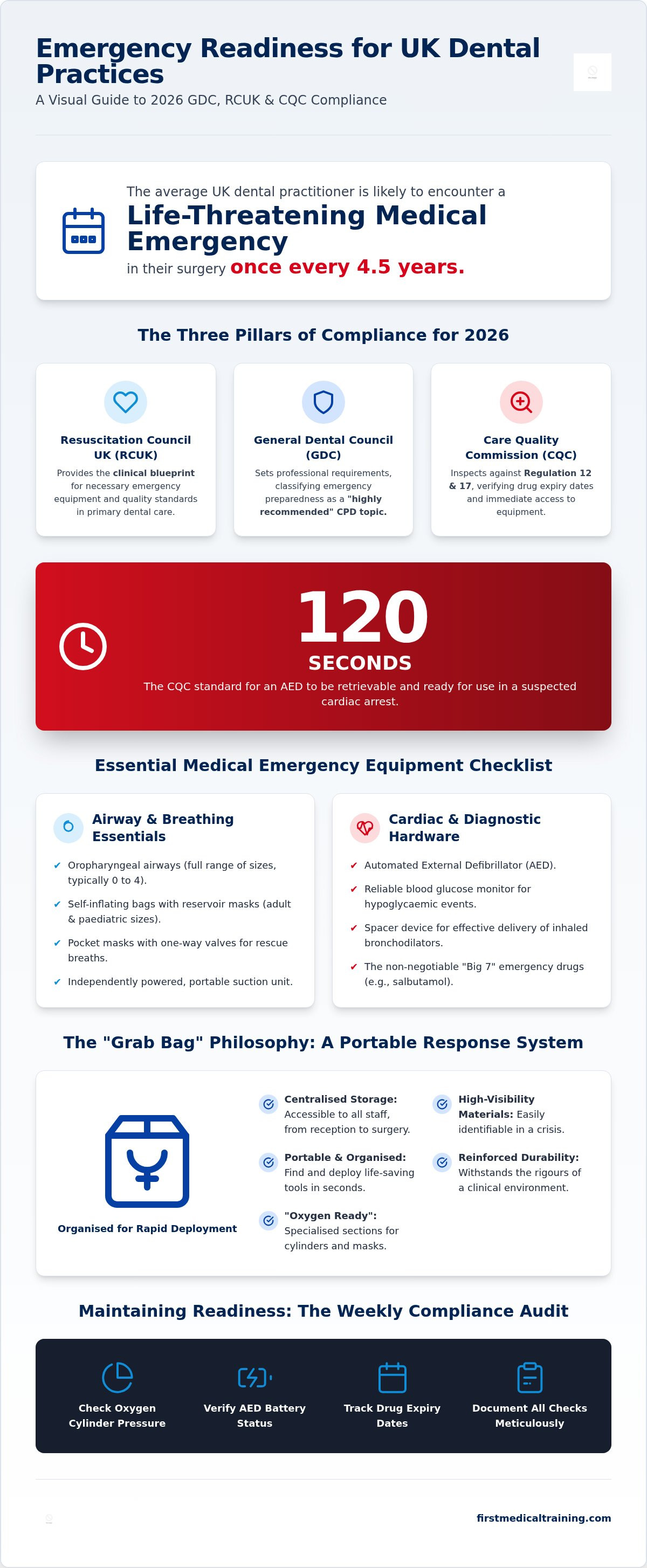
Compliance in a dental setting rests on three pillars: the Resuscitation Council UK (RCUK) standards, the General Dental Council (GDC) professional requirements, and the Care Quality Commission (CQC) inspection framework. In 2026, these bodies have aligned more closely than ever to ensure patient safety. The RCUK Quality Standards for primary dental care serve as the clinical blueprint, defining exactly what constitutes the necessary emergency equipment for dental practice. This isn't merely a suggestion. It's the benchmark by which your practice will be judged during an audit or, more critically, during a life-threatening event.
The GDC classifies medical emergency preparedness as a "highly recommended" CPD topic. This designation reflects the serious nature of maintaining clinical competency. Beyond just owning the kit, your team must be proficient in its use. To stay ahead of these expectations, you should review the gdc cpd requirements medical emergencies to ensure your staff training remains current and verifiable. Effective training ensures that when a crisis occurs, the response is instinctive rather than panicked.
When the CQC arrives, they focus heavily on Regulation 12 (Safe care) and Regulation 17 (Good governance). Inspectors will look for your "grab bag" and verify that drug expiry dates are tracked meticulously. They define "immediate access" with precision. For a suspected cardiac arrest, the AED must be retrievable and ready for use within 120 seconds. Understanding What is a dental emergency? helps staff distinguish between routine clinical issues and those requiring immediate, high-stakes intervention with your emergency kit.
Mandatory vs Recommended Equipment
The CQC "Mythbuster 4" guidance clarifies the minimum expectations for essential drugs and hardware. Whilst some smaller items might seem optional, the presence of an AED and the "Big 7" emergency drugs is non-negotiable for modern UK practices. Failing to maintain a functional kit carries severe legal implications. If equipment is missing or expired during a crisis, the practice owner faces significant professional and legal liability. It's your responsibility to ensure the hardware is as ready as the clinicians.
Beyond the clinical requirements, maintaining the financial stability of your practice is an essential part of professional management. For dentists looking to invest in their own premises or refinance existing loans, EHF Mortgages can help you explore Mortgage Brokerage Commission and Advice Fees to ensure you have the right support for your business assets.
The 2026 Compliance Audit
A robust audit system is your best defence. You should conduct weekly checks of your emergency equipment for dental practice, focusing on oxygen cylinder pressure and AED battery status. Documenting these checks is vital for satisfying GDC standards. Your risk assessments must also cover the physical location of the kit. It must be centrally stored and accessible to all staff members, including those on the reception desk, to ensure the 120-second response window is always achievable.
Essential Medical Emergency Equipment Checklist
Having a theoretical understanding of protocols is useless if your physical hardware fails you. To meet the General Dental Council (GDC) standards, your practice must maintain a specific inventory of hardware designed to support life until the ambulance service arrives. This emergency equipment for dental practice should be organised into a logical, portable system that allows for rapid deployment in any area of the building, from the surgery chair to the waiting room.
Beyond the mandatory drugs, your diagnostic toolkit must include a reliable blood glucose monitor to manage hypoglycaemic events, which remain one of the most common emergencies in dentistry. You also need a spacer device for inhaled bronchodilators to ensure effective delivery of salbutamol during an acute asthma attack. These small but vital tools often go missing or run out of battery, so they must be part of your weekly audit cycle.
Airway and Breathing Essentials
Airway management is your first priority during a collapse. Your kit must include oropharyngeal airways in a full range of sizes (typically 0 to 4) to maintain a patent airway in unconscious patients. You also require self-inflating bags with reservoir masks; it is essential to stock both adult and paediatric sizes to cater to your entire patient demographic. Pocket masks with one-way valves are also necessary for initial rescue breaths.
Effective suction is another non-negotiable. This must be an independently powered, portable unit rather than relying on your dental unit's chairside suction, which may fail if there is a power cut. For waiting room safety, many forward-thinking practices now include the LifeVac anti-choking device in their kit. This provides a non-invasive solution for airway obstructions that don't respond to standard back slaps or abdominal thrusts.
The Cardiac Response Kit
When a patient loses consciousness and stops breathing, every second counts. Your Automated External Defibrillator (AED) is the most critical piece of hardware in your building. A dental-specific AED should be simple to operate, providing clear voice prompts to guide the team. Ensure your cardiac response bag includes a "prep kit" containing a razor, heavy-duty scissors, and a towel. These allow for rapid chest preparation to ensure adhesive pads make proper contact, which is vital for successful defibrillation.
Integrating this hardware with your cardiac arrest management in dental practice protocols ensures that the team knows exactly who grabs the AED and who prepares the oxygen. Your oxygen supply must be a portable cylinder (minimum 300 litres) capable of delivering a flow rate of 15 litres per minute through a high-concentration reservoir mask. If your current setup feels fragmented, consider upgrading to accredited emergency equipment that centralises these tools into a single, high-visibility hub.
Choosing the Right Emergency Kit Bag: A Buyer’s Framework
Whilst the clinical content of your kit is dictated by CQC equipment requirements, the physical vessel that carries it is often an afterthought. In a high-pressure scenario, a flimsy zip or a hidden handle can cost precious seconds. Selecting the correct bag for your emergency equipment for dental practice involves more than just picking a size; it requires a focus on structural integrity and rapid identification. You need a system that supports your team when their adrenaline is spiking and fine motor skills are diminished.
Durability is non-negotiable. Reinforced handles and heavy-duty, oversized zippers are essential because equipment is often grabbed with force. High-visibility colours, such as fluorescent green or yellow, ensure the kit is instantly recognisable amongst standard clinical storage. Internal organisation is equally vital. We recommend modular pouches over fixed compartments; this allows a responder to "throw" the airway pouch to a colleague whilst they focus on the cardiac kit, facilitating a coordinated team response rather than everyone crowding around a single bag.
Size and Capacity Considerations
The primary challenge for most dental bags is the oxygen cylinder. A 300-litre portable cylinder is bulky and heavy, requiring a bag with a dedicated, secure cradle to prevent it from shifting during transport. If your practice spans multiple floors, a backpack-style bag is often superior to a shoulder bag. It keeps the responder's hands free to carry an AED or to use handrails on stairs, reducing the risk of trips or dropped equipment. You must balance the "all-in-one" convenience of a single large bag against the physical weight, ensuring that any staff member can comfortably lift and carry the entire system.
Hygiene and Maintenance
Infection control standards apply to your emergency kit just as much as your surgical instruments. Avoid porous fabrics that trap dust and fluids. Instead, opt for wipe-clean, TPU or PVC materials that can withstand clinical disinfectants without degrading. Clear internal windows are a professional's secret to efficiency; they allow for visual expiry date checks during your weekly audit without needing to break seals or rummage through pouches. This level of organisation is what makes the difference during the most critical moments of a patient collapse.
The "Golden Minute" in dental emergencies is the first sixty seconds of a crisis where the rapid identification and retrieval of life-saving tools directly determines the patient's clinical outcome. By investing in a high-quality, organised hub for your emergency equipment for dental practice, you're not just buying a bag; you're buying your team the time they need to save a life.
Implementation: Storing, Checking, and Training
Ownership of emergency equipment for dental practice is only half the battle. If your AED is tucked away in a locked cupboard or your oxygen cylinder is buried under boxes of PPE, your response will fail before it begins. Centralised storage is essential. Every team member, including part-time reception staff and locum nurses, must know the kit location. In a crisis, the person retrieving the bag is often the one furthest from the clinical chair, so clear communication and accessibility are paramount.
A robust logbook is your best evidence of compliance for a CQC inspector. You should conduct weekly verifications of oxygen levels, AED battery status, and drug expiry dates. This isn't just a bureaucratic exercise. It's about the peace of mind that comes from knowing your kit will work the moment you press the power button. Documentation provides a clear audit trail that demonstrates your commitment to patient safety and professional standards.
Effective Equipment Storage
Deciding between wall-mounting and floor-standing storage depends on your surgery layout. Wall-mounting provides high visibility and keeps the floor clear, whilst floor-standing units can be easier to grab if the bag is particularly heavy. Security should never override accessibility; emergency kits must never be kept under lock and key. Use luminescent signage to mark the location. This reduces the risk of a "panic search" during an incident, ensuring the kit is found instantly even in low-light conditions.
The Role of Annual Training
Physical hardware is useless without the skills to deploy it effectively. This is why a medical emergencies in dental practice course is a mandatory requirement for the whole team. Training bridges the gap between owning hardware and high-pressure performance. Use your annual sessions to practice "kit drills," where staff must retrieve and open the bag within 60 seconds. These rehearsals build the muscle memory required to act when adrenaline is high.
Adopting a "Grab Bag" philosophy ensures your practice is prepared for patient collapse dental surgery training scenarios. New staff inductions should include a physical walkthrough of the bag contents. Understanding the internal layout of your specific bag reduces fumbling during an incident. When everyone knows where the airway adjuncts are kept and how to attach the oxygen tubing, the team functions as a cohesive life-saving unit. Ensure your team is fully prepared by booking your accredited dental emergency training today.
Top Emergency Kit Solutions for 2026
Selecting the right emergency equipment for dental practice requires a shift from viewing hardware as a set of separate items to seeing it as a unified, deployable system. First Medical Training Ltd has developed a range of high-visibility trauma and first aid bags designed specifically for the clinical environment. These aren't standard carriers; they are reinforced hubs built to survive the high-pressure reality of a medical emergency whilst keeping your life-saving tools organised and ready for immediate use.
For practices that struggle with the weight and bulk of mandatory hardware, the "Oxygen Ready" Bag is a standout specialist solution. It allows you to carry a 300-litre cylinder, flowmeters, and reservoir masks together in one ergonomic unit. If you operate a mobile dental unit or a smaller surgery with limited floor space, our compact response kits provide a streamlined alternative. These smaller units ensure you don't compromise on the capacity to store essential airway adjuncts and diagnostic tools in a footprint that suits your specific environment.
A vital addition to any modern kit is the LifeVac Anti-Choking Bundle. This device provides a non-invasive, highly effective response to airway obstructions that may not respond to standard protocols. By bundling this with your standard emergency gear, you ensure your team is equipped for every eventuality, from cardiac arrest in the chair to waiting room choking incidents. It represents a proactive approach to patient safety that goes beyond the bare minimum of compliance.
Standout Products for Dental Practices
Our Emergency Kit Bag collection features durable, multiple-compartment designs that allow for the modular organisation we recommended in previous sections. The use of high-visibility materials ensures that whether the kit is wall-mounted or stored in a central cupboard, it remains the most visible object in the room. This focus on rapid identification is why our range is the preferred choice for dental practice emergency preparedness. Each bag is built with heavy-duty zips and wipe-clean fabrics to meet strict 2026 infection control standards.
Investing in Reliability
It's tempting to use domestic first aid boxes or generic bags, but these often fail under clinical stress. Professional-grade materials offer long-term value because they don't tear or jam when grabbed in haste. The right bag also simplifies your weekly audit and annual CQC inspection; clear windows and logical compartments mean you can verify your stock levels in seconds rather than minutes. This organisation reduces the cognitive load on your team, allowing them to focus entirely on the patient rather than searching for equipment.
Preparedness is a combination of the right training and the right tools. By centralising your hardware into a professional response system from First Medical Training Ltd, you empower your team to act with certainty when it matters most. Browse our full range of professional emergency kit bags today to ensure your practice meets the highest standards of safety and compliance for 2026.
Securing Your Practice for a Safer 2026
Achieving full compliance in the modern dental landscape requires more than a simple checklist; it demands a shift towards a highly organised, portable response system. By centralising your emergency equipment for dental practice into high-visibility, heavy-duty designs, you eliminate the panic of a crisis and ensure your team can act in seconds. We've explored how the right hardware, when combined with a "Grab Bag" philosophy and robust weekly audits, turns regulatory requirements into a genuine life-saving capability.
First Medical Training Ltd has been trusted by UK dental professionals since 2006 to provide solutions that are fully compliant with Resuscitation Council UK standards. Our specialised bags are designed to withstand the rigours of a clinical environment whilst keeping your team ready for any eventuality. Equip your practice with our professional Emergency Kit Bags to master your next CQC inspection and protect your patients with absolute confidence. You have the expertise to care for your patients; we provide the tools to ensure that care never falters in a crisis.
Frequently Asked Questions
What is the minimum equipment required for a dental practice in the UK?
The minimum inventory includes portable oxygen, an AED, airway adjuncts like oropharyngeal airways (sizes 0 to 4), bag valve masks for adults and children, and portable suction. These items are specified by the Resuscitation Council UK to ensure you can manage a cardiorespiratory arrest effectively. Having this specific emergency equipment for dental practice on hand ensures your team is ready for the most common clinical crises, from fainting to sudden cardiac collapse.
Does a dental practice need an AED by law in 2026?
Yes, an AED is a mandatory requirement for all UK dental practices in 2026. The CQC and GDC expect every clinical area to have immediate access to an Automated External Defibrillator. Specifically, the device must be retrievable and ready for use within 120 seconds of a suspected cardiac arrest. Failing to have a functional, checked AED on-site is a significant compliance breach that puts both your patients and your professional registration at risk.
How often should I check the emergency equipment in my surgery?
You should conduct a formal check of your emergency kit and drugs every week. This weekly audit should verify that oxygen cylinders are full, the AED battery is functional, and all emergency drugs are within their expiry dates. Documenting these checks in a dedicated logbook is vital for demonstrating good governance during a CQC inspection. Regular checks ensure that equipment is ready for use, preventing a failure during an actual life-saving event.
What drugs must be included in a dental emergency kit?
Your kit must contain the "Big 7" emergency drugs: Adrenaline, Aspirin, Glucagon, Glyceryl Trinitrate spray, Midazolam, Salbutamol, and Medical Oxygen. These drugs allow you to manage the most frequent emergencies, such as anaphylaxis, hypoglycaemia, and asthma attacks. It is essential to store these in a logical, accessible way within your bag. Always ensure you have the correct dosages and delivery mechanisms, such as spacers for inhalers, as required by the latest standards.
Can I use a standard first aid bag for my dental emergency equipment?
No, a standard first aid bag is rarely designed to handle the weight and organisational needs of specialised dental kits. Professional emergency equipment for dental practice requires reinforced handles to support heavy oxygen cylinders and modular pouches for airway adjuncts. Using a dedicated trauma bag with clear windows allows for faster identification during a crisis. These professional designs also use wipe-clean materials, ensuring you meet the strict infection control standards required in a clinical setting.
Is portable oxygen a mandatory requirement for CQC inspections?
Yes, portable oxygen is a non-negotiable requirement for passing a CQC inspection. Your practice must have a cylinder capable of delivering a flow rate of 15 litres per minute through a high-concentration reservoir mask. It is not enough to have oxygen piped into the surgery; the supply must be portable to reach a patient who collapses in the waiting room or hallway. Ensure the cylinder is stored with compatible masks for both adults and children.
What is a LifeVac device and should my dental practice have one?
The LifeVac is a non-powered, single-patient suction device designed to clear an upper airway obstruction when standard choking protocols fail. Whilst not currently a mandatory GDC requirement, it is becoming a staple for waiting room safety in many UK practices. It provides a non-invasive alternative for patients who cannot receive abdominal thrusts, such as those in wheelchairs. Adding a LifeVac to your kit demonstrates a proactive commitment to patient safety that exceeds the baseline regulatory expectations.
How should I organise my emergency bag to pass a CQC audit?
Organise your bag using a modular, colour-coded system that separates airway, circulation, and drug kits into distinct pouches. This logical structure allows any staff member to find exactly what they need within the "Golden Minute" of an emergency. CQC inspectors look for evidence that the kit is accessible and that staff are familiar with the layout. Clear internal windows are particularly helpful, as they allow for rapid visual checks of equipment status without rummaging through the bag.