

Dental Practice Emergency Drug Kit Training: A 2026 Guide to Compliance and Clinical Competence

Did you know the average UK dental practitioner will face a life-threatening medical emergency in their surgery once every four and a half years? This sobering statistic makes high-quality dental practice emergency drug kit training more than just a box-ticking exercise for the GDC; it is a fundamental pillar of patient safety. We understand that balancing a packed clinical diary with rigorous compliance can feel overwhelming, especially when you are worried about whether your team can truly handle a crisis under pressure.
This guide will help you master the essential requirements for emergency drug kit maintenance and the specialised training your team needs to remain compliant in 2026. You will gain clarity on the "Big 7" mandatory drugs and learn how to secure verifiable CPD hours that satisfy even the strictest GDC audits. We will explore the latest RCUK standards, the "Grab Bag" philosophy, and the practical steps to achieving a fully prepared, confident dental team that is ready to act when it matters most.
Key Takeaways
- Understand the latest 2026 GDC and RCUK standards to ensure your practice remains fully compliant and audit-ready at all times.
- Master the "Big 7" mandatory drugs and learn why specialised dental practice emergency drug kit training is essential for moving from simple ownership to true clinical competence.
- Discover how to overcome the "bystander effect" through regular, hands-on team drills that build genuine confidence during real-life medical crises.
- Learn a practical two-step process for conducting an effective gap analysis of your team's skills and kit status to streamline your annual training schedule.
- Enhance patient safety and secure high-quality, verifiable CPD hours by partnering with seasoned experts who understand the unique pressures of the dental environment.
The Legal and Clinical Necessity of Emergency Drug Kits in 2026
Maintaining a fully stocked and up-to-date emergency drug kit isn't merely a recommendation; it's a non-negotiable professional mandate. In 2026, the General Dental Council (GDC) and the Care Quality Commission (CQC) have aligned their expectations more closely than ever. They require every member of the dental team to be proficient in managing medical crises. While many people understand what is a dental emergency in terms of clinical pain or trauma, the ability to handle a systemic medical collapse within the surgery requires a specialised pharmaceutical response that goes far beyond basic first aid.
A standard first aid kit found in a retail environment is entirely insufficient for a professional dental practice. These basic kits lack the life-saving medications, such as Adrenaline or Glucagon, required to reverse anaphylaxis or severe hypoglycaemia. The Resuscitation Council UK (RCUK) sets the clinical benchmarks for these kits, and failing to meet these standards carries heavy risks. Inadequate drug kit maintenance or a lack of training can lead to severe professional consequences, including fitness to practise hearings, significant fines, or the suspension of your registration.
GDC Compliance and Verifiable CPD
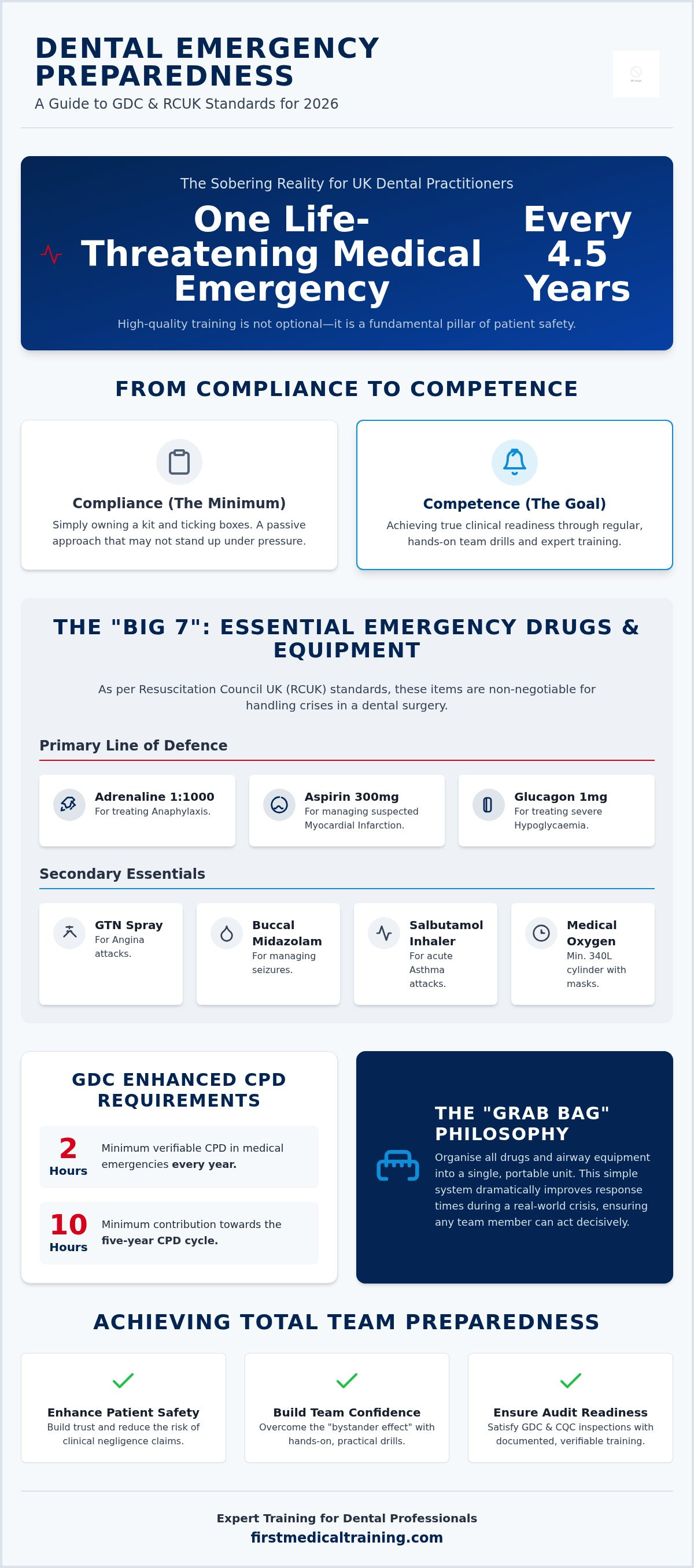
To stay on the right side of the regulator, you must adhere strictly to the GDC CPD requirements for medical emergencies. The GDC recommends at least two hours of verifiable CPD in this area every year. Over a five-year cycle, this contributes to the 10-hour minimum required under the Enhanced CPD scheme. Regular dental practice emergency drug kit training ensures that your team isn't just collecting hours but is actually developing the muscle memory needed to act during a crisis. During a CQC inspection, having a well-documented log of this training acts as a shield, proving your commitment to high-level governance and safe care.
Patient Safety and the Duty of Care
Beyond the paperwork, there is a profound moral and ethical imperative at play. Patients today have higher expectations regarding their safety, and many experience significant anxiety when visiting the surgery. Demonstrating that your team is prepared for any eventuality builds immense trust. Professional dental practice emergency drug kit training significantly reduces the risk of clinical negligence claims because it ensures that protocols are followed precisely. By investing in comprehensive education, you move from a state of passive compliance to one of active clinical readiness. It's about protecting your patients, your staff, and the long-term reputation of your practice.
Essential Drugs in a Dental Practice Kit: RCUK Standards
Ownership of a kit is only the first step; understanding the clinical application of each medication is what saves lives. The 2026 mandatory list is precise and leaves no room for improvisation. You must carry Adrenaline (1:1000), Aspirin (300mg), and Glucagon (1mg) as your primary line of defence. These medications are critical for reversing the effects of anaphylaxis, managing suspected myocardial infarction, and treating severe hypoglycaemia before the ambulance arrives. Using these drugs effectively requires regular dental practice emergency drug kit training to ensure every team member knows the correct dosages and administration routes.
Secondary essentials are equally vital for surgery safety. Glyceryl trinitrate (GTN) spray, buccal Midazolam, and Salbutamol inhalers must be present, fully functional, and easily accessible. Medical oxygen isn't an optional extra; it is a core requirement. It must be stored in a cylinder with a minimum capacity of 340 litres and be accompanied by appropriate tubing and non-rebreather masks. Adhering to the RCUK standards for emergency equipment ensures your practice is equipped to handle cardiorespiratory arrest and other common medical crises with professional precision.
Storage of these items requires a pragmatic approach. Your kit must be secure from unauthorised access, yet it should never be kept under lock and key in a way that creates delays. Many practices now adopt a "Grab Bag" system. This keeps all drugs and airway equipment in one portable, highly organised unit that any staff member can retrieve and deploy within seconds. It's a simple change that dramatically improves response times during a real-world crisis.
Drug Administration Protocols for Dental Teams
Speed and accuracy are your priorities during an emergency. Adrenaline 1:1000 must be administered via intramuscular injection at the very first sign of anaphylaxis to be most effective. Buccal Midazolam is the gold standard for managing prolonged seizures, specifically those lasting longer than five minutes. For suspected angina, GTN spray should be administered sublingually to provide rapid relief. Comprehensive dental practice emergency drug kit training focuses on these high-pressure scenarios, ensuring that your team doesn't hesitate when a patient's life hangs in the balance.
Kit Maintenance and Expiry Tracking
Assigning a dedicated "emergency lead" is the most reliable way to prevent kit failure. This individual should conduct weekly audits to check seal integrity, oxygen pressure, and expiry dates. Out-of-date drugs are clinically useless and represent a significant liability during a CQC inspection. The RCUK minimum drug requirements for 2026 include Adrenaline, Aspirin, Glucagon, Glyceryl trinitrate, Midazolam, Salbutamol, and Medical Oxygen. Regular checks ensure these remain viable and ready for use. If you're looking to refresh your team's skills, booking a professional medical emergencies course is an excellent way to ensure your protocols are up to date.
Compliance vs Competence: Why Professional Training is Vital
Owning a compliant kit is a regulatory baseline, but clinical competence is what saves lives. There is a vast psychological gulf between reading a drug label and successfully drawing up a dose of Adrenaline 1:1000 while a patient is in anaphylactic shock. Without regular dental practice emergency drug kit training, even the most experienced clinicians can fall victim to the "bystander effect". This psychological phenomenon occurs when team members hesitate, assuming someone else will take charge. Hands-on drills dismantle this hesitation, replacing panic with a structured, automatic response.
Building this confidence starts with managing the most frequent issues. Proper syncope management dental training is a perfect example. Since fainting is the most common emergency in UK surgeries, a team that can handle it smoothly is less likely to let a minor incident escalate into a major crisis. This creates a culture of steady reliability that patients can sense, even in a high-stress environment. A confident team projects an atmosphere of safety that reassures both the patient and the staff members involved.
Hands-on Training vs Online Learning
Theoretical knowledge has its place, but it often fails in the heat of a real-world scenario. Physical practice with drug ampoules, syringes, and trainers is irreplaceable. You need to feel the resistance of a plunger and understand the ergonomics of your specific "Grab Bag". Simulating emergencies in your actual surgery environment is vital. It uncovers practical obstacles, such as a narrow doorway or a poorly positioned oxygen cylinder, that an online course simply cannot replicate. Practical familiarity ensures that when a crisis occurs, your movements are fluid and your focus remains entirely on the patient.
Team Dynamics During a Medical Emergency
Success in a crisis depends on a well-drilled hierarchy. Every member of the team must have a pre-defined role. One person must be designated to call 999 and provide precise location details; another retrieves the emergency kit and AED, whilst a third assists the dentist with airway management or drug administration. Clear, verbal communication is essential whilst managing a collapsed patient to avoid duplicated efforts or missed steps. Finally, always conduct a structured debriefing after any emergency, real or simulated. This allows the team to process the event, identify areas for improvement, and reinforce their collective confidence for the future.
Organising Effective In-Practice Training and Kit Audits
Transitioning from a state of passive compliance to active readiness requires a structured approach. Effective dental practice emergency drug kit training is not a one-off event but a continuous cycle of assessment and refinement. By following a clear, five-step framework, you can ensure that your team remains sharp and your equipment stays functional without causing unnecessary stress to your daily operations.
- Step 1: Conduct a gap analysis. Assess the current confidence levels of your staff and the physical state of your kit. Identify who is due for a refresher and check for any missing or expiring items.
- Step 2: Schedule professional education. Book an annual medical emergencies in dental practice course to provide the team with accredited, hands-on experience.
- Step 3: Implement a monthly kit audit. While daily oxygen and AED checks are standard, a comprehensive monthly checklist ensures that every drug ampoule and airway adjunct is accounted for and in date.
- Step 4: Practice rapid-response drills. Run short, ten-minute "flash drills" between formal sessions to test how quickly a staff member can retrieve the "Grab Bag" and AED.
- Step 5: Document everything. Maintain a clear log of all training and audits. This provides the verifiable evidence required by the CQC and GDC during an inspection.
The Role of the Practice Manager
The Practice Manager is the architect of safety within the surgery. Your goal is to organise training that minimises disruption to the patient diary whilst ensuring the highest standards of care. It is vital that all new starters receive an immediate emergency induction on their first day; they must know exactly where the drug kit and AED are located before they see their first patient. Keep all certificates and audit logs in a centralised dental practice emergency preparedness folder. This level of organisation demonstrates to regulators that your practice operates with a culture of proactive safety rather than reactive panic.
Advanced Equipment Integration
Your emergency protocols must evolve alongside your equipment. Integrating AED use into your dental practice emergency drug kit training ensures that the transition from drug administration to defibrillation is seamless. Consider the value of adding a LifeVac anti-choking device to your waiting room and clinical areas; it provides an additional layer of protection for both patients and visitors. Finally, ensure all staff, including non-clinical members, are trained to operate emergency oxygen cylinders. Knowing how to correctly fit a non-rebreather mask and set the flow rate to 15 litres per minute is a fundamental skill that can stabilise a patient whilst waiting for the ambulance. If you are ready to ensure your team's readiness, you can book your in-practice training with First Medical Training today.
Enhancing Patient Safety with First Medical Training
Choosing a training partner is a decision that directly impacts the safety of your patients and the resilience of your clinical team. Since 2006, First Medical Training Ltd has established itself as a trusted authority by focusing exclusively on the practical realities of the dental environment. We don't just provide generic first aid; we deliver specialised dental practice emergency drug kit training that bridges the gap between regulatory theory and life-saving action. Our approach is designed to demystify complex medical protocols, making them accessible and actionable for every member of your staff, from senior associates to the newest receptionist.
The primary benefit of our in-practice training is the ability to tailor every drill to your specific surgery layout. Our instructors don't just talk about equipment; they walk through your rooms to identify the most efficient routes for retrieving oxygen or deploying an AED. This bespoke element is vital. It ensures that when a crisis occurs, your team isn't just following a textbook; they are following a plan that was built for their own workplace. This level of familiarity significantly reduces response times and increases the likelihood of a positive clinical outcome.
Accredited Training You Can Trust
Our "Medical Emergencies in a Dental Practice" course provides high-quality, verifiable CPD that meets all 2026 GDC standards and RCUK guidelines. We believe that medical education should be as engaging as it is informative. Our instructors bring years of real-world medical emergency experience to your surgery, offering a perspective that is both authoritative and supportive. We move away from cold, clinical lecturing in favour of a motivational, human-centric approach. This builds genuine confidence, ensuring that your team feels empowered rather than intimidated by their responsibilities during a medical collapse.
Taking the Next Step for Your Practice
Organising your annual training shouldn't be a source of stress. We work around your busy clinical diary to schedule sessions at a time that minimises disruption to your patients. Beyond our core medical emergencies curriculum, we offer the flexibility to customise your training day. You can integrate Dental ILS or even Mental Health First Aid for Dental Practices to create a comprehensive safety package for your team. We also supply essential life-saving equipment, such as LifeVac anti-choking devices and AEDs, ensuring your kit is as prepared as your people. Ensure your team is ready for any eventuality by booking your Medical Emergencies in a Dental Practice Course today. By choosing a partner with two decades of expertise, you are investing in the long-term safety and professional reputation of your practice.
Securing Your Practice's Clinical Readiness
Navigating the complexities of 2026 GDC standards requires more than just a well-stocked kit. It demands a team that can act with precision when every second counts. By mastering the clinical application of the "Big 7" drugs and implementing a rigorous audit schedule, you move your surgery from a state of passive compliance to one of active patient safety. The psychological transition from hesitation to automatic response is only achieved through regular, high-quality dental practice emergency drug kit training.
First Medical Training has been a trusted partner for UK dental professionals since 2006. Our courses are fully compliant with current GDC and RCUK standards, providing the hands-on experience your team needs within the familiar environment of your own surgery. Don't leave your emergency response to chance; ensure your staff are empowered to protect your patients and your professional reputation.
Ready to empower your team? Book Your Accredited Dental Emergency Training Today and take the final step toward total clinical confidence. We look forward to supporting your journey to professional excellence.
Frequently Asked Questions
What drugs are mandatory in a UK dental practice emergency kit in 2026?
The mandatory drugs for a UK dental practice in 2026 are Adrenaline (1:1000), Aspirin (300mg), Glucagon (1mg), Glyceryl Trinitrate (GTN) spray, buccal Midazolam, Salbutamol, and Medical Oxygen. These "Big 7" medications must be stored in a portable, accessible kit. Regular dental practice emergency drug kit training ensures your team knows the correct dosages for each, particularly for high-risk scenarios like anaphylaxis or severe hypoglycaemia.
How often do dental staff need medical emergency drug kit training?
Dental staff must undergo medical emergency training at least once every twelve months to remain compliant with RCUK and GDC standards. Annual training is the professional benchmark for maintaining clinical competence and ensuring that life-saving skills remain sharp. This frequency allows the team to practice with new equipment and refresh their knowledge of current drug protocols, reducing the risk of hesitation during a real-world crisis.
Does the GDC require verifiable CPD for emergency drug training?
Yes, the GDC requires all registered dental professionals to complete verifiable CPD in medical emergencies. They recommend a minimum of two hours of training per year, which contributes to the ten-hour requirement across a five-year Enhanced CPD cycle. Comprehensive dental practice emergency drug kit training provides the necessary certification to satisfy GDC audits and proves that your practice maintains a high standard of patient safety and professional governance.
Can dental nurses administer emergency drugs during a crisis?
Dental nurses can and should assist with drug administration during a medical crisis if they are appropriately trained. While the prescribing dentist usually leads the response, nurses often prepare the medication or assist with delivery under direction. In life-threatening situations where a dentist is unavailable, nurses may act according to established emergency protocols. Effective team-based training ensures every member knows their specific responsibilities when deploying the drug kit.
What happens if our emergency drugs are out of date during an inspection?
Finding out-of-date drugs during an inspection is a serious regulatory failure that can lead to a "Requires Improvement" or "Inadequate" rating from the CQC. Under Regulation 12 (Safe care) and Regulation 17 (Good governance), practices must demonstrate robust audit trails for all emergency equipment. Beyond the regulatory risk, using expired medication is a major clinical liability that could result in professional negligence claims if a patient is harmed during an emergency.
Is an AED required alongside the emergency drug kit in a dental surgery?
An Automated External Defibrillator (AED) is a mandatory requirement for every UK dental practice in 2026, sitting alongside your drug kit. It must be fully functional and ready for use within 120 seconds of a suspected cardiac arrest. Modern training sessions integrate AED use with drug protocols, ensuring that the transition from basic life support to advanced intervention is seamless and well-coordinated by the entire dental team.
What is the best way to train a new dental receptionist in medical emergencies?
New dental receptionists should receive an immediate emergency induction on their first day before they interact with patients. This induction focuses on their vital role in the chain of survival, such as calling 999, providing the practice's exact location, and retrieving the emergency "Grab Bag" or AED. Including them in annual team drills ensures they understand how the clinical and non-clinical staff work together during a medical crisis.
Do we need a specific kit for paediatric medical emergencies in dentistry?
You don't necessarily need a separate kit, but your existing kit must contain paediatric-specific equipment and dosages. This includes paediatric-sized non-rebreather masks, spacers for Salbutamol inhalers, and clear guidance on reduced dosages for medications like Adrenaline or Glucagon. Ensuring your team is trained in paediatric life support is essential, as the physiological response of a child in distress differs significantly from that of an adult patient.