

GDC Medical Emergency Training: 2026 Dental Practice Guide

If a medical emergency occurred in your surgery this afternoon, would your team move with clinical precision or freeze in collective uncertainty? Achieving gdc compliant medical emergency training is often viewed as a regulatory hurdle, yet its true value lies in the calm it brings to a high-pressure environment. We understand that managing verifiable CPD for a diverse clinical team can feel like a logistical puzzle, especially whilst standards from the GDC and Resuscitation Council UK continue to evolve. It's natural to feel anxious about how your staff might perform during a genuine crisis when the stakes are at their highest.
You deserve to feel certain that your practice is fully prepared for any eventuality. This 2026 guide provides a clear roadmap to mastering the latest requirements, ensuring you meet every benchmark for CQC and GDC inspections with ease. We'll explore the essential components of our Medical Emergencies in a Dental Practice Course, clarify training frequencies, and define the specific roles that turn your team into a life-saving unit. By the end of this guide, you'll have the tools to foster a culture of clinical confidence that goes far beyond simple compliance.
Key Takeaways
- Understand how GDC, RCUK, and CQC standards intersect to ensure your practice remains fully compliant and prepared for inspections.
- Master the essential clinical skills and management of the "Big Six" emergencies through gdc compliant medical emergency training.
- Audit your emergency drug kit and oxygen delivery systems to ensure you meet the 2026 mandatory requirements for dental surgeries.
- Implement a structured training plan that involves the whole team in their own clinical environment to build collective confidence and clear roles.
- Identify the criteria for choosing an accredited training partner with real-world medical expertise and a long-standing reputation in the dental sector.
Navigating GDC Compliance: Medical Emergency Training Requirements for 2026
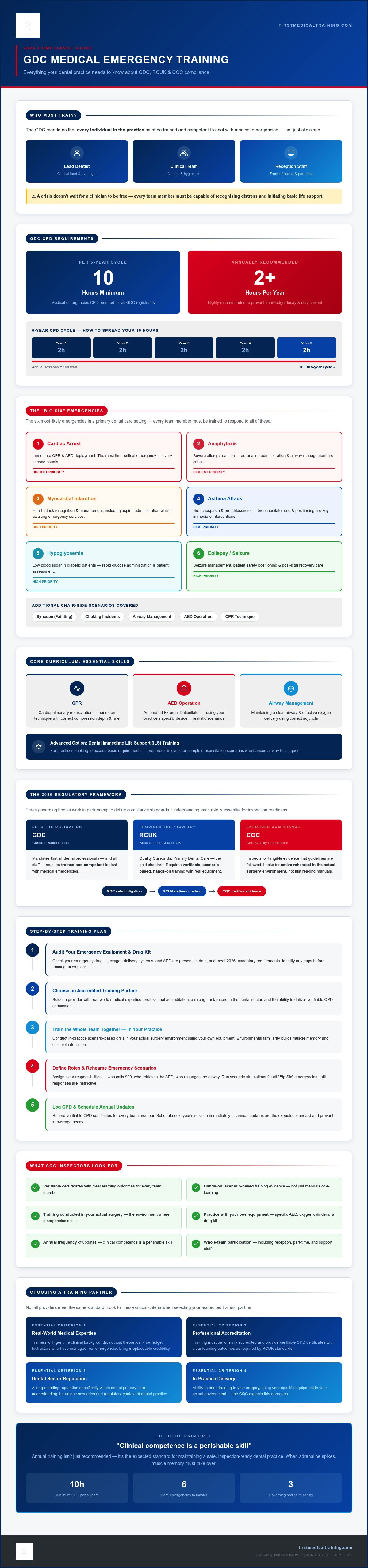
Maintaining gdc compliant medical emergency training isn't just a box-ticking exercise for your annual registration; it's a fundamental pillar of patient safety. The General Dental Council (GDC) mandates that all dental professionals must be "trained and competent" to deal with medical emergencies. This requirement is not limited to clinicians. Every individual in the practice, from the lead dentist to the part-time receptionist, plays a vital role when a patient's life is at risk. A crisis doesn't wait for a clinician to be free, so your front-of-house staff must be just as capable of recognising distress and initiating basic life support as those in the surgery.
The regulatory landscape in 2026 is defined by a close partnership between the GDC, the Resuscitation Council UK (RCUK), and the Care Quality Commission (CQC). While the GDC sets the professional obligation, the RCUK provides the clinical "how-to" through their specific guidelines. When the CQC inspects your practice, they look for tangible evidence that these guidelines are being followed. They want to see that your team hasn't just read a manual, but has actively rehearsed their response in the very rooms where they work. Clinical competence is a perishable skill, which is why annual updates are the expected standard for maintaining a safe practice environment.
The Role of the Resuscitation Council UK (RCUK)
The RCUK "Quality Standards: Primary Dental Care" document remains the gold standard for our industry. It dictates that training must be verifiable, meaning it must have clear learning outcomes and provide a certificate of completion. In 2026, there's a significant shift away from passive learning. Compliance now demands hands-on, scenario-based drills. Your team needs to practice with the actual equipment they would use in a real crisis, such as your practice's specific AED or oxygen cylinders. This pragmatic approach ensures that when adrenaline spikes, muscle memory takes over, allowing for a calm and effective response.
GDC Recommended CPD Hours
To remain compliant, the GDC requires all registrants to complete at least 10 hours of medical emergencies CPD in every five-year cycle. However, they highly recommend that at least 2 hours of this training is undertaken annually. This steady rhythm prevents knowledge decay and keeps the team updated on any minor protocol shifts. You can find more detail on these specific obligations in our guide on GDC CPD Requirements for Dentists. By integrating these hours into an annual in-practice session, you ensure the entire team meets their requirements simultaneously whilst building collective confidence.
Core Curriculum: What a GDC Compliant Course Must Cover
A robust curriculum for gdc compliant medical emergency training must bridge the gap between clinical theory and the high-stakes reality of the dental chair. It's not enough to simply watch a demonstration; your team must actively perform life-saving interventions to build true competence. The core syllabus centres on Cardiopulmonary Resuscitation (CPR), the swift application of an Automated External Defibrillator (AED), and effective airway management. For practices seeking to exceed the basic requirements, Dental Immediate Life Support (ILS) Training provides an advanced standard of care, preparing clinicians for more complex resuscitation scenarios and enhanced airway techniques.
Training should specifically address the "Big Six" emergencies most likely to occur in a primary care setting. This includes the management of cardiac arrest, myocardial infarction, anaphylaxis, asthma, hypoglycaemia, and epilepsy. By running simulations within your actual surgery environment, your team learns exactly where the oxygen is kept and who is responsible for calling 999. This environmental familiarity is crucial. It transforms a group of individuals into a coordinated emergency response unit, ensuring that equipment is reachable and roles are clearly defined before a crisis occurs.
Managing Specific Dental Scenarios
Chair-side emergencies often present with subtle signs before escalating into a full-scale crisis. Effective training covers the nuances of Syncope Management for Dental Teams, as well as handling seizures and choking incidents. Your staff must feel confident administering drugs from the practice's emergency kit, such as buccal midazolam for prolonged seizures or adrenaline for anaphylaxis. Knowing the correct dosages and administration routes whilst a patient is in the chair is a skill that only comes through regular, scenario-based practice. If you haven't updated your team's skills recently, consider booking a Medical Emergencies in a Dental Practice Course to refresh these vital protocols.
Integrating Mental Health First Aid
Holistic patient care in 2026 now extends to psychological wellbeing as much as physical safety. Including mental health awareness within your training schedule is a powerful differentiator for modern practices. It equips your team to support anxious patients and, crucially, look after each other. High-stress clinical environments can lead to burnout; by prioritising staff wellbeing, you reduce the risk of human error during physical medical crises. A team that is mentally resilient and supported is a team that performs with greater clarity when every second counts. This approach creates a safer environment for both the patients and the professionals caring for them.
Essential Equipment and Drug Kits for Dental Surgeries
Possessing the correct equipment is only half the battle; ensuring it's functional and within its expiry date is what defines a truly prepared practice. This readiness is a core requirement of gdc compliant medical emergency training, as no amount of clinical knowledge can compensate for a depleted oxygen cylinder or an empty adrenaline syringe. Every dental surgery must maintain a specific suite of emergency drugs as outlined by the British National Formulary (BNF). This kit must include Adrenaline (1:1000) for anaphylaxis, Aspirin (300mg), Glucagon for hypoglycaemia, Glyceryl Trinitrate (GTN) spray, Salbutamol inhalers, and Midazolam for prolonged seizures. Regular audits are essential. It's a common pitfall for practices to discover an expired Glucagon vial only during a crisis, which is why we recommend a designated "kit lead" to perform weekly checks.
Alongside the drug kit, medical-grade oxygen cylinders are mandatory. These must be equipped with appropriate delivery masks, including a pocket mask with an oxygen port and a self-inflating bag-valve-mask (BVM) to provide ventilatory support if a patient stops breathing. Your oxygen supply should be sufficient to last until the ambulance arrives, which often means having a backup cylinder or a high-capacity flow rate. Tracking these dates and pressure levels ensures that your practice remains safe and compliant during a CQC inspection.
Airway Management and Anti-Choking Devices
Effective airway management is the cornerstone of resuscitation. Beyond standard suction units and oropharyngeal airways, many modern practices are now integrating the LifeVac anti-choking device as a secondary life-saving tool. Whilst the standard choking protocol remains the primary response, LifeVac offers an additional layer of safety, particularly for patients where traditional abdominal thrusts may be difficult or contraindicated. Training on how to deploy these devices effectively is a key component of our Medical Emergencies in a Dental Practice Course. This hands-on experience ensures that your gdc compliant medical emergency training covers the full spectrum of airway obstructions, giving your team the confidence to act decisively when a patient's airway is compromised.
AED Readiness and Maintenance
An Automated External Defibrillator (AED) is a non-negotiable requirement for any clinical environment. When choosing an AED, you must decide between semi-automatic models, which require the responder to press a button to deliver a shock, and fully automatic versions. Both are effective, but your choice should reflect the confidence level of your team. It's vital to ensure you have paediatric pads available if you treat children, as standard adult pads deliver a joule level that is too high for smaller patients. Daily status checks on the battery and electrode pads should be part of your morning routine. We encourage every staff member to envision themselves as a confident responder, capable of grabbing the AED and applying it within seconds of a collapse.
Organising Your Practice: A Step-by-Step Training Plan
Effective emergency response is a team effort. You need a structured plan. Whilst individual clinical skills are paramount, the collective ability of the practice to function under pressure depends on how well you have organised your response protocols. Start by performing a training needs analysis for every staff member. This shouldn't be limited to dentists and nurses. Your receptionists are often the first to notice a patient in distress in the waiting room and are responsible for directing the ambulance crew. Each role requires a specific set of competencies that must be refreshed annually to ensure the safety of your patients and the clinical team.
Appointing a dedicated Medical Emergency Lead is a vital step in this process. This individual takes ownership of the emergency equipment, performs the weekly drug kit audits mentioned previously, and ensures training dates are scheduled well in advance. To help you structure this, we recommend using our Dental Practice Emergency Preparedness Checklist for 2026. This document serves as a foundation for your practice compliance folder, providing clear evidence for CQC inspectors that your emergency readiness is managed with professional rigour.
In-Practice vs External Training
There is a distinct advantage to training within your own surgery environment. External centres offer fewer distractions, but they cannot replicate the specific layout of your practice. In-practice sessions allow your team to test the actual oxygen cylinders and AED they would use in a crisis. It turns a theoretical exercise into a practical drill. Whether you are conducting a 1-day EFAW course or specific medical emergency updates, doing so in-house builds environmental familiarity. If you want to ensure your whole team is prepared in their own workspace, you can book your in-practice training session today to secure your 2026 compliance.
Maintaining Verifiable CPD Records
Achieving gdc compliant medical emergency training requires more than just attendance; it requires verifiable evidence. For a CPD certificate to be valid, it must clearly state the learning aims, objectives, and the specific GDC development outcomes it meets. Your medical emergency training should primarily link to Development Outcome C, which focuses on the maintenance and development of clinical knowledge and skills. We encourage staff to complete a brief reflective log after every course. This simple template should record what they learned and how it will change their behaviour in a real emergency, turning a mandatory requirement into a meaningful professional development tool.
Choosing a Training Partner: Why Professional Accreditation Matters
Selecting a provider for your gdc compliant medical emergency training is a decision that impacts the safety of every patient who enters your surgery. In a market crowded with generalist first aid companies, the value of a specialist cannot be overstated. You require a partner that understands the unique pressures of the dental environment, such as managing a collapsed patient in a dental chair or the specific drug protocols required by the GDC. A credible provider should demonstrate a long-standing reputation, ideally stretching back decades, to prove they've evolved alongside shifting regulations. Accreditation by recognised bodies and strict adherence to the latest Resuscitation Council UK guidelines are non-negotiable benchmarks for quality.
Instructors must possess real-world medical experience. There's a profound difference between a trainer who has read a manual and one who has managed cardiac arrests in a clinical setting. This expertise allows them to provide the "why" behind the "how", demystifying complex procedures and building the quiet confidence your team needs to act during a crisis. Every course must be updated to reflect 2026 clinical standards, ensuring your practice remains at the forefront of patient care and regulatory compliance. When your team feels the weight of a genuine emergency, they'll rely on the muscle memory developed through high-quality, professional instruction.
The First Medical Training Ltd Difference
We've been a trusted mentor to the dental profession since 2006, bringing 20 years of specialised expertise to every session. First Medical Training Ltd offers an approach that goes beyond standard CPR drills. We integrate modern life-saving tools like the LifeVac anti-choking device and provide essential Mental Health First Aid for dental teams. This holistic focus ensures your staff are not only clinically prepared for physical emergencies but also equipped to support the wellbeing of their colleagues and patients. Our training is designed to be supportive and empowering, turning a mandatory requirement into a source of professional pride and collective strength for the entire practice.
Ready to Secure Your Practice Compliance?
The journey from regulatory confusion to clinical readiness is straightforward when you have the right guide. By focusing on annual scenario-based drills, maintaining a robust equipment kit, and fostering a culture of confidence, you move past the "floor" of compliance and reach the "ceiling" of excellence. You can explore the full curriculum of our Medical Emergencies in a Dental Practice Course to see how we tailor our sessions to your specific needs. Don't leave your practice's safety to chance. Book your GDC compliant training with First Medical Training Ltd today and ensure your team is life-saving ready for 2026.
Securing Your Practice's Future Readiness
Achieving full regulatory compliance for 2026 requires more than just a set of certificates; it demands a shift towards a culture of clinical excellence. We've discussed the importance of environmental familiarity and the integration of specialised tools like LifeVac to ensure your response is as robust as possible. By appointing a dedicated lead and focusing on a whole-team approach, you move beyond the basics of gdc compliant medical emergency training to create a practice that is truly resilient. This preparation doesn't just satisfy the GDC or CQC; it provides a profound sense of security for your staff and patients alike.
First Medical Training Ltd has been a seasoned mentor to the dental sector since 2006, delivering the expertise needed to turn regulatory requirements into life-saving skills. Our instructors focus on building the quiet confidence that allows your team to act with precision when it matters most. Every session concludes with the issuance of verifiable CPD certificates for all attendees, ensuring your records are as organised as your emergency response. Book your GDC compliant Medical Emergencies in a Dental Practice Course with First Medical Training Ltd today and ensure your team is ready for any eventuality. You've built a practice dedicated to care; we're here to help you protect it.
Frequently Asked Questions
How often must dental teams complete medical emergency training for GDC compliance?
Dental teams must complete medical emergency training at least once a year to maintain clinical competence. Whilst the GDC requires a minimum of 10 hours of medical emergencies CPD per five-year cycle, they highly recommend that at least 2 hours are undertaken annually. Regular updates ensure that life-saving skills remain fresh and that the team is aware of any protocol changes from the Resuscitation Council UK. This annual rhythm is also a key expectation for CQC inspections.
Do dental receptionists need to attend the medical emergency training course?
Yes, every member of the dental team, including non-clinical staff like receptionists, must participate in gdc compliant medical emergency training. A medical crisis can occur anywhere in the practice, often starting in the waiting room. Receptionists are frequently the first to identify a deteriorating patient and are responsible for initiating the emergency response and contacting the ambulance service. Training as a whole team ensures everyone knows their specific role during a high-pressure incident.
What is the difference between BLS and Dental Immediate Life Support (ILS)?
Basic Life Support (BLS) focuses on the fundamentals of CPR and AED use for the general public or healthcare providers. Dental Immediate Life Support (ILS) is an advanced standard specifically tailored for the dental environment. It includes enhanced airway management, the use of adjuncts, and more complex resuscitation scenarios. ILS training builds a higher level of clinical confidence, preparing the team to manage a wider range of life-threatening situations within the surgery and providing greater depth than standard BLS.
Can we use online-only courses for medical emergency training in 2026?
No, online-only courses are generally insufficient for meeting GDC and Resuscitation Council UK standards. Compliance in 2026 demands hands-on, scenario-based training that allows staff to practice physical skills like chest compressions and AED application. Practical drills conducted within your own practice environment are essential for building muscle memory. While online modules can support theoretical knowledge, they cannot replace the interactive, physical experience required to ensure your team is truly life-saving ready and clinically competent.
What emergency drugs are mandatory for a UK dental practice?
UK dental practices must hold a specific kit of emergency drugs as defined by the British National Formulary. This mandatory list includes Adrenaline (1:1000) for anaphylaxis, Aspirin (300mg) for cardiac chest pain, and Glucagon for severe hypoglycaemia. You must also stock Glyceryl Trinitrate (GTN) spray, Salbutamol inhalers for asthma, and Midazolam for prolonged seizures. It is vital to check expiry dates weekly and ensure all staff, including non-clinical members, know exactly where these drugs are kept.
Is an AED a legal requirement for all dental surgeries in the UK?
Yes, having an Automated External Defibrillator (AED) on-site is a mandatory requirement for all clinical dental environments in the UK. The GDC and CQC expect practices to follow Resuscitation Council UK guidelines, which state that an AED must be available and ready for use. It's not enough to simply own the device; it must be checked daily to ensure the battery and pads are functional. Every team member must be trained to deploy it within seconds.
How many hours of verifiable CPD should we get from an annual medical emergency course?
A standard annual update for gdc compliant medical emergency training typically provides between 2 and 3 hours of verifiable CPD. This aligns with the GDC recommendation to complete at least 10 hours per five-year cycle. For the CPD to be verifiable, your certificate must clearly state the learning aims, objectives, and the specific GDC development outcomes met. Our sessions are designed to meet these rigorous standards whilst providing practical, hands-on experience for the entire team.
What happens if a practice fails to meet GDC medical emergency training standards?
Failing to meet these standards can have serious consequences for both the practice and individual registrants. During a CQC inspection, a lack of up-to-date training evidence can lead to a "requires improvement" rating or enforcement action. On a professional level, the GDC may view a lack of competence in medical emergencies as a fitness to practise issue. Most importantly, it compromises patient safety, leaving the team unprepared to manage a life-threatening crisis effectively and confidently.