

GDC Standards for the Dental Team: The 2026 Compliance Guide

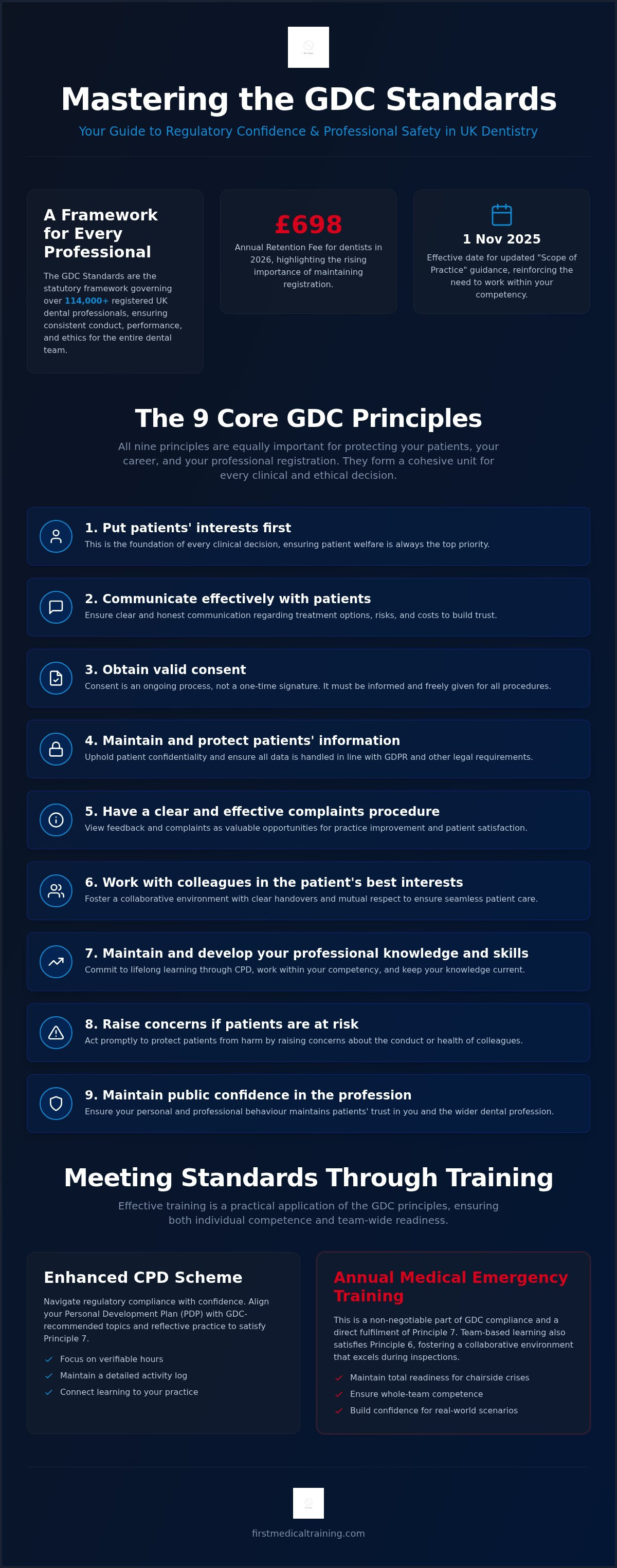
The gdc standards aren't just a bureaucratic hurdle to clear; they're the clinical safety net that protects your patients and your career when things go wrong. We know that the pressure of maintaining registration feels heavier than ever, especially with the 2026 Annual Retention Fee for dentists rising to £698. It's understandable if the fear of fitness to practise proceedings or the complexity of the new MyGDC portal keeps you awake at night. Balancing high-quality patient care with a mountain of regulatory paperwork is a constant struggle for every UK dental professional.
You don't have to face these requirements with uncertainty. This guide will help you master the nine core principles and show you exactly how to apply them to your daily practice and emergency preparedness for total regulatory confidence. We'll demystify the "10 in 2" CPD rule and clarify the difference between verifiable and general hours. From understanding the revised Scope of Practice guidance to streamlining your annual medical emergencies training, you'll gain a clear roadmap to meeting your 2026 obligations with ease.
Key Takeaways
- Understand how the statutory framework applies to every member of the dental team, ensuring collective accountability and professional safety across your practice.
- Master the 9 gdc standards to build a robust clinical framework that protects both your patients' interests and your professional registration.
- Learn why annual medical emergency training is a direct fulfilment of Principle 7 and how to maintain total readiness for a chairside crisis.
- Navigate the Enhanced CPD scheme with confidence by aligning your Personal Development Plan with the GDC’s highly recommended topics and reflection requirements.
- Discover how team-based learning satisfies Principle 6, fostering a collaborative environment that excels during CQC and GDC inspections.
Understanding the GDC Standards: The Foundation of UK Dental Practice
The gdc standards represent the statutory framework that governs every registered dental professional in the UK. Established by the General Dental Council (GDC), these standards ensure a consistent level of conduct, performance, and ethics across the industry. Whether you're a dentist, a dental nurse, or a clinical technician, these principles aren't optional extras; they're the core of your professional identity. They provide the public with a guarantee that the person treating them is held to a rigorous, nationally recognised benchmark.
It's a common mistake to think these expectations only apply to the person holding the drill. The standards apply to all 114,000+ registrants on the GDC register, including dental hygienists, therapists, and technicians. Even team members who aren't registered, such as receptionists, must work in a way that aligns with these principles. If a staff member's behaviour falls short, the registered manager or lead clinician often faces the regulatory fallout. Non-compliance doesn't just risk your individual registration; it compromises the practice's reputation and can lead to fitness to practise proceedings that take years to resolve.
Maintaining a compliant team starts with effective recruitment. For practice managers interested in the wider healthcare market's approach to talent acquisition, it can be helpful to explore Physician Recruitment and Staffing Fees as part of their long-term workforce strategy.
Why Standards Matter for Every Registrant
Public confidence is the currency of dentistry. Patients need to know that regardless of which practice they visit, they'll receive care that meets a universal standard. These principles also serve as a defensive shield for you. If a clinical dispute or a formal complaint arises, being able to demonstrate that your actions were firmly rooted in the gdc standards provides a solid foundation for your defence. This framework is intrinsically linked to your "Scope of Practice," with updated guidance taking effect on 1 November 2025. This ensures every registrant works within their trained competency, preventing the clinical "mission creep" that often leads to errors.
The Role of Professional Judgement
The current framework continues the shift away from a rigid, prescriptive rulebook towards a system based on overarching principles. This means you can't just treat compliance as a tick-box exercise. You're expected to use your professional judgement to make ethical decisions in real-time. This involves balancing a patient's specific interests with your own professional boundaries and the safety of the wider public. Professionalism is the consistent application of ethical principles and professional judgement to maintain public trust in the dental team. By focusing on the "why" behind the principles, you're better equipped to handle complex scenarios where the right path isn't immediately obvious.
The 9 GDC Principles: A Framework for Professional Conduct
The gdc standards are built upon nine core principles that function as a cohesive unit. While some practitioners mistakenly believe Principle 1 is the only priority, the GDC is clear: all nine are equally important for maintaining your registration. The official Standards for the Dental Team publication outlines these expectations in detail, providing a roadmap for every clinical and ethical decision you make.
Principle 1 requires you to put patients' interests first. This is the core of every clinical decision. Principle 2 focuses on effective communication, particularly regarding treatment options and costs. This leads naturally to Principle 3, which is obtaining valid consent. Consent must be an ongoing process, not just a one-off signature. Principle 4 involves protecting patient information, which is where your gdc standards obligations intersect with GDPR. Finally, Principle 5 requires a clear complaints procedure. View feedback as a tool for improvement rather than a personal attack.
Working Together and Maintaining Knowledge
Synergy within the dental team is the focus of Principle 6. It mandates working with colleagues in the patient's best interests, which requires clear handovers and mutual respect. Principle 7 then focuses on maintaining and developing your professional skills. You must work within your competency and keep your knowledge current. Practising these principles together ensures the whole team is prepared for any scenario. Engaging in regular, team-based CPD and emergency training is a practical way to satisfy both requirements simultaneously.
Ethics, Integrity, and Social Responsibility
The duty of candour is central to Principle 8. You have a professional obligation to raise concerns if you believe patients or colleagues are at risk. This isn't about being "difficult"; it's about clinical safety. Principle 9 addresses your personal behaviour. Your conduct outside the surgery, including your social media presence and interactions with the law, can affect your registration. The GDC expects your behaviour to maintain the public's confidence in the profession at all times. Integrity is not a part-time requirement.
GDC Standards in Emergency Scenarios: Maintaining Clinical Competence
The gdc standards are tested most acutely when a patient collapses in the waiting room or the dental chair. Principle 7 requires you to maintain, develop, and work within your professional knowledge and skills. This mandate extends far beyond clinical restorative work or hygiene protocols; it encompasses your ability to respond to life-threatening medical emergencies. The GDC is explicit that all team members, regardless of their specific role, must be trained and competent to handle a medical crisis. This collective responsibility ensures that when a cardiac arrest or anaphylactic event occurs, the response is a coordinated effort rather than a chaotic scramble.
According to the official Standards for the Dental Team, you must have the knowledge and skills to provide safe and effective care. This is especially relevant during high-stress scenarios where teamwork (Principle 6) becomes your most valuable asset. Standard 6.6 specifically emphasises that you must work with colleagues in a way that is in the patient's best interests. In an emergency, this means having a practiced, rehearsed plan where every individual knows exactly which piece of equipment to grab and which protocol to follow.
Standard 7.1: Keeping Knowledge and Skills Up to Date
Compliance with Standard 7.1 involves more than just reading a manual. The GDC classifies medical emergencies as a "highly recommended" topic, advising at least 10 hours of verifiable CPD per cycle, with a minimum of two hours completed annually. This annual rhythm ensures that life-saving skills remain fresh and reflexive. Mastering cardiac arrest management in dental practice is a non-negotiable requirement for every registrant. Your standard of care must also evolve alongside technology, such as the integration of Automated External Defibrillators (AEDs) and advanced airway management equipment into your practice protocols.
Dealing with Patient Collapse under Principle 1
Putting patients' interests first is the cornerstone of the gdc standards. In an emergency scenario, this principle translates into an ethical obligation to maintain the "chain of survival" through immediate, competent intervention. If you are unprepared for a patient collapse, you are failing to provide the safe environment that the public expects and deserves. A lack of regular, verifiable emergency training constitutes a direct breach of Principle 1, as it represents a failure to safeguard the patient's most fundamental interest: their physical safety. Professionalism requires you to envision your role as a capable responder before a crisis occurs, ensuring you have the confidence to act when seconds count.
Verifiable CPD and Regulatory Compliance: Meeting Your GDC Obligations
The Enhanced CPD scheme represents a significant shift in how the gdc standards are upheld. It moves away from passive attendance and towards a structured, accountable model of professional growth. To meet your obligations, your CPD must be "verifiable," meaning it includes clear learning aims, anticipated outcomes, and a method of quality control. Crucially, the GDC now requires a written reflection for every activity you record. This ensures you aren't just collecting certificates, but actively considering how new knowledge improves your clinical practice. For dentists, this means completing 100 hours of verifiable CPD per five-year cycle, whilst dental hygienists require 75 hours, and dental nurses must complete 50 hours.
The GDC identifies specific "Highly Recommended" topics that every registrant should cover within their cycle. These include five hours each of disinfection and decontamination and radiography and radiation protection. However, medical emergencies carry the highest weighting. You must complete at least 10 hours per cycle, with the GDC strongly recommending at least two hours of this training every single year. Failing to meet these specific hour requirements can lead to registration being challenged during an audit, as these topics are considered fundamental to safe practice.
Structuring Your Personal Development Plan (PDP)
Your PDP is the cornerstone of your compliance. It shouldn't be a generic list; it must identify specific gaps in your clinical skills based on your individual scope of practice. By linking your learning outcomes directly to Principle 7, you demonstrate a proactive commitment to the gdc standards. When planning your cycle, refer to the GDC CPD requirements for medical emergencies to ensure your hour breakdowns align with the 2026 expectations. A well-structured PDP acts as your roadmap, preventing the last-minute scramble for hours as your five-year deadline approaches.
The Importance of Reflective Practice
Reflection is the process of evaluating what you've learned and how it changes your behaviour in the surgery. The GDC values this application of learning above the mere duration of a course. After completing a medical emergencies in dental practice course, your reflection should detail how the training improved your confidence in using an AED or managing an airway. Choosing a practice-wide training day is particularly effective. It directly satisfies Principle 6.1 by improving team communication and ensuring everyone understands their specific role during a crisis. This collective approach transforms regulatory compliance into a practical, life-saving asset for the entire practice.
To ensure your team meets every verifiable requirement with confidence, book your GDC-aligned team training with an industry-recognised provider.
Ensuring Your Practice Meets GDC Standards with Expert Training
First Medical Training Ltd has been bridging the gap between GDC theory and clinical reality since 2006. We understand that reading the gdc standards is one thing; applying them under the intense pressure of a medical crisis is quite another. Our tailored in-practice courses allow your entire team to learn together in your own clinical environment. This collective approach directly satisfies Principle 6 by ensuring every member of the team understands their specific role during an emergency. It transforms a regulatory requirement into a practical, life-saving asset that builds genuine confidence. Safety is a team effort.
Every course we deliver is designed by industry experts to ensure learning outcomes align perfectly with GDC verifiable CPD standards. We don't just teach theory; we provide hands-on experience with professional equipment, including LifeVac anti-choking devices and Automated External Defibrillators (AEDs). This practical focus ensures that when you record your reflections, you're documenting real-world skills that will stand up to any GDC audit or CQC inspection. You'll move beyond the "tick-box" mentality and embrace a higher standard of clinical readiness.
Why Choose a Specialist Dental Training Provider?
A generic first aid certificate often lacks the context-specific nuances required in a dental surgery. Dental teams face unique challenges, such as managing a collapse in a dental chair or handling emergencies whilst a patient is under sedation. Using our dental practice emergency preparedness checklist helps you identify specific gaps in your surgery's readiness before an inspector arrives. Training with authoritative, reassuring mentors provides the peace of mind that your team is prepared for the worst-case scenario. It's about being ready when it matters most.
Next Steps for Your 2026 Compliance
Maintaining total regulatory confidence requires a proactive approach to your professional development. Start by auditing your current CPD cycle to identify any upcoming deadlines, particularly the July and August declarations for dental care professionals mentioned earlier. Once you've identified your training gaps, organise a dedicated team training day. This fosters a culture of safety and excellence that resonates with patients and regulators alike. Contact First Medical Training Ltd today to discuss bespoke Medical Emergency or Dental Immediate Life Support (ILS) solutions tailored to your practice's needs. We act as your trusted partner, ensuring your team is always ready to act in a crisis.
Mastering Your 2026 Regulatory Journey
Navigating the gdc standards doesn't have to be a source of anxiety for your team. By treating the nine principles as a robust framework for excellence rather than a mere checklist for survival, you protect your professional registration and your patients' safety. We've explored how Principle 7 demands proactive annual medical emergency training and how structured reflective practice turns a simple certificate into a vital tool for clinical growth. It's about building a culture where every member of the team feels empowered to act during a crisis.
With 20 years of expertise in medical education, First Medical Training Ltd provides courses that are fully aligned with GDC and RCUK guidelines. We are also specialist suppliers of life-saving equipment, including the LifeVac anti-choking device and AEDs. Book your GDC-compliant Medical Emergencies Course with First Medical Training Ltd today to secure your practice's compliance and clinical confidence for 2026 and beyond. You already possess the clinical skills to provide exceptional care; we're here to ensure you have the regulatory peace of mind and emergency readiness to match.
Frequently Asked Questions
What are the 9 GDC principles for the dental team?
The nine principles are: put patients' interests first; communicate effectively with patients; obtain valid consent; maintain and protect patients' information; have a clear and effective complaints procedure; work with colleagues in a way that is in patients' best interests; maintain, develop, and work within your professional knowledge and skills; raise concerns if patients are at risk; and make sure your personal behaviour maintains patients' confidence in you and the dental profession. These form the core of all gdc standards.
Is medical emergency training a mandatory GDC requirement?
Yes, medical emergency training is a fundamental requirement for maintaining clinical competence. Whilst the GDC classifies it as a "highly recommended" CPD topic, failing to keep these skills updated is a direct breach of Principle 7. Every member of the dental team must be prepared to handle a crisis to ensure patient safety remains the top priority at all times. It's a cornerstone of professional practice.
How many hours of verifiable CPD do I need for medical emergencies?
You must complete at least 10 hours of verifiable CPD in medical emergencies during every five-year cycle. The GDC strongly recommends that you complete at least two of these hours every year. This annual rhythm ensures that life-saving skills stay sharp and reflexive. You must also satisfy the "10 in 2" rule, which requires at least 10 hours of verifiable CPD across any two consecutive years.
Does the GDC require receptionists to have first aid training?
The GDC expects the entire dental team, including non-registered staff like receptionists, to know their role in a medical emergency. Whilst receptionists don't have individual CPD targets, Principle 6 mandates that the team works together in the patient's best interests. As You Can Do It Training Ltd highlights, workplace safety is a collective duty, and providing front-of-house staff with basic first aid or AED training ensures a seamless, practice-wide response during a cardiac arrest or patient collapse in the waiting area.
What happens if I fail to meet GDC CPD standards?
Failing to meet the gdc standards for CPD can result in your removal from the professional register. If you don't submit your annual statement or fail to complete the required hours by the end of your cycle, you lose your right to practise in the UK. Restoring your name to the register is a costly, complex process that involves paying restoration fees and providing evidence of backdated compliance.
Can I do my medical emergency training online to meet GDC standards?
You can complete theoretical elements of medical emergency training online, but the GDC and Resuscitation Council UK (RCUK) emphasise the importance of practical, hands-on learning. Verifiable CPD requires clear learning outcomes and quality control. Most dental professionals find that in-person, team-based rehearsals are far more effective for building the muscle memory needed to use AEDs or airway management equipment safely under pressure.
What is the GDC's 'Scope of Practice' and how does it relate to standards?
The Scope of Practice describes the boundaries of the procedures you are trained and competent to perform. It relates directly to Principle 7, which requires you to work within your knowledge and skills. A revised version of this guidance took effect on 1 November 2025. It is less prescriptive than previous versions, allowing for professional flexibility whilst ensuring that patient safety remains the absolute priority during every treatment.
How often should our dental practice rehearse medical emergency scenarios?
You should rehearse medical emergency scenarios at least once a year to meet the GDC's recommended CPD targets. However, high-performing practices often conduct shorter, informal "mock drills" every few months. These frequent rehearsals ensure that equipment like the LifeVac or oxygen cylinders are checked regularly and that every team member remains confident in their specific emergency role, ensuring total readiness for any chairside crisis.