
In-House Dental Medical Emergency Training: The 2026 Compliance Guide

Imagine a patient suddenly collapses in your surgery's furthest treatment room. In that high-pressure moment, does your team instinctively know where the emergency drugs are kept, or are they mentally retracing steps from a generic course held in a distant hotel? Achieving GDC compliance shouldn't feel like a logistical headache or a box-ticking exercise that lacks real-world application. By prioritising in house dental medical emergency training, you ensure that every staff member practises life-saving protocols within the actual environment where they work. This approach eliminates the stress of coordinating off-site travel whilst ensuring that your specific surgery layout becomes second nature to your responders.
We understand that finding time for whole-team development is challenging amidst a busy clinical diary. You want the peace of mind that comes from knowing your team is prepared, accredited, and confident. This 2026 guide provides a comprehensive roadmap to mastering your annual requirements through tailored, on-site education. We'll explore how to secure verifiable CPD hours, streamline your compliance documentation, and transform your practice into a centre of excellence for patient safety.
Key Takeaways
- Understand the GDC "Highly Recommended" status and how to efficiently meet the 10-hour CPD requirement for medical emergencies within your current cycle.
- Master the ABCDE assessment approach and practical BLS skills using your own equipment to ensure team reflexes are tailored to your specific surgery layout.
- Discover why in house dental medical emergency training is the most effective way to eliminate travel expenses whilst building genuine confidence across the entire practice.
- Identify the mandatory emergency drugs and equipment, such as the AED and LifeVac device, essential for maintaining compliance and patient safety in 2026.
- Learn how to organise a bespoke training session that addresses your team's unique needs through flexible, national on-site delivery.
Understanding GDC Requirements for Dental Medical Emergency Training
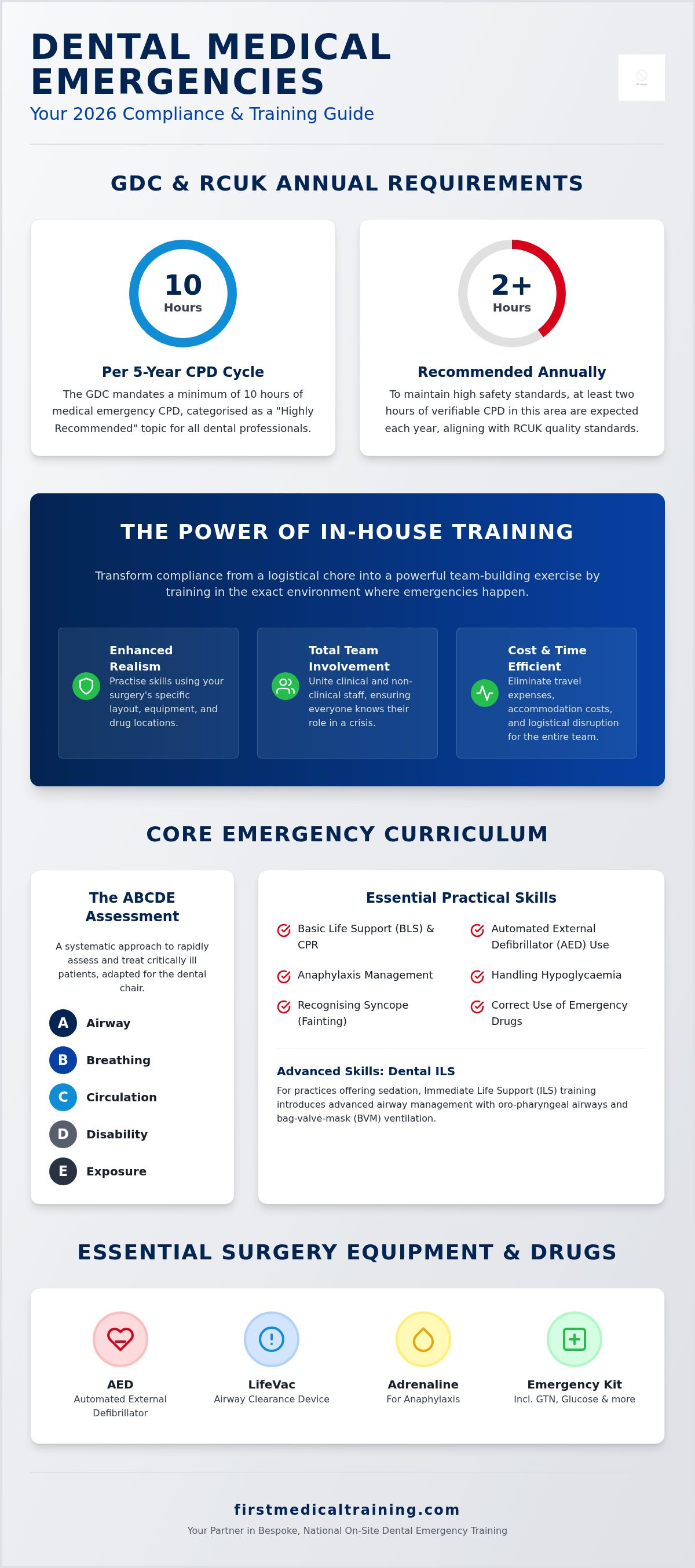
The General Dental Council (GDC) categorises medical emergency training as a "Highly Recommended" CPD topic. This designation places it alongside disinfection and radiography as a fundamental pillar of safe clinical practice. It isn't merely a suggestion; it's a core expectation for maintaining your professional registration. By prioritising in house dental medical emergency training, you ensure your team meets these rigorous standards without the disruption or cost of external travel.
For dental professionals, the GDC mandates a minimum of 10 hours of medical emergency CPD within every five-year cycle. However, the requirement goes deeper than a simple cumulative total. To maintain high levels of safety, the GDC expects you to engage with this training regularly, recommending at least two hours of verifiable CPD in this area every single year. This guidance aligns with the Resuscitation Council UK (RCUK) Quality Standards for Primary Dental Care, which provide the clinical framework for emergency response in the UK.
The Role of Verifiable CPD in 2026
To count toward your registration requirements, your training must be "verifiable" under the GDC Enhanced CPD scheme. This means the session must offer clear learning outcomes that address specific clinical needs. A valid certificate must include:
- The participant's full name and GDC number.
- The date and duration of the course.
- A clear statement of the learning outcomes.
- The name of the training provider.
Beyond the paperwork, the GDC emphasises reflective practice. After the session, take a moment to consider how the training has improved your confidence or highlighted areas in your surgery's protocol that might need adjustment.
RCUK Quality Standards for Dental Practices
The RCUK standards are explicit: clinical staff must update their skills annually through practical, hands-on sessions. Whilst online modules provide useful theory, they can't replicate the physical experience of performing chest compressions or using an Automated External Defibrillator (AED). Practical in house dental medical emergency training allows your team to rehearse these skills in the exact environment where they would occur. These standards also specify that every member of the team should be involved. From the principal dentist to the part-time receptionist, everyone has a role to play when a patient's life is at risk. A well-organised session ensures that non-clinical staff feel just as capable of fetching the emergency kit or managing the scene as the clinicians themselves.
Core Components of an In-House Dental Emergency Curriculum
A robust curriculum for in house dental medical emergency training must be grounded in the ABCDE rapid assessment framework. This systematic approach ensures that nothing is missed during those critical first minutes of a crisis. In a dental setting, this means adapting the assessment to the constraints of the chair, assessing the Airway whilst the patient is supine and moving through Breathing, Circulation, Disability, and Exposure with precision.
Practical sessions form the heart of the learning experience. Your team should demonstrate competency in Basic Life Support (BLS) and the immediate application of an Automated External Defibrillator (AED). It's also vital to rehearse the management of common surgery-specific emergencies. This includes recognising and treating anaphylaxis, managing hypoglycaemia with the correct glucose delivery, and handling syncope effectively. Understanding the exact location and administration of drugs like Adrenaline and Glyceryl Trinitrate within your own kit is what transforms a panicked response into a controlled clinical intervention.
Advanced Skills: Dental Immediate Life Support (ILS)
Whilst BLS provides the foundation, many practices opt for Dental Immediate Life Support (ILS) Training to elevate their readiness. This level of training introduces advanced airway management techniques, such as the use of oro-pharyngeal airways and bag-valve-mask (BVM) ventilation. These skills are particularly relevant for practices providing sedation, where deeper levels of respiratory support may be required before the ambulance arrives. If you want to ensure your practice meets the highest safety standards, consider how in house dental medical emergency training can be tailored to these advanced requirements.
Team-Based Response Scenarios
An emergency is a team event, not a solo performance. Success depends on clearly defined roles. During your session, we designate a "First Responder" to stay with the patient, whilst an "Equipment Runner" retrieves the oxygen and AED. Crucially, the receptionist's role is integrated into the drill. They are responsible for making the 999 call and directing the paramedics to the correct surgery upon arrival. This level of coordination is often missed in generic courses.
Practising "pit-stop" CPR transitions is another essential component. This involves rehearsing the handover between team members to ensure chest compressions are interrupted for no more than a few seconds. By simulating these transitions in your own surgery, you build the muscle memory needed to maintain high-quality resuscitation under pressure.
The Advantages of In-House vs. External Dental CPD
When you choose in house dental medical emergency training, you bridge the gap between abstract theory and the physical reality of your practice. External courses often take place in sterile hotel conference rooms or generic training centres. Whilst these venues are functional, they lack the specific obstacles and layout of your clinical environment. Practising a medical emergency in the exact room where you treat patients allows the team to navigate physical space effectively. They learn how to move the dental chair into the supine position or clear floor space for CPR without the guesswork that comes from training in an unfamiliar hall. This shared experience builds a level of cohesion that external courses can't replicate, as the whole team develops a collective muscle memory for your specific surgery.
Familiarity with Your Own Emergency Kit
A critical benefit of on-site training is the opportunity to audit your actual medical emergency equipment. We don't just discuss protocols; we integrate your specific tools into the drills. Checking drug expiry dates during the session ensures everyone knows exactly where the Glucagon or Adrenaline is kept and how the packaging opens. We also verify the location of your AED. Is it easily accessible from all surgeries, or is it tucked away in a staff room cupboard? Testing the oxygen cylinders and masks you actually use ensures that, in a crisis, there are no surprises with unfamiliar valves or fittings. This level of familiarity is a life-saving advantage that generic external courses simply cannot provide.
Cost-Effectiveness for Larger Teams
From a business perspective, the financial logic of training on-site is clear. External providers typically charge a per-head fee, which becomes expensive when you're coordinating a full team of dentists, hygienists, nurses, and receptionists. In contrast, in house dental medical emergency training usually operates on a flat day rate. This represents a significant saving for medium-to-large practices. You also eliminate the travel costs and lost productivity associated with sending staff to a distant centre. By organising training on a designated staff day or a quiet half-day, you minimise clinic downtime. It ensures that 100% of your team receives the same high standard of instruction simultaneously, ensuring no one is left behind in your compliance cycle.
This approach transforms a logistical headache into a streamlined, productive morning. Instead of managing multiple bookings and travel claims, you have one seasoned mentor coming to you. It's an efficient, practical solution that respects your time and your budget whilst prioritising the safety of your patients.
Preparing Your Surgery: Equipment, Drugs, and Protocols
Effective in house dental medical emergency training relies on more than just theoretical knowledge; it requires high-functioning equipment and a fully stocked drug kit. Your surgery must be equipped to handle the most common life-threatening scenarios immediately. This starts with the core pharmaceutical requirements. Adrenaline for anaphylaxis, Aspirin for suspected myocardial infarction, Glucagon for severe hypoglycaemia, and Glyceryl Trinitrate (GTN) for angina are the non-negotiable staples of your emergency bag. During our sessions, we don't just list these drugs; we ensure your team knows exactly where they are kept and how to administer them under pressure.
Beyond drugs, the presence of a functional Automated External Defibrillator (AED) is a mandatory GDC requirement. However, compliance isn't just about owning the device; it's about ensuring it's ready for use at a second's notice. Integrating modern life-saving tools, such as the LifeVac anti-choking device, into your practice protocol further enhances patient safety. Whilst traditional back blows and abdominal thrusts remain the standard, having a non-invasive suction device provides an additional layer of protection in a choking emergency, especially for patients where traditional methods may be difficult to apply.
The 2026 Emergency Equipment Checklist
A dental practice emergency preparedness audit must confirm the presence of high-flow oxygen and appropriate delivery masks for both adults and children. Your AED requires daily or weekly status checks to ensure the battery and pads are within their service life. Similarly, your emergency drug kit must be maintained to BNF standards, with a clear log for checking expiry dates. We often find that kits are tucked away in drawers that are difficult to reach; we recommend a central, clearly marked location known to all staff, including the reception team. Regular audits prevent the scenario where a team reaches for a mask only to find the seal has degraded over time.
Mental Health First Aid in Dentistry
The scope of dental care is evolving to include the psychological wellbeing of both patients and staff. Why mental health first aid for dental practices is becoming a core component of team wellbeing is clear to any seasoned practitioner. High-pressure clinical environments can lead to significant stress and burnout amongst staff. Recognising these early signs is as vital as recognising clinical symptoms in a patient. Additionally, supporting patients who experience extreme dental anxiety or panic attacks ensures a holistic approach to care. By training your team to manage these moments with confidence, you create a more supportive and professional environment for everyone.
Ensure your practice is fully equipped and compliant by booking your next Medical Emergencies in a Dental Practice Course today.
Booking Your First Medical Training: The In-House Experience
Organising your annual compliance shouldn't be a source of logistical stress for the practice. First Medical Training Ltd provides a streamlined process for coordinating national on-site sessions, ensuring that professional development fits around your clinical schedule rather than disrupting it. When you book in house dental medical emergency training, you're choosing a solution that respects the unique dynamics of your team. The "Medical Emergencies in a Dental Practice Course" is specifically tailored to your team size, ensuring that every participant, from the lead clinician to the newest dental nurse, receives focused, hands-on instruction.
On the day of the training, you can expect a methodical and highly structured session led by a seasoned mentor. These trainers bring a wealth of practical experience, moving beyond the textbook to address the real-world challenges of a dental surgery. The atmosphere is supportive and empowering, designed to build genuine confidence amongst your staff. Once the session is complete, we prioritise the administrative side of compliance. Verifiable CPD certificates are issued promptly, providing the necessary evidence for your GDC records and ensuring your practice remains fully compliant for the 2026 cycle.
A Legacy of Dental Training Excellence
Established in 2006, First Medical Training Ltd has built a reputation for excellence over two decades of specialist service. We understand that the dental sector requires more than just general first aid knowledge. Our trainers are healthcare specialists who recognise the nuances of the dental environment, from the complexities of the patient chair to the specific drugs in your emergency kit. Many practices have shared testimonials on how our sessions have transformed their confidence, particularly regarding syncope management dental training. This legacy of expertise ensures that your team is learning from industry veterans who understand the practical realities of your field.
Next Steps for Practice Managers
Taking the next step toward full compliance is straightforward. To begin, simply request a quote tailored to your specific team requirements and practice size. To prepare for the session, we recommend clearing a surgery space and ensuring your emergency kit and AED are accessible for the practical drills. This allows the trainer to integrate your actual equipment into the scenarios, reinforcing the familiarity your team needs during a crisis. By choosing in house dental medical emergency training, you're investing in the safety of your patients and the professional readiness of your team. Book your in-house dental medical emergency training today to secure your 2026 session and ensure your team is prepared for any eventuality.
Ensuring Practice Readiness for 2026 and Beyond
Maintaining GDC compliance is more than a regulatory hurdle; it's a fundamental commitment to the safety of every patient who enters your surgery. By choosing in house dental medical emergency training, you transform mandatory CPD into a high-impact exercise that takes place in your actual clinical environment. This approach ensures that your staff don't just understand the theory of resuscitation but can execute it flawlessly amongst the physical constraints of your specific treatment rooms.
Since 2006, we've served as a trusted partner to dental practices across the UK, providing national on-site delivery of accredited courses. Whether you require specialist Dental ILS or EFAW certification, our seasoned mentors bring the expertise needed to demystify complex protocols and build lasting clinical confidence. Don't leave your team's readiness to chance or generic off-site modules that lack surgery-specific context. Secure your team's compliance with our Medical Emergencies in a Dental Practice Course and ensure you're fully prepared for any crisis. We look forward to helping your practice reach its highest standard of emergency excellence.
Frequently Asked Questions
Is in-house medical emergency training GDC compliant?
Yes, in house dental medical emergency training is fully GDC compliant provided it meets the "Highly Recommended" criteria for verifiable CPD. The session must include clear learning outcomes and be delivered by a competent, professional provider. Because on-site sessions utilise your own equipment and surgery layout, they often exceed the GDC's expectations for practical competency. This ensures your team isn't just ticking a box but is genuinely prepared for a clinical crisis.
How many CPD hours do we get for a medical emergencies course?
Most sessions provide between three and four hours of verifiable CPD for each participant. Whilst the GDC requires 10 hours per five-year cycle, they recommend at least two hours of training annually to maintain proficiency. Attending a comprehensive in-house course ensures that every team member earns these hours simultaneously. This structured approach simplifies your compliance record-keeping and ensures that no one falls behind their individual professional development requirements.
Does everyone in the dental team need to attend the training?
Yes, the GDC and Resuscitation Council UK (RCUK) expect the entire team to participate in annual training. This includes dentists, nurses, hygienists, and all non-clinical staff. In a real-world emergency, receptionists are often the ones calling 999 or directing paramedics, whilst clinical staff manage the patient. Training together ensures that everyone understands their specific role within the practice's emergency protocol, creating a cohesive and effective response when seconds count.
How often should a dental practice have medical emergency training?
You should conduct medical emergency training at least once every 12 months. This frequency is a core recommendation from both the GDC and the RCUK to ensure that life-saving skills remain sharp. Regular practice is essential because clinical skills like CPR and AED use can degrade over time. Annual sessions provide a vital opportunity to refresh your team's memory and check that all emergency drugs and equipment are in good working order.
What equipment do we need to provide for the in-house trainer?
You only need to provide a suitable surgery or waiting area and access to your practice's own emergency equipment. This includes your oxygen cylinders, emergency drug kit, and AED. Using your own tools during in house dental medical emergency training is a significant advantage, as it builds familiarity with the exact items you'll use in a crisis. The trainer will bring specialised manikins and training AEDs to facilitate the practical elements of the course.
Can we include AED and CPR training in the same session?
Yes, AED and CPR training are almost always integrated into the same session for maximum efficiency. Since modern resuscitation protocols rely on the early use of a defibrillator alongside high-quality chest compressions, it's logical to practice them together. Your team will learn how to transition seamlessly from manual CPR to AED application. This combined approach ensures that the "chain of survival" is maintained effectively within your unique practice environment.
Is mental health first aid part of the recommended dental CPD?
Whilst not currently a "Highly Recommended" topic like medical emergencies, mental health first aid is increasingly recognised as vital for dental team wellbeing. The GDC encourages CPD that supports the "Standards for the Dental Team," which includes maintaining a safe environment. Training in this area helps staff recognise signs of stress and burnout. It also equips them to support patients experiencing acute anxiety or panic attacks during their appointments.
What happens if a staff member misses the annual in-house training?
If a staff member misses the session, they must complete an equivalent verifiable CPD course to maintain their individual compliance. They won't be covered by the team's collective certification for that year. It's the practice's responsibility to ensure that every registered professional meets their annual two-hour recommendation. In these cases, the individual might need to attend an external course or join a session at a neighbouring practice to ensure their skills remain current.