

LifeVac Anti-Choking Device: Professional UK Guide 2026

What happens when the standard back slaps and abdominal thrusts you've practised for years simply don't work? It's a silent fear many healthcare professionals and carers carry, particularly when managing high-risk patients in a busy clinical environment. You know the protocols, yet the reality of a complete airway obstruction that refuses to budge is a scenario that requires more than just hope. Investing in a genuine lifevac anti choking device uk has become a vital step for those seeking a non-invasive, regulated fail-safe for their emergency response kits.
We understand that while Basic Life Support (BLS) remains your primary defence, having a reliable secondary option provides essential peace of mind. This professional guide for 2026 confirms exactly how the LifeVac functions when traditional methods are unsuccessful. You'll learn how to verify MHRA registration, distinguish genuine units from dangerous counterfeits, and effectively integrate this Class I medical device into your workplace safety strategy. We aim to demystify the regulatory requirements, ensuring you have the confidence to act decisively and protect those in your care when every second counts.
Key Takeaways
- Understand how the LifeVac serves as a vital, non-invasive fail-safe when standard Basic Life Support (BLS) protocols fail to clear an airway obstruction.
- Confirm the regulatory status of the lifevac anti choking device uk, including its classification as an MHRA-registered Class I medical device with essential UKCA marking.
- Learn to identify the critical differences between genuine life-saving equipment and the dangerous counterfeit devices frequently found on unregulated online marketplaces.
- Discover practical strategies for integrating the device into your clinical emergency kits and aligning its use with your practice's annual medical emergency training.
- Gain insights into why sourcing equipment from an established training provider ensures your team receives professional-grade guidance and long-term clinical support.
What is the LifeVac Anti-Choking Device and How Does it Work?
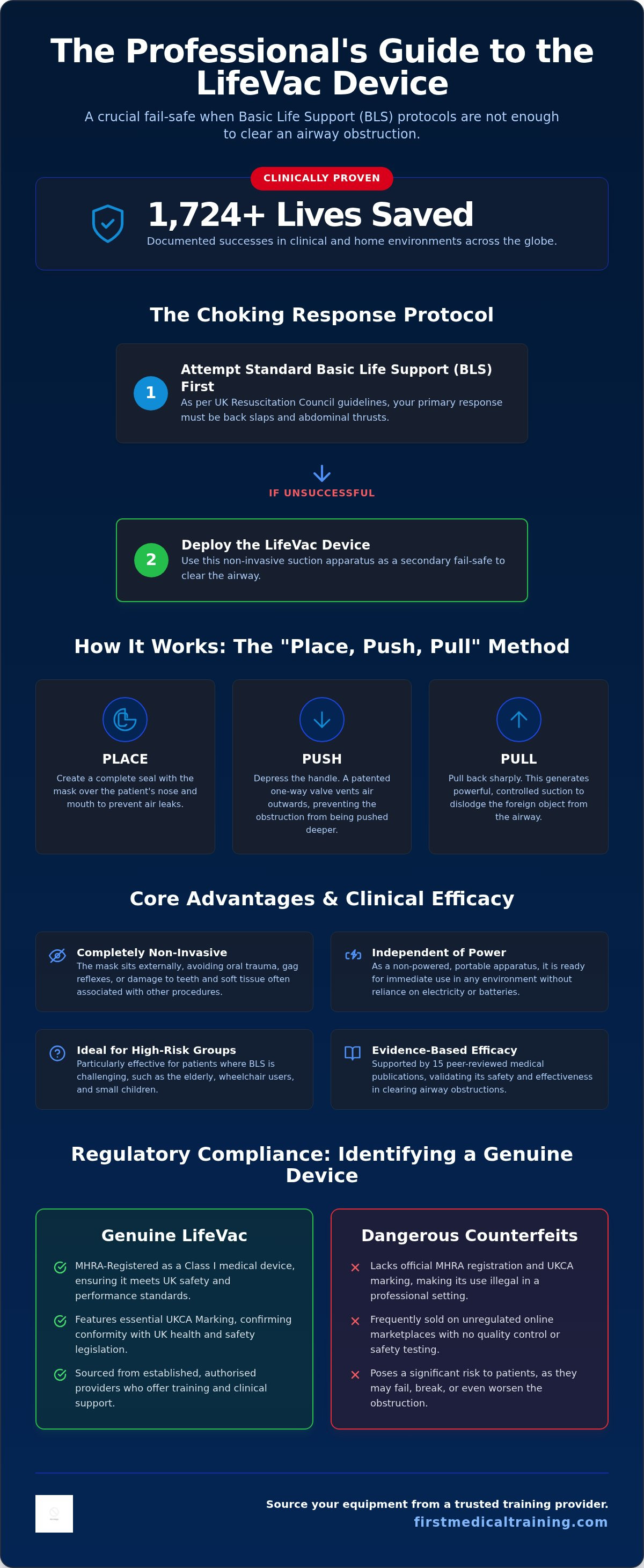
The LifeVac is a portable, non-powered suction apparatus designed to clear an upper airway obstruction when standard protocols fail. It's essential to recognise that this device serves as a vital backup rather than a replacement for traditional Basic Life Support (BLS). In any Choking emergency, the UK Resuscitation Council guidelines dictate that back slaps and abdominal thrusts must be attempted first. However, when these physical manoeuvres prove unsuccessful or are impossible to perform, the lifevac anti choking device uk provides a clinical fail-safe that has already saved over 1,700 lives globally.
Its design is particularly beneficial for demographics where traditional methods might be risky or ineffective. This includes the elderly with fragile ribs, small children, and wheelchair users who cannot easily be positioned for a Heimlich manoeuvre. Because it requires no electricity or complex assembly, it's increasingly becoming a staple in UK care homes, schools, and dental surgeries where a lifevac anti choking device uk can be accessed in seconds.
The Physics of Suction: The One-Way Valve System
The efficacy of the device lies in its patented one-way valve system. This mechanism ensures that when you depress the bellows, air is vented out through the sides rather than being pushed into the patient's airway. This prevents the risk of forcing an obstruction deeper. Once the seal is established, a quick upward pull creates a powerful vacuum. The "Place, Push, Pull" methodology is straightforward but effective. By generating significantly more negative pressure than a natural human cough, the device can dislodge stubborn blockages that physical force alone cannot move. It's a controlled, mechanical solution for a high-pressure physiological crisis.
Non-Invasive vs. Invasive Airway Clearance
Unlike the high-volume suction units found in dental surgeries or the invasive tubes used by paramedics, the LifeVac is entirely non-invasive. The mask sits over the nose and mouth, meaning no part of the apparatus enters the oral cavity. This is a critical distinction for clinical environments. Using invasive equipment during a panic-stricken emergency carries a high risk of oral trauma or triggering a gag reflex that could worsen the situation. By remaining external, the LifeVac avoids damaging soft tissue or teeth. It offers a calm, structured alternative to the often-violent physical nature of abdominal thrusts, making it a supportive tool for responders who need to act with precision under pressure.
The Science and Efficacy of Airway Clearance Devices
In a choking emergency, the "Time is Life" principle is the absolute priority. Brain damage can begin in as little as four minutes after oxygen deprivation, meaning every second spent on ineffective manoeuvres increases the risk of a fatal outcome. While standard Basic Life Support (BLS) protocols are the gold standard, they don't always yield results. This is where the lifevac anti choking device uk enters the clinical workflow as a secondary intervention, providing a mechanical solution when physiological efforts fail. Time is life.
For patients with limited mobility or physical disabilities, the risk of choking is statistically higher, yet the ability to perform standard BLS is often lower. A patient in a wheelchair may not be easily removable for back blows, and a patient with severe scoliosis or a stoma may present unique challenges. The suction-based approach bypasses these physical barriers by focusing solely on creating a seal over the airway, rather than relying on the responder's ability to lift or wrap their arms around the casualty.
Peer-Reviewed Evidence and Clinical Recognition
The safety and effectiveness of LifeVac are supported by 15 peer-reviewed medical publications, which offer a level of clinical scrutiny that generic suction devices lack. These studies validate the device's ability to clear an airway without causing the rib fractures or internal bruising sometimes associated with aggressive abdominal thrusts. International emergency medical bodies increasingly recognise the role of suction in airway management. As of August 2026, the LifeVac device has a documented success rate involving 1,724 lives saved across various global clinical and home environments.
Contraindications and When Traditional BLS Fails
Identifying scenarios where abdominal thrusts may be ineffective is a core part of advanced emergency planning. Pregnancy and obesity are the most common examples where traditional pressure cannot be safely or effectively applied to the diaphragm. In these specific instances, the lifevac anti choking device uk offers a non-invasive alternative that avoids abdominal trauma. It fits into the wider emergency response by acting only after primary methods are exhausted.
According to the MHRA guidance on anti-choking devices, these tools should only be deployed after back slaps and abdominal thrusts have been attempted and failed. This ensures that the device remains a "fail-safe" within the established UK Resuscitation Council framework. Integrating this tool into your dental practice emergency preparedness plan bridges the gap between traditional first aid and modern clinical fail-safes, ensuring your team is ready for every eventuality.
MHRA Regulation and Avoiding Counterfeit Anti-Choking Devices
Ensuring your equipment is legally compliant isn't just a paperwork exercise; it's a fundamental pillar of patient safety. In the United Kingdom, the LifeVac is registered as a Class I Medical Device and carries both the UKCA and CE marks. While the MHRA lifted voluntary restrictions on these devices in June 2023, this increased accessibility has unfortunately led to a surge in dangerous, unregulated imitations. Investing in a genuine lifevac anti choking device uk ensures that the tool you reach for in a crisis has undergone the rigorous testing required by British medical standards.
The risks associated with unbranded suction devices are severe. Many of these products, often found on global online marketplaces, haven't been verified for suction strength or material safety. Using a substandard device can lead to catastrophic failure, such as the mask seal breaking during use or, worse, the device pushing the obstruction further into the airway. It's estimated that over 10,000 counterfeit or unbranded anti-choking devices have been purchased by the UK public in the last two years, highlighting the scale of the risk facing clinical practices and households alike.
The MHRA Safety Alert: What You Need to Know
In March 2024, the government issued a significant safety warning regarding these imitations. According to the MHRA guidance on counterfeit anti-choking devices, users should only purchase products that are clearly registered and compliant with UK regulations. Counterfeit units often lack the patented one-way valve system we discussed in previous sections. Without this valve, the "push" phase of the methodology can force air into the lungs, potentially wedging the object deeper. This is why purchasing your lifevac anti choking device uk from a reputable medical training organisation is essential. We provide the professional-grade equipment needed to support your team's clinical readiness.
Verifying Your Device: A Checklist for Practices
If you already have a device or are looking to purchase one, you can verify its authenticity using several physical markers. Genuine LifeVac units are manufactured in Devon, UK, for the domestic market and aren't shipped from overseas warehouses in China. Use this checklist to ensure your equipment is legitimate:
- Holographic Security Label: Every genuine kit features a unique hologram and serial number that can be traced back to the manufacturer.
- Colour-Coded Masks: The masks should be genuine LifeVac versions, typically colour-coded (e.g., white for small, yellow for medium/large) for rapid identification.
- MHRA Registration: You can verify a manufacturer’s status by searching the MHRA public access database for registered medical devices.
First Medical Training has been a trusted partner in the dental and healthcare sectors since 2006. We only supply regulated, genuine equipment because we understand the gravity of the situations where these tools are deployed. Buying from a training specialist ensures you receive a device that is fully compliant with the latest 2026 UK safety standards.
Implementing LifeVac Within Your Dental Practice Emergency Protocol
Integrating the lifevac anti choking device uk into your practice isn't just about adding another box to the emergency cupboard. It's about creating a robust safety net that covers every square metre of your facility. While the surgery is the focus of clinical care, the waiting room is often where patients, especially those with comorbidities, spend significant time. A well-placed device in both areas ensures that your team can respond within seconds, regardless of where the incident occurs. This proactive approach is a cornerstone of dental practice emergency preparedness.
GDC Compliance and Annual Training Requirements
Professional standards require more than just owning the right equipment. To meet GDC CPD requirements for medical emergencies, your team must be familiar with every tool in the emergency kit. Documenting the inclusion of the LifeVac in your practice’s emergency equipment log is essential for compliance and inspections. Practising with the trainer device during your annual medical emergencies session builds the muscle memory needed to act under pressure. Annual staff drills must include the anti-choking device to ensure that every team member can deploy it effectively without hesitation during a real-life crisis. This hands-on familiarity is what ultimately builds clinical confidence during medical emergencies.
Managing Choking in the Dental Chair
The dental chair presents specific physiological challenges. When a patient is reclined, gravity can cause a foreign object, such as a crown or an impression tray, to slip further back into the oropharynx. For patients with dysphagia or neurological conditions like Parkinson’s, the risk of a compromised airway is significantly higher. In these moments, the lifevac anti choking device uk provides a non-invasive way to clear the obstruction without needing to haul a heavy patient out of the chair immediately.
Once the device has been successfully used and the airway is clear, post-event protocols are vital. You must always seek immediate medical evaluation for the patient to ensure no secondary issues, such as aspiration pneumonia or internal irritation, have occurred. Recording the incident in the practice’s accident book and notifying the MHRA through the Yellow Card scheme are also standard professional requirements. To ensure your protocols are fully up to date with 2026 standards, you can find more expert guidance in our article on clinical confidence during medical emergencies.
Why Professionals Choose First Medical Training for Life-Saving Equipment
Choosing where to source emergency equipment is a decision that impacts the safety of every person who walks through your doors. First Medical Training Ltd has been a trusted mentor in the healthcare sector since 2006, specialising in the unique demands of the dental industry. When you purchase a lifevac anti choking device uk from us, you aren't just buying a piece of equipment. You're gaining access to a veteran partner that understands the practicalities of clinical emergencies and the rigorous standards of GDC compliance. We bridge the gap between regulatory requirements and real-world application, ensuring your team is ready for the unexpected.
Our team doesn't just sell boxes; we provide the context needed to use tools effectively. Sourcing your kits from a training provider ensures that the advice you receive is grounded in current Immediate Life Support (ILS) protocols and the latest 2026 medical guidelines. You can operate with the peace of mind that comes from knowing your equipment is genuine, MHRA-regulated, and supported by industry experts who have spent decades in the training room. In a similar vein, maintaining high safety standards in the health and social care sector relies on having dependable personnel, such as those provided by Jessamy Staffing Solutions.
Expert Support Beyond the Sale
Our relationship with your practice doesn't end at the checkout. We offer integrated solutions that combine equipment provision with specialised training, such as syncope management for dental teams. This holistic approach means your staff are not only equipped with the lifevac anti choking device uk but are also confident in the wider skills needed for emergency airway management. There are several distinct advantages to partnering with a training-led supplier:
- Clinical Relevance: We select equipment based on its effectiveness in high-pressure dental and medical environments.
- Compliance Advice: Access expert guidance on how to document your equipment for CQC and GDC inspections.
- Free Replacement Policy: We provide a free replacement for any LifeVac device successfully used in a life-saving emergency.
- Single Partner Convenience: Source your annual training and your emergency drug kits from one dependable centre.
Ready to Protect Your Patients and Staff?
The LifeVac is an essential, non-invasive addition to your emergency kit. It provides the vital backup required when traditional methods fail, offering a level of protection that is both simple to deploy and clinically proven. By choosing a genuine unit from an authorised UK supplier, you eliminate the risks associated with counterfeit imitations. Secure your practice today and give your team the tools they need to act with absolute certainty in a crisis.
Enhancing Your Emergency Response Strategy for 2026
Preparing for a choking emergency requires a combination of rigorous training and the right clinical tools. We've explored how a genuine lifevac anti choking device uk acts as a vital fail-safe when traditional Basic Life Support protocols aren't enough. Ensuring your equipment is MHRA-registered and sourced from a reputable partner is the only way to avoid the risks posed by dangerous counterfeits. By integrating this non-invasive technology into your dental surgery or clinical environment, you provide your team with the tools needed to manage airway obstructions with absolute confidence. This commitment to safety is mirrored in other professional sectors; for example, UK Skydiving adheres to stringent protocols for their experiences to ensure participant wellbeing.
First Medical Training has been a trusted mentor to healthcare professionals since 2006. As an authorised UK supplier, we don't just provide equipment; we offer expert clinical training support to ensure your staff are fully prepared for a crisis. It's about more than just compliance; it's about the peace of mind that comes from knowing you've taken every possible step to protect your patients. Equip your practice with the genuine LifeVac Anti-Choking Device today and take a proactive lead in patient safety. You have the skills to save a life, and we are here to provide the support you need to succeed.
Frequently Asked Questions
Is the LifeVac anti-choking device MHRA approved in the UK?
Yes, the LifeVac is a registered Class I Medical Device in the United Kingdom. It carries both the UKCA and CE marks, confirming it meets rigorous safety and performance standards for airway clearance. While the MHRA previously held voluntary restrictions on suction-based devices, these were lifted in June 2023. This allows the genuine device to be sold and used as a secondary intervention within clinical and home environments.
Can I use the LifeVac device on myself if I am alone?
You can use the device on yourself if you are alone and standard self-help methods fail. The design allows for simple one-handed operation, enabling you to place the mask, push down to vent air, and pull up to create suction. It's a vital safety tool for individuals living alone or those with a higher risk of choking, providing a mechanical alternative when abdominal thrusts are impossible to perform on oneself.
Does the LifeVac device work on babies and small children?
The device is suitable for use on children and babies, provided the correct paediatric mask is used. Each kit typically includes multiple mask sizes to ensure an airtight seal on different face shapes. For very small children, the lifevac anti choking device uk offers a non-invasive backup that avoids the potential physical trauma associated with aggressive back slaps or chest thrusts on delicate ribcages and internal organs.
How often do I need to replace my LifeVac device or masks?
You should replace the masks every two to three years to ensure the material remains flexible and maintains a perfect seal. While the main bellows unit is durable, it's designed for single-use in a life-saving event. Most authorised suppliers, including First Medical Training, offer a free replacement policy for any unit used to successfully clear an airway, ensuring your emergency kit is always ready for immediate deployment.
Is LifeVac a replacement for the Heimlich manoeuvre?
No, the LifeVac is not a replacement for the Heimlich manoeuvre or standard Basic Life Support (BLS) protocols. UK Resuscitation Council guidelines recommend that back slaps and abdominal thrusts are always attempted first. This device is intended as a secondary intervention for use only when these primary physical manoeuvres have failed or cannot be performed due to the patient's physical condition or environment.
Can LifeVac be used on someone in a wheelchair or dental chair?
Yes, the device is highly effective for patients in wheelchairs or dental chairs where positioning for abdominal thrusts is challenging. Because it relies on suction rather than physical force applied to the diaphragm, it can be used whilst the patient is seated or reclined. This makes the lifevac anti choking device uk a critical addition to dental surgeries and care facilities where patients may have limited mobility or complex postural needs.
What should I do if I think I have purchased a counterfeit device?
If you suspect your device is a counterfeit, stop using it immediately and report it to the MHRA via the Yellow Card scheme. Dangerous imitations often lack the patented one-way valve, which can push obstructions deeper into the airway. To ensure your equipment is genuine, always purchase from an authorised UK supplier that provides traceable serial numbers and holographic security labels on every unit they distribute.
Do I need special training to use the LifeVac anti-choking device?
You don't need formal medical qualifications to use the device, as it's designed for ease of use in high-stress situations. However, we strongly recommend that staff in clinical environments undergo familiarisation as part of their annual medical emergencies training. Understanding the "Place, Push, Pull" methodology ensures that responders can act with speed and precision, maximising the chances of a successful outcome during a real-life airway obstruction.