

Medical Emergencies in a Dental Practice Course: The 2026 Guide to Compliance and Confidence

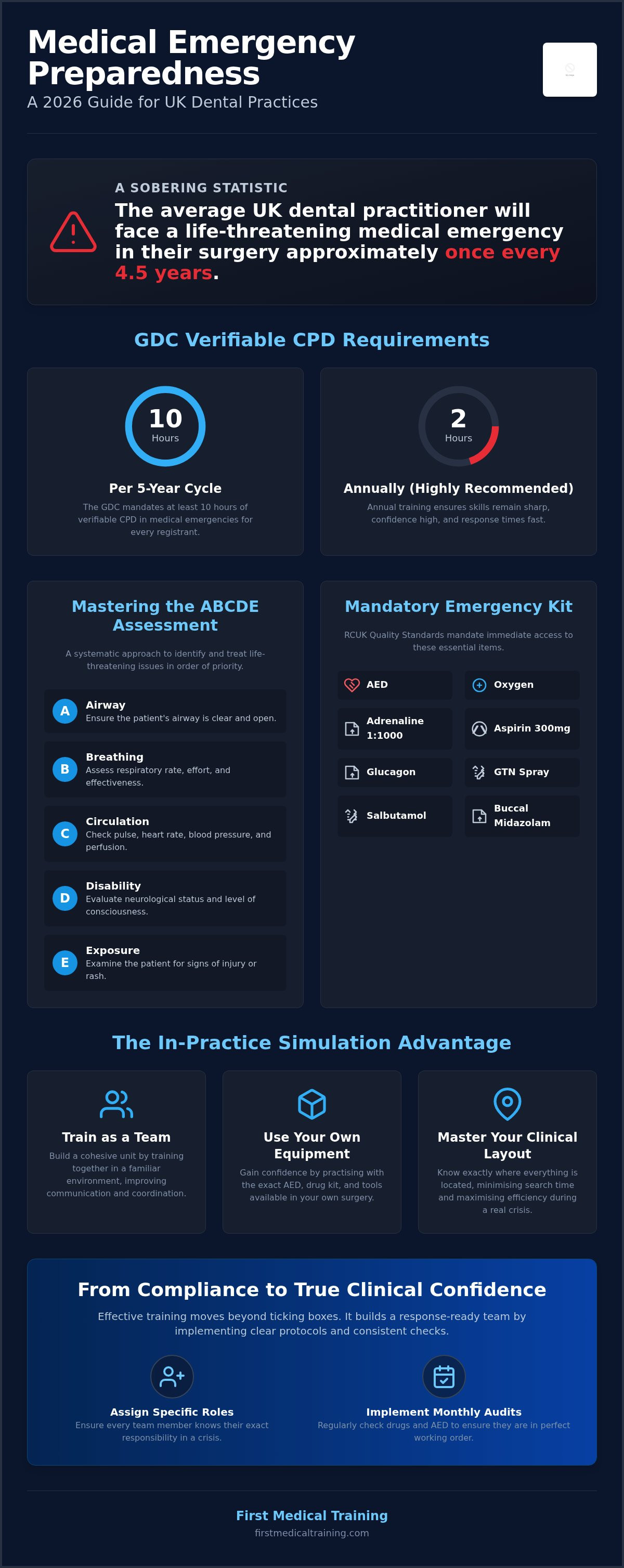
Did you know that the average UK dental practitioner will face a life-threatening medical emergency in their surgery approximately once every four and a half years? It is a sobering statistic that often sits at the back of a clinician's mind, creating a persistent sense of unease. You likely recognise the stress of managing annual CPD cycles for your entire team, or perhaps you have felt the confusion that arises when trying to distinguish between varying BLS and ILS standards.
We understand that GDC compliance is just the beginning. The real goal is a team that remains calm and organised during a crisis. By choosing a high-quality medical emergencies in a dental practice course, you can meet your professional requirements whilst building the genuine clinical confidence needed to save a life. This 2026 guide explores the latest Resuscitation Council UK guidelines and the "Big Seven" emergency scenarios. We will also examine how in-practice simulation provides the most efficient way to earn verifiable CPD hours and ensure your practice is fully prepared for any patient crisis.
Key Takeaways
- Understand the GDC’s 2026 verifiable CPD requirements to ensure your entire team meets the highly recommended annual training standards.
- Identify the essential components of a medical emergencies in a dental practice course, including the ABCDE assessment and the latest RCUK protocols.
- Evaluate the advantages of in-practice simulation, which allows your team to train together using your own equipment and clinical layout.
- Learn how to assign specific emergency roles and implement monthly audit protocols to keep your drugs and AED in perfect working order.
- Discover how to bridge the gap between regulatory compliance and genuine clinical confidence through expert-led, bespoke dental emergency training.
Understanding GDC Requirements for Medical Emergencies in a Dental Practice
For every GDC registrant in the UK, maintaining a high standard of emergency preparedness is a non-negotiable professional duty. The General Dental Council mandates that all dental professionals complete at least 10 hours of verifiable Continuing Professional Development (CPD) in medical emergencies during each five-year cycle. While this acts as a regulatory floor, the GDC also highly recommends that at least two of these hours are completed every single year. This ensures that a medical emergencies in a dental practice course remains a core part of your annual professional development schedule.
Compliance isn't just about logging hours; it's about adhering to the Resuscitation Council UK (RCUK) Quality Standards. These standards dictate that practices must have immediate access to an Automated External Defibrillator (AED) and a specific set of emergency drugs. As of 2026, the mandatory kit includes Adrenaline (1:1000), Aspirin (300mg), Glucagon, GTN spray, Salbutamol, and buccal Midazolam. Oxygen is also a fundamental requirement. Ensuring your team knows exactly where these items are and how to use them is the difference between a managed incident and a tragedy.
The Annual Training Mandate: Why Once a Year?
Skills like chest compressions or administering buccal midazolam are perishable. Without regular practice, clinical confidence fades, and response times slow down. The GDC’s recommendation of at least 2 hours of annual training isn't just a box-ticking exercise; it's a vital safety mechanism. You can find a detailed breakdown of these obligations in our guide to GDC CPD Requirements for Medical Emergencies. Regular training ensures the whole team acts as a single, cohesive unit when the clock is ticking during a real patient crisis.
Compliance vs Clinical Excellence: Moving Beyond the Minimum
There's a vast difference between simply holding a certificate and being truly response-ready. While Defining Dental Emergencies often focuses on managing acute pain or trauma, a systemic medical crisis requires a higher level of coordination. The 2026 clinical standard moves beyond the minimum requirements by involving every team member, including non-clinical staff. A receptionist is often the first to notice a patient’s distress or the person responsible for calling 999. True excellence means every staff member knows their specific role, transforming a chaotic environment into a controlled, life-saving operation through a dedicated medical emergencies in a dental practice course.
Core Curriculum: What a Medical Emergencies Course Must Cover
A robust medical emergencies in a dental practice course provides the clinical framework required to handle the high-pressure moments following a patient collapse. While Section 1 outlined the regulatory requirements, the curriculum itself must bridge the gap between having the right equipment and knowing how to use it effectively under stress. Practical training focuses on the sequence of action, ensuring that every second is used to stabilise the patient while waiting for emergency services.
Mastering the ABCDE Assessment
The foundation of all emergency medical care is the systematic evaluation of Airway, Breathing, Circulation, Disability, and Exposure. This structured approach ensures that life-threatening issues are identified and treated in order of priority. The ABCDE approach serves as the primary tool for preventing clinical deterioration by providing a systematic path through a chaotic event. By following this method, the dental team can focus on physiological priorities rather than becoming overwhelmed by secondary symptoms. This clarity of thought is essential for reducing panic amongst staff during a crisis, allowing for a calm and professional response.
Training must also cover the specific protocols for Basic Life Support (BLS) and Immediate Life Support (ILS) for both adults and children. This includes the management of common but serious scenarios such as anaphylaxis, acute asthma attacks, cardiac emergencies, and hypoglycaemia. Each of these requires a distinct clinical pathway and rapid decision-making from the lead clinician and their supporting team.
Emergency Drugs and Equipment Mastery
The core drug kit is a practice's first line of defence. Every team member needs to be familiar with the administration of Adrenaline, Aspirin, Glucagon, and Glyceryl Trinitrate (GTN). However, modern preparedness in 2026 has evolved. Integrating specialised equipment like the LifeVac anti-choking device into your practice response plan offers a superior standard of care. For a detailed breakdown of what your surgery needs, consult our Essential Checklist for Managing Medical Emergencies in a Dental Surgery.
Beyond drugs, the course must cover the safe and effective use of Automated External Defibrillators (AEDs) and airway management tools. Effective training ensures that any team member can deploy an AED or provide emergency oxygen without hesitation. This aligns with the BDA guidance on managing medical emergencies, which emphasises the importance of coordinated team roles and suction techniques. Practices looking to enhance their readiness can explore our medical emergency training options to ensure their skills remain at the forefront of patient safety.
In-Practice vs External Training: Choosing the Best Format
Deciding where to host your medical emergencies in a dental practice course is a critical logistical choice that impacts both compliance and team confidence. External training centres offer a dedicated learning space away from the distractions of the surgery, yet they often fail to account for the unique layout of your specific clinical environment. In contrast, on-site bespoke courses allow the entire team to train in the rooms where they actually work. This practical approach helps identify "dead spots" in the emergency layout, such as areas where equipment is difficult to reach or where patient access is restricted during a crisis.
For larger dental practices, group training is significantly more cost-effective than individual external sessions. Instead of sending staff to workshops on different days, bringing an expert trainer to the practice ensures everyone receives the same consistent instruction simultaneously. This unified approach eliminates the "knowledge drift" that occurs when different team members learn varying protocols from different providers. It also minimises disruption to the clinical schedule, allowing the practice to return to normal operations more quickly.
The Power of Team-Based Simulation
Simulation is most effective when it builds muscle memory within your own workspace. Knowing the theoretical location of an AED is quite different from practicing the physical retrieval of the unit from its specific shelf in your surgery. Role-playing scenarios, such as Syncope Management for Dental Teams, in your actual treatment rooms allows staff to practice moving around the dental chair and accessing the emergency kit without hesitation. This process is particularly empowering for non-clinical staff like receptionists. They gain a clear understanding of their role as the vital link between the surgery and emergency services, ensuring they feel calm and capable rather than overwhelmed.
Ensuring Verifiable CPD and Certification
When selecting a training provider, you should prioritise accreditation and clear GDC alignment. A provider with a long-standing history, such as First Medical Training Ltd (established in 2006), offers the steady reliability required for professional development. Every participant must receive an individual certificate that clearly states the learning outcomes and the number of verifiable CPD hours earned. These records are essential for your Personal Development Plan (PDP) and must be readily available for inspection during a GDC audit. A high-quality medical emergencies in a dental practice course will ensure that these hours are earned efficiently whilst meeting every regulatory standard for 2026. Practices looking to enhance their readiness can explore our medical emergency training options to ensure their skills remain at the forefront of patient safety.
Implementing an Emergency Response Protocol Post-Training
Completing a medical emergencies in a dental practice course provides the clinical foundation, but true readiness depends on how that knowledge is embedded into your daily operations. A certificate on the wall does not automatically translate to a coordinated response during a crisis. To bridge this gap, practices must move from passive compliance to active preparedness. This involves creating a culture where every team member knows exactly what to do the moment an emergency is called.
Assigning specific emergency roles to every staff member is the most effective way to eliminate confusion during a crisis. When an incident occurs, there should be no doubt about who acts as the "Oxygen Lead", the "AED Runner", or the "Scribe" responsible for timing interventions and recording drug dosages. This structure ensures that vital tasks are performed simultaneously rather than sequentially, saving precious seconds. To maintain this level of coordination, you should conduct "Micro-Simulations" during regular staff meetings. These 10-minute drills allow the team to practice specific responses, such as managing a suspected anaphylactic shock, without disrupting the clinical day.
Maintaining equipment is just as critical as maintaining skills. Establish a monthly "Emergency Kit Audit" to verify drug expiry dates and AED battery levels. Following any real incident or a "near miss", a formal debriefing protocol should be followed. This allows the team to discuss what went well and identify any areas for improvement in a supportive, non-critical environment.
Organising Your Emergency Equipment
Storage and accessibility are the pillars of effective equipment management. Your emergency drug kit should be stored in a consistent, central location known to every member of the team. A "Grab Bag" is a centralised, portable response kit that contains all necessary emergency drugs and airway management equipment for immediate deployment to any area of the practice. This concept ensures that life-saving tools are always within reach, regardless of which surgery the emergency occurs in. Additionally, the AED must be visible and accessible to both clinical and non-clinical staff, ensuring it can be retrieved and powered on within the first minute of a cardiac arrest.
The Role of Mental Health First Aid
The impact of a medical crisis extends beyond the patient; the stress of an emergency can significantly affect staff wellbeing. Integrating Mental Health First Aid into your practice culture helps build resilience and provides a framework for supporting the team after a traumatic event. This is particularly important following a Cardiac Arrest Management incident, where the emotional toll on the responders can be high. By addressing the human element of emergency response, you create a more supportive and capable workplace. To ensure your practice meets the highest standards of safety and support, you can book your accredited dental emergency training with our specialist team.
Why First Medical Training is the Professional Choice for 2026
First Medical Training Ltd has been a pillar of medical emergency education since 2006. We understand that dental teams face specific clinical pressures that generic providers often overlook. Our training is designed to be a partnership in your professional development. By choosing our medical emergencies in a dental practice course, you're investing in a bespoke service that understands the practicalities of the UK dental sector.
We distinguish ourselves by integrating advanced equipment directly into our sessions. This includes hands-on practice with AEDs and the LifeVac anti-choking device. We don't just talk about equipment; we supply these life-saving tools to ensure your surgery maintains a superior standard of care. This focus on high-impact equipment ensures your team is prepared for complex airway obstructions or cardiac events without feeling overwhelmed by technicality.
Expert Mentorship from Industry Veterans
Our trainers act as seasoned mentors rather than just instructors. They carry the quiet confidence of experts who have spent years demystifying complex procedures for dental teams. The primary outcome we target is "Clinical Confidence", a state where every team member feels empowered to act rather than frozen by anxiety during a crisis. We bridge the gap between regulatory requirements and real-world application, ensuring the technicality of the subject matter supports, rather than hinders, the human element of care.
Seamless Compliance Management
Managing the annual CPD cycle for a whole team can be a significant administrative burden. First Medical Training Ltd simplifies this process with automated reminders and a logical, efficient booking system. Our commitment to your practice doesn't end when the training session finishes; we provide comprehensive course materials and ongoing support to ensure your emergency protocols remain sharp whilst you focus on patient care. To secure your team's readiness and meet your professional obligations, Book your Medical Emergencies in a Dental Practice Course today. We provide the structured, purposeful guidance you need to move from curiosity to professional readiness with total peace of mind.
Preparing Your Practice for a Safer Future
Ensuring your team is response-ready requires more than just meeting a regulatory requirement; it demands a culture of continuous preparedness. We've explored how GDC compliance serves as the essential foundation, whilst team-led simulation in your own clinical environment provides the necessary muscle memory to act without hesitation. By assigning clear emergency roles and conducting regular micro-drills, you transform your surgery into a highly organised, life-saving environment.
Investing in a comprehensive medical emergencies in a dental practice course is the most effective way to protect your patients and support your staff's wellbeing. Since 2006, we've provided accredited Dental CPD that bridges the gap between theory and real-world application, including specialised training for AED use and LifeVac anti-choking devices. Don't leave your practice's safety to chance; take the proactive step towards total clinical confidence today.
Secure your team’s compliance and confidence—book your course now
We look forward to partnering with you to ensure your practice remains at the forefront of patient safety and professional excellence.
Frequently Asked Questions
Is annual medical emergency training a mandatory GDC requirement?
The GDC highly recommends that dental professionals complete at least two hours of medical emergency training every year. While the formal requirement is 10 hours over a five-year cycle, annual sessions are vital to prevent skill fade and maintain patient safety. Regular attendance in a medical emergencies in a dental practice course ensures your team remains compliant with the latest Resuscitation Council UK standards and stays ready for any patient crisis.
Who in the dental practice needs to attend the medical emergencies course?
Every member of the practice team should attend, including dentists, dental nurses, hygienists, and receptionists. The GDC expects all registrants to be competent in managing emergencies, but non-clinical staff play a vital role in the response chain. A receptionist is often the first to identify a patient in distress or the person responsible for contacting emergency services, making their participation essential for a coordinated and effective team response.
What is the difference between BLS and ILS for dental professionals?
Basic Life Support (BLS) focuses on fundamental life-saving skills like CPR and AED use. Immediate Life Support (ILS) is a more advanced level of training that includes airway management adjuncts and the use of specific emergency equipment. While BLS is the standard for most staff, ILS is often required for practices providing conscious sedation. Both levels of training provide the clinical framework necessary to stabilise a patient until an ambulance arrives at the surgery.
Does the course cover the use of emergency drugs and AEDs?
Yes, our training comprehensively covers the administration of the "Big Seven" emergency drugs and the safe operation of an AED. You will practice using adrenaline for anaphylaxis, salbutamol for asthma, and GTN for cardiac issues. We also include training on the LifeVac anti-choking device to ensure your team is equipped with the most modern life-saving tools. This practical experience builds the confidence needed to deploy these items correctly under pressure.
How many hours of verifiable CPD does the medical emergencies course provide?
A standard in-practice session typically provides three hours of verifiable CPD for all attendees. This exceeds the GDC’s highly recommended annual minimum of two hours, helping your team stay ahead of their five-year cycle requirements. Every participant receives an individual certificate that clearly outlines the learning outcomes and accreditation details. These hours are essential for your Personal Development Plan and provide documented evidence of your commitment to professional standards and safety.
Can we have the training delivered at our own dental surgery?
Yes, we specialise in delivering training directly at your dental surgery. Training in your own clinical environment is the most effective way to build muscle memory and identify the specific layout challenges of your practice. It allows the entire team to practice with their own emergency kits and AEDs. This bespoke approach minimises clinical downtime and ensures that everyone learns the exact protocols relevant to their specific workspace, equipment, and team roles.
What emergency equipment is required to be on-site for the training?
Your practice should have its standard emergency drug kit and a functional AED available for the session. We also bring our own high-quality training equipment, including manikins and trainer AEDs, to ensure everyone gets hands-on experience without depleting your clinical stock. If you need to upgrade your equipment, we can supply items like the LifeVac anti-choking device or new defibrillators to ensure your surgery meets the 2026 standards for emergency preparedness.
Does the training include paediatric life support for practices treating children?
Yes, our curriculum includes specific protocols for paediatric Basic Life Support and the management of medical emergencies in children. We cover the physiological differences between adults and paediatric patients, ensuring your team can adapt their response accordingly. This is vital for any practice that treats younger patients, as it provides the specialised knowledge required to manage airway obstructions or cardiac events in children with the same confidence as adult cases.