

Personal Protective Equipment (PPE): The Professional Buyer’s Guide for 2026

The "one-size-fits-all" approach to clinical safety is officially a thing of the past. With the global market for personal protective equipment (ppe) projected to exceed $98 billion in 2026, the shift towards precision fit and modularity reflects a deeper understanding that protection is only effective if it's worn correctly. You likely feel the weight of this responsibility every day, especially when trying to distinguish between Type IIR masks and FFP3 respirators whilst ensuring your team remains protected during aerosol-generating procedures.
We understand that the confusion over EN ratings and the transition from CE to UKCA marking can be overwhelming. This guide will help you master the essentials of selecting medical-grade PPE to ensure clinical compliance and maximum protection for your team and patients. We will examine the ANSI/ISEA 105-2024 hand protection standards, the rise of sustainable materials, and how to achieve full compliance with the Personal Protective Equipment at Work Regulations whilst meeting the rigorous demands of the GDC and HSE.
Key Takeaways
- Understand how to position personal protective equipment (ppe) as the vital final barrier within the hierarchy of safety controls to ensure maximum team safety.
- Learn to distinguish between Type IIR surgical masks and FFP respirators to meet specific clinical requirements for aerosol-generating procedures.
- Discover how to verify genuine medical-grade certifications on packaging whilst navigating the transition from CE to UKCA marking.
- Identify why professional fit and modularity are essential for maintaining staff compliance and preventing cross-contamination in high-pressure environments.
- Master a two-step risk assessment process to match the correct level of protection to specific hazards, from routine check-ups to complex surgical extractions.
Understanding Personal Protective Equipment (PPE) in a Clinical Context
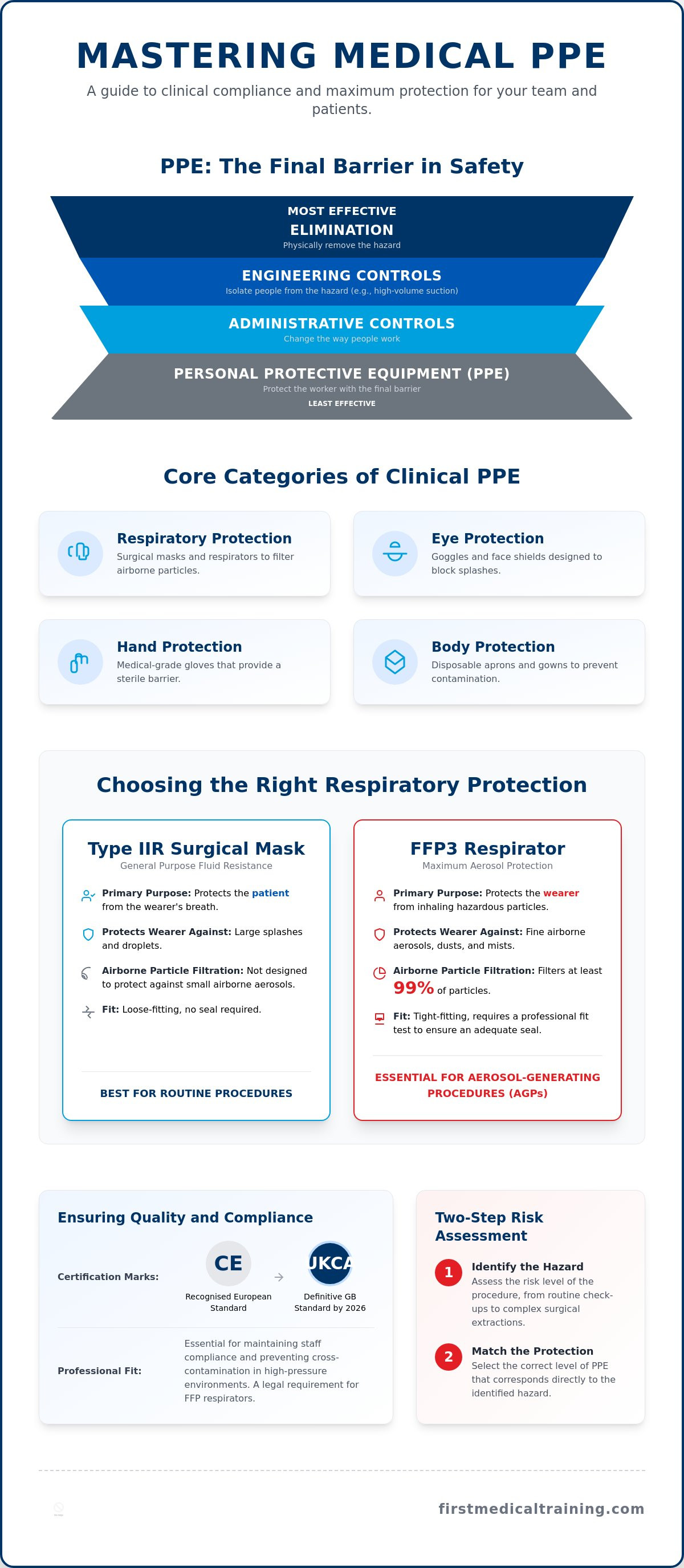
Safety in the clinical environment isn't a single action; it's a structured sequence. We define personal protective equipment (ppe) as the final, essential barrier within the "hierarchy of controls". This safety framework prioritises eliminating hazards at the source or using engineering controls, such as high-volume suction and ventilation. However, when these measures cannot fully mitigate risk, PPE acts as the last line of defence between a healthcare professional and potential pathogens. For healthcare workers and first aiders, this equipment is a non-negotiable safeguard against invisible threats encountered during daily procedures.
Professional protection is typically divided into four core categories:
- Respiratory protection: Surgical masks and respirators that filter airborne particles.
- Eye protection: Goggles and face shields designed to block splashes.
- Hand protection: Medical-grade gloves that provide a sterile barrier.
- Body protection: Disposable aprons and gowns that prevent clothing contamination.
Selecting the right gear requires a clear understanding of the difference between medical-grade and industrial-grade equipment. While industrial gear might protect against dust or heavy impact, medical-grade equipment is specifically engineered for fluid resistance and high bacterial filtration efficiency (BFE). For those seeking a deeper look at the evolution and global standards of these tools, this Comprehensive Guide to PPE provides an excellent foundation for understanding how these standards protect the workforce.
The Legal Framework: HSE and GDC Standards
The Personal Protective Equipment at Work Regulations demand that all gear is fit for purpose, properly maintained, and correctly assessed for the specific task at hand. By 2026, the UKCA mark has become the definitive standard for equipment reliability in Great Britain, although the CE mark remains a recognised indicator of European quality. Selecting compliant gear isn't just about safety; it's about professional accountability. This selection process aligns directly with your gdc cpd requirements medical emergencies, ensuring you maintain a clinical environment that meets the highest regulatory expectations.
Why Quality Matters: Protecting Against Cross-Contamination
Core Categories of PPE: From Face Masks to Disposable Gloves
Selecting the correct categories of personal protective equipment (ppe) requires a granular understanding of the specific risks present in your clinical environment. It isn't just about wearing a mask; it's about choosing the right barrier for the task. While general safety standards like OSHA's PPE Guidelines provide a global benchmark for workplace safety, medical professionals must adhere to even tighter specifications regarding fluid resistance and filtration efficiency. Every piece of equipment, from the thickness of a glove to the weave of a mask, plays a part in your practice's safety strategy.
Respiratory Protection: Navigating Mask Ratings
In the surgery, the distinction between a Type IIR surgical mask and an FFP3 respirator is critical. Type IIR masks are fluid-resistant and designed to protect the patient from the wearer's breath, whilst also shielding the wearer from large splashes of bodily fluids. However, for aerosol-generating procedures (AGPs), filtering facepieces (FFP) are necessary. FFP3 respirators offer the highest level of protection, filtering at least 99% of airborne particles. It's vital to remember that a respirator only works if it fits. A fit test is a legal requirement for any tight-fitting respirator to ensure an adequate seal. When selecting masks for long shifts, look for features like soft inner linings and high breathability to maintain staff comfort and compliance.
Hand Protection: Nitrile, Latex, and Vinyl Compared
Nitrile has largely replaced latex as the gold standard for clinical hand protection. This shift is driven by the need to eliminate the risk of Type I latex allergies amongst both staff and patients. Nitrile gloves offer superior puncture resistance and chemical protection compared to vinyl, which is generally reserved for low-risk, non-clinical tasks. When comparing gloves, check the AQL (Acceptable Quality Level). For medical-grade gloves, an AQL of 1.5 or lower is expected, indicating a lower probability of pinhole defects. The latest ANSI/ISEA 105-2024 hand protection standard also introduces clearer pictograms for resistance, helping you choose the right thickness. A thinner glove may offer better tactile sensitivity for delicate procedures, whereas a thicker nitrile glove provides the durability needed for cleaning contaminated instruments.
Beyond masks and gloves, eye and body protection complete the safety circuit. Full-face shields are often preferred for AGPs to provide comprehensive coverage, whilst disposable aprons ensure that fluid splashes don't contaminate your professional attire. If you're looking to upgrade your practice's inventory, you can browse our full range of Personal Protective Equipment designed for clinical compliance.
Evaluating Quality: Key Features to Compare When Buying
Quality in clinical supplies isn't just about a brand name; it's about verifiable performance metrics that ensure safety during high-risk procedures. When you're procuring personal protective equipment (ppe), the primary goal is to move beyond mere availability and focus on the technical specifications that define a product's reliability. A robust safety programme, as outlined in the OSHA Personal Protective Equipment Overview, requires a thorough assessment of whether the gear actually meets the specific clinical standards claimed by the manufacturer. This involves looking past the marketing and scrutinising the certification codes printed on the packaging.
A common pitfall is assuming the cheapest option is the most cost-effective. In reality, sub-standard gear often leads to higher long-term costs. If a batch of nitrile gloves frequently tears during donning, or if face shields are so uncomfortable that staff constantly adjust them, you aren't just wasting material; you're increasing the risk of cross-contamination. High-quality, medical-grade equipment is designed for durability and precision, reducing the number of replacements needed throughout a single shift. Whilst reusable options might seem sustainable, the rigorous decontamination protocols required often make single-use items a safer and more predictable choice for modern dental and medical practices.
Fluid Resistance and Barrier Integrity
For surgical masks, the Type IIR designation is the benchmark you must look for. This "R" signifies fluid resistance, meaning the mask has been tested to withstand a specific pressure of synthetic blood splash. If this rating is absent, the mask is likely only suitable for general social use rather than clinical surgery. Similarly, ensure your gloves are entirely powder-free. Powdered gloves were once common, but they're now avoided because the powder can act as a carrier for allergens and cause respiratory irritation amongst staff. When your order arrives, use this quick checklist to verify quality:
- Check for the BS EN 14683 standard on mask boxes.
- Verify that glove boxes display an AQL of 1.5 or lower.
- Ensure the UKCA or CE mark is clearly visible and not a "lookalike" logo.
- Inspect for any visible defects, such as irregular stitching on mask loops.
Ergonomics and Staff Compliance
Protection only works if your team is willing to wear it. This is where the "Comfort Factor" becomes a critical safety metric. A "one size fits all" approach rarely works for items like goggles or face shields; if the bridge of the nose is too tight or the headband is non-adjustable, staff will inevitably remove the equipment prematurely. Precision is equally important. Anti-fog coatings on eye protection are essential for maintaining visibility during delicate procedures, especially when worn alongside a mask. The breathability of a mask directly influences long-term wearer behaviour. If a mask feels stifling or damp after thirty minutes, it's highly likely that the wearer will unconsciously touch their face or pull the mask down, instantly breaking the sterile field.
Clear communication is also a critical component of staff compliance; for instance, using professional-grade radio accessories from Earpiece Hub ensures that team members can coordinate effectively without needing to adjust or remove restrictive face protection.
Risk Assessment: Matching PPE to Your Specific Clinical Needs
Risk assessment is the vital bridge between possessing the right gear and actually staying safe. You don't need the same level of protection for a routine consultation as you do for a complex surgical extraction. Effective use of personal protective equipment (ppe) starts with a systematic evaluation of the specific hazards present in every clinical interaction. This isn't just a regulatory box-ticking exercise; it's a fundamental part of patient and staff welfare that requires a methodical five-step approach.
- Step 1: Identify the hazard. Recognise the specific threat, whether it's blood splash, aerosolised saliva, or the harsh chemicals used for surface disinfection.
- Step 2: Determine exposure risk. Assess the likelihood and volume of contact. A routine check-up carries a different risk profile than a procedure involving significant fluid spray.
- Step 3: Select the PPE "bundle". Choose the combination of gear that addresses the identified risk. This might range from a simple Type IIR mask and gloves to a full FFP3 and gown setup.
- Step 4: Train on donning and doffing. Ensure every team member knows the correct sequence for putting on and taking off gear. Most cross-contamination occurs during the doffing (removal) phase when staff accidentally touch contaminated outer surfaces.
- Step 5: Review and update. Clinical guidelines evolve. Schedule regular audits to ensure your assessments align with the latest 2026 standards and GDC expectations.
PPE for Aerosol Generating Procedures (AGPs)
Aerosol-generating procedures, such as those involving high-speed drills or ultrasonic scalers, represent the highest risk tier in dental settings. Because these tools create a fine mist of saliva and potentially blood, FFP3 respirators and full-face shields are considered the gold standard for protection. Standard surgical masks are insufficient here; you need the high-efficiency filtration and tight seal of a respirator to block airborne pathogens. This focused approach to risk is a core component of dental practice emergency preparedness, ensuring your surgery remains a controlled, safe environment even during intensive procedures.
PPE for First Aiders and Emergency Responders
Protection isn't only for the clinical chairside team. Non-clinical staff acting as first aiders must have immediate access to personal protective equipment (ppe) during a medical crisis. Every practice should maintain an organised "grab bag" for emergency response. This kit must include nitrile gloves and pocket masks with one-way valves to facilitate safe cardiac arrest management in dental practice. Having these items pre-packed and ready ensures that responders can protect themselves whilst delivering life-saving care without hesitation.
Ensure your practice is fully compliant and your team is protected by exploring our range of medical-grade Personal Protective Equipment.
Standout Solutions: Choosing from the First Medical Training Ltd Collection
Bridging the gap between regulatory requirements and daily clinical practice requires access to equipment you can trust without hesitation. Finding the right personal protective equipment (ppe) shouldn't be a gamble. At First Medical Training Ltd, we've spent nearly two decades curating a range of supplies that meet the rigorous demands of the healthcare and dental sectors. Our collection isn't just a list of items; it's a selection of precision tools designed to support your team's safety and comfort during every procedure.
Featured Product Categories
Our disposable glove range focuses heavily on powder-free, medical-grade nitrile. Whilst we still provide latex options for those who prefer them, nitrile has become the industry favourite due to its superior puncture resistance and allergy-safe profile. We provide various sizes to ensure a precise fit, which is essential for maintaining tactile sensitivity during delicate dental work. For face protection, our Type IIR surgical masks are a staple for dental teams, offering the high-level fluid resistance necessary for surgical environments whilst maintaining excellent breathability.
When the risk assessment calls for higher-tier respiratory gear, our FFP2 and FFP3 respirators provide the necessary filtration for aerosol-generating procedures. These are designed to create a reliable seal, ensuring your team is protected from airborne pathogens. We complement these with full-face shields and eye protection that prioritise optical clarity. These shields feature anti-fog coatings to ensure your vision remains sharp, even during long, demanding shifts. To complete your clinical setup, our disposable gowns and aprons provide an effective barrier for fluid management, helping you maintain a sterile environment and prevent cross-contamination.
Why Shop with First Medical Training Ltd?
We don't just sell equipment; we understand how it's used in high-pressure scenarios. Our range is expertly curated based on 20 years of medical training experience, ensuring that every product we stock is capable of performing when it matters most. This equipment directly complements the skills taught in our medical emergencies in dental practice course, creating a seamless link between your training and your physical resources.
Choosing First Medical Training Ltd as your supply partner means you're working with a mentor who understands GDC and HSE requirements inside out. We provide reliable UK-wide delivery to ensure your practice never runs low on essential stock. You can feel confident that every item in your order has been vetted for quality, durability, and compliance. Take the next step in securing your practice's safety today.
Browse our full Personal Protective Equipment (PPE) collection here
Securing Your Clinical Future with Precision Protection
Mastering your selection process ensures that your practice remains a safe environment for both staff and patients. We have explored how the correct application of personal protective equipment (ppe) serves as the definitive barrier in the hierarchy of clinical safety. By prioritising medical-grade certifications and conducting thorough task-based risk assessments, you can meet regulatory requirements with absolute certainty. Precision in your choice of barriers, from Type IIR masks to nitrile gloves, ensures that protection is never compromised by poor fit or sub-standard materials.
First Medical Training Ltd has acted as a trusted partner to healthcare professionals since 2006. We provide medical-grade equipment that is fully compliant with HSE and GDC standards, backed by the expert support of a dedicated training company. You can trust our range to perform under pressure during every clinical procedure, from routine check-ups to complex aerosol-generating procedures.
Shop our professional Personal Protective Equipment (PPE) collection and ensure your practice is ready for any challenge.
You now have the knowledge and the tools to maintain the highest standards of care. We are here to support your professional development and help you lead your team with reassuring confidence.
Frequently Asked Questions
What is the difference between Type I, Type II, and Type IIR face masks?
Type I masks have a Bacterial Filtration Efficiency (BFE) of at least 95%, whilst Type II and IIR masks must reach 98%. The "R" in Type IIR signifies fluid resistance, which is the defining feature for clinical use. This additional layer protects the wearer from splashes of blood or bodily fluids, making Type IIR the standard choice for dental and surgical environments.
Can an employer charge employees for their PPE in the UK?
No, employers cannot charge employees for any personal protective equipment (ppe) required for their work. Under the Health and Safety at Work etc. Act 1974 and the Personal Protective Equipment at Work Regulations, it's a legal obligation for the employer to provide necessary safety gear free of charge. This responsibility also extends to the provision of replacement items when equipment becomes worn or damaged.
How often should PPE be replaced in a clinical environment?
Most clinical equipment is strictly single-use and must be replaced after every patient contact or specific task to prevent cross-contamination. You should also change your gear immediately if it becomes damp, visibly soiled, or physically damaged during a procedure. Using a fresh set of barriers for every patient is a fundamental requirement of modern infection control protocols.
What PPE is required for dental aerosol-generating procedures (AGPs)?
Aerosol-generating procedures require a higher tier of protection, specifically a fit-tested FFP3 respirator instead of a standard surgical mask. This setup must be combined with a full-face shield or wrap-around goggles, medical-grade gloves, and a fluid-resistant long-sleeved gown or apron. These layers work together to mitigate the high risk of inhaling or contacting airborne pathogens created by high-speed instruments.
Is nitrile better than latex for medical gloves?
Nitrile is generally considered the superior choice because it eliminates the risk of Type I latex allergies for both staff and patients. It also provides higher puncture resistance and a better barrier against a wider range of clinical chemicals. Whilst latex offers excellent elasticity, the safety and durability of nitrile have made it the gold standard in most modern practices.
What does the "UKCA" mark mean for my PPE?
The UKCA (UK Conformity Assessed) mark is the product marking used for goods being placed on the market in Great Britain. It signifies that the equipment meets the essential health and safety requirements defined by UK legislation. It has replaced the CE mark for new products sold in the UK, although many items will carry both marks during the current transition period.
How should I store my PPE to ensure it remains effective?
PPE must be stored in a cool, dry place away from direct sunlight, moisture, and potential chemical contaminants. It's best to keep items in their original packaging until they're ready for use. This protects the integrity of the materials and ensures that vital information, such as expiry dates and batch numbers, is always available for your practice's safety audits.
Do first aiders need specific PPE for CPR?
First aiders should always use a pocket mask or a face shield with a one-way filter valve when delivering rescue breaths. This personal protective equipment (ppe) is essential for preventing the transmission of bacteria and viruses between the responder and the patient. Combining a pocket mask with medical-grade nitrile gloves ensures the responder is protected whilst managing a cardiac arrest or other medical emergency.