

Resuscitation Training for Dental Practice: The 2026 Clinical Reference Guide

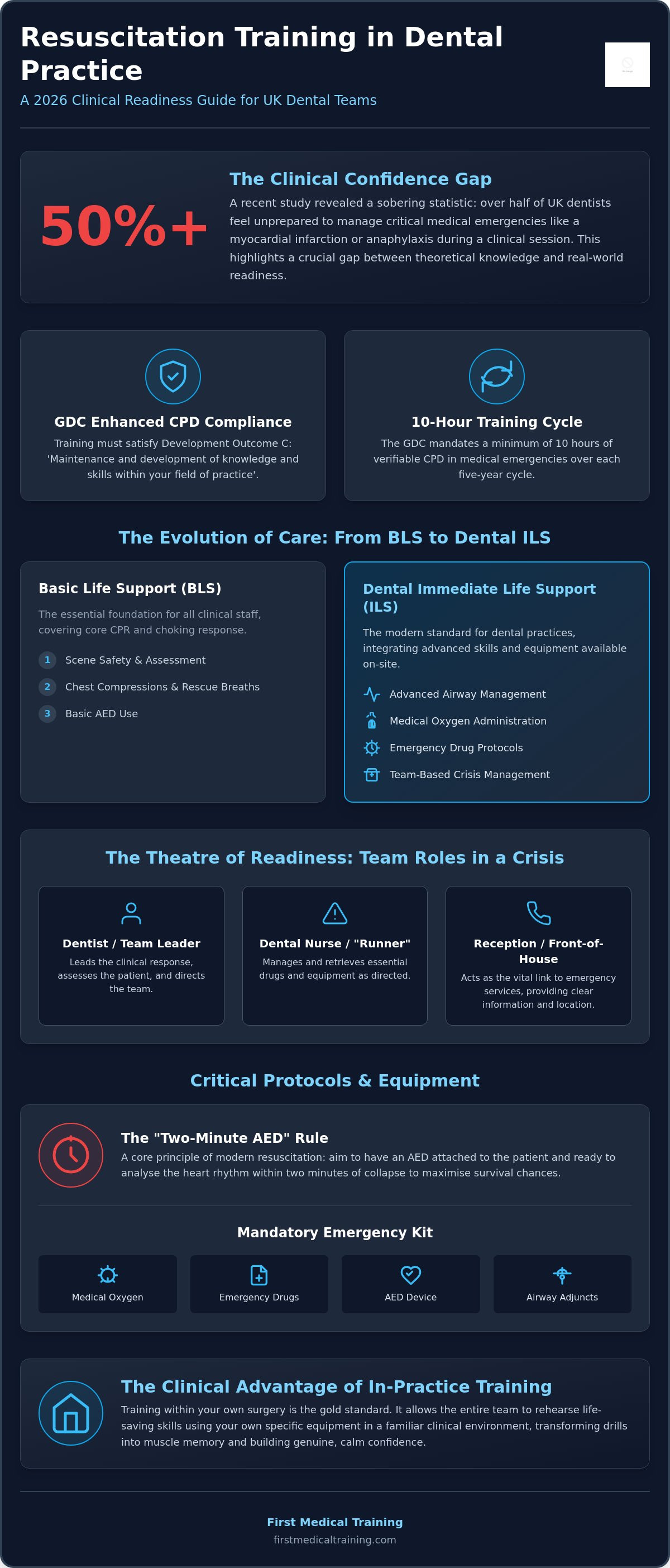
Over 50% of dentists in a recent study admitted they felt unable to manage a myocardial infarction or anaphylaxis during a clinical session. It's a sobering statistic that highlights the gap between theoretical knowledge and real-world emergency readiness. Most dental professionals feel the weight of GDC compliance and the underlying anxiety of a potential patient collapse, especially whilst managing a busy surgery. Effective resuscitation training dental practice teams receive shouldn't just be a "tick-box" exercise for your CPD folder; it needs to build genuine, calm confidence.
This 2026 clinical reference guide provides a comprehensive roadmap to current UK resuscitation standards, ensuring your team is fully compliant and prepared for any crisis. You'll gain a clear understanding of the latest GDC requirements and the essential equipment needed to save a life. We will explore the practical differences between BLS and ILS, outline the mandatory emergency drugs list, and explain how to implement the "two-minute AED rule" to ensure your practice remains a theatre of clinical readiness.
Key Takeaways
- Understand the specific GDC Enhanced CPD requirements for Development Outcome C, including the recommended 10-hour medical emergency training cycle.
- Discover how high-quality resuscitation training dental practice teams undertake integrates Basic Life Support (BLS) with specialised Dental Immediate Life Support (ILS) protocols.
- Learn how to transform your surgery into a "theatre of readiness" by assigning clear team roles and managing patient collapse effectively within the constraints of a dental chair.
- Master the "two-minute AED rule" and the use of essential emergency equipment, such as the LifeVac anti-choking device, to ensure rapid response times.
- Identify the clinical advantages of in-practice training sessions that allow your entire team to rehearse life-saving skills using your own equipment in a familiar environment.
Resuscitation Training for Dental Practice: A 2026 Clinical Overview
Effective resuscitation training dental practice teams undertake is far more than a simple annual update or a certificate for the wall. It is a holistic system that synthesises clinical skills, specialised equipment, and rigorous team protocols into a single, life-saving response. In the modern surgery, resuscitation training is the professional standard for maintaining patient safety during dental interventions. It ensures that when a crisis occurs, the response is methodical rather than reactive. By viewing emergency readiness as a clinical discipline in its own right, practices can move beyond basic compliance toward true excellence in patient care.
Dental surgeries present a unique set of challenges that differ significantly from other primary care settings. We regularly administer local anaesthetics, which carry a small but documented risk of systemic toxicity or anaphylaxis. Patients often arrive with high levels of anxiety, which can trigger vasovagal syncope or even more severe cardiac events in vulnerable individuals. The physical environment is also complex. Managing a collapse whilst a patient is reclined in a dental chair requires specific techniques and positioning that general training often overlooks. These factors make specialised, context-aware training an absolute necessity for every dental professional.
For clinics specialising in complex procedures like dental implants, such as when you visit Implantološki centar Smile, maintaining these high safety standards is essential for patient peace of mind.
Similarly, leading practitioners like Dr Samintharaj Kumar advocate for rigorous safety standards in oral surgery and full mouth rehabilitation, highlighting that clinical excellence is built on a foundation of patient safety and emergency preparedness.
This complexity has led to a significant clinical shift in recent years. While Basic Life Support (BLS) remains a foundational requirement, the standard in contemporary dentistry has moved towards Dental Immediate Life Support (ILS). This level of care accounts for the fact that dental teams have immediate access to medical oxygen, airway adjuncts, and a specific list of emergency drugs. Transitioning to an ILS framework allows the team to provide a higher level of intervention while waiting for the ambulance service to arrive.
The Importance of a Team-Based Approach
Success in an emergency relies on every member of the practice, from the principal dentist to the front-of-house team. When a patient collapses, there's no time for a committee meeting. Training ensures each person knows their specific role. Receptionists become the vital link to emergency services, whilst nurses manage the "runner" duties for drugs and equipment. This level of preparation prevents the "panic-freeze" response that often occurs during unexpected crises. It transforms a chaotic situation into a rehearsed drill, fostering a visible culture of safety that patients instinctively trust and value.
Resuscitation vs. General First Aid
It's vital to distinguish between standard workplace first aid and clinical resuscitation protocols. While an emergency first aid at work course UK is excellent for managing non-clinical incidents like minor injuries or falls in the waiting room, it doesn't cover the depth of clinical intervention required for a cardiac arrest. Cardiopulmonary resuscitation (CPR) in a dental setting requires a higher degree of technical skill, particularly regarding airway management and the integration of an Automated External Defibrillator (AED). Specialised training addresses these dental-specific scenarios, ensuring your team is prepared for the unique medical risks associated with modern clinical practice.
GDC Compliance and Resuscitation Council UK Standards
Maintaining regulatory compliance in 2026 requires more than a casual awareness of first aid; it demands strict adherence to the frameworks established by the General Dental Council (GDC) and the Resuscitation Council UK. For any resuscitation training dental practice chooses to implement, the curriculum must align with the Resuscitation Council UK Quality Standards for primary dental care. These standards provide the definitive blueprint for clinical response, specifying everything from the required drugs in your emergency kit to the frequency of team rehearsals. Adhering to these guidelines ensures that your practice operates within a recognised clinical safety net.
The GDC mandates that all registered dental professionals complete a minimum of 10 hours of verifiable Continuing Professional Development (CPD) in medical emergencies during every five-year cycle. However, the recommendation for annual updates is non-negotiable for high-performing teams. Clinical skills in chest compressions and airway management degrade quickly without regular use. Completing at least two hours of training annually ensures that your competency remains sharp and your CPD status stays verifiable. This proactive approach protects your professional registration and, more importantly, your patients.
Enhanced CPD and Development Outcome C
Resuscitation training falls under Development Outcome C, which focuses on the maintenance and development of knowledge and skill within your field of practice. To satisfy GDC inspectors, your training must be documented with a clear certificate showing the learning objectives and the number of hours completed. For a deeper dive into these regulatory nuances, you can refer to our gdc cpd requirements medical emergencies guide. Proper documentation is your primary defence during an audit, proving that your team's skills are current and professionally validated.
The Role of the CQC in Emergency Preparedness
The Care Quality Commission (CQC) evaluates dental practices through the "Safe" domain. Inspectors look for evidence that the team is prepared for the worst-case scenario. This includes checking that you have a designated lead for emergency drugs and equipment who performs weekly checks. Increasingly, inspectors expect to see evidence of "mock drills" where the team rehearses a collapse in the surgery. These rehearsals demonstrate that your training is practical, not just theoretical. If you want to ensure your team is ready for an inspection, booking an accredited Medical Emergencies in a Dental Practice Course with First Medical Training Ltd is a reliable way to bridge the gap between compliance and clinical confidence.
Core Curriculum: From BLS to Dental Immediate Life Support (ILS)
A robust curriculum for resuscitation training dental practice teams must evolve beyond the basics of first aid. While Basic Life Support (BLS) provides the foundation, the dental environment allows for a more sophisticated response known as Dental Immediate Life Support (ILS). This framework utilises the clinical setting's unique resources, such as medical oxygen and emergency drug kits, to stabilise a patient before the arrival of paramedics. According to the General Dental Council guidance, every team member must be trained and prepared to deal with medical emergencies, ensuring patient safety remains the paramount priority during any procedure.
The core curriculum focuses on high-quality chest compressions and effective ventilation. In a dental surgery, this often involves the use of medical gases. Mastering emergency oxygen training dental professionals receive is a critical component of ILS. It ensures that the team can deliver high-flow oxygen correctly during a wide range of incidents, from myocardial infarction to severe asthma attacks. Clinical readiness also requires a deep understanding of the four most common dental emergencies:
- Anaphylaxis: Rapid recognition and administration of intramuscular adrenaline.
- Asthma: Managing acute respiratory distress with salbutamol and oxygen.
- Cardiac Arrest: Immediate initiation of the resuscitation algorithm and AED use.
- Hypoglycaemia: Identifying the signs of low blood sugar and administering oral glucose or glucagon.
Advanced Airway Management and AED Use
In the high-pressure environment of a patient collapse, airway management is the first line of defence. Training covers the use of adjuncts like pocket masks and Bag Valve Masks (BVM) to provide effective rescue breaths without direct contact. Alongside this, the integration of an Automated External Defibrillator (AED) is non-negotiable. Many staff members harbour a quiet fear of "doing it wrong" or causing harm with a shock. Modern training demystifies these devices, demonstrating that the AED is a sophisticated, fail-safe tool that guides the user through every step. It's impossible to shock a patient who doesn't need it.
Managing Choking and Airway Obstruction
Dental procedures carry a specific risk of foreign object inhalation. Whether it's a crown, a bridge, or a fragment of dental material, an airway obstruction is a terrifying prospect. Standard protocols involve back blows and abdominal thrusts, but modern practices are increasingly looking at secondary life-saving tools. The LifeVac anti-choking device has emerged as a vital addition to the surgery's emergency kit. It provides a non-invasive way to clear an obstruction when traditional methods fail. Integrating these anti-choking protocols into your regular team drills ensures that every member can act with precision when seconds count.
Handling Patient Collapse: Practical Skills for the Dental Team
When a patient collapses, the transition from a routine check-up to a life-saving event happens in seconds. Success in these moments relies on the "Theatre of Readiness," a system where every staff member has a predefined role. Rather than a chaotic scramble, the team operates as a single unit. The clinician leads the medical intervention, the "Runner" retrieves the emergency drugs and AED, and the "Caller" alerts emergency services. This structured approach is the core of effective resuscitation training dental practice teams rely on to maintain order during high-pressure incidents.
A systematic framework is essential for assessing an unwell patient. We utilise the ABCDE approach: Airway, Breathing, Circulation, Disability, and Exposure. This clinical sequence ensures that the most life-threatening issues are identified and treated first. If the patient is unresponsive and not breathing normally, the team must initiate the resuscitation algorithm immediately. Once the crisis is managed and the patient is handed over to paramedics, the work isn't finished. You must document the event accurately in the patient's records, report the incident under RIDDOR if applicable, and conduct a team debrief to discuss what went well and identify areas for improvement.
Managing the "Chair Factor"
The dental chair is a significant physical obstacle during a cardiac arrest. You must know how to safely and rapidly lower the chair into a flat, supine position to facilitate effective chest compressions. Performing CPR on a soft, moving surface is physically demanding and less efficient than on a firm floor, yet the confined space of a surgery often makes moving the patient impossible. Our guide on patient collapse dental surgery training provides specific positioning diagrams to help you navigate these spatial challenges. Practising these movements ensures that the physical layout of your surgery doesn't hinder your response times.
The Receptionist’s Role in Resuscitation
Non-clinical staff are the backbone of a successful resuscitation effort. The receptionist usually takes the role of the "Caller," providing clear, concise information to the 999 or 112 operator. They must stay calm whilst managing other patients in the waiting area and clearing a path for the ambulance crew. The receptionist should also be the expert on the "Emergency Grab Bag" and AED location. Under the British Standard BS 8599-1:2019+A1:2026, the defibrillator must be retrievable and ready for use within 120 seconds of a suspected arrest. Knowing the exact location of this equipment saves precious seconds that can define the outcome. To ensure your entire team is prepared for these roles, consider booking our accredited Dental Immediate Life Support (ILS) Training with First Medical Training Ltd to rehearse these protocols in your own environment.
Organising In-Practice Training: Ensuring Team Readiness and Confidence
Choosing the right environment for resuscitation training dental practice teams is just as vital as the curriculum itself. Whilst external courses have their place, in-practice training offers a distinct clinical advantage. It allows your staff to rehearse life-saving protocols in the actual rooms where they work, using the specific equipment they reach for every day. This eliminates the "translation gap" that occurs when moving from a generic classroom setting to the unique physical constraints of a dental surgery. Learning where the AED is stored and how to move the suction unit during a crisis makes the response far more fluid.
When selecting a training partner, prioritising accreditation is essential. You should look for instructors who are accredited by the Resuscitation Council (UK) to ensure the clinical advice you receive is evidence-based and fully compliant with current standards. First Medical Training Ltd has acted as a seasoned mentor to the dental sector since 2006, delivering specialised medical emergencies in dental practice course modules. We understand the practical realities of a busy surgery and tailor our delivery to meet the specific needs of the whole dental team.
Skill retention is a significant challenge in emergency medicine. Research indicates that manual skills in CPR can begin to deteriorate within months of training if they aren't practised. This is why the annual refresher remains the gold standard for maintaining clinical competency. It isn't just about renewing a certificate for GDC compliance; it's about ensuring that every team member remains sharp, cohesive, and capable of acting without hesitation when a life is on the line.
Auditing Your Emergency Equipment
A professional in-practice training session doubles as a comprehensive equipment and drug audit. During live drills, it's common to identify expiry dates on adrenaline, glucagon, or aspirin that have been overlooked in weekly checks. We ensure your AED pads and batteries are within their service life and that your medical oxygen cylinders are correctly pressurised and ready for immediate use. This process ensures that your hardware is as prepared as your people, removing any technical uncertainty from the resuscitation algorithm.
Building Long-Term Clinical Confidence
The ultimate goal of regular training is the transition from "knowing" what to do to "acting" instinctively. By encouraging a "no-blame" culture during practice drills, teams can discuss errors openly and refine their communication. This supportive atmosphere builds a foundation of steady reliability that patients can sense and trust. When the team feels empowered, they remain calm during a crisis. Ready to secure your team's readiness? Book your practice’s annual resuscitation training with First Medical Training Ltd today.
Empowering Your Team for Clinical Excellence in 2026
Transitioning from basic regulatory compliance to a high-performance "Theatre of Readiness" is the most effective way to protect your patients and your professional reputation. By moving beyond standard Basic Life Support to a comprehensive Dental Immediate Life Support framework, you ensure that every team member knows exactly how to act when seconds count. High-quality resuscitation training dental practice teams undergo annually isn't just about ticking a box for the GDC; it's about building the instinctive confidence required to manage a crisis with calm, clinical precision. When your team rehearses together in their own environment, the fear of "doing it wrong" is replaced by a culture of steady reliability.
First Medical Training acts as a seasoned mentor, bringing over 20 years of expert medical training experience directly to your surgery. Our specialist instructors provide real-world emergency insights and fully GDC-compliant verifiable CPD certificates to keep your practice safe and organised. Ensure your team is ready for any crisis—book your Dental Medical Emergencies course now. Investing in these vital skills today creates a safer environment for your patients and a more resilient, empowered practice for the future.
Frequently Asked Questions
How often do dental professionals need resuscitation training in the UK?
UK dental professionals should update their knowledge and skills in resuscitation at least annually. Whilst the General Dental Council (GDC) requires 10 hours of medical emergencies training per five-year cycle, annual refreshers ensure that manual skills like chest compressions remain sharp. This regular schedule is the professional standard for maintaining clinical safety within a busy surgery environment.
Is BLS training enough for a dental practice, or do we need ILS?
Clinical dental teams should ideally undertake Dental Immediate Life Support (ILS) rather than just Basic Life Support (BLS). This is because dental practices have access to specialised equipment like medical oxygen and emergency drugs. ILS training covers the use of these adjuncts, allowing the team to provide a higher level of stabilising care before paramedics arrive.
What emergency drugs are mandatory for a UK dental surgery in 2026?
The mandatory emergency drug kit for a UK dental surgery includes Adrenaline (1:1000), Aspirin (300mg), Glucagon (1mg), Glyceryl Trinitrate (GTN) spray, Salbutamol inhaler, and Midazolam. You must also ensure that medical oxygen is available in a size D cylinder. Regular resuscitation training dental practice sessions should always include a check of these drugs to ensure they are within their expiry dates.
Can dental receptionists participate in resuscitation training?
Yes, dental receptionists are encouraged to participate in resuscitation training as they are essential to the emergency response team. In a real-world collapse, the receptionist often acts as the "Caller" to emergency services and the "Runner" for the AED. Their involvement in practice drills ensures the whole team operates as a cohesive unit during a crisis.
Does our resuscitation training count towards GDC verifiable CPD?
Verifiable CPD is a core component of accredited resuscitation training dental practice providers deliver. To be verifiable, the training must have clear learning objectives, a method of assessment, and a certificate of completion. Our courses are specifically designed to meet GDC Enhanced CPD Development Outcome C, ensuring your professional development records satisfy both GDC and CQC inspectors.
What happens if we fail to meet the GDC resuscitation training requirements?
Failing to meet GDC resuscitation requirements can result in a fitness to practise investigation and professional registration sanctions. From a regulatory perspective, the CQC may issue an "Inadequate" rating for the Safe domain if training records are missing or out of date. Ultimately, a lack of training increases the risk of patient harm and potential professional negligence claims.
Should we have a LifeVac anti-choking device in our dental emergency kit?
Including a LifeVac anti-choking device in your emergency kit is highly recommended as a secondary life-saving tool. Dental procedures carry a specific risk of foreign object inhalation, such as crowns or fragments. Whilst back blows and abdominal thrusts are the primary response, the LifeVac provides a non-invasive alternative if traditional methods fail to clear a stubborn airway obstruction.
How do we perform CPR if the patient is stuck in the dental chair?
To perform CPR in a dental chair, you must immediately lower the chair to its flat, supine position. If the chair design allows, removing the headrest can provide better access for airway management. Performing compressions on a reclined patient is physically challenging, so regular rehearsals are necessary to master the positioning and ensure the clinician can deliver effective chest compressions in a confined space.