

The Essential Guide to Choosing a Choking Device for Your Dental Waiting Room

Approximately 5,000 people die from choking every year, making it the fourth leading cause of unintentional injury death. While your clinical team is expertly trained for emergencies within the surgery, a crisis in the reception area often falls on the shoulders of non-clinical staff. Selecting a reliable choking device for dental waiting room use is no longer just an optional extra; it's a vital component of modern practice safety and patient care.
We understand the anxiety that comes with managing a front-of-house emergency, particularly when navigating complex MHRA regulations or worrying about counterfeit equipment from unregulated online marketplaces. You want to ensure your team is prepared, but the technical jargon can feel overwhelming. This guide will show you exactly how to protect both your patients and your staff by selecting and implementing the right anti-choking technology for your practice. We'll provide a clear plan for waiting room safety, ensuring you invest in compliant equipment that gives your non-clinical team the confidence to act decisively in a crisis.
Key Takeaways
- Understand why the reception area requires a specific emergency plan that accounts for the gap between non-clinical staff and clinical responders.
- Learn how a non-invasive choking device for dental waiting room use provides a critical second-line response when standard first aid protocols fail.
- Evaluate the practical differences between wall-mounted and portable kits to ensure your equipment is visible and accessible during a crisis.
- Discover how to integrate anti-choking technology into your existing GDC-compliant training to empower your entire front-of-house team.
- Recognise the importance of sourcing genuine, MHRA-compliant devices to avoid the serious safety risks associated with counterfeit equipment.
Why the Dental Waiting Room is a Unique Choking Risk Zone
The dental waiting room is often viewed as a safe, administrative space, yet it presents a specific set of risks that differ significantly from the controlled environment of the surgery. Whilst clinical teams are busy performing procedures behind closed doors, the reception area remains a high-traffic zone filled with diverse patient demographics, including young children and the elderly. A choking device for dental waiting room installation addresses this unique environment by providing a non-invasive suction tool designed to be used when standard first aid protocols for choking are unsuccessful. These devices act as a vital safeguard, offering a secondary response that doesn't require the complex setup of clinical suction units.
The Clinical vs. Non-Clinical Response Gap
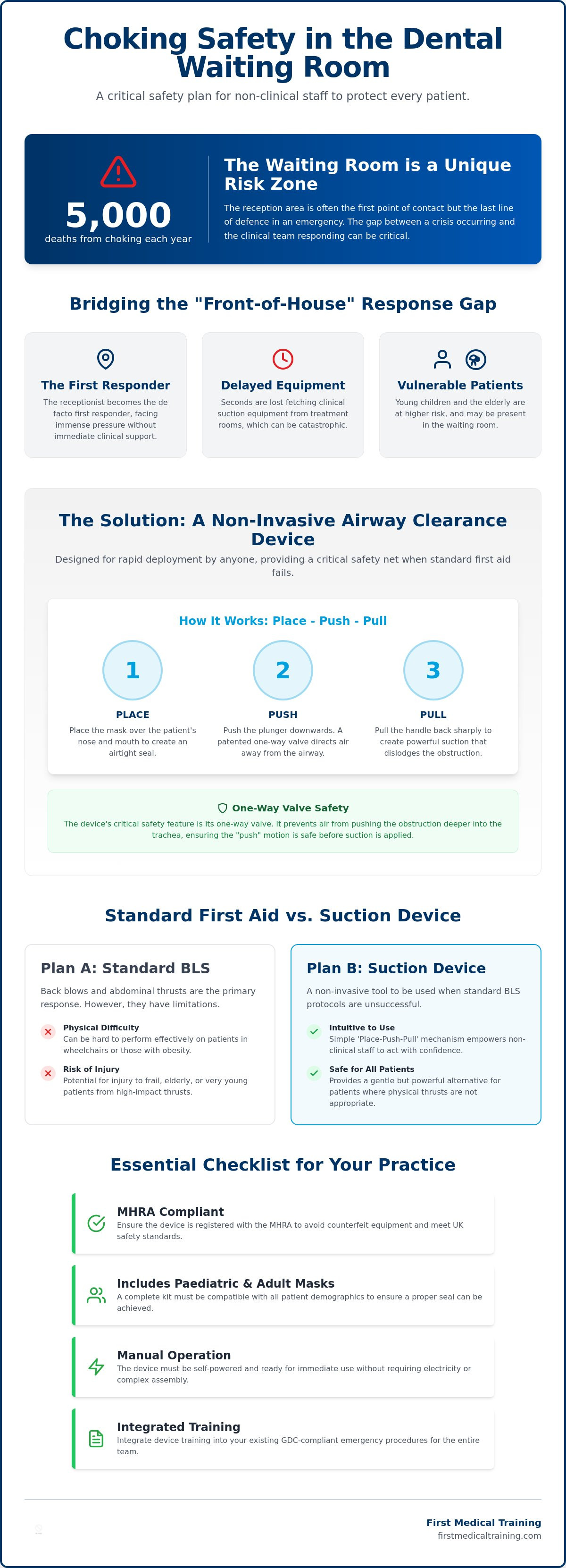
In most practices, emergency equipment like high-volume suction and oxygen is stored within the clinical bays or a central sterilisation room. If a patient begins to choke in the reception area, the seconds lost while a staff member runs to fetch clinical equipment can be catastrophic. This creates a "front-of-house" gap where the receptionist becomes the de facto first responder. These admin professionals often face immense psychological pressure during a medical emergency. They're dealing with common waiting room triggers like complimentary boiled sweets or small parts from toys in the children's play corner. Having dedicated equipment at the front desk bridges this gap, ensuring help is immediate rather than delayed by the building's layout.
Why Standard BLS May Require a Safety Net
Standard Basic Life Support (BLS) techniques, including back blows and abdominal thrusts, are the foundation of emergency response. However, these methods have limitations. They can be difficult to perform on patients in wheelchairs, the very young, or the frail elderly who may lack the physical resilience to withstand high-impact thrusts. In these scenarios, a non-invasive suction device provides a critical "Plan B" for airway management. Because these devices are designed to be intuitive, they allow non-clinical staff to act with certainty. They don't require a power source or assembly, making them a practical choice for the reception desk. By implementing a choking device for dental waiting room safety, you provide your team with a reliable safety net that complements their existing first aid training and protects your most vulnerable patients.
Understanding Anti-Choking Technology: Suction in 2026
The technology behind a modern choking device for dental waiting room use has evolved significantly by 2026. Unlike the invasive medical suction units found in your treatment rooms, which require power and clinical expertise to navigate the oropharynx, these devices are entirely manual and non-invasive. They are designed for rapid deployment by any member of the team. Clinical standards for airway management in the UK now emphasize the importance of having equipment that is compatible with all patient demographics. This means a kit must include both paediatric and adult masks to ensure a proper seal can be achieved on anyone from a small child to an elderly patient with sunken cheeks.
According to the FDA safety communication on anti-choking devices, these tools are intended as a second-line treatment. They provide a vital alternative when standard first aid protocols, such as back blows and abdominal thrusts, have failed to clear an obstruction. For a dental practice, where patients may be in various states of physical health or mobility, having this technological "safety net" is a matter of professional diligence.
How One-Way Suction Protects the Airway
Devices like the LifeVac utilize a patented one-way valve system that is fundamental to patient safety. The mechanism follows a simple "place-push-pull" methodology. When the device is depressed, the one-way valve ensures that air is vented out of the sides of the bellows rather than being forced into the patient's airway. This prevents the risk of pushing the obstruction further down the trachea. When the handle is pulled back, it creates a powerful vacuum that draws the object upwards and out. Achieving a perfect seal is the most critical factor here; without it, the suction cannot generate the necessary force to dislodge a stubborn bolus of food or a small toy.
Clinical Evidence and Regulatory Approval
Regulatory compliance is non-negotiable for medical equipment in a healthcare setting. In the UK, any choking device for dental waiting room use must be registered with the MHRA and carry the appropriate UKCA marking for 2026 compliance. In March 2026, the regulatory landscape shifted when the FDA established a new Class II medical device category (21 CFR 874.5400) for suction anti-choking devices. LifeVac remains the first and only device of its kind to receive FDA De Novo classification, providing a level of clinical assurance that is essential for professional peace of mind. For a deeper look at these technical requirements, you can consult our LifeVac anti-choking device UK guide. Ensuring your practice is equipped with a genuine LifeVac Anti-Choking Device is a vital step in your emergency preparedness plan.
Selecting the Best Choking Device for Your Practice Reception
Choosing the right equipment for your reception area requires a balance between visibility and accessibility. While clinical staff follow specific choking emergency protocols within the surgery, the reception team needs a solution that is immediately identifiable during the chaos of a medical crisis. Selecting a choking device for dental waiting room settings isn't just a standard purchase; it's a strategic investment in patient safety. The goal is to ensure that even a staff member with no clinical background can locate and use the tool within seconds of recognising an airway obstruction.
Visibility is paramount. Clear, high-contrast signage should mark the location of your anti-choking device, mirroring the way you would highlight an AED station. If your equipment is tucked away in a drawer to maintain a clean aesthetic, you're adding precious seconds to a response time where every moment counts. Professional-grade airway tools provide a high cost-to-benefit ratio when you consider the potential clinical outcomes and the peace of mind they offer to your front-of-house team.
Wall-Mounted vs. Portable: Which Fits Your Layout?
A wall-mounted kit is often the superior choice for a standard dental reception. It serves as a permanent visual cue, ensuring that in a moment of high stress, staff don't have to search through cupboards or bags. For practices spread across multiple floors or those with expansive, open-plan waiting areas, a portable bag-based kit offers the flexibility to move the equipment to the patient quickly. Regardless of the format, your kit must include multiple mask sizes. A professional set typically provides adult, paediatric, and large-adult masks to accommodate the diverse range of patients who visit your practice daily.
Identifying Genuine MHRA-Registered Equipment
The rise of unregulated online marketplaces has introduced a dangerous influx of counterfeit suction tools. These devices often lack the critical one-way valve technology required to ensure air isn't forced back into the patient's lungs. To protect your practice, use this verification checklist when your equipment arrives:
- Verify the serial number directly with the manufacturer's database.
- Ensure the packaging clearly displays a valid UKCA or CE mark alongside the manufacturer's address.
- Check that the masks are made from medical-grade silicone rather than rigid, brittle plastics.
- Confirm the supplier is a recognised UK distributor of genuine, MHRA-registered medical devices.
Using unbranded suction tools from marketplaces is a significant clinical risk. Beyond the immediate danger to the patient, the liability implications for a dental practice are severe. If a non-regulated device fails during an emergency, the practice's professional indemnity and CQC compliance could be called into question. It's always safer to source your choking device for dental waiting room use from a trusted partner who understands the rigorous standards of the UK healthcare sector.
How to Organise Staff Training for Waiting Room Emergencies
The General Dental Council (GDC) is explicit in its requirements: every member of the dental team, including non-clinical staff, must be trained and competent in managing medical emergencies. Whilst your dentists and nurses focus on clinical procedures, your reception and admin teams act as the first line of defence in the front-of-house area. Successfully implementing a choking device for dental waiting room safety depends entirely on how well your staff are prepared to use it. Equipment alone is not a solution; it is the combination of the right tool and the confidence to deploy it that saves lives.
Training should not be a one-off event. To maintain competence, your practice should adopt annual refresher cycles that align with your broader CPD requirements. This ensures that even in a high-pressure situation, the response is instinctive rather than hesitant. To ensure your team is ready, consider enrolling them in a specialised course from First Medical Training Ltd that covers both theory and practical application.
Training Your Reception and Admin Teams
Effective training for non-clinical staff should be broken down into three logical steps. First, every team member must be familiar with the device's location and the contents of the kit, including how to identify the correct mask size for a patient. Second, staff need to understand their legal duty of care. Whilst they are not expected to perform advanced clinical interventions, they have a responsibility to act within the scope of their training until clinical help arrives. Finally, practical drills are essential. Using a training manikin and non-live, training-specific units allows staff to feel the resistance of the suction and practice the "place-push-pull" technique without the stress of a real emergency.
Integrating Devices into Medical Emergency Protocols
Once your team is trained, you must formalise the use of the device within your practice's written procedures. It is vital to update your dental practice emergency preparedness checklist to include the regular inspection and presence of the choking device for dental waiting room use. Clear communication is the next priority; establish a specific signal or alarm that the reception staff can use to alert the clinical team that a life-threatening emergency is occurring in the waiting area. This prevents the receptionist from being left alone during the crisis. Regarding record-keeping, any use of the anti-choking device should be recorded within the patient's clinical records, noting the nature of the obstruction and the specific response steps taken. This documentation is a critical part of your post-incident review and CQC compliance.
Securing Your Practice with First Medical Training Ltd
At First Medical Training Ltd, we understand that emergency readiness is a blend of high-quality equipment and the confidence to use it. Since 2006, we've positioned ourselves as a steady partner for dental practices, providing the tools and training necessary to manage life-threatening incidents with professional composure. Sourcing a choking device for dental waiting room use through a specialised UK provider ensures that your front-of-house team has more than just a tool; they have a verified, compliant safety net. We act as a bridge between rigorous regulatory requirements and the practical application of life-saving skills.
Our approach is grounded in the reality of the dental environment. We know that when a crisis occurs in the reception area, your staff don't need academic theories; they need reliable equipment and the muscle memory to deploy it. By choosing to work with an industry veteran like First Medical Training Ltd, you're ensuring that your practice remains at the forefront of patient safety and professional development.
Professional Supply of LifeVac Devices
We are a trusted supplier of genuine LifeVac devices, which remain the only suction anti-choking tools to hold FDA De Novo classification as of 2026. Our professional dental practice kits are specifically assembled to meet the needs of a busy reception area, containing the necessary mask sizes for both adult and paediatric patients. First Medical Training Ltd handles the technical burden of MHRA compliance and UKCA marking verification so you don't have to. This protects your practice from the significant clinical and legal risks associated with counterfeit equipment found on unregulated marketplaces. You can find a detailed breakdown of these standards in our LifeVac buying guide.
Verifiable CPD and Medical Emergency Courses
Compliance is about more than just having the right kit on the wall. Integrating a choking device for dental waiting room safety into your wider CPD plan ensures your team is truly prepared. Our Medical Emergencies in a Dental Practice Course provides the verifiable CPD your team needs to satisfy GDC requirements. We move beyond basic theory, offering hands-on experience that empowers non-clinical staff to act decisively during an airway obstruction. From managing a choking incident to mastering cardiac arrest response for the dental team, our curriculum is designed for the practical realities of a modern surgery. Choosing a UK-based specialist like First Medical Training Ltd offers the reassurance that your equipment and training are aligned with current national standards. Audit your waiting room safety protocols today and ensure your team has the support they deserve.
Elevating Your Practice Safety Standards
Implementing a robust safety strategy for your reception area ensures that your practice's duty of care begins at the front desk. Throughout this guide, we have explored how a choking device for dental waiting room settings provides a non-invasive, secondary response that empowers your non-clinical team. From understanding the "place-push-pull" technology to the vital importance of sourcing MHRA-compliant equipment, the path to a safer waiting area is clear. It requires a synergy between the right tools and accredited, hands-on training.
First Medical Training Ltd has served as a trusted mentor to the dental sector since 2006, offering the quiet confidence that comes from nearly two decades of expertise. By choosing a partner that provides both genuine equipment and GDC-aligned CPD, you are investing in a culture of readiness that protects every patient and staff member. Equip your practice with a genuine LifeVac device today and take the final step in securing your front-of-house environment. With the right preparation, your team will be ready to act with certainty in any crisis.
Frequently Asked Questions
Is a choking device a legal requirement for UK dental waiting rooms?
No, there is currently no specific UK legislation that mandates a choking device for dental waiting room use by name. However, the CQC and GDC require practices to have "appropriate" emergency equipment based on a robust risk assessment of their environment. Including a non-invasive suction device is increasingly recognised as best practice for managing the "front-of-house" gap where clinical equipment might be too far away to be effective in the first few seconds of a crisis.
Can a receptionist use an anti-choking device before the dentist arrives?
Yes, a trained receptionist is fully authorised to use the device if they encounter a life-threatening airway obstruction where standard first aid has failed. These tools are specifically designed for non-clinical use and don't require the complex medical knowledge needed for surgical suction. It's essential that your practice protocol includes a clear signal to alert the clinical team whilst the receptionist begins the initial rescue steps.
How do I know if the choking device I bought online is genuine or counterfeit?
You can identify a genuine device by checking for a valid MHRA registration and clear UKCA or CE markings on both the device and its packaging. Genuine manufacturers like LifeVac provide unique serial numbers that you can verify directly through their official databases. Counterfeit tools, often found on unregulated marketplaces, frequently lack the critical one-way valve technology, meaning they could dangerously push an obstruction further into the patient's lungs.
Does the LifeVac device replace the need for standard first aid training?
No, the LifeVac is a second-line treatment and must never replace standard Basic Life Support (BLS) protocols. Your staff should always attempt back blows and abdominal thrusts first, as these remain the primary response recommended by the UK Resuscitation Council. The choking device for dental waiting room safety is a "Plan B" intended for use only when these traditional methods have proven unsuccessful or cannot be performed due to patient frailty.
Are there different mask sizes for children and adults in the waiting room kits?
Yes, professional-grade kits include multiple mask sizes to ensure you can treat any patient who enters your practice. A standard kit typically contains paediatric, adult, and large adult masks. This is a critical safety feature because the device relies entirely on creating a perfect vacuum seal; without the correct mask size, the suction won't be strong enough to dislodge the obstruction.
How often do the masks or the device itself need to be replaced?
The masks generally have a shelf life of two to three years and must be replaced even if they haven't been used, as the silicone can lose its flexibility. Whilst the suction unit itself is durable, it's standard medical protocol to replace the entire device after it has been used in a real-life emergency. You should include these expiry dates in your practice's monthly emergency equipment audit to ensure everything remains in peak condition.
What should I do if a patient chokes in the dental chair versus the waiting room?
If a patient chokes in the dental chair, the clinical team will use high-volume surgical suction and clinical airway management protocols within the surgery. If the incident occurs in the waiting room, the reception staff are the first responders and will use standard first aid followed by the anti-choking device. The response depends on which team is closest and which equipment is immediately accessible to prevent a delay in treatment.
Does using a choking device count towards our annual medical emergency CPD?
Training on how to use these devices counts as verifiable CPD when it's delivered as part of an accredited medical emergencies course. The GDC requires all dental professionals to stay up to date with emergency protocols, and learning to use new airway technology is a valid part of that development. Ensuring your reception team joins these sessions helps your practice meet its collective training obligations whilst building essential front-of-house confidence.