

Verifiable CPD: Dental Medical Emergencies 2026 Guide

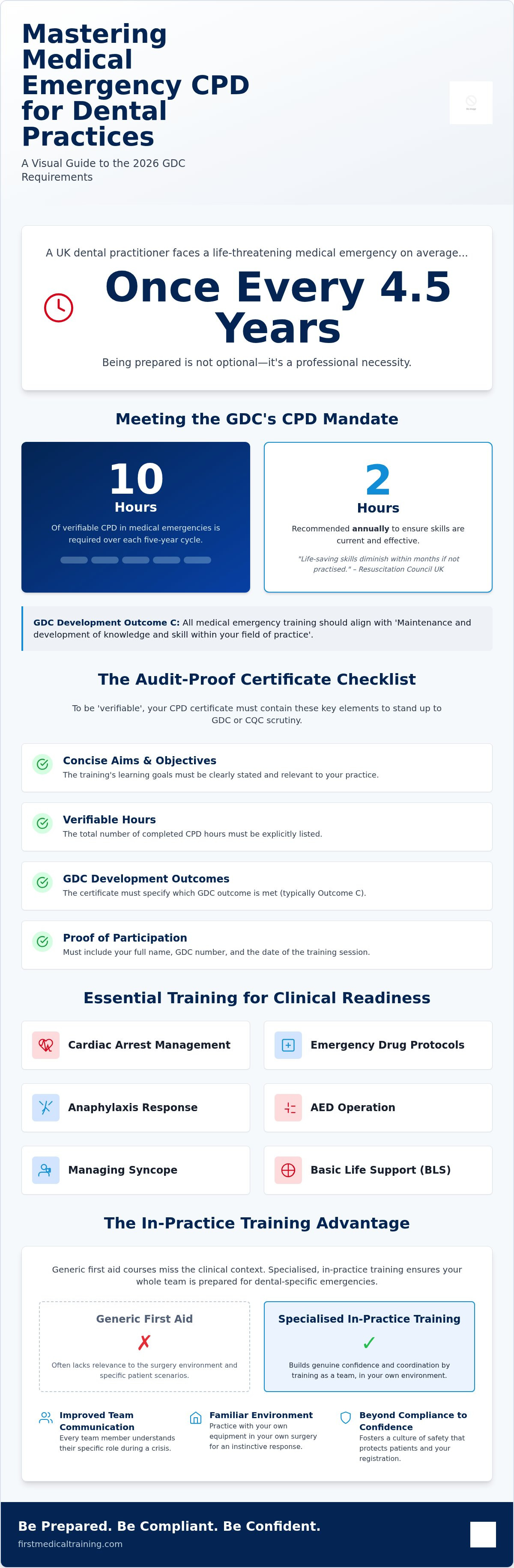
Did you know that the average UK dental practitioner will face a life-threatening medical emergency in their surgery approximately once every four and a half years? This sobering statistic highlights why staying current with your verifiable cpd dental medical emergencies isn't just about ticking a box for the GDC; it's about being ready when a patient's life is on the line. We understand the pressure of managing a busy practice whilst trying to coordinate team training that feels relevant, rather than sitting through another generic first aid course that misses the specific clinical context of a dental environment.
This guide will show you how to master the 2026 GDC requirements and ensure your entire team is clinically prepared with high-quality training that builds genuine confidence. You'll learn exactly how to meet your 10-hour cycle obligations whilst fostering a culture of safety that protects both your patients and your professional registration. We will explore the mandatory drug lists, the latest AED protocols, and how to streamline your certification process to make your next audit entirely stress-free.
Key Takeaways
- Understand the GDC's specific expectations for medical emergencies, including the requirement for ten hours of verifiable training per five-year cycle.
- Identify the core criteria for verifiable cpd dental medical emergencies to ensure every certificate in your portfolio is fully compliant for a GDC or CQC audit.
- Prioritise the most common clinical scenarios, from syncope to anaphylaxis, and establish clear protocols for managing a cardiac arrest within the surgery.
- Discover the benefits of whole-team, in-practice training for improving communication and ensuring every staff member knows their role during a crisis.
- Learn how to select specialised training that addresses dental-specific challenges rather than settling for generic first aid courses.
Understanding GDC Requirements for Medical Emergencies CPD
The General Dental Council (GDC) is clear about the standards required to keep patients safe. Medical emergencies are designated as a "Highly Recommended" topic, which means they aren't optional extras. Every registrant must complete at least 10 hours of verifiable CPD in medical emergencies over their five-year cycle. This isn't just an administrative hurdle; it's a vital component of Continuing medical education that ensures dental teams can handle a crisis with composure.
Compliance involves more than just attending a talk. Since the Enhanced CPD scheme launched, the way we record verifiable cpd dental medical emergencies has become more rigorous. Registrants must now link their learning to specific GDC development outcomes and maintain a robust Personal Development Plan (PDP). This shift ensures that training is purposeful and tailored to the specific needs of the dental professional and their patient base.
The Role of Enhanced CPD in 2026
The GDC uses four development outcomes, labelled A, B, C, and D, to categorise professional learning. Training for medical emergencies is almost exclusively aligned with Outcome C: Maintenance and development of knowledge and skills within your field of practice. By focusing on clinical skills, such as basic life support and the use of emergency drugs, you meet the GDC's expectations for clinical excellence. For a comprehensive look at these rules, see our GDC CPD Requirements for Medical Emergencies guide.
Frequency of Training: Is Annual Enough?
Although the five-year requirement is 10 hours, the GDC strongly recommends that you undertake at least two hours of medical emergency training every year. This is a recommendation we take seriously. The Resuscitation Council UK (RCUK) points out that life-saving skills begin to diminish within months if they aren't practiced. In a high-stakes environment like a dental surgery, relying on skills learned several years ago is a significant risk to patient safety.
Annual refreshers function as a clinical rehearsal. They allow the whole team to practice together in their own environment, ensuring everyone knows where the oxygen cylinder is kept and how to use the AED. Regularly engaging in verifiable cpd dental medical emergencies ensures that your response is instinctive and coordinated, which is exactly what's needed when a patient collapses in the chair. This consistent approach moves you beyond mere compliance and into a state of genuine clinical readiness.
What Constitutes 'Verifiable' CPD in a Dental Context?
For CPD to count towards your GDC requirements, it must meet specific criteria that move beyond simple attendance. The GDC defines verifiable CPD as activity that has concise learning aims and objectives, clear anticipated outcomes, and a robust quality assurance process. Without these elements, your hours might be rejected during a GDC or CQC audit. It's essential that every certificate for your verifiable cpd dental medical emergencies includes these details to prove that the training was both relevant and high quality.
Validation doesn't end when the training session finishes. Every registrant must provide feedback on the training to confirm it met their specific professional needs. This participant feedback loop is a mandatory part of the verifiable process. Simultaneously, the training provider must maintain detailed records of the session, including attendance lists and the specific curriculum delivered. This dual layer of accountability protects your professional standing and ensures the training remains effective.
The Five Pillars of Verifiable Certification
A compliant certificate is your primary evidence of professional development. To stand up to scrutiny, it must clearly display specific information that links the training to your clinical practice. Following the GDC Guidance on Medical Emergencies ensures your practice remains on the right side of regulation whilst maintaining high clinical standards. A valid certificate must include:
- Evidence of participation, including your name and the exact date of the training.
- The total number of verifiable hours completed.
- A clear statement of the GDC development outcomes met (typically Outcome C).
- The learning aims and objectives of the session.
- Confirmation of an independent quality assurance process.
Online vs. In-Practice: Which is More Effective?
Digital modules are convenient for theoretical knowledge, but they often lack the practical assessment required for medical emergency scenarios. While both can be "verifiable", hands-on training allows for real-time correction of technique, such as chest compression depth or the correct use of airway adjuncts. This physical practice is vital for building the muscle memory needed during a patient collapse. You can read more about the differences in our guide on In-Practice vs Online Dental Training.
If you're looking to refresh your team's skills, our Medical Emergencies in a Dental Practice Course provides fully compliant, verifiable certification that covers all these essential pillars whilst focusing on practical, life-saving skills.
Core Medical Emergency Scenarios for Verifiable Training
Effective training must go beyond theory to address the specific physical environment of a dental practice. Whilst generic first aid courses cover basic trauma, verifiable cpd dental medical emergencies must prioritise the scenarios most likely to occur in the surgery. These include vasovagal syncope, hypoglycaemia, and anaphylaxis. Each requires a distinct clinical response that the entire team must be able to execute without hesitation.
Managing a cardiac arrest in a dental setting presents unique challenges, such as navigating the restricted space around the dental chair. According to the Resuscitation Council UK Quality Standards, practices must have immediate access to an Automated External Defibrillator (AED) and oxygen. Training ensures that the transition from a routine procedure to a resuscitation attempt is seamless, with every staff member knowing their specific role before the emergency services arrive.
We also address less common but equally critical risks, such as choking on dental materials or prosthetic components. Incorporating modern equipment like the LifeVac anti-choking device into your practice protocols provides an additional layer of safety when traditional back blows or abdominal thrusts are not possible or effective. This specialised focus is what separates high-quality dental CPD from standard first aid instruction.
Managing Patient Collapse in the Surgery
Syncope is the most frequent emergency in dental practices, often triggered by anxiety or the administration of local anaesthesia. Your response should be immediate: stop the procedure, remove any instruments from the mouth, and recline the dental chair so the patient's head is lower than their heart. Ensure the airway is clear and monitor their breathing whilst they regain consciousness. In the context of a dental chair, the recovery position involves tilting the patient's head to the side whilst they remain in a fully reclined position to maintain a clear airway. For a deeper dive into these protocols, read our guide on Syncope Management for Dental Teams.
The Emergency Drug Kit: Compliance and Use
Your practice must maintain a fully stocked emergency drug kit as part of your compliance obligations. This kit includes adrenaline for anaphylaxis, salbutamol for asthma, and glyceryl trinitrate (GTN) for angina. Verifiable training ensures that staff don't just know where the kit is kept, but can confidently identify and administer the correct medication under pressure. Regular kit audits should be integrated into your CPD learning to ensure all drugs are within their expiry dates and that the team is familiar with any changes in administration protocols.
Organising Annual In-Practice Training for the Dental Team
Whilst individual online modules provide theoretical knowledge, they cannot replicate the dynamics of a team responding together in their actual clinical environment. Scheduling a dedicated session for verifiable cpd dental medical emergencies ensures that every staff member understands their specific responsibilities. To minimise disruption to the patient diary, many practice managers block out a training morning or afternoon six months in advance. This treats emergency preparedness as a non-negotiable clinical priority rather than a last-minute box-ticking exercise.
A professional trainer will typically require access to one of your surgeries to conduct realistic simulations. Ensure your emergency drug kit and AED are accessible, as the trainer will often use these as part of the assessment. This hands-on approach allows the team to navigate the physical constraints of the surgery, such as positioning the dental chair correctly for a collapse. It also provides an opportunity for an expert to verify that your airway management equipment is fit for purpose and that your team feels confident using it.
The "Whole Team" Approach to Crisis Management
Medical emergencies require a coordinated effort where everyone knows their station. One person manages the airway whilst another fetches the AED and a third contacts the emergency services. Scenario-based rehearsals build the muscle memory needed to reduce panic and ensure a logical flow of care. We also find that integrating mental health first aid into these sessions provides a more holistic approach to patient care. This ensures the team can support patients experiencing acute anxiety or panic attacks during their visit, which is a vital part of modern dental practice wellbeing strategies.
Maintaining the CPD Folder for Inspections
Clear documentation is essential for demonstrating compliance during a GDC or CQC audit. Every participant, including administrative and reception staff, must receive a certificate that clearly states the learning outcomes and verifiable hours. Using a Dental Practice Emergency Preparedness Checklist allows you to track both training dates and equipment expiry in one central location. This structured method ensures that no one’s certification lapses and that your practice remains constantly ready for an unannounced inspection.
Ready to secure your practice's compliance? You can book our Medical Emergencies in a Dental Practice Course to provide your entire team with high-quality, on-site training that meets every GDC requirement.
Choosing First Medical Training Ltd for Your Verifiable CPD Needs
Since 2006, First Medical Training Ltd has acted as a bridge between rigorous GDC requirements and the practical realities of the dental surgery. We don't offer generic first aid instruction that ignores the clinical setting. Instead, we provide highly specialised training tailored specifically to the unique environment of a dental practice. Choosing First Medical Training Ltd for your verifiable cpd dental medical emergencies means partnering with seasoned mentors who understand the layout of your surgery and the specific clinical pressures your team faces during a crisis.
Our trainers are industry veterans with extensive experience in emergency healthcare. They don't just teach from a manual; they bring real-world expertise into your surgery. This authoritative approach demystifies complex procedures and empowers your staff to take control of high-pressure situations. Whether you are a small private practice or a large multi-site group, our national delivery model ensures consistent, high-quality training across all your locations. First Medical Training Ltd handles the logistical burden of certification and record-keeping, allowing you to focus on patient care whilst we manage your clinical readiness.
Our Medical Emergencies in a Dental Practice Course
Our flagship Medical Emergencies in a Dental Practice Course is designed to build genuine clinical confidence through practical rehearsal. The curriculum goes beyond basic theory, incorporating practical AED and BLS assessments as a standard part of the session. Your team will gain hands-on experience with airway management adjuncts and the correct administration of emergency drugs, ensuring that everyone is prepared to act decisively. We provide comprehensive certification that clearly maps to GDC development outcomes, ensuring your CPD portfolio is always audit-ready for a CQC inspection.
Advanced Solutions: Dental ILS and Equipment
Some practices require more than basic life support training, particularly those involved in conscious sedation or complex oral surgery. Our Dental Immediate Life Support (ILS) Training offers advanced insights into patient monitoring and resuscitation protocols. We also provide access to the latest life-saving technology, acting as a trusted supplier of LifeVac anti-choking devices and airway management equipment. By choosing First Medical Training Ltd, you are building a long-term partnership for your annual compliance needs. Our expert trainers travel nationally to deliver in-practice sessions, allowing your whole team to train together in the environment where they actually work. This methodical, purposeful approach ensures that your response to a medical emergency is both organised and effective.
Securing Your Practice's Clinical Future
Ensuring your team is prepared for a crisis involves more than just meeting a regulatory quota. We've explored how the GDC's 2026 standards prioritise clinical outcomes and why hands-on, team-based training is far more effective than isolated theory. By focusing on dental-specific scenarios and clear learning objectives, you transform mandatory training into a vital safety net for your patients. Maintaining your verifiable cpd dental medical emergencies isn't just about passing an audit; it's about the confidence that comes from being genuinely ready for the unexpected.
Professional training should be as practical as it is informative. Book your team onto our accredited Medical Emergencies in a Dental Practice Course today to benefit from national in-practice training tailored to your surgery. Our professional trainers bring years of clinical experience directly to your door, providing GDC-compliant certification for the entire team. It's a straightforward way to build a safer, more resilient practice whilst ensuring your professional portfolio remains impeccable. You've worked hard to build your reputation; let's ensure your team has the skills to protect it in any situation.
Frequently Asked Questions
What makes CPD "verifiable" for GDC medical emergencies?
CPD is considered verifiable when it includes concise learning aims, objectives, and clear anticipated outcomes. It must also feature a robust quality assurance process and a participant feedback loop. To meet the criteria for verifiable cpd dental medical emergencies, your certificate must clearly state the number of hours completed and be issued by a reputable provider. This documentation serves as your primary evidence during a GDC or CQC compliance audit.
How many hours of medical emergency training do I need annually?
The GDC requires all registrants to complete a minimum of 10 hours of verifiable CPD in medical emergencies within every five-year cycle. However, they strongly recommend that at least two of these hours are undertaken annually. Regular training prevents skill decay and ensures that your team remains clinically prepared. Maintaining this consistent rhythm is widely regarded as best practice for high-risk clinical environments where life-saving skills must be instinctive.
Does the whole dental team need to attend the medical emergencies course?
Yes, the GDC expects the entire dental team to be trained together in their clinical environment. This collective approach ensures that every member, from clinicians to support staff, understands their specific role during a crisis. Training as a unit improves communication and ensures that emergency protocols are executed seamlessly. It also allows the team to practice using their own equipment, such as oxygen cylinders and AEDs, within the actual surgery layout.
Can I do my verifiable medical emergencies CPD online?
Whilst theoretical modules can be completed online for verifiable credit, the GDC and Resuscitation Council UK strongly advocate for practical, hands-on training. Online courses often lack the physical assessment needed for basic life support and airway management. For medical emergencies, in-practice training is the gold standard because it allows for real-time correction of techniques. Practical rehearsal in your own surgery builds the muscle memory that digital modules simply cannot replicate.
What emergency equipment is required for GDC compliance in 2026?
In 2026, every UK dental practice must have immediate access to an Automated External Defibrillator (AED) and medical grade oxygen. Your surgery must also maintain a compliant emergency drug kit containing adrenaline, aspirin, glucagon, glyceryl trinitrate spray, salbutamol, and midazolam. All equipment and medications must be regularly audited to ensure they are within their expiry dates. Having these tools available is a mandatory requirement for both GDC and CQC compliance.
Is the LifeVac device recommended for dental practices?
The LifeVac anti-choking device is highly recommended as a supplementary life-saving tool for dental environments. It provides a non-invasive solution for clearing airway obstructions when standard protocols, such as back blows or abdominal thrusts, prove ineffective or impossible due to the patient's position. As a specialist supplier of these devices, we integrate their use into our training sessions to ensure your team can deploy them safely and effectively during a choking emergency.
Do receptionists need to participate in medical emergency training?
Receptionists and administrative staff are vital components of the emergency response team and should always participate in training. They are often the first to identify a deteriorating patient in the waiting area or are responsible for contacting the emergency services. By involving them in your verifiable cpd dental medical emergencies training, you ensure they can provide effective support, fetch emergency equipment, and manage the practice environment whilst the clinicians focus on the patient.
What development outcomes should a dental CPD certificate include?
A valid CPD certificate must clearly state which GDC development outcomes have been met during the session. For medical emergencies training, this almost always aligns with Outcome C: Maintenance and development of knowledge and skills within your field of practice. Some courses may also cover Outcome A or B if they involve communication or team leadership. Ensure your training provider includes these specific descriptors to ensure your hours are accepted by the regulator.