

AED Training for Dental Practices: Ensuring GDC Compliance and Clinical Confidence in 2026

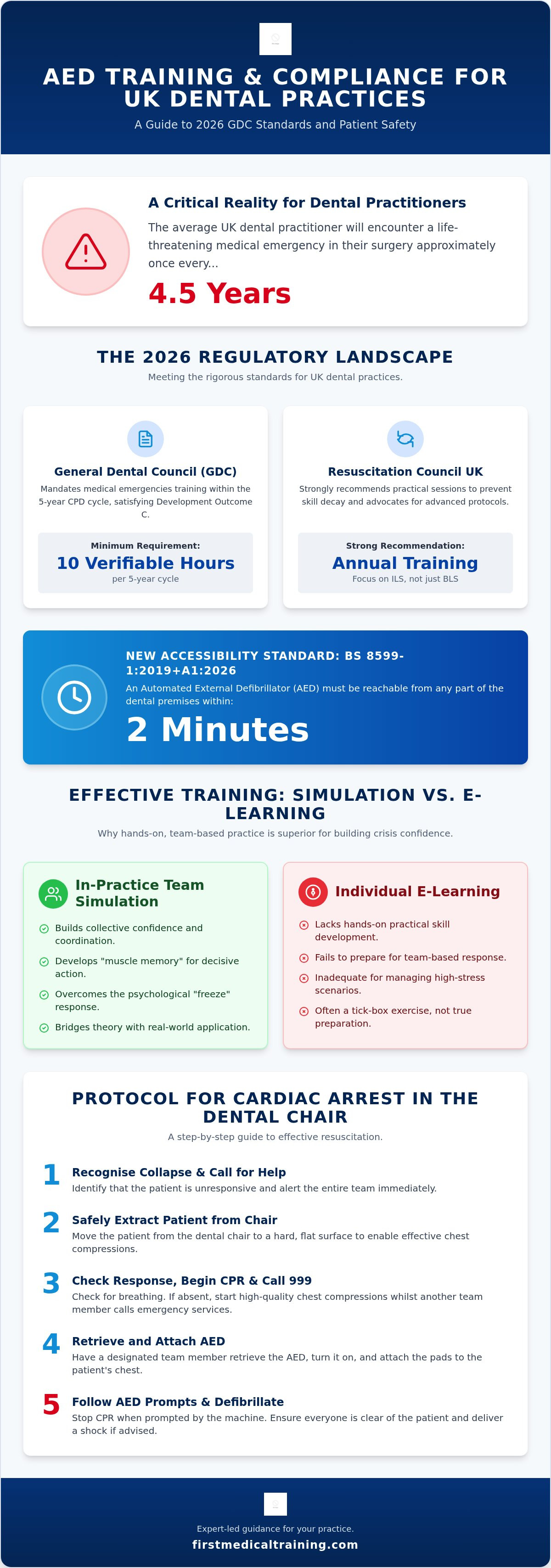
Did you know the average UK dental practitioner will encounter a life-threatening medical emergency in their surgery approximately once every four and a half years? It's a sobering statistic that often fuels anxiety about patient collapse, especially when you're trying to navigate the complexities of Enhanced CPD Outcome C. You already understand that keeping your team prepared is vital; however, coordinating comprehensive aed training for dental practices can feel like a significant logistical hurdle amidst a packed clinical schedule.
This article provides a clear roadmap to mastering essential defibrillator protocols and meeting the rigorous GDC standards required for 2026. You'll learn how to ensure your practice complies with the updated BS 8599-1:2019+A1:2026 accessibility standards, which now require an AED to be reachable within two minutes from any part of the premises. We will examine the shift towards high-impact team drills and clarify how to secure your verifiable CPD hours. By the end, you'll have a structured plan to achieve full regulatory compliance and the clinical confidence needed to protect your patients effectively.
Key Takeaways
- Understand the latest GDC and Resuscitation Council (UK) requirements to ensure your practice remains fully compliant throughout 2026.
- Learn how to integrate bespoke aed training for dental practices into your clinical routine to manage the specific risks associated with dental anxiety and local anaesthetics.
- Discover why hands-on, team-based simulation is superior to individual e-learning for building collective confidence during a cardiac crisis.
- Master the step-by-step protocol for safely extracting a collapsed patient from the dental chair to a hard surface for effective resuscitation.
- Secure verifiable CPD hours whilst bridging the gap between theoretical knowledge and real-world emergency response with expert-led guidance.
The Regulatory Landscape of AED Training for Dental Practices
For 2026, the regulatory framework governing dental surgeries is explicit; every clinical environment must maintain a functional Automated External Defibrillator (AED) and ensure staff are competent in its use. This mandate is overseen by the Care Quality Commission (CQC) and the General Dental Council (GDC), both of whom require practices to follow the guidelines set by the Resuscitation Council UK. Whilst the GDC mandates 10 hours of medical emergencies training per five-year cycle, the Resuscitation Council UK strongly recommends annual practical sessions to prevent skill decay. Investing in structured aed training for dental practices ensures that your team isn't just compliant on paper, but capable in a crisis. Verifiable CPD for dental medical emergencies is defined as any learning activity with concise educational aims, documented proof of participation, and a certificate of completion that the General Dental Council can independently validate.
GDC Enhanced CPD and Development Outcome C
The GDC places medical emergencies at the heart of professional development. AED training specifically satisfies Development Outcome C, which focuses on the maintenance and development of knowledge and skill within your field of practice. Failing to record these hours accurately can lead to registration lapses; it's a risk no professional should take. By following the GDC CPD requirements for medical emergencies, practices can ensure they meet the minimum threshold whilst prioritising patient safety. This structured approach moves beyond a simple tick-box exercise. It transforms regulatory necessity into a culture of clinical excellence where every team member understands their professional obligations.
Resuscitation Council (UK) Standards for Primary Care
The 2026 standards for primary care go beyond basic life support. Recent updates to the British Standard BS 8599-1:2019+A1:2026 now require that an AED must be reachable within two minutes from any part of the dental premises. This places a significant emphasis on equipment placement and staff response times. Simply owning a device isn't enough; staff must demonstrate competency through regular drills. Basic Life Support (BLS) is no longer viewed as the clinical gold standard in isolation. Instead, the focus has shifted toward Immediate Life Support (ILS) and comprehensive aed training for dental practices. These protocols ensure that clinical staff can manage the initial stages of a cardiac arrest effectively while waiting for emergency services to arrive. Regular competency checks are essential to ensure that equipment is maintained and that team skills remain sharp.
Why Defibrillation Skills are Critical in a Clinical Dental Setting
The dental chair is a unique environment where physiological stress meets clinical intervention. Whilst most appointments are routine, the intense anxiety many patients feel can trigger a significant catecholamine release. This surge of adrenaline, combined with pre-existing cardiovascular conditions, can lead to sudden cardiac arrest (SCA) amongst vulnerable individuals. Recognising a collapse isn't always straightforward. Patients are often supine, draped, and under the influence of local anaesthetics that may mask early symptoms of distress. Effective aed training for dental practices prepares your team to look past the procedure and monitor the patient's vital signs with a critical eye.
Success in a crisis depends on the "Chain of Survival". The dental team's role is pivotal during the first four minutes. During this window, immediate recognition and early defibrillation are the only ways to restore a life-sustaining heart rhythm. However, even the most skilled clinicians can experience a psychological "freeze" response when an emergency occurs. This is why the GDC guidance on medical emergencies emphasises the need for regular, practical training. By simulating these high-pressure scenarios, staff can build the "muscle memory" required to act decisively rather than hesitating whilst a life hangs in the balance.
Physiology of Sudden Cardiac Arrest in the Surgery
Most out-of-hospital cardiac arrests involve ventricular fibrillation (VF), a state where the heart's electrical activity becomes chaotic. In this state, the heart cannot pump blood, and an AED is the only effective treatment to "reset" the rhythm. Our ageing patient population means we're seeing more individuals with complex medical histories and polypharmacy, which naturally increases the risk of SCA during dental treatment. It's a race against time; data from the Resuscitation Council UK indicates that the probability of survival drops by approximately 10% for every minute that defibrillation is delayed. Ensuring your equipment is ready and your skills are sharp is the only way to beat these odds.
The Impact of Team Behaviour and Clinical Organisation
Clinical organisation is what separates a chaotic response from a successful resuscitation. A well-drilled team knows how to reduce "hands-off" time during CPR, ensuring that chest compressions are only interrupted for the minimum time required for AED analysis. Clear leadership and communication are essential components of cardiac arrest management in dental practice. Every member should have a predefined role, from the person calling 999 to the individual retrieving the emergency kit. Developing a "culture of preparedness" within your practice centre transforms anxiety into confidence. If you're looking to strengthen your team's response, our specialist aed training for dental practices provides the hands-on experience needed to manage these events with professional poise.
Comparing AED Training Formats: In-Practice vs Online CPD
When selecting a training format, practitioners often weigh the convenience of digital modules against the rigour of in-person simulation. Whilst e-learning offers flexibility, it cannot replicate the physical reality of a medical emergency. The Resuscitation Council UK guidelines are clear on this matter; they strongly favour frequent, hands-on refresher sessions to ensure that life-saving skills remain sharp. Genuine clinical competence requires more than just passing a multiple-choice theory quiz. It demands the ability to handle equipment, coordinate with colleagues, and perform physically demanding tasks under pressure. Choosing a provider that understands the unique spatial and clinical constraints of a dental surgery is vital for ensuring your team is truly prepared.
The Benefits of Hands-on Simulation in the Surgery
Training within your own clinical environment provides context that external centres simply cannot match. One of the most challenging aspects of resuscitation in a dental surgery is the transition from the dental chair to the floor. Practising this specific manoeuvre ensures that your team can move a collapsed patient safely and quickly to a hard, flat surface for effective CPR. High-quality aed training for dental practices also allows your staff to familiarise themselves with the exact AED model and emergency drugs kit you keep on-site. Mock drills help identify logistical bottlenecks, such as a narrow surgery layout or a heavy lead apron, that might hinder a rapid response during a real crisis.
Flexibility and Theory via Online CPD Modules
Online training does have a place in a comprehensive professional development plan. It's often appropriate for non-clinical staff or as a theoretical refresher between annual practical sessions. When choosing these modules, ensure they specifically meet the GDC CPD requirements for dentists regarding medical emergencies. However, relying solely on e-learning for life-saving physical skills carries significant risks. You can't learn the tactile pressure required for chest compressions or the precise speed of AED pad placement through a screen. A blended approach, where digital theory is supported by robust in-practice simulation, remains the gold standard for clinical readiness and patient safety.
A Protocol for Managing Cardiac Arrest in the Dental Chair
Managing a cardiac arrest within the confines of a dental surgery requires a disciplined, rehearsed workflow. The moment a patient loses consciousness and shows no signs of normal breathing, the team must transition from clinical treatment to emergency resuscitation. Recognition is the first critical step. You must immediately shout for help and request the practice AED. Unlike a typical medical ward, the dental environment presents the unique challenge of the chair itself. Effective chest compressions cannot be performed on a reclining dental chair due to its lack of stability and the height of the operator. You must safely extract the patient to a hard, flat surface on the floor without delay to ensure the force of your compressions is effective.
Once the patient is on the floor, high-quality chest compressions should commence at a rate of 100 to 120 beats per minute. This must continue whilst the AED is being prepared. When the device arrives, open it and follow the voice prompts immediately. Apply the pads to the patient's bare chest as directed, ensuring minimal interruption to compressions. Comprehensive aed training for dental practices teaches your team to "work around" the device, only pausing when the AED explicitly instructs you to stop for rhythm analysis or shock delivery. If you want to ensure your team can execute this protocol under pressure, you can book our specialist AED training course to practice these manoeuvres in your own surgery.
Immediate Action and Team Roles
A successful resuscitation relies on a "pit crew" approach where every member has a defined role. The Rescuer remains with the patient to provide continuous CPR. The AED Operator is responsible for retrieving and managing the defibrillator. The Emergency Services Liaison calls 999, provides the exact location, and meets the paramedics at the practice entrance. Beyond the clinical response, a member of the team must manage the waiting room. Moving other patients and closing surgery doors maintains the dignity of the victim and prevents secondary distress amongst bystanders. Throughout this process, maintaining a clear airway is vital. Use basic airway adjuncts or the head-tilt, chin-lift manoeuvre to ensure oxygenation is possible whilst waiting for the AED to analyse the heart rhythm.
Paediatric vs Adult AED Application
Dental practices often treat patients of all ages, making it essential to understand the nuances of paediatric resuscitation. If your AED has a "child mode" or paediatric pads, these should be used for children under eight years old to reduce the energy of the shock. For infants and very small children, standard adult pad placement might cause the pads to touch, which can lead to electrical arcing. In these cases, use an anterior-posterior placement, with one pad in the centre of the chest and the other in the centre of the back. Children over eight years of age should be treated using standard adult AED protocols and pad positions. This distinction is a core part of aed training for dental practices, ensuring that your team acts with precision regardless of the patient's age.
Professional Training Solutions from First Medical Training Ltd
Established in 2006, First Medical Training Ltd operates with two decades of experience as a specialist provider for the healthcare and dental sectors. We understand that regulatory compliance is often a source of stress for practice managers. Our medical emergencies in dental practice course is designed to alleviate this burden by providing authoritative, in-practice education that meets every GDC requirement. We don't merely focus on theoretical knowledge; we integrate the use of specialised equipment such as the LifeVac anti-choking device and modern defibrillators directly into our sessions. This comprehensive approach ensures your team remains fully aligned with current dental practice emergency preparedness standards whilst maintaining a focus on high-impact, practical skills. By choosing an industry veteran like First Medical Training Ltd, you're investing in aed training for dental practices that is both practical and reassuringly confident.
Our Dental Immediate Life Support (ILS) Training
Our Dental Immediate Life Support (ILS) Training is specifically tailored for clinicians involved in conscious sedation or high-risk surgical procedures. These sessions move beyond basic protocols to include advanced airway management, the use of airway adjuncts, and oxygen therapy. We believe that a crisis is managed best when every team member knows their specific role. From the receptionist who meets the ambulance to the principal dentist leading the resuscitation, our training ensures a coordinated response. We provide hands-on practice with your own equipment, ensuring that your aed training for dental practices is contextually relevant to your surgery's layout and tools.
Equipment Provision and Post-Training Support
Beyond education, First Medical Training Ltd serves as a dependable supplier of life-saving equipment, including high-quality AEDs, Airway Management Equipment, and Personal Protective Equipment. We understand that maintaining a practice centre involves more than just a single training day. That's why we offer post-training support to help you track verifiable CPD hours and schedule annual refresher sessions before skills begin to fade. Our goal is to act as your long-term partner in professional development and patient safety. We bridge the gap between rigorous regulatory requirements and real-world application amongst your clinical team. If you are ready to build a more confident, compliant team, contact First Medical Training Ltd to organise your bespoke in-practice session today.
Strengthening Your Practice's Emergency Response for 2026
Maintaining GDC compliance involves more than just owning a defibrillator; it requires a team that can act with precision during a cardiac crisis. By prioritising annual, hands-on aed training for dental practices, you move beyond simple tick-box exercises and build genuine clinical confidence. This structured approach ensures your team masters dental-specific protocols, such as safe patient extraction from the chair, whilst meeting the rigorous requirements of Enhanced CPD Outcome C.
Ensuring your surgery is prepared doesn't have to be a logistical burden. Since 2006, First Medical Training Ltd has acted as a trusted partner for dental professionals, providing a curriculum strictly aligned with Resuscitation Council (UK) standards. Our sessions guarantee verifiable CPD hours and deliver the practical skills needed to manage life-threatening situations with professional poise. You're not just meeting a mandate; you're fostering a culture of safety and reliability within your clinical environment.
Book your GDC-compliant AED and Medical Emergencies training with First Medical Training Ltd today to secure your practice's readiness. Taking this proactive step ensures your surgery remains a safe, authoritative centre for patient care.
Frequently Asked Questions
Is AED training mandatory for all dental staff in the UK?
Yes, competency in cardiopulmonary resuscitation and the use of an automated external defibrillator is mandatory for all clinical dental staff in the UK. Both the GDC and the Care Quality Commission expect practices to adhere to Resuscitation Council UK guidelines, which state that an AED must be available in all clinical environments. Investing in structured aed training for dental practices ensures that your entire team understands their roles, fulfilling both regulatory and safety obligations.
How often should a dental practice refresh their AED training?
You should refresh your training annually to maintain clinical competence and prevent skill decay. Whilst the GDC requires 10 hours of medical emergencies CPD per five-year cycle, they strongly recommend that at least 2 hours of this are completed every year. Regular practical sessions ensure your team remains confident in their specific roles and can operate life-saving equipment without hesitation, bridging the gap between theoretical knowledge and real-world application.
Can we use an AED on a patient whilst they are still in the dental chair?
No, you must move the patient from the dental chair to a hard, flat surface on the floor before using an AED or starting chest compressions. As discussed in our protocol section, dental chairs lack the mechanical stability required for effective resuscitation. Placing the patient on the floor allows for full chest recoil during compressions and prevents potential electrical arcing against the metal components of the chair, ensuring the AED operates safely and effectively.
What is GDC Development Outcome C, and does AED training count?
Development Outcome C focuses on the maintenance and development of your knowledge and skills within your field of practice. Undergoing aed training for dental practices is a core component of this outcome, as it directly relates to clinical skill and patient safety. Completing accredited courses allows you to record these hours as verifiable CPD, which is essential for maintaining your professional registration and demonstrating high standards of care to your patients.
Do we need a specific AED for paediatric dental patients?
You don't necessarily need a separate device, but your AED must have paediatric capabilities if you treat children. Most modern units feature a "child mode" switch or allow for the connection of paediatric pads, which reduce the energy level of the shock for patients under eight years old. If these aren't available in an emergency, standard adult pads can be used as a last resort, provided you use the anterior-posterior placement technique described earlier.
What happens if our AED fails during a medical emergency?
If your device fails, you must immediately revert to high-quality chest compressions and rescue breaths without interruption until emergency services arrive. To prevent such failures, it's vital to perform weekly equipment checks as part of your practice's medical emergency preparedness. Always ensure that batteries and pads are within their expiry dates. Our training sessions include guidance on equipment maintenance to help you identify and resolve potential hardware issues before they become critical.
Does First Medical Training Ltd provide certificates for verifiable CPD?
Yes, First Medical Training Ltd provides certificates for all our courses, including the Medical Emergencies in a Dental Practice Course and Dental ILS Training. These certificates include the necessary information for your CPD log, such as the educational aims, objectives, and the specific GDC Development Outcomes met. Since 2006, we've helped thousands of dental professionals keep their portfolios compliant whilst building the practical skills needed for real-world emergency response.
How long does a typical dental AED and medical emergencies course last?
A typical in-practice session usually lasts approximately three hours. This duration allows enough time for a comprehensive review of the most common medical emergencies, hands-on CPR practice, and thorough AED simulation. We structure our courses to be efficient and purposeful, respecting your practice's busy clinical schedule whilst ensuring that every team member feels empowered and capable of responding to a collapse with professional confidence and the latest clinical knowledge.