

Automated External Defibrillator Course: A Complete Guide to Life-Saving Training in 2026

Did you know that whilst over 350,000 people experience out-of-hospital cardiac arrest each year, prompt bystander intervention can actually triple their chance of survival? It's a sobering thought, especially when many professionals still worry they might do the wrong thing in a crisis. You aren't alone if you feel the pressure of meeting GDC or HSE compliance whilst also fearing the technical complexity of different AED models. However, an automated external defibrillator course is less about teaching you how to press a button and more about organising a calm, systematic response to a chaotic crisis.
We understand that you need more than just a certificate; you need the certainty that your team can act decisively. This comprehensive guide provides everything you need to master AED training and cardiac arrest response in 2026. We will walk you through the updated Chain of Survival protocols, demystify equipment types, and ensure your practice remains fully compliant with UK health and safety regulations. From understanding the nuances of 2026 guidelines to building genuine team confidence, this is your roadmap to becoming a capable, certified responder.
Key Takeaways
- Understand how early defibrillation serves as the most critical link in the Chain of Survival and how training bridges the gap between being a witness and a responder.
- Discover what to expect during a professional automated external defibrillator course, including the essential balance of theoretical knowledge and hands-on manikin practice.
- Learn why AED proficiency is vital for the entire dental team, including non-clinical staff, to ensure a swift and coordinated response during a cardiac arrest.
- Clarify UK certification requirements and why annual refresher training is the gold standard for preventing "skill fade" and maintaining long-term clinical confidence.
- Gain insights into how 20 years of mentor-led training experience can help your team move beyond ticking boxes to achieve genuine, life-saving readiness.
The Role of an Automated External Defibrillator Course in the Chain of Survival
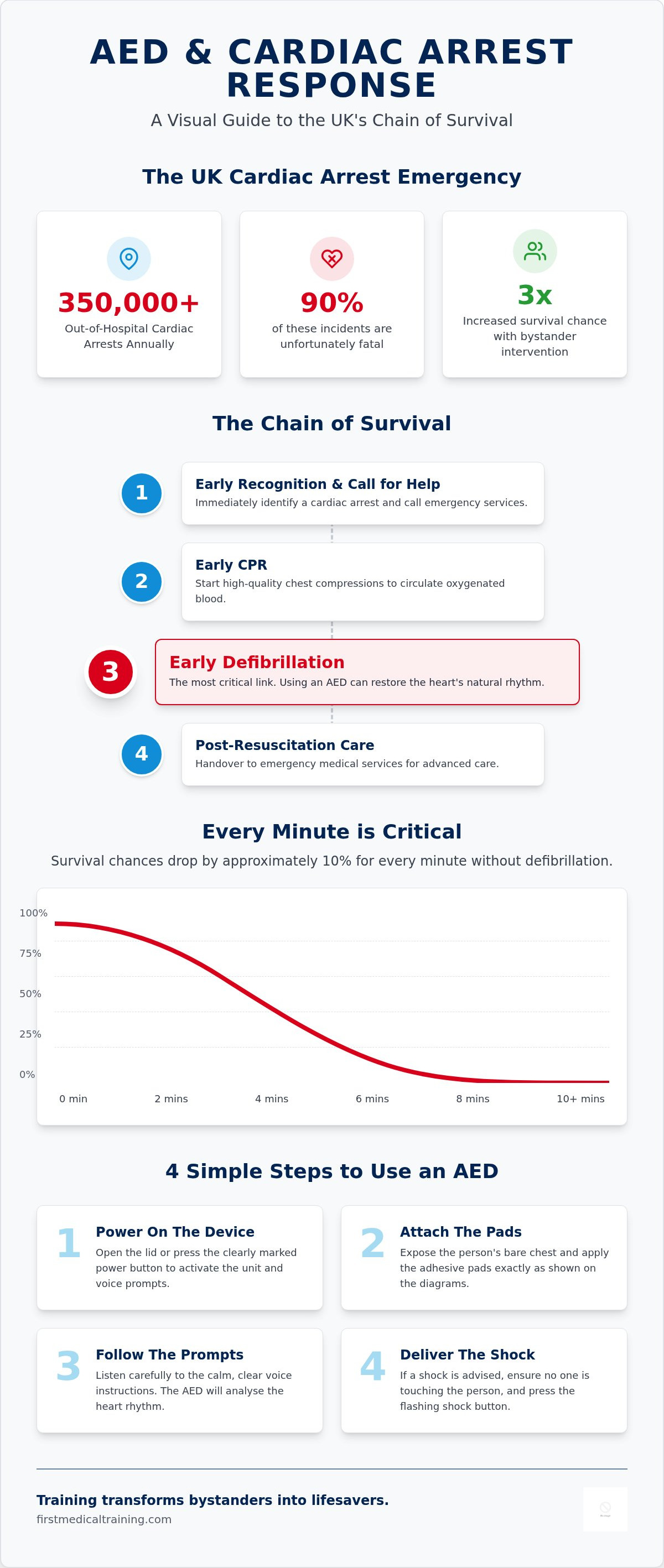
An automated external defibrillator course is a practical training programme designed to bridge the gap between witness and responder, turning a bystander into a capable life-saver. In the UK, more than 350,000 people experience cardiac arrest outside of a hospital every year, and 90% of these incidents are fatal. These figures highlight why workplace readiness isn't just a compliance box to tick; it's a moral and professional obligation. Central to this response is the "Chain of Survival," a series of four vital steps. Whilst early recognition and CPR are essential, early defibrillation remains the most critical link for increasing survival rates.
It's vital to distinguish between a heart attack and sudden cardiac arrest (SCA) to understand the focus of your training. A heart attack is a "plumbing" problem where blood flow is blocked, but the person is usually conscious. SCA is an "electrical" fault where the heart suddenly stops beating. An Automated external defibrillator (AED) is the only tool that can correct this electrical failure and give the patient a fighting chance.
Understanding Cardiac Arrest Physiology
During sudden cardiac arrest, the heart often enters a state called ventricular fibrillation (VF). You can think of this as the heart's electrical system becoming chaotic and "quivering" rather than pumping. An AED doesn't actually jump-start the heart like a car battery. Instead, it delivers a controlled shock to stop the chaotic activity entirely. This allows the heart's natural pacemaker to take over and resume a normal rhythm. CPR alone is rarely enough to fix this rhythm; it simply buys time by manually moving oxygenated blood to the brain until the device arrives.
The Critical Minutes: Time-to-Shock Ratios
Time is the enemy in a cardiac crisis. For every minute that passes without a shock, the probability of survival drops by approximately 10%. This is why an automated external defibrillator course focuses so heavily on rapid deployment and efficient team coordination. Your role as a responder is to maintain perfusion through high-quality chest compressions whilst the device is retrieved and applied. By mastering these skills, you aren't just waiting for help; you're actively buying the critical minutes needed for emergency services to arrive and provide advanced care.
What to Expect During Your Automated External Defibrillator Training
Many people hesitate to act in an emergency because they fear causing further harm. This psychological barrier is often the greatest hurdle to saving a life, but a professional automated external defibrillator course is specifically designed to dismantle these fears by replacing uncertainty with structured, practical experience. Most sessions follow a methodical half-day structure, allowing enough time for every participant to become comfortable with the equipment. You'll find a healthy balance between vital theoretical knowledge and intensive, hands-on manikin practice.
We utilise specialised "trainer AEDs" during these sessions. These devices mimic the visual and auditory prompts of live units but are incapable of delivering an actual shock. This allows you to practice the full sequence of events in a safe, controlled environment. The curriculum prioritises a "safety first" protocol, teaching you to assess the surrounding environment before initiating care. It's about ensuring the scene is safe for both you and the casualty, aligning with broader OSHA guidelines for AEDs in the workplace regarding responder safety and equipment readiness.
Step-by-Step Device Operation
Modern devices are designed to be intuitive, but training ensures you don't hesitate when seconds count. The operation generally follows a logical four-step guide:
- Switch on: Most units activate the moment you open the lid or press a clear power button.
- Attach pads: Apply the adhesive pads to the casualty's bare chest exactly as illustrated on the packaging.
- Follow prompts: The machine will give clear, calm voice instructions to guide your next move.
- Deliver shock: If the device advises a shock, ensure everyone is clear before pressing the button on semi-automatic models or allowing the machine to discharge on fully-automatic models.
You'll also learn the critical differences in pad placement for paediatric casualties. Using the correct positioning for children ensures the energy is delivered effectively, which is a vital skill for anyone working in schools or family-oriented environments.
Integrating CPR with Defibrillation
One of the most vital skills you'll master is the seamless transition between chest compressions and device analysis. High-quality CPR must continue whilst the AED is being prepared and the pads are being applied. However, you must not touch the casualty whilst the machine is analysing the heart rhythm, as this can lead to an incorrect reading. Clear communication amongst the rescue team is essential here; shouting "Stand clear" ensures everyone's safety. If you're looking to equip your team with these vital skills, our Automated External Defibrillator (AED) Training Course provides the hands-on confidence required for real-world response.
Who Should Attend? Assessing Training Needs for Workplaces and Dental Practices
In high-pressure environments like dental surgeries or busy offices, a medical emergency doesn't wait for a clinician to be present. Every member of the team, including receptionists and administrative staff, must possess AED proficiency. This ensures a coordinated response the moment a casualty is identified, even if the clinical staff are occupied with other patients. For a deeper look at specific clinical protocols, see our guide on cardiac arrest management in dental practice.
Beyond the dental sector, the Health and Safety Executive (HSE) recommends that first aiders in high-traffic or high-risk workplaces are trained in defibrillation. This is particularly relevant for environments like warehouses, gyms, or large retail centres where the risk of cardiac events is statistically higher. Business owners hold a legal duty of care to provide adequate life-saving equipment and training based on their specific risk assessment. Enrolling your staff in an automated external defibrillator course protects your team and visitors whilst fulfilling your professional obligations as a responsible employer.
Dental Practice Compliance and GDC Standards
AED training is a fundamental component of the "Medical Emergencies" core CPD requirement. The General Dental Council (GDC) expects all registrants to be highly competent in resuscitation and the use of emergency equipment. According to Resuscitation Council UK guidelines for primary care dental settings, this training should involve the whole dental team in a simulated environment to ensure everyone knows their role. You can find detailed information on maintaining these standards in our GDC CPD requirements for dentists guide, which highlights the necessity of annual refreshers for 2026 compliance.
Community and Public Access Defibrillation (PAD)
Outside the workplace, the need for training is equally pressing. Community leaders and residents are increasingly organising group sessions to ensure local PAD units are used effectively. Once your community has a device, it's vital to register it on "The Circuit," the national defibrillator network used by ambulance services. This ensures that when someone calls 999, the dispatcher knows exactly where your device is located. A professional automated external defibrillator course reduces the "bystander apathy" that often occurs when people feel unqualified to help. It replaces hesitation with a sense of community responsibility and the confidence to act when it matters most.
Certification, Compliance, and Maintaining Life-Saving Skills
Once you complete an automated external defibrillator course, you'll receive a certificate that typically remains valid for three years in the UK. Whilst this meets the baseline legal requirement for many workplaces, it doesn't account for the phenomenon of "skill fade." Research consistently shows that the practical skills required for effective resuscitation begin to decline within just a few months of training. This is why annual refreshers have become the gold standard for maintaining clinical confidence and ensuring your team can act without hesitation. It's also vital to understand the difference between Ofqual regulated certificates and CPD certified attendance. Ofqual qualifications provide a nationally recognised standard, whilst CPD certificates are often tailored to specific professional development needs, such as those required by the GDC.
Meticulous record-keeping is just as important as the training itself. Whether you're preparing for a CQC inspection or a standard workplace health and safety audit, you must be able to produce clear evidence of staff competency. Digital or paper-based training logs should include the names of attendees, the date of their last automated external defibrillator course, and the date their refresher is due. Inspectors don't just want to see that your team is "certified" on paper; they're looking for a culture of ongoing preparedness and safety.
The Importance of Annual Refresher Training
The Resuscitation Council UK is clear in its advice: CPR and AED drills should be practiced at least once every year. Robust dental practice emergency preparedness relies on these regular team rehearsals to ensure everyone knows their role in a crisis. It's not just about the person holding the defibrillator. It's about the team member calling the ambulance and the person managing the airway. You can keep these skills sharp between formal sessions by conducting monthly kit checks or running short, ten-minute "mock codes" during your regular staff meetings.
Maintaining Your Equipment
Even the best training is useless if your device isn't ready to fire when you need it. Basic maintenance is straightforward but essential. You must regularly check battery expiry dates and ensure that your electrode pads are still within their shelf-life. Most pads have a lifespan of around two years, whilst batteries can last up to five depending on the model. Appointing a dedicated "AED Lead" within your practice or office is a smart move to ensure these checks are never missed. Combining your training with the provision of high-quality emergency equipment creates a holistic safety strategy that protects both your staff and your patients. If your team is due for an update, you can book your next Automated External Defibrillator (AED) Training Course to ensure your compliance remains current for 2026.
Why Professional AED Training with First Medical Training Makes the Difference
Choosing an automated external defibrillator course is a decision that directly impacts the safety of your staff and patients. At First Medical Training, we've spent the last 20 years refining our approach to emergency education since our founding in 2006. We don't believe in a one-size-fits-all model. Instead, we offer a mentor-led experience that prioritises building genuine confidence amongst your team. Our goal is to ensure that every participant leaves feeling empowered to act, rather than simply possessing a certificate for compliance purposes. We act as a bridge between rigorous regulatory requirements and the real-world application of life-saving skills.
We specialise in bringing the training to you. By conducting sessions in your own surgery or workplace, we can tailor the scenarios to your specific environment. This practical approach allows us to identify the best locations for your equipment and the most efficient routes for your team to move during a crisis. Beyond training, we act as a trusted partner in your safety strategy, supplying essential tools like the LifeVac anti-choking device and high-quality AED units. This ensures you have the right equipment to match your team's high level of training.
Expert Instructors with Real-World Experience
Our training team is comprised of professionals with extensive clinical backgrounds. They don't just teach from a manual; they draw upon real-world emergency experience to make every lesson resonate. We use storytelling and scenario-based learning to ensure the information is memorable and applicable. This methodology is strictly aligned with the latest Resuscitation Council UK 2026 standards, ensuring your practice remains at the forefront of modern medical protocols. We believe that understanding the "why" behind a procedure is just as important as the "how" when it comes to performing under pressure.
Comprehensive Support Beyond the Classroom
Our relationship with your practice doesn't end when the course finishes. We help many of our clients manage their complex CPD cycles, ensuring that no staff member falls behind on their mandatory refreshers. Whether you need advice on the best AED pads for your specific model or require a full rescue kit audit, we're here to help. Our expertise in equipment supply means you'll always have access to the latest life-saving technology and reliable advice. If you're ready to elevate your team's readiness and ensure your practice is fully prepared for any emergency, we invite you to contact our team for a bespoke training quote tailored to your specific needs.
Empowering Your Team for a Life-Saving Response
Mastering the skills covered in an automated external defibrillator course is about more than just fulfilling a regulatory requirement; it's about the peace of mind that comes from being genuinely prepared. We've explored how early defibrillation serves as the most critical link in the Chain of Survival and why regular, annual refreshers are the only way to effectively combat skill fade. Whether you're managing a busy dental practice or a high-traffic office, your team's ability to act decisively in those first few minutes is what truly saves lives.
With over 20 years of medical training expertise and a specialist focus on dental and healthcare compliance, First Medical Training provides the highly-rated, mentor-led instruction you need to move beyond ticking boxes. Our approach ensures your staff don't just hold a certificate but possess the confidence to use their equipment under pressure. Don't wait for an emergency to test your readiness. You can Book Your Professional AED Training Course Today and take the first step toward a safer, more resilient workplace. Protecting your community starts with the right training, and we're here to guide you every step of the way.
Frequently Asked Questions
Do I need any previous medical experience to attend an AED course?
No, you don't need any prior medical background or healthcare experience to attend an automated external defibrillator course. These sessions are designed to be accessible to everyone, from office administrators and receptionists to community volunteers. The training starts with the basics of recognition and safety, ensuring that even a total beginner feels confident and capable by the end of the half-day session.
How long does an automated external defibrillator course take to complete?
A standard automated external defibrillator course typically takes between three and four hours to complete. This half-day structure allows for a focused delivery of essential theoretical knowledge followed by intensive hands-on practice with manikins and trainer devices. It's an efficient way to gain life-saving skills without requiring a significant time commitment away from your practice or office duties.
Is it possible to accidentally shock someone who is not in cardiac arrest?
It's virtually impossible to accidentally shock someone who doesn't need it. The device's internal software is designed to analyse the casualty's heart rhythm with extreme precision. If it doesn't detect a shockable rhythm, such as ventricular fibrillation, it simply won't charge or allow a shock to be delivered. You can't override this safety feature, which removes the fear of making a fatal mistake.
Can I use an AED on a casualty who is wet or lying on a metal surface?
Yes, you can use an AED in these environments, provided you follow specific safety protocols. If a casualty is wet or in a puddle, you should quickly dry their chest before applying the pads to ensure proper adhesion and electrical contact. Whilst using an AED on a metal surface is safe, you must ensure that the pads don't touch the metal and that nobody is in contact with the casualty during analysis or shock delivery.
What is the difference between a CPR course and an AED course?
A CPR course focuses exclusively on manual chest compressions and rescue breaths to maintain blood flow. An AED course includes these skills but adds the critical technical training required to operate a defibrillator safely. Since defibrillation is the only way to correct a chaotic heart rhythm, an integrated course is the modern standard for workplace safety and clinical compliance.
How often should my dental team refresh their AED training for GDC compliance?
The General Dental Council (GDC) and the Resuscitation Council UK recommend that dental teams undertake annual refresher training. Whilst a certificate might be valid for three years, annual drills are considered the gold standard for maintaining the clinical competence required in primary care settings. Regular sessions ensure that every team member, including non-clinical staff, remains sharp and ready to act in a crisis.
Will the course cover how to use different brands of defibrillators?
Yes, our training covers the universal principles of operation that apply to all major AED brands. Whilst the physical design or voice prompts might vary slightly between models, the core steps remain identical. We ensure you're comfortable with the general logic of these devices so that you can pick up any AED in a public space and use it effectively.
Are there any legal risks if I use an AED on someone and they do not survive?
There are no recorded instances in the UK of a layperson being successfully sued for using an AED in good faith. Under the Social Action, Responsibility and Heroism (SARAH) Act 2015, the courts take a positive view of individuals who act to help others in an emergency. The device itself provides clear instructions, and acting to save a life is always better than doing nothing at all.