
BLS Training for Dental Professionals: The 2026 Comparison and Compliance Guide

Imagine the silence in your surgery when a patient collapses, and instead of a coordinated response, there is only hesitation. With the 2026 Resuscitation Council UK guidelines now in full effect, that split-second delay isn't just a clinical risk; it is a compliance failure. Finding the right bls training for dental professionals has become more complex as the transition period ends, leaving many practice managers anxious about meeting the latest GDC standards and passing inspections.
We understand that coordinating practical training for a busy team is difficult, especially when you worry that staff might freeze during a real cardiac arrest. It is vital to move beyond tick-box exercises to ensure your team is genuinely prepared for a crisis. This guide provides a comprehensive comparison of training options to help you choose a provider that understands the unique dental environment. You will discover how to secure verifiable CPD whilst building a team that is calm, competent, and fully compliant with the 2026 regulations, from mandatory AED protocols to advanced airway management.
Key Takeaways
- Understand the mandatory GDC Enhanced CPD requirements for 2026 and why annual verifiable training is essential for every team member.
- Master the ABCDE primary survey approach specifically adapted for the dental surgery environment to ensure a rapid, structured response.
- Learn how to distinguish between BLS and ILS to ensure your dentists, nurses, and sedationists receive the correct level of training for their clinical roles.
- Discover how to choose the most effective bls training for dental professionals by comparing the benefits of online, classroom, and in-practice delivery methods.
- See how integrating modern equipment like the LifeVac anti-choking device and the latest AED protocols can significantly elevate your practice safety.
The 2026 Standard for BLS Training in UK Dentistry
The landscape of dental compliance has shifted significantly as we progress through 2026. The Resuscitation Council UK (RCUK) 2025 guidelines are now the clinical benchmark for all healthcare settings, with the transition period for full implementation ending on April 1, 2026. For practice managers, this means that outdated training materials no longer suffice. Effective bls training for dental professionals must now bridge the gap between theoretical knowledge and the physical reality of a medical emergency. Basic Life Support (BLS) acts as the critical bridge between the onset of an emergency and the arrival of advanced medical help, and its mastery is a prerequisite for safe clinical practice.
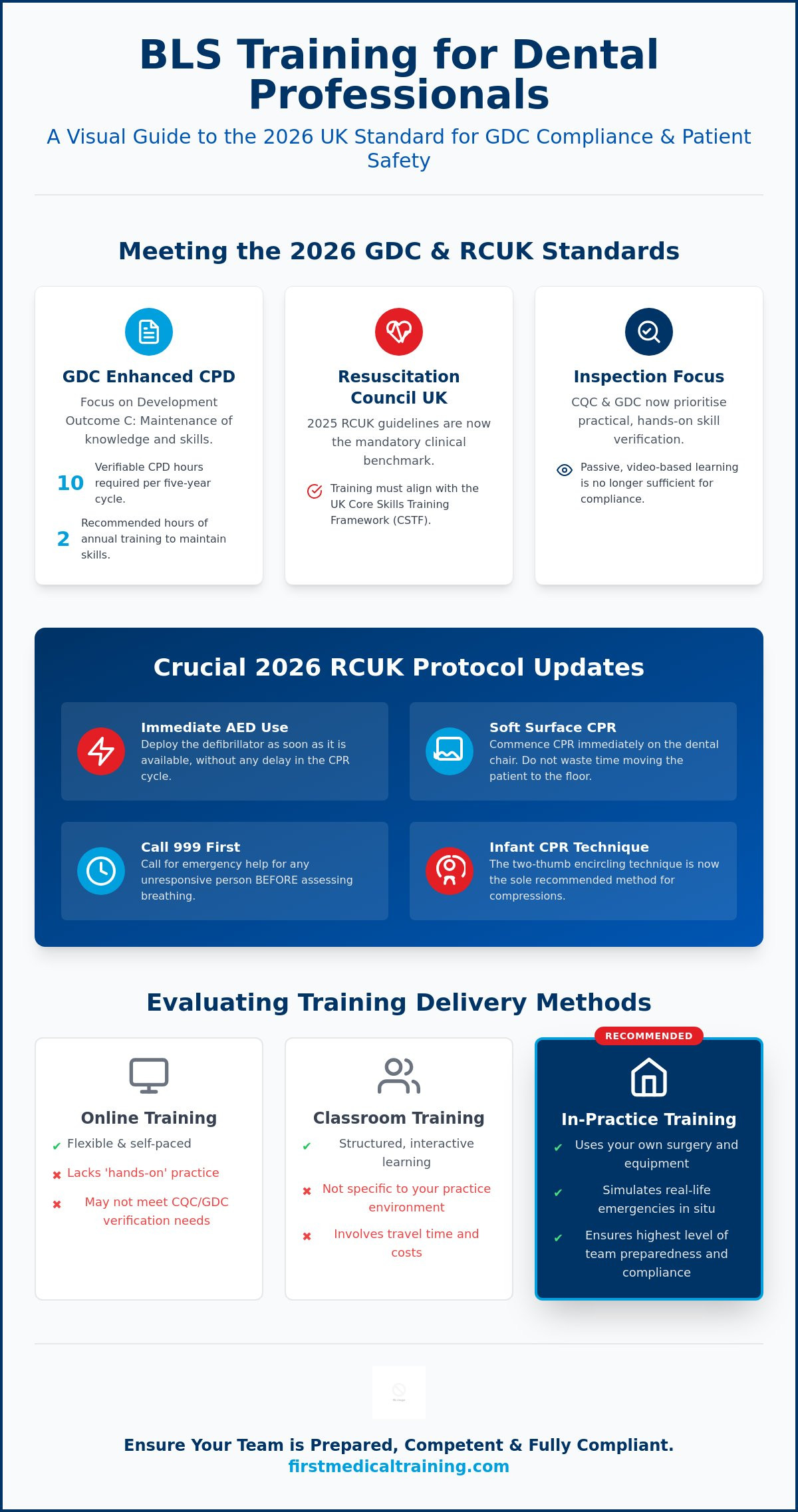
The General Dental Council (GDC) places medical emergencies at the heart of its Enhanced CPD framework. Whilst the formal requirement is 10 hours of verifiable CPD per five-year cycle, the GDC strongly recommends at least two hours of this training annually. This yearly rhythm ensures that life-saving skills don't fade over time. High-quality BLS training forms the bedrock of cardiac arrest management in dental practice, giving your team the confidence to act when every second counts. In 2026, the focus has moved away from passive, video-based learning towards rigorous practical assessments. The CQC and GDC now prioritise 'hands-on' verification to ensure that every staff member can physically perform high-quality CPR under pressure.
GDC Requirements and Development Outcomes
Compliance hinges on Development Outcome C, which focuses on the maintenance and development of knowledge and skills within your field of practice. To be considered 'verifiable', your training must provide a certificate that clearly states the participant's name, their GDC number, the date, and the total CPD hours earned. The course must have a clear set of aims, objectives, and anticipated outcomes that align with the GDC's standards. You'll need to keep these certificates organised within your CPD records, as they are a primary focus during inspections by both the GDC and the Care Quality Commission (CQC).
The Role of the Resuscitation Council UK (RCUK)
The RCUK Quality Standards for CPR are the gold standard for clinical education. Any professional dental BLS course should reflect the latest 2026 guidelines, such as the requirement to call 999 immediately for any unresponsive person before assessing their breathing. Training providers should also align with the UK Core Skills Training Framework (CSTF) to ensure consistency across the healthcare sector. By following these standards, your practice ensures that chest compressions and ventilation techniques are performed to the highest possible clinical standard, incorporating specific 2026 updates such as:
- Immediate AED Use: Deploying the defibrillator as soon as it is available without any delay in the cycle.
- Soft Surface Protocols: Commencing CPR immediately on the dental chair rather than wasting time moving the patient to the floor.
- Infant CPR: Utilising the two-thumb encircling technique as the sole recommended method for compressions.
Key Components of Basic Life Support for Dental Professionals
Effective bls training for dental professionals must account for the physical constraints of a clinical environment. Unlike a standard first aid course, dental BLS requires a deep understanding of the ABCDE approach (Airway, Breathing, Circulation, Disability, Exposure) within the confines of a treatment room. When a patient becomes unresponsive, the primary survey must be rapid and structured. In line with the latest 2026 clinical standards, your first action is to call 999 before assessing breathing. This ensures that advanced life support is already en route whilst you begin your initial interventions.
Chest compressions remain the priority for circulation. For adults, maintain a depth of 5-6cm at a rate of 100-120 compressions per minute. Paediatric variations are critical; for infants, the 2026 guidelines now mandate the two-thumb encircling technique as the only recommended method. Managing a choking patient also requires a specific protocol. Whilst manual back blows and abdominal thrusts are the traditional first line of defence, modern practice often integrates the use of anti-choking devices to clear stubborn obstructions quickly. Every team member must also be proficient in the safe use of an Automated External Defibrillator (AED), ensuring pads are placed correctly even amongst the complex electrical equipment of a modern surgery.
Managing Patient Collapse in the Chair
A common anxiety for dental teams is managing a patient collapse dental surgery training scenario without causing further injury. If a patient loses consciousness in the chair, the immediate priority is to lower the chair back to a horizontal position to improve cerebral blood flow. The 'D' in ABCDE stands for Disability; here, you assess the patient's neurological status using the AVPU scale (Alert, Voice, Pain, Unresponsive). A successful outcome depends on clear communication protocols. Assigning specific roles—such as the dentist leading the resuscitation, the nurse managing the airway, and the receptionist coordinating with emergency services—prevents the chaos that often leads to clinical errors.
Emergency Drugs and Oxygen Administration
The BLS responder's role extends to the efficient preparation of the emergency kit. During a crisis, the dentist needs the correct dosage of Adrenaline, Aspirin, or Salbutamol ready for immediate use. Oxygen administration is equally vital; for most medical emergencies, a high-flow oxygen mask (non-rebreather) at a rate of 15 litres per minute is the standard requirement. According to General Dental Council (GDC) guidance, maintaining these skills is a professional obligation for all registrants. For 2026, the GDC mandates that the minimum essential drugs list must include Glyceryl Trinitrate spray, Salbutamol inhaler, Adrenaline injection (1:1000), Aspirin (300mg), Glucagon injection, and Midazolam oromucosal solution.
Ensuring your team is prepared for these high-pressure moments starts with a specialised medical emergencies course tailored specifically to your practice layout.
BLS vs ILS: Choosing the Right Level for Your Clinical Staff
Deciding between Basic Life Support (BLS) and Immediate Life Support (ILS) isn't merely a matter of administrative preference; it's a strategic decision based on clinical risk. For the majority of your team, bls training for dental professionals provides the essential foundation required to recognise a medical emergency and sustain life until help arrives. However, as dental procedures evolve to include more complex interventions, the boundary between "basic" and "advanced" support becomes critical. The Resuscitation Council UK Quality Standards provide a framework for these requirements, ensuring that the level of training matches the potential complications of the treatment being provided.
Mapping these training levels to job roles is the most efficient way to manage practice compliance. Whilst dentists and dental nurses in general practice typically rely on BLS, those working with IV sedation or performing advanced oral surgery often require the enhanced skills found in ILS. This higher level of training involves a deeper understanding of patient deterioration, allowing clinicians to intervene during the "peri-arrest" phase before a full cardiac arrest occurs. Balancing the additional training time for ILS against the clinical risks of your specific practice is a vital part of your annual safety audit.
When is BLS Sufficient?
Basic Life Support remains the gold standard for the vast majority of the dental team. For receptionists and administrative staff, BLS provides the confidence to manage the initial stages of a crisis, such as calling emergency services and deploying the AED. It's a team-based approach where every member, regardless of their clinical status, is trained to a uniform standard. This ensures that if a clinician is occupied, any other staff member can step in to provide effective chest compressions and ventilations without hesitation.
The Case for Immediate Life Support (ILS)
Immediate Life Support moves beyond the basics by introducing advanced airway management techniques. This includes the use of Oropharyngeal (OP) airways and Supraglottic Airway Devices (SADs), which are far more effective than a simple pocket mask during prolonged resuscitation. ILS also trains clinical staff to recognise specific heart rhythms and, where the equipment is available, utilise manual defibrillation features. Integrating these advanced skills significantly enhances the outcomes of a medical emergencies in a dental practice course, as it prepares the team for the technical realities of managing a patient who isn't responding to standard BLS protocols.
Ultimately, the choice depends on your patient demographic and the complexity of your clinical list. If your practice regularly treats medically compromised patients or utilises sedation, upgrading your clinical lead's training to ILS offers an extra layer of reassurance that goes beyond simple GDC compliance.
Evaluating Training Providers: Online, Classroom, or In-Practice?
Choosing the right delivery method for bls training for dental professionals is a decision that impacts both your budget and your team's clinical readiness. Whilst online courses offer a convenient way to cover theoretical components, they cannot replace the tactile experience of performing chest compressions on a manikin or deploying a defibrillator. For 2026, the GDC is increasingly rigorous about 'hands-on' verification. A purely digital certificate may satisfy a basic administrative requirement, but it rarely provides the clinical confidence needed when a patient's life is at stake. Practical, face-to-face assessment is now the non-negotiable standard for clinical staff who must prove their competency under pressure.
Vetting your training provider is essential to avoid compliance gaps. You should look for accreditation from recognised bodies and ensure the company carries robust professional indemnity insurance. Crucially, ask about the tutor's clinical background. An instructor who has worked in a dental or emergency medical environment will offer practical insights that a generalist trainer simply cannot provide. They understand the specific challenges of a dental surgery, from the narrow spaces between equipment to the unique physiological responses of patients undergoing dental procedures.
The preference for this type of focused, immersive education is growing across many professional fields. Just as an Intensive Residential Driving School (IRDS) provides a dedicated environment for individuals to master complex skills in a condensed timeframe, choosing a high-impact, in-practice BLS course ensures your team achieves clinical competency without the distractions of a fragmented training schedule.
The Value of In-Surgery Simulations
Training within your own practice environment allows you to identify physical 'blind spots' that might hinder an emergency response. For example, you might discover that a specific surgery layout makes it difficult to move the emergency trolley or that the receptionist cannot hear a call for help from the back of the building. Using your own AED and oxygen cylinders during the session ensures that every team member is familiar with the exact equipment they will use in a crisis. This rehearsal in the actual environment builds a level of team cohesion and muscle memory that a classroom setting cannot replicate.
GDC Compliance and Certification Audit
Your training certificates must be robust enough to withstand a CQC or GDC audit. They should clearly align with the GDC CPD requirements for medical emergencies, detailing the specific learning outcomes achieved. To maintain a smooth patient flow, many practices find that booking a dedicated training half-day is more effective than trying to squeeze sessions into lunch breaks. A 'certificate of attendance' is insufficient for verifiable CPD purposes because it fails to document the specific skills and knowledge that have been assessed and confirmed by the trainer.
Ensure your practice remains fully compliant and your team feels empowered to act. Book an in-practice medical emergencies course to ensure your training is as realistic as possible.
Elevating Practice Safety with First Medical Training
With a 20-year legacy in providing specialised emergency education, First Medical Training has established itself as a trusted partner for dental teams across the UK. We understand that bls training for dental professionals is about more than just obtaining a certificate; it is about fostering a culture of clinical excellence and readiness. Our instructors bring decades of real-world experience into your surgery, ensuring that every session is grounded in the practical realities of the dental environment. We don't just teach the protocols; we help you master them within the specific layout of your practice.
Our curriculum stays at the forefront of medical advancement by integrating modern life-saving technology into every session. We provide comprehensive instruction on the LifeVac anti-choking device, an essential tool for clearing airway obstructions when traditional methods fail. We also ensure your team is proficient with the latest AED protocols, reflecting the 2026 requirement for immediate defibrillation. By sourcing your equipment and training from a single expert provider, you ensure that your gear is always rescue-ready and your staff are fully competent in its use.
Beyond Resuscitation: A Holistic Approach
A truly prepared team is one that is resilient both clinically and emotionally. This is why we include Mental Health First Aid for dental practices within our wider educational framework. Dental professionals often face high-pressure environments that can lead to significant stress and burnout. Our holistic approach aims to reduce staff anxiety by providing 'reassuringly confident' training. When your team feels supported in their wellbeing, they are better equipped to remain calm and decisive during a physical medical emergency.
Booking Your Team's 2026 Training
Organising your annual refresher doesn't have to be a logistical burden. We offer flexible 1-day EFAW courses tailored specifically for the dental sector, alongside our core resuscitation programmes. For organisations with multiple sites, our national delivery model ensures that every one of your practices meets the same high standard of dental practice emergency preparedness. This consistency is vital for maintaining compliance across a larger group and ensuring that every staff member receives the same quality of verifiable CPD.
Don't wait for an inspection or, worse, a real-life emergency to find the gaps in your team's skills. Preparation is the only antidote to panic. Secure your 2026 Dental BLS training dates today and ensure your practice remains a safe, compliant, and confident environment for both patients and staff.
Secure Your Practice's Clinical Future
As 2026 progresses, the margin for error in dental emergency preparedness has narrowed. Ensuring your team meets the latest Resuscitation Council UK guidelines isn't just about ticking a box for the GDC; it's about building a culture of safety that protects your patients and your professional reputation. By prioritising in-practice simulations, you move beyond theoretical knowledge to practical mastery of the ABCDE approach and the safe use of life-saving equipment like the LifeVac anti-choking device.
Selecting the right bls training for dental professionals is a strategic investment in your team's confidence and competence. Established in 2006, First Medical Training is a specialist provider of Dental ILS and Mental Health First Aid, committed to delivering training that is both rigorous and reassuringly confident. Book Your GDC-Compliant Dental BLS Training Now to ensure your practice remains a safe and compliant environment for everyone.
You have the expertise to provide exceptional dental care. Let us help you gain the steady reliability to protect that care in any medical emergency.
Frequently Asked Questions
Is BLS training mandatory for dental receptionists in the UK?
Yes, Basic Life Support training is essential for dental receptionists as part of a whole-team approach to patient safety. Whilst they are non-clinical, receptionists are often the first to identify a waiting room emergency or coordinate with the emergency services. The GDC and Resuscitation Council UK emphasise that every staff member must be capable of supporting the clinical team during a crisis, including deploying the AED.
How often do dental professionals need to refresh their BLS training?
Dental professionals must refresh their skills annually to remain compliant with GDC recommendations. The council suggests a minimum of two hours of verifiable CPD in medical emergencies every year to prevent skill fade. This regular rhythm ensures that life-saving techniques, such as high-quality chest compressions and ventilation, remain sharp. Maintaining an up-to-date certificate is a core requirement for your professional indemnity and CQC inspections.
Can I complete my dental BLS training entirely online in 2026?
You cannot complete your 2026 bls training for dental professionals entirely online if you require verifiable CPD. While theoretical modules can be studied digitally, the GDC and RCUK require a face-to-face practical assessment. Clinicians must demonstrate physical competency with manikins and AEDs to prove they can perform these skills correctly. A purely online course lacks the physical verification necessary for clinical compliance in a surgery environment.
What is the difference between BLS and ILS for a General Dental Practitioner?
The primary difference lies in the complexity of the airway and cardiac interventions. BLS focuses on CPR, AED use, and basic airway management using pocket masks. In contrast, Immediate Life Support (ILS) includes advanced airway adjuncts and the recognition of peri-arrest rhythms. ILS is specifically recommended for those performing IV sedation or complex oral surgery where the risk of patient deterioration is significantly higher.
Does BLS training for dentists include paediatric resuscitation?
Yes, comprehensive training must include paediatric resuscitation protocols to cover your entire patient demographic. Your team must be proficient in adult, child, and infant CPR variations. This includes mastering the specific 2026 guideline for infant compressions, which mandates the two-thumb encircling technique. Understanding these variations is vital for any practice that treats families, ensuring the safety of the smallest patients in your care.
What emergency equipment must be present during a BLS training session?
A standard training session should utilise the equipment found in your practice's emergency kit. This includes an Automated External Defibrillator (AED), medical oxygen cylinders with high-flow masks, and basic airway adjuncts. Using your own equipment during a simulated emergency helps identify any maintenance issues. It also ensures that every team member knows exactly where to find and how to operate the kit during a real crisis.
How many CPD hours does a standard Dental BLS course provide?
A standard bls training for dental professionals course typically provides between two and three hours of verifiable CPD. This aligns perfectly with the GDC's annual recommendation for medical emergency training. To be valid, your certificate must clearly state the learning outcomes, your GDC number, and the date of the session. This provides clear, documented evidence of your commitment to maintaining high clinical standards and professional readiness.
What happens if our practice fails to meet the GDC medical emergency training standards?
Failing to meet GDC and CQC training standards carries serious professional and legal consequences. During an inspection, inadequate training records can lead to a 'requires improvement' rating or formal enforcement action. More importantly, it leaves the practice vulnerable to clinical negligence claims and fitness to practise hearings if a medical emergency is managed poorly due to a lack of verified staff competency and regular rehearsal.