

Continuing Professional Development in Dentistry: The 2026 UK Compliance Guide

Could your professional registration survive a General Dental Council audit tomorrow morning? For many practitioners, the fear of being removed from the register due to a simple administrative oversight is a constant, underlying stressor. You likely feel that managing continuing professional development in dentistry is a complex maze of hours that pulls you away from your patients. It's a common frustration to find high-quality training that fits into a packed surgery schedule without feeling like a box-ticking exercise.
This guide is designed to help you master the GDC requirements for 2026. We'll show you how to build a robust Personal Development Plan that simplifies your compliance whilst prioritising clinical excellence and patient safety. We'll break down the 2026 deadlines, the specific hour requirements for your role, and the essential protocols for handling medical emergencies with confidence. By the end of this article, you'll have a structured roadmap to turn regulatory demands into a source of professional pride.
Key Takeaways
- Navigate the GDC 5-year cycle with confidence by understanding the specific verifiable hour requirements for dentists and dental care professionals.
- Develop a robust Personal Development Plan that aligns your continuing professional development in dentistry with clinical excellence and patient safety goals.
- Prioritise "Highly Recommended" topics, ensuring your team meets the mandatory requirements for medical emergencies and disinfection protocols.
- Distinguish between verifiable and general CPD to protect your registration and ensure every training session counts towards your annual statement.
- Implement a whole-team approach to emergency response training to build a culture of readiness and collective competence in your surgery.
Understanding the Enhanced CPD Scheme for UK Dental Professionals
The Enhanced CPD scheme, introduced by the General Dental Council (GDC), shifted the focus of professional growth from passive attendance to active, planned development. Its primary objective is straightforward: to ensure that every member of the dental team is equipped to provide the highest standard of patient care. By engaging in Continuing Professional Development (CPD), you demonstrate a clear commitment to maintaining your skills in a field that evolves daily. It is no longer enough to simply "do the hours"; you must now show how that learning impacts your daily practice.
The 5-Year Cycle and Annual Declarations
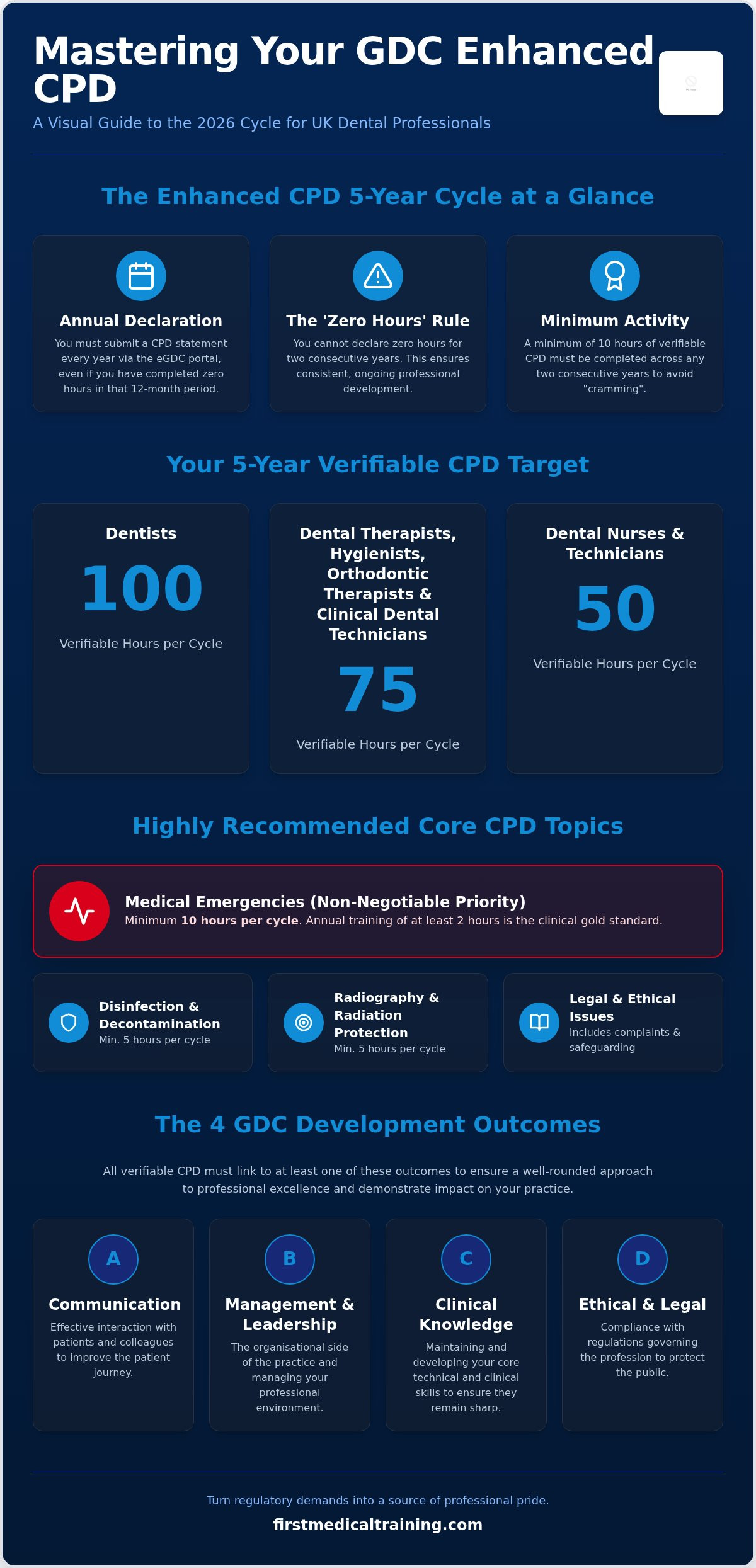
The system operates on a fixed five-year cycle, but your responsibilities are annual. Every year, you're required to submit a declaration through the eGDC portal. This is a mandatory step, even if you've completed zero hours in that specific twelve-month period. However, you cannot declare zero hours for two consecutive years. This rule ensures that practitioners don't leave their entire requirement until the final year of the cycle. For the 2026 cycle, Dental Care Professionals (DCPs) must submit their annual statement by 28 August. Neglecting these administrative milestones is a common reason for registration appeals, so staying organised is vital for your peace of mind.
The total number of verifiable hours required depends on your specific registration. Dentists must complete 100 hours per cycle. Dental therapists, hygienists, orthodontic therapists, and clinical dental technicians require 75 hours. Dental nurses and technicians are required to complete 50 hours. Regardless of your role, you must complete at least 10 hours of verifiable CPD in any two consecutive years. This structure prevents "cramming" and encourages a culture of consistent, lifelong learning.
The Four GDC Development Outcomes
To qualify as verifiable, your continuing professional development in dentistry must align with at least one of the four GDC development outcomes. These categories are designed to ensure a well-rounded approach to professional excellence:
- Outcome A: Communication and effective team working. This focuses on how you interact with patients and your colleagues to improve the patient journey.
- Outcome B: Effective management and leadership. This covers the organisational side of the practice and how you manage your own professional environment.
- Outcome C: Maintenance and development of clinical knowledge. This is the technical core of your practice, ensuring your clinical skills remain sharp.
- Outcome D: Ethical and legal requirements. This ensures you're fully compliant with the regulations that govern the profession and protect the public.
When you record your hours, you must link each activity to one of these outcomes. This provides a clear audit trail that shows you're developing across the full spectrum of your professional duties, rather than just focusing on a single area of interest.
Core Requirements and Highly Recommended CPD Topics for 2026
While the GDC allows for a broad range of learning activities, certain subjects are designated as "Highly Recommended" because they're fundamental to patient safety and clinical governance. These topics form the backbone of your continuing professional development in dentistry and should be prioritised in your five-year cycle. By focusing on these core areas, you ensure that your practice remains aligned with the latest evidence-based standards and regulatory expectations.
For the 2026 compliance year, all registrants should ensure they're on track with the following recommended topics:
- Medical Emergencies: At least 10 hours per cycle, with a recommendation for at least two hours of training every year.
- Disinfection and Decontamination: A minimum of five hours per cycle.
- Radiography and Radiation Protection: A minimum of five hours per cycle for dentists and dental care professionals who take or process radiographs.
- Legal and Ethical Issues: Including complaints handling and safeguarding.
Medical Emergencies: The Non-Negotiable Priority
The GDC is clear that medical emergency training isn't a one-off requirement; it's a skill that requires regular reinforcement. Because life-saving protocols can easily be forgotten in the high-pressure environment of a busy surgery, annual training is considered the clinical gold standard. This frequent practice ensures that every team member, from the lead clinician to the apprentice nurse, knows exactly how to respond when seconds count. Under the GDC's Enhanced CPD Scheme, this training is directly linked to Development Outcome C, which focuses on the maintenance and development of clinical knowledge and skills.
Practical, hands-on sessions are far more effective than passive reading for this specific topic. Our Medical Emergencies in a Dental Practice Course is designed to meet these annual requirements whilst building genuine clinical confidence through realistic scenarios. It's a pragmatic way to ensure your team is prepared for the unexpected whilst fulfilling your verifiable hour count.
Emerging CPD Trends: Mental Health and Wellbeing
In recent years, the dental profession has seen a significant shift towards acknowledging the importance of mental health and wellbeing. A healthy practice environment isn't just better for the staff; it leads to better outcomes for patients. Integrating Mental Health First Aid for Dental Practices into your CPD portfolio is a proactive way to support your team and improve staff retention. This type of training helps colleagues identify signs of stress or burnout, providing them with the tools to offer support before a crisis occurs. Whilst not a mandatory "core" topic, it's increasingly seen as an essential component of a modern, patient-centred practice that values the human element of care.
Creating an Effective Personal Development Plan (PDP) and Reflective Record
Under the Enhanced CPD scheme, a Personal Development Plan (PDP) is a mandatory living document that must be in place before you undertake any learning. It isn't a one-off task to be filed away; it's a strategic roadmap that ensures your continuing professional development in dentistry remains relevant to your specific role and patient demographic. By planning your development in advance, you shift from a reactive approach to a proactive one, ensuring every hour spent training contributes directly to your clinical excellence. This structured approach is a core part of meeting the General Dental Council CPD requirements and maintaining your professional standing.
Laying the Foundation: Identifying Your Learning Needs
To create an effective PDP, start by auditing your current skill set against the daily realities of your surgery. If you treat a high volume of medically compromised patients, for example, your plan should prioritise advanced emergency response and pharmacology. You should align these goals with the specific GDC development outcomes (A, B, C, or D) to ensure a balanced portfolio. Planning your five-year cycle in this way helps you avoid the stressful last-minute scramble for hours as your registration deadline approaches.
The Art of Reflective Writing in Dentistry
Reflective practice is the final, crucial piece of the compliance puzzle. The GDC values reflection because it demonstrates that you've processed new information and considered its real-world application. Attendance certificates prove you were in the room, but a reflective record proves you actually learned. A concise reflection should answer three questions: what did you learn, how is it relevant to your PDP, and how will it change your clinical behaviour or practice management?
Using reflection to justify your chosen continuing professional development in dentistry allows you to build a cohesive narrative of professional growth. For instance, after an ILS session, you might reflect on how a specific simulation improved your team's communication during a crisis. This level of detail provides the GDC with clear evidence that your training is meaningful, purposeful, and directly impacts the safety of the patients in your care.
Navigating Verifiable vs. General CPD: Quality Standards in Training
Understanding the distinction between verifiable and general learning is fundamental to maintaining your registration. General CPD includes activities like reading dental journals or viewing unverified webinars. Whilst these are excellent for staying informed, they don't count towards your mandatory hour requirement. For an activity to be classed as verifiable continuing professional development in dentistry, it must meet strict GDC criteria. This includes having clear learning aims, anticipated outcomes, and a robust quality control process. High-quality training isn't just about accumulating hours; it's about ensuring the information you receive is evidence-based and clinically sound.
Criteria for Verifiable CPD Certificates
A valid CPD certificate is more than just a proof of attendance. To satisfy an audit, the document must clearly state your name, your GDC registration number, the date, and the total number of hours completed. Crucially, it must also identify which of the four GDC development outcomes the training addressed. There must be a clear evaluation process where you, as the participant, can provide feedback on the training's effectiveness. First Medical Training Ltd ensures all certificates meet these rigorous standards, providing you with a standardised record that is ready for inspection at any time.
When you're choosing a provider, look for established credentials and industry experience. A reputable training company should be transparent about their instructors' qualifications and the clinical guidelines they follow. This transparency gives you the confidence that your time is being invested in education that actually enhances your professional capability. It also ensures that the reflective record you create afterwards is based on high-quality, relevant content.
In-Practice Training vs. Online Learning
Digital modules offer convenience, but they often lack the depth required for life-saving clinical skills. For instance, syncope management dental training requires a physical understanding of patient positioning and airway management that a screen simply cannot provide. Hands-on, in-practice training allows your entire team to practice together in the environment where an actual emergency would occur. This "whole-team" approach is invaluable for building the collective muscle memory needed for a swift, organised response.
Effective cardiac arrest management in dental practice relies on the seamless use of an AED and coordinated chest compressions. Practising these physical skills on high-fidelity manikins ensures that every staff member, from the receptionist to the lead clinician, knows their specific role in a crisis. This group learning dynamic fosters team cohesion and reduces the individual anxiety often associated with medical emergencies. If you want to ensure your surgery is fully prepared, you can book a hands-on medical emergencies course for your entire team today.
Integrating Emergency CPD into Your Practice’s Annual Training Calendar
Integrating mandatory training into a busy surgery schedule requires a pragmatic approach. Many practices find that dedicating a specific "Core CPD Day" once or twice a year is the most efficient way to manage continuing professional development in dentistry. By closing the surgery for a morning or a full day, you eliminate the distraction of patient appointments and allow the team to focus entirely on life-saving skills. This structured time should be used to review your dental practice emergency preparedness, ensuring all medical equipment is functional and protocols are current.
Emergency response isn't solely the clinician's responsibility. If a patient collapses in the waiting room, the receptionist is often the first responder. If a crisis occurs chairside, the nurse's ability to locate the AED or prepare the emergency drugs is vital. A whole-team approach ensures that every member of staff possesses the same baseline of emergency skills. This collective competence is a cornerstone of professional excellence and directly impacts the safety of every patient who walks through your door.
The Annual Medical Emergency Drill
Online modules have their place for theoretical knowledge, but they can't replicate the physical pressure of a medical emergency drill. An annual in-practice course allows the team to rehearse Dental ILS and AED training in their actual workspace. This helps identify logistical bottlenecks, such as the accessibility of the emergency kit or the clarity of the practice's 999 protocol. Clearly defined roles prevent confusion during a real-life patient collapse, turning a potentially chaotic scene into a coordinated and effective rescue effort.
Building a Culture of Continuous Improvement
A high-performing practice treats every near-miss or clinical incident as a learning opportunity. You should encourage your staff to suggest CPD topics based on real-world challenges they've faced in the surgery. This ensures your continuing professional development in dentistry remains grounded in the practicalities of your specific environment. First Medical Training Ltd supports this by offering bespoke training solutions tailored to your team's unique needs and patient demographic, helping you move beyond basic compliance towards genuine clinical mastery.
Stay organised by setting digital reminders for certificate expiry and PDP reviews. Don't wait for a GDC audit to discover a gap in your compliance records. Review your PDP today and ensure your team's emergency training is up to date for the 2026 cycle.
Secure Your Practice’s Clinical Future
Navigating the GDC requirements for 2026 is about more than avoiding registration risks; it is an opportunity to strengthen your clinical foundation. By integrating a robust PDP and focusing on high-quality, verifiable learning, you transform the mandatory process of continuing professional development in dentistry into a source of genuine team confidence. Patient safety and clinical excellence are the natural results of this proactive, organised approach to professional growth.
Since 2006, First Medical Training Ltd has acted as a dependable partner for dental professionals across the UK. We provide specialised compliance solutions, from accredited hands-on courses to essential equipment like LifeVac devices and AEDs. Our veteran instructors ensure your team is not just compliant, but truly capable of responding to a crisis with poise. Book your practice’s Medical Emergencies in a Dental Practice Course today and lead your surgery with the quiet confidence that comes from expert preparation.
Frequently Asked Questions
How many hours of CPD do I need to complete as a dentist in 2026?
Dentists are required to complete a minimum of 100 hours of verifiable CPD over a five-year cycle. You must also ensure that you complete at least 10 hours of verifiable learning in any two consecutive years. This structure is designed to encourage consistent professional growth rather than a last-minute rush at the end of the cycle. Every year, you must submit an annual statement on the eGDC portal to confirm your progress.
What are the GDC highly recommended topics for dental CPD?
The GDC specifies several "Highly Recommended" topics that are essential for patient safety. These include Medical Emergencies (at least 10 hours per cycle), Disinfection and Decontamination (at least 5 hours per cycle), and Radiography and Radiation Protection (at least 5 hours per cycle). Engaging in continuing professional development in dentistry should also cover other recommended areas such as legal and ethical issues, complaints handling, and safeguarding vulnerable patients to ensure a well-rounded portfolio.
Is online medical emergency training sufficient for GDC compliance?
Whilst online modules can count towards your verifiable hours, they aren't the clinical gold standard for emergency readiness. The GDC recommends at least two hours of medical emergency training annually, and hands-on sessions are far more effective for building team cohesion. Physical practice with equipment like AEDs and airway management tools ensures that your team possesses the muscle memory needed to act decisively. Practical training turns theoretical knowledge into a reliable, life-saving skill set.
What happens if I fail to meet my CPD requirements by the end of my cycle?
Failure to meet your CPD requirements can lead to your removal from the GDC register. If this occurs, you'll be unable to practice dentistry legally in the UK until you've successfully applied for restoration. This process is often complex and requires you to prove that you've corrected any deficiencies in your training. Maintaining a structured Personal Development Plan is the most effective way to protect your registration and avoid these severe professional consequences.
Can I carry over extra CPD hours into my next five-year cycle?
No, you cannot carry over any surplus hours into a new five-year cycle. Each cycle is a distinct period with its own specific hour requirements. If you complete more than the mandated 100, 75, or 50 hours, those additional hours won't reduce the amount you need to complete in the following five years. This policy ensures that all dental professionals remain current with the latest clinical standards and evidence-based practices throughout their careers.
Do dental receptionists need to complete verifiable CPD?
Receptionists who aren't GDC-registered aren't legally required to complete verifiable CPD. However, most high-performing practices include them in annual medical emergency drills and safeguarding training. Since receptionists are often the first point of contact during a waiting-room crisis, their ability to assist is vital for patient safety. If a receptionist is also a registered dental nurse, they must fulfil the full CPD requirements for their registrant category to maintain their professional status.
How often should a dental team undergo Medical Emergencies training?
The GDC recommends that dental teams participate in medical emergency training at least once every year. Your total requirement is 10 hours of verifiable CPD in this topic per cycle, but annual sessions ensure that skills remain sharp and protocols are fresh in everyone's mind. Conducting this training as a whole team in your own surgery is particularly effective. It allows staff to practice with their own equipment and understand their specific roles during a patient collapse.
What is the difference between ILS and BLS in a dental context?
Basic Life Support (BLS) focuses on the core skills of CPR and the use of an Automated External Defibrillator. Dental Immediate Life Support (ILS) is a more advanced level of training that builds upon these fundamentals. It includes airway management, the administration of emergency drugs, and the coordination of a team-based response within a clinical environment. ILS is specifically designed for healthcare professionals who may need to manage a patient until an ambulance crew arrives at the surgery.