

Dental Emergency Response Team Roles: The 2026 UK Practice Guide

Did you know that the average UK dental practitioner will face a life-threatening medical emergency in their surgery approximately once every four and a half years? It's a sobering statistic that explains why so many professionals feel a surge of anxiety during mock drills or when the emergency kit is actually opened. Establishing clear dental emergency response team roles is the only way to replace that uncertainty with a structured, life-saving response that meets 2026 GDC standards.
You aren't alone if you worry about a patient collapsing whilst in the chair or fear falling short of clinical requirements during a crisis. This guide provides the roadmap you need to establish a clear hierarchy of duty within your practice. We'll examine how to delegate responsibilities effectively, ensuring that everything from calling 999 to deploying an AED or a LifeVac anti-choking device happens with clinical precision. By the end, you'll have the confidence to lead your team through any medical crisis with total professional readiness.
Key Takeaways
- Establish defined dental emergency response team roles to eliminate the "bystander effect" and ensure every staff member acts with immediate, clinical precision.
- Learn how the Clinical Lead maintains a vital overview of the resuscitation effort whilst making critical decisions regarding emergency drug administration.
- Master the specific nursing responsibilities for airway management and circulation support to ensure high-quality chest compressions and oxygen delivery.
- Understand the essential role of reception staff in managing emergency communications and retrieving critical equipment like the AED and LifeVac anti-choking device.
- Discover how First Medical Training Ltd helps you implement structured mock drills and annual training to maintain GDC compliance and build genuine team confidence.
Why Defined Roles are Critical for Dental Emergency Preparedness
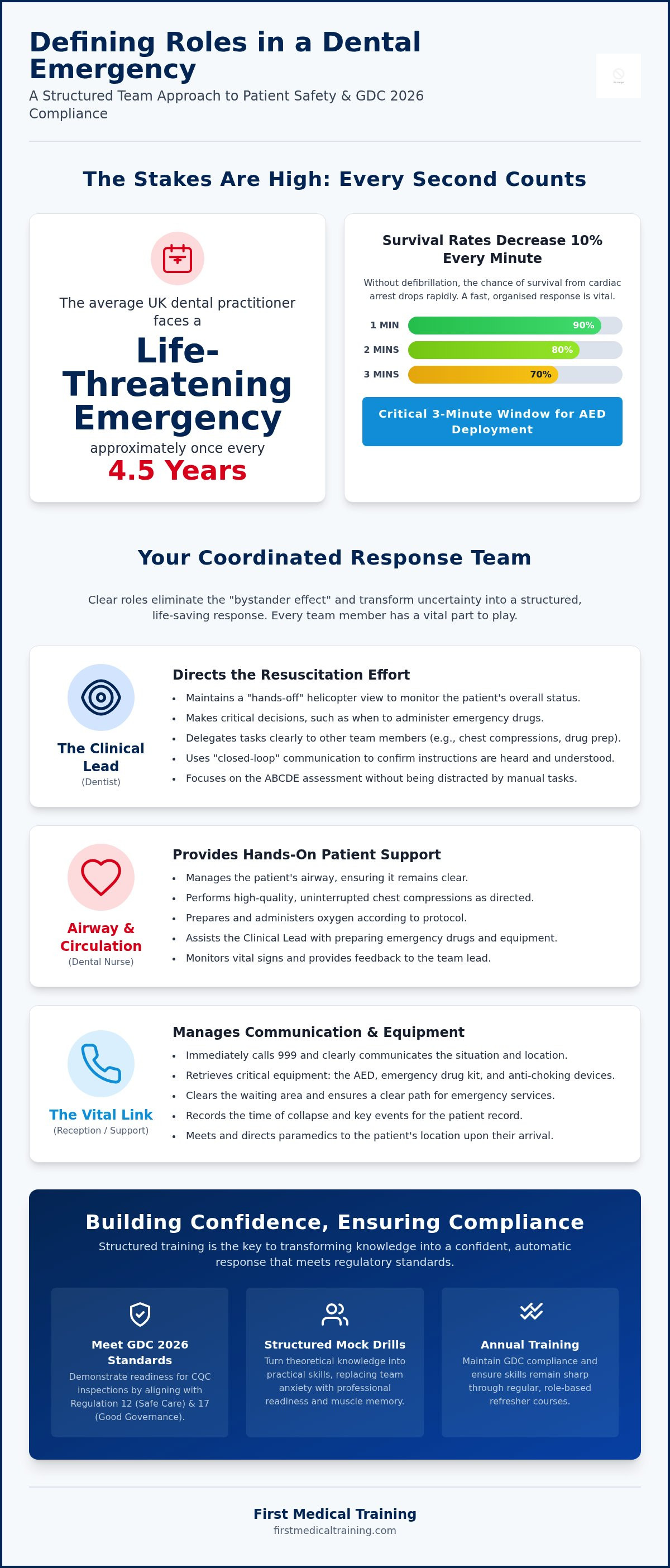
Establishing clear dental emergency response team roles is not merely a box-ticking exercise for compliance; it is a fundamental pillar of patient safety. Without a pre-defined structure, teams often fall victim to the bystander effect, where individuals hesitate, assuming someone else has already called for help or retrieved the emergency kit. In a clinical environment, this hesitation is dangerous. Research indicates that cardiac arrest survival rates drop by approximately 10% for every minute defibrillation is delayed. By assigning specific duties, you ensure that the AED is at the patient's side within the critical three-minute window, significantly increasing the chances of a positive outcome.
Structured delegation transforms a frantic surgery into a professional resuscitation unit. Statistics show that whilst 86% of dentists can identify a vasovagal syncope, many feel a significant sense of anxiety when the emergency kit is actually opened. This psychological pressure is mitigated by role clarity. When every staff member, from the receptionist to the senior associate, knows exactly which piece of equipment to grab or which number to dial, the time to first shock is slashed. This level of organisation allows the clinician to remain at the head of the chair, focusing on the patient's immediate clinical needs whilst the surrounding environment is managed with quiet efficiency.
The Regulatory Necessity of Role Assignment
In 2026, the Care Quality Commission (CQC) focuses heavily on Regulation 12 (Safe Care and Treatment) and Regulation 17 (Good Governance). Inspectors expect to see a cohesive dental practice emergency preparedness plan that is understood by every staff member. Aligning your team with the gdc cpd requirements medical emergencies involves proving that you can function as a single unit under pressure. Documented role assignments provide the audit trail necessary to demonstrate competence and readiness during practice inspections, ensuring you meet the industry benchmark for clinical excellence.
Reducing Cognitive Load During a Crisis
High-stress scenarios naturally impair cognitive function, even for experienced practitioners. When a patient collapses, the clinician must quickly differentiate between what is a dental emergency and a systemic medical crisis. Pre-assigned dental emergency response team roles allow the lead dentist to maintain a "helicopter view" of the situation. This structured approach eliminates decision fatigue, as the clinician does not need to waste mental energy wondering if the ambulance has been called. Instead, they can focus entirely on the ABCDE assessment, analysing the patient's response whilst others manage the equipment. This clarity of purpose leads to better patient outcomes, as the team remains calm and the lead responder retains the mental capacity to think critically.
The Clinical Lead: Directing the Resuscitation Effort
The Clinical Lead, typically the dentist, is the cornerstone of the dental emergency response team roles. Their primary objective isn't necessarily to perform every physical task, but to maintain a "hands-off" overview of the situation. This perspective is vital for monitoring the patient's overall status and ensuring that no detail is missed during the chaos of a collapse. By stepping back, the Lead can effectively delegate tasks, such as drug preparation or chest compressions, whilst retaining the mental clarity required for high-stakes decision-making. Defining these dental emergency response team roles beforehand ensures that the Lead is never forced to perform manual tasks whilst trying to calculate a drug dose.
According to the GDC guidance on medical emergencies, all registrants must know their specific duties. As the Lead, you are responsible for the final decision on administering emergency drugs from the BNF-mandated kit. Whether it's the 1:1000 Adrenaline for anaphylaxis or Glucogel for a hypoglycaemic episode, the Lead must confirm the dose and route before administration. To prevent errors, always use the "closed-loop" method of communication. This means when you give an instruction, the team member repeats it back to confirm they have heard and understood you correctly.
Decision Making and Diagnosis
The Lead's first priority is a rapid, systematic assessment to determine the nature of the crisis. The ABCDE approach (Airway, Breathing, Circulation, Disability, Exposure) is the gold standard for 2026 dental assessments. Identifying the exact point at which a situation escalates from Basic Life Support to Immediate Life Support protocols is a critical skill for any clinician. This transition often involves the introduction of advanced airway management equipment or the decision to use a defibrillator before the patient's condition deteriorates further.
Effective Communication with the Emergency Services
When the ambulance service arrives, the quality of the handover can dictate the next phase of the patient's care. Use the SBAR (Situation, Background, Assessment, Recommendation) framework to provide a concise, professional summary to the paramedics. It's essential to ensure the Scribe has recorded all drug dosages and timings accurately, as this documentation is vital for the transition of care. Maintaining a calm, authoritative atmosphere throughout the process not only aids the clinical effort but also helps to reassure other patients and staff members who may be distressed by the event.
Mastering these leadership dynamics is a core component of a medical emergencies in a dental practice course, which helps teams transition from individual responders to a unified, confident unit.
The Airway and Circulation Support Roles: Dental Nursing Responsibilities
Within the framework of dental emergency response team roles, the dental nurse transitions from a clinical assistant to a critical life-support provider. Whilst the dentist maintains the clinical overview, the nurses execute the technical interventions that sustain life. This requires absolute proficiency in airway management and circulatory support, using specialised equipment that must be checked and ready for immediate deployment. In a high-pressure scenario, these roles ensure that the ABCDE assessment is supported by practical, life-saving actions.
Airway Management and Oxygen Administration
The Airway Manager (Role 2) takes their position at the head of the patient. Their primary duty is ensuring the airway remains patent, which often requires a head-tilt, chin-lift or the insertion of an oropharyngeal airway. Correct positioning in the dental chair is vital; the chair should be fully reclined to the supine position to facilitate better access. If a patient is choking and standard abdominal thrusts or back blows are ineffective or impossible to perform in the chair, the LifeVac anti-choking device provides a non-invasive solution to clear the obstruction. Role 2 is also responsible for delivering high-flow oxygen at 15 litres per minute using a bag-valve-mask (BVM) or a non-rebreather mask, whilst monitoring the patient's respiratory rate and oxygen saturation levels.
AED Operation and Circulation Support
The Circulation Support (Role 3) focuses on maintaining blood flow to vital organs through high-quality chest compressions. If the patient is unresponsive and not breathing normally, this role must initiate compressions immediately. According to current protocols, rescuers must maintain a 30:2 compression-to-breath ratio, ensuring the chest fully recoils between each push to maximise blood flow. Because manual compressions are physically exhausting, Role 3 should rotate with another capable staff member every two minutes to prevent fatigue from compromising the quality of the resuscitation effort.
Simultaneously, the nurse must ensure the Automated External Defibrillator (AED) is applied without delay. This involves placing the pads on the patient’s bare chest and following the device's voice prompts. A key responsibility within these dental emergency response team roles is "clearing the patient" before a shock is delivered, ensuring that no team member is in contact with the patient or the chair. Quick, decisive action in these nursing roles is what bridges the gap between the initial collapse and the arrival of the paramedics.
The Vital Link: Receptionist and Support Staff Roles in a Crisis
The receptionist’s contribution to dental emergency response team roles is often underestimated, yet they act as the vital link between the clinical surgery and the outside world. In the event of a patient collapse, the receptionist immediately transitions into the dual role of Communicator and Runner. This position requires a calm, methodical approach to ensure that help is summoned correctly and that the clinical team has every tool they need without having to leave the patient’s side. Effective communication at the front desk is what allows the dentist and nurses to maintain their focus on life-saving interventions.
Emergency Call Protocols
When a crisis occurs, the receptionist must dial 999 and provide precise information to the emergency operator. This includes the practice's exact location, the patient’s age, their level of consciousness, and whether they are breathing. It is essential to stay on the line until the operator confirms they have all the necessary details. Simultaneously, the receptionist should access the practice management software to print the patient’s medical history and current medication list. This information is invaluable to the Clinical Lead and the arriving paramedics, as it can reveal underlying conditions or allergies that may influence the treatment path.
The Runner: Equipment and Logistics
As the 'Runner', the support staff member is responsible for the rapid retrieval of the emergency drug kit, the portable oxygen cylinder, and the AED from their central storage locations. If the patient is suffering from a foreign body airway obstruction, the runner should also ensure the LifeVac anti-choking device is brought to the surgery immediately. Beyond equipment retrieval, the runner manages the practice environment. This involves clearing corridors and doorways to ensure an unobstructed path for the ambulance trolley and paramedics. If the clinical team is fully occupied, the receptionist may also need to support the Scribe role, noting down the timings of any drug administrations or shocks delivered for the final handover.
Managing the waiting room involves more than just a polite request for patience. It requires the receptionist to act as a barrier between the emergency and other patients, protecting the dignity of the person in the chair whilst preventing a secondary panic amongst those waiting for their appointments. They must also be ready to greet the ambulance at the practice entrance, ensuring the paramedics are guided directly to the correct surgery without a single second of delay. To ensure your front-of-house staff are fully prepared for these high-stakes duties, consider enrolling the entire team in a Medical Emergencies in a Dental Practice Course to build collective confidence.
Implementing Role-Based Training and Mock Drills in Your Practice
Knowledge of theory is only the first step; the true test of dental emergency response team roles lies in their practical application. Annual attendance on a medical emergencies in dental practice course is essential to keep skills sharp and ensure your team functions as a cohesive unit. During these sessions, and throughout your own internal training, you must move beyond passive learning. Effective mock drills should involve rotating staff through different roles. This prevents a single point of failure; if your lead nurse is away, a junior member must be capable of stepping into the Airway Manager position without hesitation.
Scenario-Based Learning for Dental Teams
Your drills should be varied and realistic. Practising syncope management dental training helps teams distinguish between a simple faint and more severe conditions. Similarly, simulating a cardiac arrest management in dental practice allows you to test your AED response times. Aim for the goal of delivering the first shock within three minutes of the collapse. For smaller practices or "skeleton staff" days, role fluidity is even more critical. In a two-person team, the dentist often manages the clinical overview and airway, whilst the nurse handles circulation and equipment retrieval. Identifying these "merged roles" beforehand ensures that nothing is overlooked when resources are lean.
After every drill, a formal debrief is vital. This is the time to identify gaps in the response plan. Did the "Runner" struggle to find the Glucagon? Was the communication with the emergency operator clear? Honest reflection amongst the team builds a culture of continuous improvement and steady reliability.
Verifiable CPD and Compliance Documentation
The GDC requires all registrants to complete a minimum of 10 hours of verifiable CPD in medical emergencies every five-year cycle, with a strong recommendation for at least two hours annually. Documenting these drills is not just a regulatory hurdle; it is proof of your commitment to patient safety. Recording the outcomes of your internal sessions alongside certificates from an accredited provider ensures you are prepared for CQC audits. In-practice training is consistently superior to online-only modules because it allows staff to master their dental emergency response team roles within the actual physical layout of their surgery. Selecting a training provider that understands the 2026 clinical standards ensures your practice remains a safe environment for both patients and staff.
Securing Your Practice with Clinical Readiness
Transforming a frantic surgery into a structured resuscitation unit is the most effective way to protect your patients and your professional reputation. By establishing clear dental emergency response team roles, you ensure that every staff member acts with clinical purpose, from the first second of a collapse through to the final paramedic handover. This structured approach is about more than just meeting 2026 GDC requirements; it's about building a culture of safety where every team member feels fully empowered to save a life. When everyone knows their duty, panic is replaced by a calm, methodical response.
Don't wait for a real-world crisis to test your team's preparedness. Book your 2026 Medical Emergencies in a Dental Practice Course today to receive accredited training that ensures total GDC compliance. Our expert instructors bring real-world emergency experience directly to your surgery, providing comprehensive, hands-on coverage of AED operation and LifeVac equipment. You already have the clinical foundation; now give your team the organised framework they need to excel in any medical emergency. With the right training and a clear plan, you'll act with absolute confidence when it matters most.
Frequently Asked Questions
What are the four main roles in a dental emergency response team?
The four primary dental emergency response team roles include the Clinical Lead, the Airway Manager, the Circulation Support, and the Communicator/Runner. First Medical Training Ltd recommends this structure to ensure that every necessary intervention, from oxygenation to equipment retrieval, is covered without overlap. Each position has distinct technical responsibilities that allow the team to function as a unified resuscitation unit during a patient collapse.
Does every dental practice need a designated "Scribe" during an emergency?
Whilst a dedicated Scribe is ideal for larger teams, it isn't always mandatory for smaller surgeries. However, the function of a Scribe is essential for recording drug dosages and timings for the paramedic handover. In these cases, the Runner or the Clinical Lead usually absorbs the responsibility. Accurate documentation is a core part of GDC compliance and ensures a seamless transition of care once help arrives.
How often should a dental team practice their emergency roles?
The GDC strongly recommends that all registrants complete at least two hours of verifiable CPD in medical emergencies annually. To maintain true clinical competence, high-performing teams often conduct internal mock drills quarterly. Regular practice builds the muscle memory required to perform dental emergency response team roles instinctively. This frequent rehearsal ensures that equipment locations and communication protocols remain fresh in everyone's mind during a real crisis.
Can a dental receptionist perform CPR if the clinical team is busy?
Yes, any staff member who has received accredited training, such as an Emergency First Aid at Work (EFAW) or BLS course, can perform CPR. In a life-threatening situation, the priority is maintaining high-quality chest compressions. If the clinical team is occupied with advanced airway management or drug preparation, a trained receptionist can provide vital circulatory support until paramedics arrive, provided they are competent in the technique.
What is the "Lead" role responsible for in a dental surgery crisis?
The Lead, typically the dentist, is responsible for the overall management of the resuscitation effort. They perform the initial ABCDE assessment and make the final decision on administering emergency drugs from the BNF kit. It's their duty to maintain a "helicopter view" of the situation, ensuring that all other team members are performing their tasks correctly and providing a structured SBAR handover to the ambulance crew.
How do we assign roles in a small practice with only two staff members?
In a two-person team, roles must be merged to cover all essential life-support functions. Usually, the dentist acts as the Clinical Lead and manages the airway and oxygen. The dental nurse then takes responsibility for circulation support, AED operation, and acting as the Runner to call 999. This requires both individuals to be highly proficient in multiple skills, often necessitating more frequent "in-practice" mock drills to master the transition.
Should emergency roles be permanent or rotated amongst the team?
Roles should be rotated during training sessions to ensure every staff member is competent in every task. This "role fluidity" is vital if a key team member is absent or if the emergency occurs whilst someone is on a lunch break. However, for daily operations, roles should be clearly assigned during the morning huddle. This ensures that when an emergency happens, there is no confusion about who is responsible for each action.