

Dental Emergency Team Roles and Responsibilities: A 2026 Guide to Clinical Excellence

What if the difference between a successful resuscitation and a clinical failure isn't your clinical knowledge, but simply who was assigned to fetch the oxygen cylinder? In the high-stakes environment of a dental surgery, a medical crisis can quickly spiral into chaos without a defined structure. You likely already know that feeling of adrenaline-fuelled uncertainty whilst waiting for an ambulance to arrive. Understanding dental emergency team roles and responsibilities is the only way to transform that panic into a coordinated, professional response that satisfies both patient safety and GDC audit requirements.
This 2026 guide will help you master the essential distribution of tasks and communication protocols to ensure your practice operates with clinical precision when every second counts. By moving away from individual heroics and towards a rehearsed, functional system, you'll eliminate confusion and ensure every staff member, including the reception team, knows their exact duty. We'll provide a clear, printable framework for role assignment that builds confidence across the entire practice and ensures you remain fully compliant with Resuscitation Council (UK) standards and CQC expectations.
Key Takeaways
- Learn how to define dental emergency team roles and responsibilities to eliminate decision paralysis and ensure every staff member knows their specific duty before a crisis occurs.
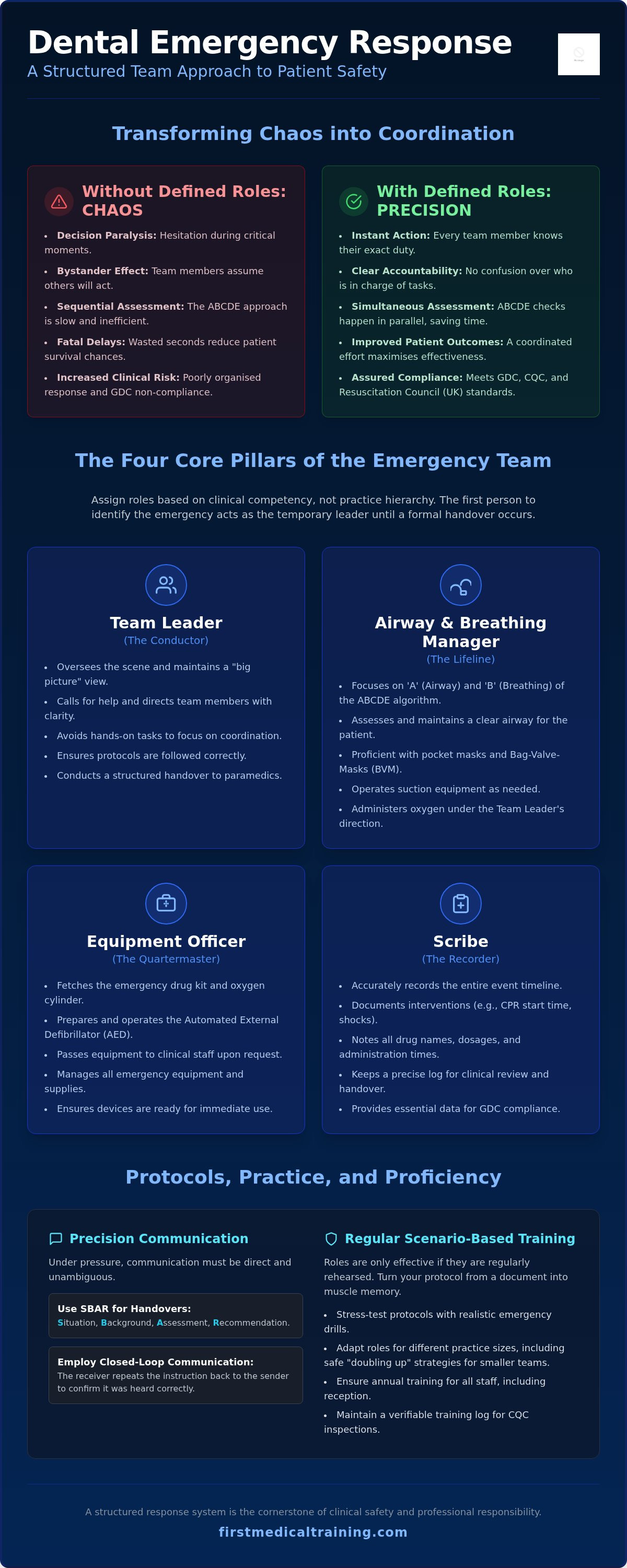
- Discover the four core pillars of an emergency response—Team Leader, Airway Manager, Equipment Officer, and Scribe—and how to assign them based on clinical competency rather than office hierarchy.
- Master professional communication protocols like the SBAR tool and closed-loop communication to maintain clarity and precision during high-pressure medical incidents.
- Understand how to scale these roles for any practice size, including safe "doubling up" strategies for smaller teams whilst maintaining patient safety and clinical standards.
- Gain insights into using scenario-based training to stress-test your protocols and ensure your practice remains fully compliant with GDC and Resuscitation Council (UK) requirements.
The Critical Need for Defined Dental Emergency Team Roles
Defining dental emergency team roles and responsibilities isn't merely an administrative exercise; it's the foundation of clinical safety. When a patient collapses or suffers an acute reaction, the transition from routine care to life-saving intervention must be instantaneous. By establishing a pre-determined distribution of tasks, you ensure that every staff member knows exactly where to stand and what to touch. This clarity is essential for Defining Dental Emergencies and managing them effectively within a surgery setting. Without these roles, teams often succumb to the "bystander effect," where individuals assume someone else is taking charge, leading to fatal delays in care.
Decision paralysis is a common psychological response to high-stress incidents. When the "fight or flight" response kicks in, the ability to think logically can diminish. Pre-assigned roles bypass this cognitive block by providing a clear script to follow. This organised approach doesn't just improve patient outcomes; it protects your professional indemnity. Demonstrating that your team acted with clinical precision through a rehearsed framework is a powerful defence should a case ever be reviewed by the General Dental Council (GDC). It shows you've prioritised patient safety over simple guesswork.
The ABCDE Approach and Role Allocation
Clinical excellence in a crisis relies on the ABCDE assessment: Airway, Breathing, Circulation, Disability, and Exposure. In an unorganised team, these steps happen sequentially, wasting precious time. With defined roles, these assessments occur simultaneously. Whilst the Team Leader manages the airway, the Equipment Officer can prepare the AED. This synchronised effort is vital for cardiac arrest management in dental practice, where every minute without intervention reduces the chance of survival significantly. Role allocation ensures every letter of the acronym is addressed without hesitation.
Regulatory Compliance: GDC and CQC Expectations
The GDC is clear: all dental professionals must be trained and competent to deal with medical emergencies. This isn't just about the dentist; it includes nurses, hygienists, and receptionists. Clear role assignment is a cornerstone of a robust dental practice emergency preparedness plan. During a CQC inspection, you must prove that your team undergoes regular drills and that their training is verifiable. Annual training ensures these roles remain fresh in the mind, turning complex protocols into second nature for every member of the practice.
The Four Core Pillars: Assigning Emergency Responsibilities
Effective response isn't about job titles. It's about who is best equipped for the task at that specific moment. Establishing dental emergency team roles and responsibilities ensures that when a crisis hits, the team functions as a single unit rather than a group of individuals. The person who first identifies the emergency must act as the temporary leader until a formal handover occurs, regardless of their usual position in the practice hierarchy. This dynamic approach prevents the bystander effect and ensures life-saving interventions begin without delay.
Role 1: The Team Leader (The Conductor)
The Team Leader acts as the conductor of the clinical orchestra. Their primary job is overseeing the scene, calling for help, and directing others. Crucially, this person should avoid being hands-on with the patient. Stepping back allows them to maintain "the big picture" and spot clinical deterioration that others might miss. When a more senior clinician or paramedic arrives, a structured handover ensures no vital information is lost. This role is less about performing CPR and more about ensuring CPR is performed correctly.
Role 2: The Airway and Breathing Manager
The Airway and Breathing Manager focuses on the "A" and "B" of the ABCDE algorithm. They must be proficient with pocket masks, bag-valve-masks (BVM), and suction equipment. This role is central to syncope management dental training, ensuring the patient's oxygenation remains stable whilst the cause of the collapse is assessed. They are responsible for maintaining a patent airway and monitoring respirations throughout the entire incident.
Role 3: The Equipment and Drugs Officer
The Equipment and Drugs Officer is the logistical engine of the response. They fetch the emergency kit and AED immediately upon being summoned. In cases of sudden collapse, applying the AED is their highest priority. They also manage the LifeVac anti-choking device if an airway obstruction is identified. To ensure your team is ready for these tasks, our Medical Emergencies in a Dental Practice Course provides the hands-on practice needed to build confidence with this equipment.
Role 4: The Scribe and Communication Runner
The Scribe and Communication Runner provides the vital link to the outside world. They record timings of drug administration, pulse checks, and shocks delivered. This documentation is essential for a smooth handover to the ambulance crew. Often, a receptionist is the ideal candidate for this role. They are already positioned near the phone and possess the administrative skills to record details accurately under pressure, proving that every member of the practice is an essential part of the life-saving chain.
In a high-stress scenario like anaphylaxis, these roles must interlock perfectly. The Leader identifies the systemic reaction and directs the Equipment Officer to prepare the adrenaline. The Airway Manager monitors breathing whilst the Scribe notes the time of the first injection. This level of coordination is what defines clinical excellence in the modern dental surgery.
Adapting Roles for Different Dental Practice Structures
Not every practice has the luxury of a large team on site at all times. Adapting dental emergency team roles and responsibilities to your specific surgery size is a critical component of clinical excellence. Whether you're a single-handed practitioner with one nurse or part of a large multidisciplinary centre, the life-saving requirements remain identical. The challenge lies in distributing these tasks safely without causing confusion. A clear hierarchy of tasks ensures that even with limited staff, the most vital interventions occur first.
Emergencies in the waiting room present unique challenges, such as a lack of clinical equipment and limited space. In these instances, the Equipment Officer must act quickly to bring the emergency kit and AED to the patient's side. Regardless of where the incident occurs, the hierarchy of tasks remains fixed: airway management and CPR must always take precedence over drug preparation. If you only have two or three people available, you must focus on the non-negotiables before attempting complex protocols.
The Small Practice Strategy: Two-Person Response
In smaller practices, the clinical team must "double up" on functions. Usually, the dentist assumes the roles of Team Leader and Airway Manager, whilst the dental nurse takes charge of the equipment, drugs, and AED. This requires a high level of coordination and trust. If you only have two people available, your primary focus is maintaining the airway and performing high-quality CPR. Complex drug administration should be secondary to early defibrillation and effective chest compressions.
The receptionist plays a pivotal role in this structure. Whilst the clinical team remains with the patient, the receptionist must manage the 999 call and clear the practice entrance for the ambulance crew. This prevents the dentist from having to leave the patient to provide directions or unlock doors. Prioritising these core tasks ensures that the patient receives the best possible care until further help arrives. It's often better to do the basics perfectly than to attempt a full four-person response with only two sets of hands.
The Large Multidisciplinary Centre: Utilising All Staff
Large centres face the opposite problem: "too many cooks" in a confined space. Here, the challenge is managing the crowd and ensuring clear communication. Assigning specific "Area Marshals" can streamline the process. These individuals don't need to be clinical; their job is to wait at the street level or entrance to guide paramedics directly to the correct room. This saves vital seconds that are often lost as ambulance crews navigate unfamiliar corridors.
Spare clinical staff should be used to support the Scribe or to monitor other patients who may be distressed by the incident. The Practice Manager should also take an active role, not necessarily in the clinical intervention, but in the post-incident phase. Leading a structured debrief and focusing on staff wellbeing is essential for long-term team resilience. Organising these functions beforehand ensures that the practice continues to operate safely even during the chaotic aftermath of a medical crisis.
Communication Protocols and Emergency Response Drills
Clarity in a crisis depends on how information flows between team members. Even with perfectly assigned dental emergency team roles and responsibilities, a breakdown in communication can lead to clinical errors. We advocate for the SBAR tool: Situation, Background, Assessment, and Recommendation. This structured framework allows the Scribe or Team Leader to convey critical data to emergency services or arriving clinicians without omitting vital details. It ensures that everyone involved has the same mental model of the patient's condition.
To prevent tasks from being missed, use closed-loop communication. When the Team Leader gives an instruction, the recipient repeats it back to confirm they've heard and understood. This is supported by "Call-Outs," such as stating, "Oxygen is on at 15 litres per minute." These verbal markers keep the entire team informed of the patient's status and the interventions already completed. Practising these skills through "Mock Codes" or unannounced drills allows your staff to rehearse their roles in a safe environment without disrupting the daily patient list.
Mastering the 999 Call
The Scribe must be prepared with specific information before the 999 operator answers. You'll need the practice's exact location, the patient's age, and a concise description of the incident. Using terminology like "unconscious and not breathing" or "suspected anaphylaxis" helps the dispatcher categorise the call correctly, often securing a Category 1 response. The caller must stay on the line, relaying instructions from the operator back to the clinical team until the paramedics arrive. This ensures that the advice from the emergency services is integrated into the ongoing resuscitation effort immediately.
The Power of the Post-Incident Debrief
Once the crisis has passed, a structured debrief is essential. This isn't about assigning blame but reviewing role performance to see what worked and what felt confusing. Use these insights to update your dental practice emergency preparedness plan. Real-world feedback is the most valuable tool for refining your protocols. Don't forget to address the emotional impact on your staff; medical emergencies are traumatic, and offering mental health support is a key responsibility of practice leadership. To ensure your team can communicate with this level of precision, book your next Medical Emergencies in a Dental Practice Course with our expert trainers today.
Enhancing Team Performance through Professional Medical Emergency Training
Clinical confidence isn't something you can download from a PDF or absorb through a passive webinar. It's a physical skill set that requires repetition and expert feedback. Engaging an external provider like First Medical Training Ltd allows you to stress-test your dental emergency team roles and responsibilities in a controlled yet realistic environment. By simulating high-pressure scenarios, you can identify exactly where the friction points lie in your team's response before a real patient’s life is on the line. This hands-on approach builds a level of steady reliability that cannot be replicated by theory alone.
Mastering these functional roles is also a core component of your professional development. It's directly linked to meeting the GDC CPD requirements for medical emergencies. Verifiable CPD isn't just about ticking a box; it’s about proving that every member of the team is competent and ready to act. Professional certification acts as a badge of readiness, reassuring both your patients and regulatory bodies that your practice operates at the highest clinical standard expected in 2026.
Why In-Practice Training Trumps Online Theory
The primary advantage of in-practice training is the development of muscle memory. When you handle your own AED or practice using the LifeVac anti-choking device in your own surgery, you're training your brain to react instinctively. You'll quickly discover blind spots in your surgery layout, such as where the oxygen cylinder is stored or how difficult it is to move the dental chair into a CPR-friendly position. These logistical hurdles are often invisible until you attempt a mock collapse in the actual room where it might occur.
Training in your own environment also allows for customisation. You can tailor your drills to the specific medical history of your patient demographic, whether that’s managing polypharmacy issues in older patients or paediatric-specific emergencies. This level of specificity ensures that your dental emergency team roles and responsibilities are perfectly aligned with the real-world risks your practice faces every day. It turns the entire surgery into a learning lab where every cupboard and piece of equipment is part of the rehearsal.
Choosing the Right Course for 2026 Compliance
When selecting a training provider, it's vital to ensure they understand the nuances of the 2026 GDC standards and the latest Resuscitation Council (UK) updates. A general first aid course isn't enough for a clinical environment. You should look for programmes that offer Dental ILS and Medical Emergencies in a Dental Practice specifically. These courses are designed to integrate your clinical equipment into the response, ensuring that the Equipment Officer and Airway Manager are fully proficient with the tools at their disposal.
Securing your team's clinical excellence requires a commitment to annual, high-quality training. Don't leave your emergency response to chance or outdated protocols. Book your Medical Emergencies in a Dental Practice Course today to ensure your team is prepared, compliant, and confident.
Mastering Clinical Readiness for the Modern Practice
Clinical excellence during a medical crisis is built on preparation rather than luck. Transitioning from individual panic to a coordinated response requires a deep understanding of dental emergency team roles and responsibilities. By implementing structured communication tools and rehearsing specific functions whilst in your own surgery, you ensure that every staff member acts with certainty. This approach doesn't just satisfy GDC audit requirements; it saves lives.
First Medical Training Ltd has provided specialist dental education since 2006, bringing two decades of expertise directly to your practice. Our courses are fully aligned with the Resuscitation Council (UK) 2026 Quality Standards and offer nationwide UK coverage for in-practice training sessions. This ensures your team develops the muscle memory needed to handle real-world emergencies with clinical precision.
Take the next step in your professional development today. Secure your team’s clinical confidence with our GDC-compliant Medical Emergencies Course. Empowering your staff with the right skills creates a safer environment for your patients and a more resilient, confident team.
Frequently Asked Questions
What are the most important roles in a dental medical emergency?
The four fundamental roles are the Team Leader, Airway Manager, Equipment Officer, and Scribe/Runner. Each role focuses on a specific aspect of the ABCDE algorithm. Whilst the Team Leader oversees the entire scene and directs the flow of care, the Airway Manager ensures oxygenation. The Equipment Officer fetches the AED and emergency kit, and the Scribe records timings. These pre-determined roles ensure clinical precision and prevent the bystander effect.
Does the GDC require specific emergency roles to be assigned in writing?
The GDC does not mandate a specific written list of names against roles, but they do require that all team members are trained and competent in their specific duties. Clear documentation of dental emergency team roles and responsibilities within your practice's emergency protocol is highly recommended. This provides evidence during CQC inspections or GDC audits that your practice has a robust management plan and that staff are prepared for a crisis.
Can a dental receptionist be the Team Leader during an emergency?
A receptionist can act as the initial Team Leader if they are the first person to discover the emergency. Their role is to secure the scene and call for help. However, leadership usually hands over to a senior clinician once they arrive. Receptionists are often better utilised as the Scribe and Communication Runner, as they can manage the 999 call and record drug timings whilst the clinical staff perform hands-on interventions.
How often should a dental team practice their emergency roles and responsibilities?
Formal medical emergency training must be completed annually to comply with GDC standards and Resuscitation Council (UK) guidelines. However, we recommend conducting internal "mock code" drills every quarter. These short, unannounced sessions help maintain muscle memory and ensure that role assignments remain second nature. Regular practice reduces the adrenaline-fuelled confusion that often occurs during real-life incidents, ensuring the team remains calm and coordinated.
What is the SBAR tool and how is it used in a dental surgery?
SBAR stands for Situation, Background, Assessment, and Recommendation. It is a structured communication tool used to relay critical information clearly and concisely. In a dental surgery, the Scribe uses SBAR when speaking to the 999 operator or the arriving paramedic crew. It ensures that the most vital clinical data, such as the patient's symptoms and the treatments already administered, is communicated without omission or misunderstanding during a high-pressure handover.
Who is responsible for checking the emergency drugs and equipment in a dental practice?
Whilst the entire team must know where the kit is located, a designated Equipment Officer usually takes responsibility for weekly checks. They must ensure that oxygen cylinders are full, the AED battery is functional, and that emergency drugs are within their expiry dates. Keeping a signed log of these checks is essential for CQC compliance. This role ensures that when an emergency occurs, the equipment is ready for immediate use.
What should a small dental team do if they don’t have enough staff for all four roles?
Smaller teams should prioritise the most critical tasks by "doubling up" on roles. The dentist often combines the Team Leader and Airway Manager positions, whilst the dental nurse acts as the Equipment Officer and Scribe. The absolute priority in any small-team response is high-quality CPR and early defibrillation. Complex drug administration should only be attempted once the patient's airway and circulation are being managed effectively by the available staff.
Is an AED required for all dental practices in the UK in 2026?
Yes, having an Automated External Defibrillator (AED) on-site is a mandatory requirement for all UK dental practices according to Resuscitation Council (UK) standards. The AED is a core component of the Equipment Officer's duties. It must be easily accessible, and all staff members must be trained in its use. Regular training ensures that the team can deploy the device within the first few minutes of a cardiac arrest.