

Dental Immediate Life Support Training: The Complete 2026 Guide to Clinical Excellence

If a patient collapses in your chair today, would your team respond with the clinical precision of a resuscitation unit, or would there be a moment of hesitation whilst waiting for an ambulance? It's a concern that keeps many practice leads awake, especially when managing the specific requirements for dental immediate life support training. You likely agree that whilst basic first aid is a vital foundation, the unique environment of a dental surgery demands a more robust, authoritative approach to emergency care.
This guide is designed to bridge the gap between basic life support and hospital-grade intervention, ensuring you meet every GDC requirement for 2026. We'll show you how to lead a team during a cardiac arrest and manage complex medical emergencies with clinical excellence. We will examine the latest RCUK protocols, clarify mandatory drug lists, and provide a roadmap for turning clinical anxiety into professional readiness through verifiable CPD. By mastering these protocols, you can transform a high-pressure scenario into a controlled, professional response that protects both your patients and your practice.
Key Takeaways
- Understand how dental immediate life support training acts as the essential bridge between basic first aid and advanced resuscitation in a clinical setting.
- Learn to implement a systematic patient assessment and structured communication model to ensure your team remains calm and organised during a crisis.
- Clarify the 2026 GDC requirements for medical emergencies, including the "Highly Recommended" status and the necessity for annual team-based training.
- Gain the clinical confidence to lead a coordinated response to the most common medical emergencies found in UK dental surgeries.
- Discover how a rehearsed response model can transform your practice’s emergency readiness and ensure full regulatory compliance.
What is Dental Immediate Life Support (ILS) Training?
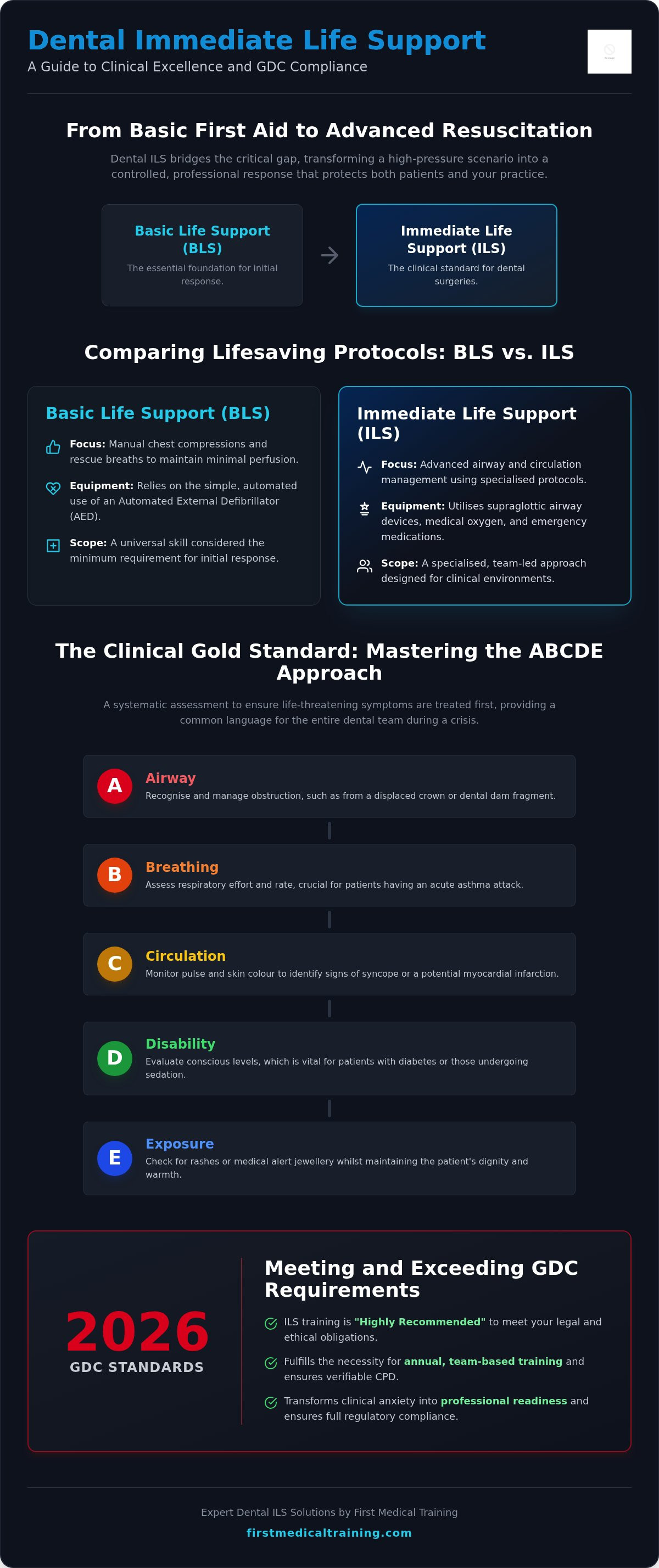
Dental immediate life support training represents the clinical standard for managing critical events within a primary care setting. It is not merely an extension of basic first aid; it's a specialised resuscitation protocol designed for the unique environment of a dental surgery. Whilst Basic Life Support (BLS) focuses on the initial steps of chest compressions and rescue breaths, Immediate Life Support (ILS) provides the tools to manage a patient's airway and circulation using advanced equipment and medications.
The core objective of this training is simple: to stabilise a patient effectively during the high-stakes window between a collapse and the arrival of an ambulance. In a dental practice, the dentist or senior clinician must assume the role of a clinical lead. This involves directing the team, delegating tasks, and making rapid decisions under pressure. It's about ensuring that every second is used to improve the patient's chances of survival through coordinated, rehearsed actions.
The Difference Between BLS and ILS
The distinction between these two levels of care is significant. BLS is a universal skill that focuses on maintaining minimal perfusion through manual compressions. In contrast, dental immediate life support training introduces advanced airway management, including the use of supraglottic devices and medical oxygen. Whilst BLS users rely on an Automated External Defibrillator (AED) in its simplest form, ILS practitioners are trained to recognise rhythms and integrate defibrillation into a broader treatment plan. For practices performing sedation or treating patients with complex medical histories, basic protocols are often insufficient to manage the physiological demands of a true cardiac arrest.
Why Dental Practices Require Level 3 Training
Modern dental care in 2026 involves an increasingly elderly population with co-morbidities that make chairside emergencies more likely. Relying on basic skills is no longer enough to meet professional standards. There is a clear legal and ethical obligation to provide a level of care that matches the risks associated with clinical procedures. This level 3 training aligns directly with the GDC CPD requirements for medical emergencies, which mandate that dental professionals maintain their skills through regular, verifiable education. By choosing ILS, you ensure that your practice doesn't just meet the minimum threshold, but sets a benchmark for patient safety and clinical excellence.
Core Components of the Dental ILS Curriculum
A robust dental immediate life support training curriculum focuses on more than just the mechanics of resuscitation. It prioritises the prevention of cardiac arrest by identifying early warning signs through a systematic clinical framework. This approach ensures that every member of the team, from the lead clinician to the dental nurse, understands their specific responsibilities within a multi-disciplinary emergency response. It's about moving away from reactive panic towards a proactive, structured intervention that saves lives.
Mastering the ABCDE Approach in the Surgery
The ABCDE approach is the clinical gold standard for emergency assessment, ensuring no life-threatening symptom is overlooked during a crisis. This sequence allows you to treat the most critical issues first:
- Airway: Recognising obstruction, such as a displaced crown or dental dam fragment during a procedure.
- Breathing: Assessing respiratory effort and rate in a patient experiencing an acute asthma attack.
- Circulation: Monitoring pulse and skin colour to identify syncope or a potential myocardial infarction.
- Disability: Evaluating conscious levels, which is vital for patients with diabetes or those undergoing sedation.
- Exposure: Checking for rashes or medical alert jewellery whilst maintaining the patient's dignity and warmth.
Using this method prevents the common pitfall of focusing on a minor symptom whilst missing a deteriorating vital sign. It provides a common language for the whole team.
Advanced Airway Management and Oxygen Therapy
Managing a patient's airway is often the most critical intervention you'll perform. Dental immediate life support training equips you with the skills to use oropharyngeal and supraglottic airway adjuncts effectively. These tools are essential for maintaining patency when manual manoeuvres aren't enough. You'll also master the administration of high-flow oxygen at 15 litres per minute, adhering to the latest Resuscitation Council UK Quality Standards.
Patient safety starts before they even reach the chair. This includes having an anti-choking device for dental waiting rooms to manage risks in communal areas. If you're looking to upgrade your team's readiness, exploring a Medical Emergencies in a Dental Practice Course is a practical next step to unify your response protocols.
The Role of Non-Clinical Staff in Emergency Response
Effective resuscitation is a team effort. Whilst the clinician leads, the receptionist acts as the vital link to external emergency services. They must be trained to provide clear, concise information to 999 operators using structured tools like SBAR (Situation, Background, Assessment, Recommendation). When non-clinical staff are integrated into your emergency drills, they can manage the waiting room and guide the ambulance crew, allowing the clinical team to focus entirely on the patient. This level of organisation reduces errors and ensures a seamless transition of care.
Managing Critical Scenarios: From Collapse to Cardiac Arrest
Emergencies in a dental surgery are statistically rare, yet they demand an immediate, high-precision response when they occur. The most common issues include vasovagal syncope, acute asthma attacks, anaphylaxis, and hypoglycaemia. To manage these effectively, your team must move beyond theoretical knowledge and adopt a rehearsed response model. This involves regular, hands-on drills where every staff member knows exactly where the emergency kit is located and who is responsible for each aspect of the cardiac arrest management in dental practice.
Coordination with emergency services is a vital part of this rehearsed response. When a 999 call is placed, the information provided must be clinical and concise. Using the SBAR (Situation, Background, Assessment, Recommendation) framework ensures that the ambulance crew arrives with a clear understanding of the patient's condition. This professional handover is a core element of dental immediate life support training, as it facilitates a seamless transition from the surgery chair to hospital care.
Managing Patient Collapse in the Dental Chair
When a patient loses consciousness whilst in the chair, the physical environment presents unique challenges. Your first action should be to safely lower the chair back into a horizontal position. If you suspect simple syncope, elevating the patient's legs can often restore cerebral perfusion. However, you must quickly differentiate between a faint and a more serious event. If the patient does not regain consciousness rapidly or shows signs of respiratory distress, you must escalate to your full ABCDE assessment. For a deeper look at managing these specific incidents, refer to our guide on syncope management dental training.
Defibrillation and Recognition of Heart Rhythms
A key differentiator in dental immediate life support training is the transition from basic AED use to a more advanced understanding of heart rhythms. Whilst an AED provides automated prompts, an ILS-trained clinician understands the logic behind the device's decisions. You will learn to recognise shockable rhythms, such as Ventricular Fibrillation (VF), versus non-shockable rhythms like Asystole. The priority during any cardiac event is maintaining high-quality chest compressions with minimal interruptions. Even during defibrillation, the "hands-off" time must be kept to a few seconds. This level of clinical discipline ensures the highest possible coronary perfusion pressure, significantly improving the chances of a successful Resumption of Spontaneous Circulation (ROSC).
Compliance, CPD, and GDC Standards for 2026
The General Dental Council (GDC) categorises medical emergencies as a "Highly Recommended" topic. This classification isn't arbitrary; it signifies that the regulator expects every registrant to remain current in their life-saving skills. To maintain compliance, dentists and dental care professionals (DCPs) must complete at least 10 hours of verifiable CPD in medical emergencies over each five-year cycle. The GDC also strongly recommends that at least two of these hours are completed every year.
Meeting the annual requirement involves more than just a tick-box exercise. You must undergo dental immediate life support training at least once every twelve months to align with both GDC and Resuscitation Council UK standards. This ensures your team remains proficient in the use of mandatory emergency drugs, such as Adrenaline (1:1000) and buccal Midazolam, whilst also maintaining the operational readiness of your AED.
Meeting the GDC Verifiable CPD Requirements
For training to be considered verifiable, it must include clear learning aims, objectives, and anticipated outcomes. You must also integrate these sessions into your Personal Development Plan (PDP) to demonstrate a structured approach to professional growth. Auditors look for evidence of written reflection following the course to ensure the learning has been internalised. Crucially, a comprehensive session of dental immediate life support training provides 6 hours of verifiable CPD, which significantly contributes to your annual and five-year targets.
Organising Annual Team Training and Drills
Conducting training within your own surgery offers distinct advantages over external centres. In-practice sessions allow your team to handle their own equipment and drugs in the exact environment where an emergency would occur. Mock emergency drills are particularly effective for identifying logistical gaps, such as an expired oxygen cylinder or a poorly positioned emergency kit. Whilst ILS is the clinical gold standard, ensuring you have staff with first aid at work for dental practices certification provides a secondary layer of safety for non-clinical incidents.
Maintaining an equipment log and drug expiry register is a non-negotiable part of your clinical governance. These records prove to inspectors that your practice is prepared for the worst-case scenario. When you are ready to secure your practice's compliance for the coming year, you can book your accredited Dental ILS training to ensure your team meets every regulatory standard.
First Medical Training: Expert Dental ILS Solutions
First Medical Training has spent the last 20 years refining a pedagogical approach that balances rigorous clinical standards with the practical realities of a busy dental surgery. We understand that clinical excellence isn't achieved through passive learning, but through hands-on, expert-led instruction. Our Medical Emergencies in a Dental Practice Course serves as the definitive solution for teams seeking to move beyond basic compliance. By choosing a provider that specialises in the dental sector, you ensure your dental immediate life support training is relevant, up-to-date, and delivered with the quiet confidence of an industry veteran.
We believe that the best teachers are those who remain active in the field. Our instructors are active clinical professionals who bring real-world emergency experience into your surgery. This background allows them to provide nuanced advice that generic first aid trainers simply cannot offer. Because our training is bespoke and delivered on-site, we can tailor every scenario to the specific layout of your practice, ensuring your team knows exactly how to navigate their own clinical environment during a crisis.
Why Choose an Accredited 2006-Founded Provider?
Longevity in the training sector is a marker of reliability and deep-rooted expertise. Since our founding in 2006, we've guided thousands of practices through two decades of regulatory shifts, from the evolution of GDC requirements to the latest Resuscitation Council UK updates. This history gives us a unique perspective as a seasoned mentor to the profession. We don't just deliver a syllabus; we provide a reassuring and authoritative environment where staff feel empowered to ask complex questions. Our national reach means we can offer this high level of expertise to practices across the UK, providing flexibility that respects your practice's busy schedule.
Integrating Life-Saving Equipment: AEDs and LifeVac
Superior training is only effective when paired with high-quality equipment. We specialise in providing Automated External Defibrillators (AEDs) that are specifically selected for their ease of use in a high-pressure dental environment. Beyond standard resuscitation tools, we advocate for the inclusion of the LifeVac Anti-Choking Device in every practice's emergency kit. This device is a vital addition for managing airway obstructions where traditional methods might fail, particularly in waiting rooms or with patients who have limited mobility. Our dental immediate life support training ensures that every staff member, including non-clinical receptionists, is proficient in the practical use of all supplied equipment. This holistic approach ensures that when you invest in training, you're also investing in a complete, practice-wide safety net.
Securing Your Practice's Clinical Future
Maintaining clinical excellence in 2026 requires more than just meeting a minimum CPD threshold. It's about building a culture of readiness where every staff member knows their role during a cardiac arrest or patient collapse. By mastering the ABCDE approach and integrating advanced airway management into your annual drills, you transform your surgery into a safer environment for both patients and staff. You've seen how structured communication and rehearsed responses can mitigate the risks of high-pressure emergencies.
Choosing the right partner for your dental immediate life support training is essential for long-term compliance and peace of mind. Since 2006, First Medical Training has provided nationwide coverage with a curriculum strictly aligned with Resuscitation Council UK standards. Our expert clinical tutors bring decades of experience directly to your surgery, ensuring your team is prepared for any scenario. We act as your guide, bridging the gap between regulatory requirements and real-world application.
Don't leave your practice's emergency response to chance. Book Your GDC-Compliant Dental ILS Training Today and take the next step towards total clinical confidence. We look forward to helping your team reach its full potential in emergency care.
Frequently Asked Questions
Is ILS training a mandatory requirement for UK dentists?
Yes, it's a core requirement under GDC and Resuscitation Council UK guidelines. Dentists must remain competent in managing medical emergencies to ensure patient safety. While classified as "Highly Recommended," failing to maintain these skills breaches clinical governance standards. It ensures you can provide advanced airway management and use emergency drugs effectively. Every practice must have at least one person trained to ILS level during clinical sessions.
How often should a dental team undergo ILS training?
You should complete this training at least once every twelve months to remain compliant. The GDC strongly recommends a minimum of two hours of medical emergencies CPD annually. Regular training ensures that life-saving skills stay sharp and that your team is familiar with any updates to Resuscitation Council UK protocols. Annual sessions also allow for a professional inspection of your emergency drug kits and equipment.
What is the difference between Level 2 BLS and Level 3 ILS?
Level 2 BLS focuses on basic chest compressions and rescue breaths, whereas Level 3 dental immediate life support training introduces advanced clinical interventions. This includes using airway adjuncts like supraglottic devices, administering medical oxygen, and managing complex cardiac rhythms. ILS bridges the gap between basic first aid and hospital-grade resuscitation, providing a higher level of stabilising care before the ambulance crew arrives at your surgery.
Can dental nurses and receptionists attend the ILS course?
Yes, we encourage the whole practice team to participate in our training sessions. Whilst the clinical focus is on dentists and nurses, receptionists play a vital role in coordinating the emergency response and managing the 999 call. A multi-disciplinary approach ensures that everyone understands their specific duties during a crisis, creating a more organised and effective life-saving team within the dental environment.
Does the ILS course count towards my GDC verifiable CPD hours?
It certainly does, providing 6 hours of verifiable CPD for your current cycle. To meet GDC standards, our courses include clear learning aims, objectives, and anticipated outcomes. You'll receive a certificate that serves as evidence for your Personal Development Plan (PDP). This helps you meet the required 10 hours of medical emergencies CPD over five years whilst staying current with annual recommendations.
What equipment do we need to have in the surgery for an ILS course?
You don't need to provide any special equipment as our tutors bring all the necessary training manikins and medical devices. However, we'll use your practice’s own emergency drug kit and AED during the session to ensure your team is familiar with their specific locations and operation. This practical approach helps identify any missing items or expired drugs in your practice's current medical emergency provision.
How long does a Dental Immediate Life Support certificate remain valid?
The certificate is valid for one year from the date of completion. Resuscitation Council UK and GDC guidelines stipulate that medical emergencies training must be refreshed annually to ensure clinical competence. Because these skills are rarely used in daily practice, they can degrade quickly. Renewing your dental immediate life support training every twelve months ensures your team remains ready to act with precision during a real-life medical crisis.
Do we need to learn manual defibrillation or just AED use?
Most dental professionals focus on AED operation, but ILS training provides a deeper understanding of cardiac rhythm recognition. You'll learn to differentiate between shockable and non-shockable rhythms, which informs how the AED functions. Whilst you won't typically use manual defibrillators in a primary care setting, understanding the logic behind the device allows you to lead the resuscitation attempt with greater clinical authority and confidence during a cardiac event.