

First Aid & ILS for Dental Practices: 2026 Buyer’s Guide

Did you know that a general dental practitioner is statistically likely to encounter a medical emergency in their surgery once every four and a half years? Whilst these moments are rare, they demand absolute clinical precision. Selecting the right first aid and ils training for dental practices is about more than just ticking a regulatory box; it's about ensuring every team member, from the receptionist to the lead clinician, knows exactly how to act when seconds count.
We understand that managing practice compliance often feels like a constant battle against varying expiry dates and complex GDC requirements. It's common to feel confused by the distinctions between Basic Life Support and Immediate Life Support (ILS), or to worry about wasting your training budget on courses that don't provide the necessary verifiable CPD. This guide provides a clear roadmap for 2026. You'll learn how to select accredited training that guarantees compliance, builds genuine clinical confidence, and streamlines the booking process for your whole team. We'll explore the essential emergency drugs required this year and explain how to align your training with the latest Resuscitation Council UK standards.
Key Takeaways
- Understand the dual-regulatory landscape of HSE workplace safety and GDC clinical standards to ensure your practice remains fully compliant and legally protected.
- Learn how to distinguish between basic workplace first aid and the advanced skills required for first aid and ils training for dental practices.
- Implement a structured training matrix that assigns the correct level of life support and first aid education to each team member based on their specific clinical or administrative role.
- Identify the essential qualities of a training provider, prioritising real-world clinical expertise and strict alignment with the latest Resuscitation Council UK protocols.
- Streamline your annual compliance by ensuring all chosen courses provide the necessary verifiable CPD hours to meet GDC professional development requirements for 2026.
Navigating First Aid and ILS Compliance for Dental Practices
Dental practices operate within a unique regulatory intersection that distinguishes them from standard commercial environments. As a practice manager or owner, you are responsible for two distinct areas of safety: the clinical wellbeing of your patients and the workplace safety of your staff. This dual-regulatory landscape is governed by the General Dental Council (GDC) and the Health and Safety Executive (HSE). Relying on a generic office first aid course is a common mistake that can lead to significant compliance gaps. Whilst First aid principles are universal, the specific risks associated with dental procedures, such as anaphylaxis, syncope, or cardiac arrest during treatment, require a more specialised approach.
Effective first aid and ils training for dental practices ensures that your team moves beyond basic knowledge into clinical competence. High-quality training must be verifiable for Continuing Professional Development (CPD). This is a non-negotiable requirement for dental professionals. Beyond the paperwork, there is the vital issue of clinical muscle memory. Research indicates that life-saving skills, particularly CPR and the use of an Automated External Defibrillator (AED), can begin to diminish in as little as six months. Annual updates are not just a recommendation; they are a practical necessity to ensure your team remains calm and capable when a crisis occurs in the chair.
For those interested in the curriculum and standards of professional BLS and AED certification, read more.
GDC Requirements for Medical Emergencies
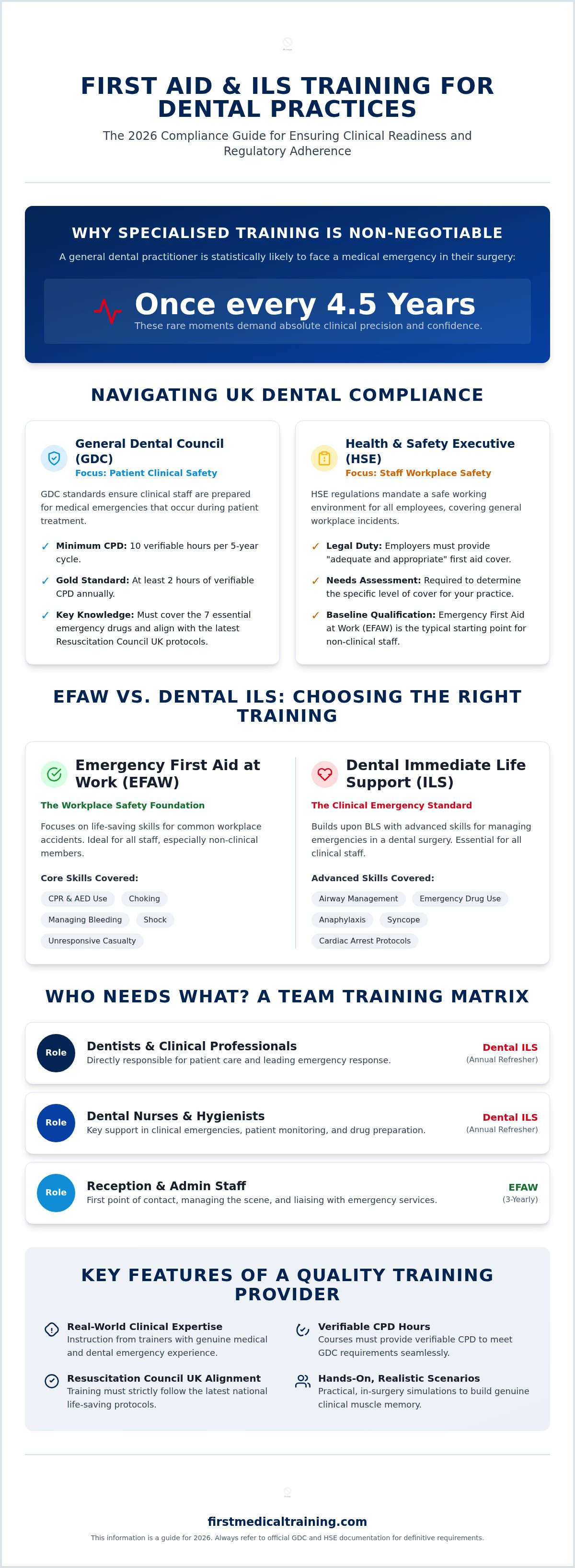
The GDC categorises medical emergency training as a "highly recommended" topic for all registrants. To maintain their professional standing, dentists and dental care professionals (DCPs) must adhere to strict GDC CPD requirements for medical emergencies. This includes a minimum of 10 hours of verifiable CPD in this subject per five-year cycle. However, the gold standard for dental practice emergency preparedness is to complete at least two hours of training annually. This regular cadence ensures that every team member is familiar with the seven essential emergency drugs and the latest Resuscitation Council UK protocols. Failure to stay updated can lead to fitness to practise proceedings if an emergency is handled poorly.
HSE Workplace First Aid Standards
Whilst the GDC focuses on the patient, the HSE ensures your staff are protected. Under the Health and Safety (First-Aid) Regulations 1981, all UK employers must provide "adequate and appropriate" first aid cover. For most dental surgeries, this begins with the Emergency First Aid at Work (EFAW) qualification. This one-day course provides foundational skills for handling common workplace injuries. To determine your specific requirements, you must conduct a first aid needs assessment. Consider the number of employees, the physical layout of your practice, and any specific risks, such as the use of hazardous chemicals or sharps. A well-conducted assessment often reveals that a combination of EFAW for administrative staff and advanced ILS for clinical staff is the most robust strategy.
Comparing Core Qualifications: EFAW vs. Dental ILS
Choosing the right level of training requires an understanding of where general workplace safety ends and clinical emergency response begins. Whilst all staff members need foundational skills, the requirements for a clinician performing invasive procedures differ significantly from those of a front-of-house team member. A comprehensive strategy for first aid and ils training for dental practices involves mapping these roles to specific qualifications to ensure both legal and professional compliance.
The curriculum for a dental team must be broader than a standard office-based course. It should bridge the gap between the health and safety of the workplace and the high-stakes environment of clinical care. This is why many practices now move beyond Basic Life Support (BLS) to a more robust Immediate Life Support (ILS) framework. This transition ensures that the team is not just performing chest compressions but is also capable of managing a patient's airway and administering emergency drugs while waiting for an ambulance.
The 1-Day EFAW Course
The Emergency First Aid at Work (EFAW) qualification is the baseline for workplace safety. It focuses on life-preserving skills such as CPR, managing severe bleeding, treating shock, and assisting a choking casualty. This course is the primary choice for first aid at work for dental practices, particularly for receptionists and administrative staff. These team members are often the first to encounter an emergency in the waiting room and need the confidence to act before clinical staff take over.
Immediate Life Support (ILS) Training
For the clinical team, ILS training provides the advanced skills required to handle complex medical crises. This includes sophisticated airway management using adjuncts and a deep understanding of the ABCDE approach (Airway, Breathing, Circulation, Disability, Exposure). ILS is essential for effective cardiac arrest management in dental practice, as it integrates defibrillation and the specific emergency drug protocols mandated for UK surgeries.
The General Dental Council guidance on medical emergencies emphasises that clinical competence is best maintained through regular, practical application. Training is most effective when it is scenario-based and conducted within your actual surgery environment. This allows the team to practise using their own equipment and drugs in the physical space where an event is most likely to occur. If you are reviewing your team's current certification levels, you can explore our range of accredited dental first aid courses to find the best fit for your practice.
How to Choose the Right Training for Your Team Members
Selecting the appropriate level of instruction for each staff member is the most effective way to optimise your training budget and ensure comprehensive safety coverage. A blanket approach often results in over-training administrative staff or under-training clinical teams. To build a resilient practice, you need a clear training matrix that aligns professional roles with specific clinical and legal requirements. This structured approach ensures that your first aid and ils training for dental practices is both relevant and compliant.
In-house group training is often the superior choice for established teams. It allows for collective practice in the surgery environment, which is particularly beneficial for syncope management dental training. Since faints are the most frequent medical emergency in dentistry, having the whole team rehearse the response together ensures a seamless transition from the waiting room to the chair. For practices with a high volume of younger patients, you should also consider whether your training provider includes paediatric-specific life support protocols to meet the needs of your patient demographic.
Clinical Staff: Dentists and Dental Nurses
For those directly involved in patient care, Dental Immediate Life Support (ILS) is the recognised standard. This level of training equips clinicians to manage the initial stages of a collapse, including the use of airway adjuncts and the administration of emergency drugs. Whilst the GDC requires all registrants to be competent in medical emergencies, your practice also needs at least one designated lead first aider. For this role, a 3-Day First Aid at Work course is recommended. This provides a deeper level of knowledge for handling non-clinical accidents, such as falls or major trauma, that could occur anywhere on the practice premises.
Non-Clinical Staff: Receptionists and Admin
Front-of-house staff are the gatekeepers of your practice. Their training should focus on the early recognition of a deteriorating patient and the ability to provide immediate assistance. The 1-Day Emergency First Aid at Work (EFAW) course is typically the most cost-effective and appropriate choice for this group. It ensures they can perform effective CPR and use an AED whilst alerting the clinical team. Managing the transition for staff who need to refresh their skills is simpler when you schedule annual updates, as this prevents the confusion of staggered expiry dates across the team and keeps everyone's skills sharp.
Key Features to Look for in a Training Provider
Identifying a reliable partner for first aid and ils training for dental practices requires looking beyond the price tag. The most effective training is delivered by individuals who have faced medical emergencies in real clinical settings. When your team asks complex questions about patient physiology or drug interactions, they need answers from a seasoned professional, not someone reading from a manual. Look for providers who employ paramedics, combat medics, or clinical specialists with years of frontline experience. This clinical background ensures the training is grounded in the practical realities of emergency response.
Accuracy is paramount in medical education. You must verify that the curriculum strictly adheres to the latest Resuscitation Council UK guidelines. These standards are updated periodically to reflect the most current evidence-based practices in resuscitation. A provider with an 18-year history, such as one established in 2006, offers a level of reliability that is essential for maintaining long-term practice compliance. They act as a bridge between rigorous regulatory requirements and the real-world application of life-saving skills.
Equipment-Focused Training
Practical, hands-on experience with specialised equipment is a cornerstone of high-quality instruction. It's not enough to watch a demonstration; every team member must physically handle Automated External Defibrillators (AEDs) and practice the correct techniques for airway management. Many modern practices are now integrating the LifeVac anti-choking device into their protocols, providing an additional layer of safety for choking incidents. Your trainer must also be intimately familiar with the specific emergency drug kits used in UK dentistry, ensuring your staff can identify and prepare medications like adrenaline or midazolam with speed and precision.
Accreditation and Certification
For dental professionals, a certificate is only valid if it meets the GDC definition of verifiable CPD. This means the training must have clear learning outcomes, a mechanism for feedback, and a certificate that includes the date, duration, and the provider's accreditation details. Reliable providers help you manage the long-term compliance of your team by offering requalification paths that prevent certification gaps. When booking for a whole practice, look for flexible models that allow for group sessions on-site. This often provides better value and allows the training to be tailored to your specific surgery layout, ensuring everyone is comfortable with where the emergency kit is stored.
Securing high-quality instruction ensures that your team is prepared for the 2026 clinical landscape. If you're ready to book a session that combines clinical excellence with GDC compliance, view our accredited first aid courses for dental teams.
Featured First Aid and Life Support Courses for 2026
Choosing the right educational pathway is the final step in securing your practice's compliance and safety. By aligning your team's skills with specific, accredited qualifications, you create a culture of readiness that extends from the front desk to the surgery. The following courses are designed to meet the rigorous demands of first aid and ils training for dental practices, ensuring every staff member is equipped for their specific role.
Workplace and Paediatric Essentials
- Emergency First Aid at Work (EFAW) - 1 Day: This course provides the foundational knowledge required for workplace safety. It's a practical and compliant solution for administrative staff, covering CPR, wound management, and basic life-saving techniques.
- First Aid at Work (Initial - 3 Day): Designed for your designated practice first aiders, this comprehensive course offers in-depth training on a wider range of injuries and medical conditions. It ensures your practice has a lead responder capable of managing significant incidents.
- Paediatric First Aid (12 Hours): If your practice treats infants and children, this course is essential. It focuses on the specific physiological needs of younger patients, ensuring your team can respond effectively to paediatric emergencies.
Advanced Life Support and Requalification
Advanced training ensures your practice stays ahead of regulatory changes and clinical best practices. Implementing a robust schedule for first aid and ils training for dental practices through regular requalification prevents the "skills fade" that naturally occurs over time. The First Aid at Work Requalification is an efficient two-day refresher designed for existing first aiders whose certificates are nearing expiry. This ensures there are no gaps in your practice's legal cover.
For teams looking to upgrade their emergency response capabilities, a dedicated AED Training Course offers focused, four-hour sessions. These sessions ensure that every staff member, regardless of their clinical background, is confident in using an Automated External Defibrillator. Many modern practices also integrate training for the LifeVac Anti-Choking Device to provide a non-invasive solution for airway obstructions. This equipment-focused approach, combined with regular clinical updates, ensures your team remains at the forefront of patient safety.
Ready to secure your team's compliance? Explore our full range of accredited first aid courses to find the right fit for your dental practice.
Future-Proofing Your Practice for 2026 and Beyond
Maintaining a compliant and clinically excellent practice requires more than just meeting the minimum standards. By aligning your team's skills with the specific demands of their roles, you ensure that every emergency is met with calm, professional competence. We've explored how selecting the correct first aid and ils training for dental practices bridges the gap between GDC requirements and workplace safety law, protecting both your patients and your staff.
First Medical Training Ltd has been a trusted partner in professional medical education since 2006. As an accredited CPD provider following the latest Resuscitation Council UK guidelines, we specialise in training tailored for dental, clinical, and workplace environments. Whether you're integrating new life-saving equipment or refreshing foundational skills, our courses provide the steady reliability you need to manage a crisis with confidence.
Take the next step in your professional development. Browse our collection of accredited First Aid and Life Support Courses to secure your team's readiness. Your commitment to training today ensures a safer tomorrow for your entire community.
Frequently Asked Questions
Which first aid course is mandatory for dental practices in the UK?
Every UK dental practice must have an Emergency First Aid at Work (EFAW) qualification for workplace safety, alongside annual medical emergency training for clinical staff. Whilst the EFAW satisfies Health and Safety Executive (HSE) requirements, the General Dental Council (GDC) mandates that all registrants remain competent in handling clinical emergencies. This dual approach ensures your practice is protected from both a workplace and a professional standpoint.
Does a standard EFAW course meet GDC requirements for medical emergencies?
A standard EFAW course does not satisfy the GDC requirements for medical emergencies on its own. Whilst EFAW covers essential workplace injuries, it lacks the clinical depth required by the GDC, such as managing anaphylaxis or using emergency drug kits. For clinical compliance, you need dedicated first aid and ils training for dental practices that specifically follows the Resuscitation Council UK guidelines.
How often does my dental team need to undergo ILS or BLS training?
Your dental team should undergo medical emergency training, including ILS or BLS, at least once every year. The GDC highly recommends a minimum of two hours of verifiable CPD in this topic annually. This regular cadence is vital because life saving skills like CPR can begin to diminish within six months, so annual updates keep your team's muscle memory sharp and effective.
Can we earn verifiable CPD hours from a 1-day first aid course?
You can earn verifiable CPD hours from a one day first aid course if the provider is accredited and the curriculum meets GDC standards. To qualify as verifiable, the training must have clear learning outcomes and provide a mechanism for attendee feedback. Always check that your provider offers a formal certificate that details the date, duration, and specific subjects covered during the session.
What is the difference between the 6-hour and 12-hour Paediatric First Aid courses?
The primary difference is the depth of the curriculum and the specific regulatory requirements they meet. The 6 hour course is an Emergency Paediatric First Aid qualification, focusing on life threatening conditions. The 12 hour course is the Full Paediatric First Aid qualification, which is a requirement for certain early years settings and covers a broader range of childhood illnesses and injuries in greater detail.
Is AED training included in the standard Emergency First Aid at Work course?
Modern Emergency First Aid at Work (EFAW) courses do include basic instruction on how to use an Automated External Defibrillator (AED). However, clinical teams often benefit from more intensive, dedicated AED training sessions. These focused four hour workshops allow staff to practice specific scenarios they might face in the surgery, ensuring everyone can act with absolute certainty during a cardiac event.
How do we organise in-practice training for our whole team?
You can organise in practice training by booking a group session with an accredited provider who delivers on site instruction. This is often the most efficient way to manage first aid and ils training for dental practices because it allows your team to rehearse in their actual clinical environment. Training together as a unit builds collective confidence and ensures everyone knows exactly where the emergency equipment is kept.
Do we need a specific first aider for the dental surgery by law?
Every UK business is legally required to have a designated first aider or an "appointed person" to comply with HSE regulations. In a dental surgery, your needs assessment will likely dictate that you need at least one staff member with a full First Aid at Work qualification. This ensures that someone is always available to manage non clinical accidents, such as falls or injuries, occurring on the premises.