

ILS vs ALS for Dental Professionals: Choosing the Right Life Support Training in 2026

If you believe that the most advanced training is always the best choice for your surgery, you might be over-investing in skills your team will never actually use. When weighing up ils vs als for dental professionals, it's easy to assume that the "Advanced" label makes ALS the superior option for every clinical setting. However, for the vast majority of UK practices in 2026, the gold standard isn't necessarily the most complex course; it's the one that most accurately reflects your daily clinical environment and GDC requirements.
We understand the pressure of meeting GDC CPD targets whilst ensuring your team is genuinely prepared for a medical emergency. It's a delicate balance between regulatory box-ticking and real-world patient safety, particularly when conscious sedation is part of your offering. This article clarifies the critical differences between Immediate and Advanced Life Support to help you make an informed decision for 2026. You'll discover which level of training ensures GDC compliance for your specific role, how these courses align with the latest Resuscitation Council UK guidelines, and why Dental ILS is often the more pragmatic, effective choice for your team's professional development.
Key Takeaways
- Understand how the latest GDC and Resuscitation Council UK guidelines for 2026 dictate the level of emergency training required for your specific dental role.
- Compare the curriculum and clinical scope of ils vs als for dental professionals to determine which course provides the most relevant skills for your surgery environment.
- Identify why Dental ILS is the mandatory standard for teams involved in conscious sedation and how it bridges the gap between basic life support and advanced resuscitation.
- Learn how adopting ILS as your surgery's standard of care enhances patient safety and protects your practice against clinical litigation risks.
- Discover the benefits of choosing accredited training from First Medical Training Ltd, tailored to the unique challenges of the dental chair to ensure your team feels confident and capable in a crisis.
Navigating Resuscitation Standards: The ILS vs ALS Dilemma for Dentists
Resuscitation training isn't merely a regulatory hurdle; it's the foundation of clinical safety within your surgery. Whilst most teams manage basic skills well, the complexity of modern dentistry requires a more nuanced approach to emergency preparedness. In a high-stakes environment where patient health can change rapidly, having a clear hierarchy of intervention is vital for a coordinated response.
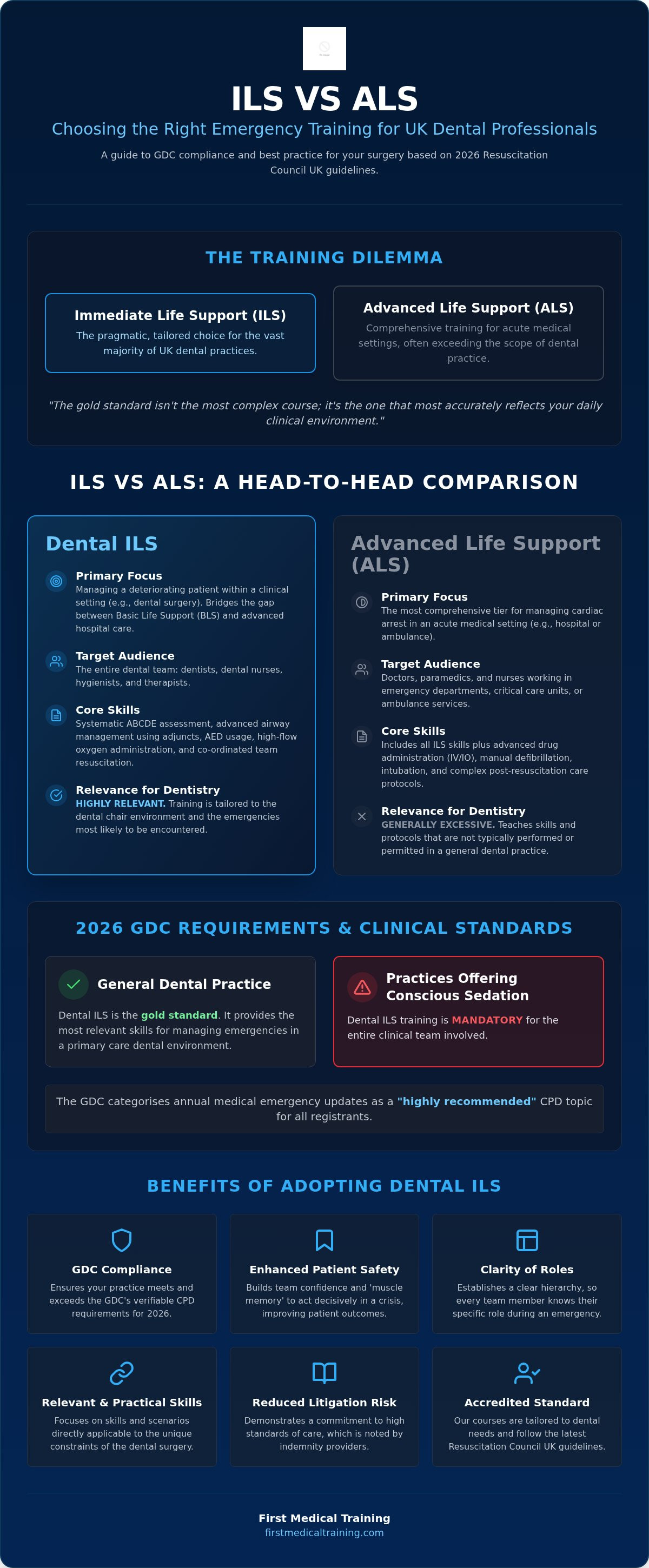
Choosing between ils vs als for dental professionals often creates confusion during the annual CPD planning phase. Immediate Life Support (ILS) is a tailored bridge between basic skills and hospital-level intervention. It focuses on the ABCDE approach, advanced airway management, and AED use within a clinical team. Conversely, Advanced Life Support is the most comprehensive tier, designed for those in acute medical settings like emergency departments. For most dental environments, ILS offers the precise level of intervention needed without the unnecessary complexity of hospital-grade protocols. Understanding the specific nuances of ils vs als for dental professionals ensures you don't over-train for scenarios you won't encounter, nor under-train for those you will.
Why the Distinction Matters for Your Practice
Clinical necessity must always drive your training choices. If your practice demographic includes high-risk patients or if you perform complex oral surgery, your duty of care increases significantly. Professional indemnity providers also take a keen interest in these standards. They expect your team's skills to align with the procedures you offer. It's not just about having a certificate on the wall; it's about ensuring every staff member knows their station during a cardiac arrest. A dental nurse trained in ILS, for example, provides invaluable support in airway management whilst the dentist leads the resuscitation effort. This clarity of role is what saves lives in the first few minutes of an emergency.
The 2026 GDC Requirements for Medical Emergencies
The GDC remains steadfast in its requirement for annual medical emergency updates, categorising it as a "highly recommended" CPD topic. For 2026, the emphasis has sharpened on verifiable, high-quality training that follows Resuscitation Council UK standards. This isn't just a suggestion; it's a professional obligation that impacts your registration and practice standing. Adhering to the gdc cpd requirements medical emergencies ensures your practice stays ahead of regulatory inspections. The trend for 2026 shows a clear move away from purely online theory towards practical, hands-on sessions that simulate real surgery crises. This approach builds the "muscle memory" required to act decisively when every second counts, turning theory into effective clinical action.
What is Dental Immediate Life Support (ILS)?
Dental Immediate Life Support (ILS) represents the critical transition from basic first aid to professional clinical intervention. Whilst Basic Life Support (BLS) is designed for the general public and focuses on simple chest compressions and rescue breaths, ILS is specifically tailored for healthcare professionals working in clinical environments. When evaluating ils vs als for dental professionals, it's essential to recognise that ILS provides the necessary tools to manage a deteriorating patient within the unique physical constraints of a dental surgery.
The curriculum moves beyond the basics by introducing advanced equipment and structured assessment frameworks. In a dental setting, a patient isn't usually on a hospital trolley; they're in a dental chair, which presents specific challenges for airway management and chest compressions. ILS training addresses these realities directly, ensuring your team can act effectively in the space they occupy every day. Key skills include the administration of high-flow oxygen, the use of airway adjuncts, and the transition from automated to manual defibrillation protocols where appropriate.
Core Skills Taught in Dental ILS
The foundation of ILS is the ABCDE approach (Airway, Breathing, Circulation, Disability, and Exposure). This systematic framework allows dental teams to recognise the early signs of clinical deterioration before a full cardiac arrest occurs. It's a proactive rather than reactive strategy. Participants learn to use advanced airway management tools, such as supraglottic devices like the i-gel, which provide a more secure airway than a simple mask. You'll also gain confidence in using an Automated External Defibrillator (AED) and understanding how to integrate it into a team-led resuscitation effort.
If you're looking to upgrade your team's readiness, choosing an accredited Dental Immediate Life Support (ILS) Training course ensures you meet these technical standards whilst fulfilling 2026 GDC requirements.
The "Immediate" Factor: Bridging the Gap
The "Immediate" in ILS refers to the critical window between the onset of an emergency and the arrival of the ambulance service. In most UK locations, this gap can last eight minutes or longer. ILS equips your team to provide a high level of care during this time, focusing on non-technical skills such as leadership and clear communication. A well-trained team doesn't just perform tasks; they coordinate their efforts to ensure the patient has the best possible chance of survival.
This training also covers common surgery crises that don't always lead to arrest but require swift intervention. This includes practical application for syncope management dental training, ensuring that a simple faint doesn't escalate into a more serious medical emergency due to poor positioning or inadequate monitoring.
ILS vs ALS: A Head-to-Head Comparison for Dental Teams
When deciding on ils vs als for dental professionals, the primary factor is the clinical environment where you operate. Whilst both courses provide life-saving skills, they differ significantly in technical depth and the equipment required to execute those skills. In a dental surgery, you are often working with a limited emergency drug kit and a small team, making the streamlined approach of Immediate Life Support highly effective. Advanced Life Support, by contrast, is designed for multi-disciplinary teams in hospital settings with access to a full range of resuscitation drugs and diagnostic tools.
| Feature | Immediate Life Support (ILS) | Advanced Life Support (ALS) |
|---|---|---|
| Primary Focus | Immediate stabilisation and team response. | Definitive care and advanced rhythm management. |
| Airway Management | Supraglottic devices (e.g., i-gel). | Endotracheal intubation and surgical airways. |
| Cardiac Monitoring | Basic AED use and rhythm recognition. | Manual defibrillation and 12-lead ECG analysis. |
| Drug Administration | Standard dental emergency kit. | Complex protocols (e.g., Amiodarone, Atropine). |
| Time Commitment | Typically 1 day (6 hours CPD). | Typically 2 days (12+ hours CPD). |
Technical Scope: What ALS Adds
ALS introduces a much deeper level of cardiac rhythm recognition. It requires the clinician to interpret complex ECG traces to differentiate between shockable and non-shockable rhythms manually. This is a significant step up from the "shock advised" prompts of an AED. Additionally, ALS covers invasive airway management, such as intubation, and a broader pharmacopeia of resuscitation drugs. For most general practices, these skills are difficult to maintain without regular hospital-based practice, as the necessary equipment isn't part of the standard CQC-required kit.
Target Audience: Who Needs Which Level?
For dental nurses, hygienists, and therapists, ILS is almost always the appropriate ceiling. It provides the advanced skills needed to assist a dentist effectively without the overwhelming technicality of hospital protocols. General Dental Practitioners (GDPs) find that ILS is the most pragmatic "gold standard" for 2026 compliance, as it perfectly aligns with the Resuscitation Council UK standards for primary dental care. However, specialists performing complex oral surgery or those acting as sedationists may consider ALS. If you are managing deep conscious sedation or working in a secondary care setting, the extra depth of ALS provides an additional layer of clinical security, though ILS remains the mandatory minimum for most sedation workflows.
Compliance and Clinical Safety: Which Level Does Your Practice Require?
Determining the right level of training involves more than just checking a box for your annual CPD. It requires a thorough clinical risk assessment of your specific patient demographic. If your surgery serves a high proportion of elderly patients or individuals with complex medical histories, the statistical likelihood of a medical emergency increases. In 2026, the "Standard of Care" in dental litigation is increasingly defined by a team's ability to provide immediate, high-level intervention. When weighing up ils vs als for dental professionals, the consensus for most high-street practices is that ILS provides the most robust protection. It ensures that if a patient collapses, your team isn't merely waiting for an ambulance; they are actively managing the crisis with advanced airway tools and structured assessment frameworks.
A tiered training strategy is often the most efficient way to manage a diverse dental team. Whilst every staff member, including reception and administrative staff, requires annual basic training, your clinical leads and those involved in surgical procedures should hold ILS certification. This creates a layered response where the most skilled individuals take charge of airway management and AED operation whilst others manage the environment and liaise with emergency services. This organised approach mirrors the efficiency of a hospital arrest team but is scaled to the practical realities of a dental surgery.
Special Considerations for Conscious Sedation
For practices offering IV or inhalation sedation, the decision is often dictated by regulatory frameworks. The Intercollegiate Advisory Committee on Sedation in Dentistry (IACSD) guidelines are explicit: all dental nurses and clinicians involved in the delivery of conscious sedation must be trained in Immediate Life Support. This is a non-negotiable requirement for clinical safety. Whilst some practitioners wonder if sedation requires an ALS-trained clinician, it remains a "highly recommended" tier rather than a mandatory one for primary care settings. However, the presence of at least one ILS-trained professional is the minimum standard to ensure patient safety during sedation, as they possess the skills to manage respiratory depression or other sedation-related complications effectively.
Maintaining the Clinical Standard
Skill fade is a genuine threat to patient safety that often goes unnoticed until a crisis occurs. Even the most comprehensive training loses its impact if it isn't reinforced through regular practice. Integrating cardiac arrest management in dental practice into your monthly team meetings or "mock drills" is essential for maintaining readiness. These sessions keep the ABCDE framework fresh and ensure that everyone knows exactly where the emergency kit is kept. Your annual training should ideally encompass the full medical emergencies in dental practice course curriculum to cover everything from anaphylaxis to myocardial infarction.
To ensure your practice meets these rigorous 2026 standards and maintains absolute compliance, you can book your next Dental Immediate Life Support (ILS) Training with our expert instructors today.
Elevating Surgery Standards with Accredited Dental ILS Training
Elevating standards goes beyond simply comparing ils vs als for dental professionals; it involves choosing a training partner that understands your unique clinical reality. Since 2006, First Medical Training Ltd has acted as a seasoned mentor to the UK dental sector, delivering accredited courses that bridge the gap between regulatory theory and surgery-floor practice. We don't just teach resuscitation; we teach it in the context of the dental chair, where space is restricted, the patient is often supine, and team roles must be clearly defined to avoid chaos during a crisis.
Building genuine clinical confidence requires more than a certificate. It requires hands-on experience with the equipment you actually use. Our training programmes integrate the use of Automated External Defibrillators (AEDs) and advanced airway adjuncts, ensuring your team is proficient with the tools kept in your emergency kit. We also support practices by supplying essential life-saving equipment, including the LifeVac anti-choking device, which provides an additional layer of safety for both patients and staff. This holistic approach ensures that your surgery isn't just compliant, but truly prepared for the unexpected.
Why First Medical Training Ltd is the Trusted Partner
Our history is rooted in the dental sector. Founded in 2006 with a specific focus on medical emergencies, First Medical Training Ltd has spent two decades refining our curriculum to meet the evolving needs of modern dentistry. Every course we deliver is accredited and meticulously mapped to the GDC and Resuscitation Council UK 2026 criteria. We recognise that your time is valuable, which is why we offer flexible training solutions designed to minimise surgery downtime whilst maximising the impact of the learning. By bringing the training to your practice, we can conduct drills in your actual treatment rooms, identifying potential logistical hurdles before they ever affect a real patient.
When you move past the initial comparison of ils vs als for dental professionals, the focus shifts to the quality of the delivery. Our instructors are industry veterans who bring a wealth of real-world experience, helping to demystify complex medical protocols and turn them into manageable, actionable steps for your entire team.
Next Steps for Your Practice
Maintaining a high standard of emergency preparedness is an ongoing commitment. We recommend conducting a training audit for your current team to identify any gaps in certification or skill levels. Ensure that your senior clinicians and those involved in sedation are booked onto a dental immediate life support course to meet the latest standards. Finally, take a moment to verify that your dental practice emergency preparedness is up to date by reviewing your equipment maintenance schedules and emergency drug expiry dates. Taking these structured steps today ensures your team can act with steady reliability tomorrow.
Secure Your Clinical Excellence for 2026
Deciding on ils vs als for dental professionals doesn't have to be a source of regulatory stress. Whilst ALS offers the highest tier of intervention, Dental ILS remains the most pragmatic and effective choice for the vast majority of UK surgeries in 2026. It provides the perfect balance of advanced clinical skills, such as supraglottic airway management, without the unnecessary complexity of hospital-grade drug protocols. By focusing on the skills most relevant to the dental chair, you ensure your team is prepared for the specific challenges they are likely to face.
Choosing a training path that aligns with both GDC standards and your team's daily reality protects your patients and your professional reputation. First Medical Training Ltd has been a trusted partner to the dental community since 2006. As specialist dental emergency experts, we provide accredited Dental CPD that turns complex guidelines into clinical confidence. We're here to support you in maintaining a safe and efficient environment for everyone who walks through your doors.
Book Your Accredited Dental ILS Training with First Medical Training Ltd today to ensure your team is ready to act with steady reliability when it matters most. Your commitment to high-standard resuscitation training is the foundation of a safe, compliant, and resilient practice.
Frequently Asked Questions
Is ILS training mandatory for all dental nurses in the UK?
ILS is mandatory for dental nurses who assist with conscious sedation, as per IACSD guidelines. For those in general practice not involved in sedation, Basic Life Support (BLS) remains the minimum GDC requirement. However, many modern practices adopt ILS as their clinical standard to ensure a higher level of patient safety. This ensures the entire clinical team can manage an airway effectively whilst waiting for emergency services to arrive.
How often do dental professionals need to renew their ILS or ALS certification?
You must renew your resuscitation skills annually to remain compliant with GDC standards. Whilst an ILS certificate might technically be valid for longer in some sectors, the Resuscitation Council UK and the GDC expect dental professionals to undergo a practical update every 12 months. This frequency helps prevent skill fade and ensures that every team member remains confident in using the surgery's emergency equipment and drugs kit during a crisis.
Can I use ILS training to meet my GDC medical emergencies CPD requirements?
Yes, an accredited Dental ILS course provides verifiable Continuing Professional Development (CPD) that directly meets the GDC's "highly recommended" criteria. A typical session provides six hours of verifiable CPD. When comparing ils vs als for dental professionals, both provide high-quality learning, but ILS is often more time-efficient for general practice teams. It covers the essential medical emergency topics required for your annual professional development record.
What is the main difference between BLS and Dental ILS?
The primary difference lies in the technical depth and the equipment used. BLS focuses on manual chest compressions, rescue breaths, and the use of a standard AED. Dental ILS builds on this by introducing the ABCDE assessment framework, high-flow oxygen therapy, and advanced airway adjuncts like supraglottic devices. This higher tier of training allows your team to provide a more sophisticated level of intervention during the critical first few minutes of a cardiac arrest.
Does a dentist need ALS training to perform conscious sedation?
No, ALS training is not a mandatory requirement for dentists performing conscious sedation in a primary care setting. The Intercollegiate Advisory Committee on Sedation in Dentistry (IACSD) specifies that Immediate Life Support (ILS) is the appropriate level of training for the sedation team. Whilst some specialists choose ALS for personal development, ILS provides the necessary skills to manage respiratory depression and other common complications associated with IV or inhalation sedation safely.
Are First Medical Training courses accredited by the Resuscitation Council UK?
First Medical Training provides accredited courses that are meticulously designed to align with the latest Resuscitation Council UK (RCUK) and GDC guidelines. Our instructors are specialists who ensure that the curriculum reflects the current 2026 clinical standards for primary dental care. This gives your practice the reassurance that the training you receive is both nationally recognised and professionally robust, meeting all the necessary quality standards for clinical resuscitation and emergency response.
What emergency equipment is required to be on-site for an ILS-trained team?
To fully utilise ILS skills, your practice must have immediate access to an Automated External Defibrillator (AED), high-flow oxygen, and airway adjuncts such as i-gels or oropharyngeal airways. You also require a standard emergency drugs kit, including Adrenaline and Glucagon. Having this equipment on-site is a CQC requirement. Our training ensures your team is proficient in using these tools effectively within the specific physical constraints of a dental surgery environment.
How long does a typical Dental ILS training session take to complete?
A typical Dental ILS training session is completed in approximately six hours, usually delivered over a single day. This timeframe is designed to be efficient whilst allowing for intensive practical drills and scenario-based learning. When evaluating ils vs als for dental professionals, the one-day format of ILS is often much more practical for busy surgeries than the multi-day commitment required for ALS, which is typically designed for hospital-based healthcare providers.